

Share this article


How CDPs Empower Retail Businesses Through Digital Transformation
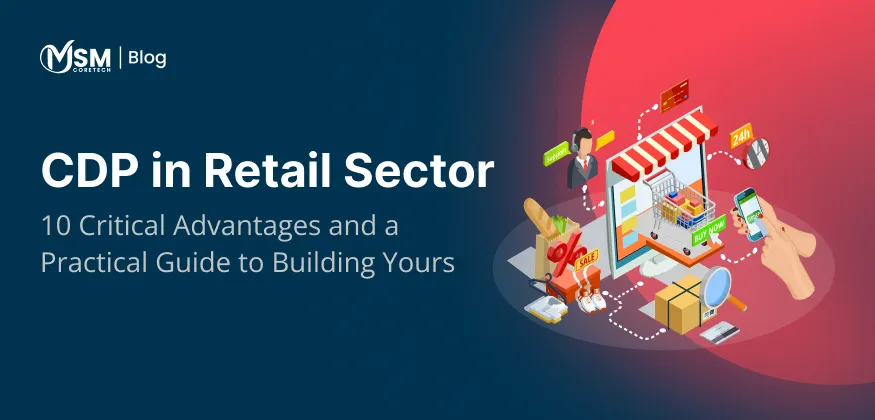
“In the era of the retail connected world, a well-designed Consumer data platform is not just a tool- it is your business competitive strategy”
Digital transformation is a process of leveraging advanced and innovative technologies in the retail sector to streamline operations and enhance the overall user experience. With the emergence of new technologies such as big data and artificial intelligence, retail businesses are maintaining a robust tech-driven system for managing their operations widely.
However, this transformation also leveraged new challenges such as inconsistent personalised offerings, the possibility of fragmented data, and ineffective consumer support. Resolving these problems requires optimised data systems and needs to develop a consumer-centric approach to address the needs of new tech-driven consumers.
The innovation of CDPs offered a large change in the retail sector: businesses are preferring data-orientated strategies more to remain competitive in the market. These consumer data platforms help companies in gathering consumer data from different kinds of sources, which helps in innovating more defined and targeted strategies.
Moreover, the retail industry will continue to evolve in this digital era to gain more consumer satisfaction and a user base.
This blog aims to analyse how consumer data platforms are empowering the digital transformation of the retail industry.
What is a Customer Data Platform (CDP)?
A consumer data platform is a type of technological innovation that offers brands and companies in gathering consumer data through various sources to develop a desired consumer profile.
These applications consist of a user database and acts as a management partner for cross-channel marketing campaigns by exploring consumer data in real-time, which helps them in curating a personalised experience for the consumers.
Difference from Other Platforms –
| Type | Main aim | Data used | Key uses |
| CDP | Gathers and unifies consumer data for marketing strategies | Primary sources, real-time data capturing | Segmentation, consumer insights and automation. |
| CRM | Consumer relationships and interactions. | First party consumer data | Service management and sales tracking |
| DMP | Gathers anonymous user data | Anonymized data through secondary sources. | Audience modelling and Ad targeting. |
How CDP Builds a Single Customer View –
A single consumer view, also referred to as unified consumer description, is a process of collecting all the data in relevant to a single client to maintain his/her unified data.
Organisations can develop a single consumer view as a descriptive picture on a CPD platform. The consumer data application offers more features, such as centralization of all user information and making it available across departments.
For instance, a CDP platform can extract data from various sources like social media platforms, CRM systems, and e-commerce platforms to create a unified consumer profile.
Why CDP Matters in Retail Today?
Several retail businesses are facing significant challenges in utilising consumer data in the best way possible. Additionally, the data is segmented across various channels in both offline and online manners, which offers a fragmented view of the data.
As the retail industry grows, retailers may find it harder to manage their existing consumer data in their data management systems or CRM softwares as they lack important functionality and support in scaling on the basis of needs.
To provide effective solutions for these issues, retailers are shifting to consumer data platforms. By gathering information from all the data sources available CDP offers fully analysed real-time consumer profiles, which helps businesses in achieving competitiveness in the market.
Why Legacy Systems Cannot Meet these Demands –
Legacy platforms are not able to fulfill these new demands as they were developed in the context with the batch-based data examination form and were built to run in a simple business ecosystem.
- Incompatible data models – Legacy data gathering systems were designed to store information in different formats, which cannot be standardised with new advanced tools. This can result in poor data collection and failure in maintaining a single record system.
- Lack of advanced data analytics – Legacy platforms were not built in with consideration of capturing real-time data, hence lacks features like predictive analysis. This hampers the growth and ability of the organisation to extract data from various sources.
- Difficulty in governance – Legacy systems were not developed to handle rapidly transforming data privacy guidelines like CCPA and GDPR. These platforms may not offer functions like data access requests, which can be very risky for businesses.
The Need for CDPs –
Several retailers do not have the best data collection and analyzation tools, and their user data was segmented into various platforms, both offline and online. They have implemented certain CRM tools and data management applications, but they sometimes lack the important information that can be very crucial for the company to scale its operations.
Due to this, the retailers have begun to shift to use consumer data platforms as it gather and unifies data across different channels and mechanisms.

10 Critical Advantages of CDP for Retail
Consumers desire to have a unique digital experience, and in order to provide this, organisations first need to focus on enhancing their capability of analysing consumer data.
This section will offer you the key advantages of CDP leveraging in businesses and marketing –
- Development of unified consumer profiles – Consumer data platforms offer various features rather than just collecting the data. These systems integrate the data into separate consumer profiles helps in offering a 360-degree analysis of different consumers. They also offer a unified approach on consumer behaviours on the basis of their purchase history, evolving preferences by monitoring their engagement rate.
- Enhances personalization with integration of Artificial Intelligence – Customers do not desire to have a personalised experience, but it is a strategy of the company to engage with its consumers more by offering personalised services. New and advanced CPD platforms are integrated with machine learning and artificial intelligence to examine vast consumer profiles. This helps in predicting the best fit strategy to offer personalisation by offering scale messaging, offering each consumer experience should feel unique.
- Increased data privacy and governance – In today’s digital era, consumers are willing to offer their personal data to companies to have a more unified experience. Consumer data platforms are designed with features like data privacy, as by combining the segmented data sources together by offering governed access to the information, CDPs help in maintaining strict control over consumer data. A single CDP system can act as a consent management tool with managing data access applications, which enhances the businesses compliance features.
- Foster revenue growth – Consumer data platforms help businesses to utilise their consumer data in a more strategic way. By developing single consumer profiles to build more personalised services through which the brand can increase consumer engagement rate and leverage strong loyalty connections. Eventually, this can be directly transformed into increased conversion rates, which will result in revenue growth ultimately.
- Removal of data silos – A major challenge big companies face is in managing and storing the extracted user data. As a large company has different sets of teams with their distinct roles, and according to their working scenario, they use different consumer information like one team might have consumer name and contact info, the other one might have their purchase history etc. CDP helps in combining all the information in its system, by which the company members can get seamless access in a single system at the same time.
- Improvises omnichannel experience – One of the most exciting advantages of a CDP is that it offers a seamless extraction of user data from each and every touchpoint. Consumer development platforms use these consumer insights to generate personalised experiences across various channels, such as social media, websites, and email. Moreover, because of a unified consumer experience, CDPs can adapt and offer more curated services for every customer.
- Enhances the overall consumer experience – Consumers generally want the brand by which they interact should feel their needs and their requirements. By rapidly changing the fragmented data into simple forms, CDPs helps brands in serving their customers with more enhanced features than ever. This type of personalised engagement reflects general consumer value, leveraging a unique brand positioning, and fosters long-term relationships with higher retention rates.
- Optimises operational efficiency – By combining all the gathered data into a single unified platform, CDSPs efficiently reduces data gaps between teams and decreases the excessiveness of soiled data. With the help of gathering data from various sources, CDPs tend to convert the most relevant data insights into a personalised user experience that can foster a relationship with the consumer. Utilising machine learning and new AI tools, CDPs can enhance these consumer profiles to elevate the consumer experience.
- Leverage effective promotions and pricing – With the incorporation of AI and machine learning models, CDP platforms analyse the consumer data and market trends and offer effective marketing and pricing methods according to the data achieved. Enhancing pricing methods in this way offers more growth and leads to higher revenue, while offering curated business strategies for strategic success.
- Improving demand forecasting and stock management – A retail CDP platform can determine consumer behaviour and user purchase patterns, retailers can forecast significant product demand, and can manage their inventory on the basis of that. For instance, if the CDP helps in notifying a product category according to the trend and market demand, the stock management team can increase the production of the particular products to fulfill the excess demand.
Real-World Examples: Retail Brands Using CDP Successfully
- Walmart – Walmart leverages the CDP to build strong connections with its consumers through offline and online platforms.
- Nordstrom – Nordstrom uses CDP to offer support to its sales and consumer support team, a unified view of consumer profiles so that they can better curate their needs better.
- Sephora – The cosmetic company Sephora utilises CDP tools to enhance its digital user experience, which can lead to more consumer attraction by offering personalised recommendations.
Current challenges with CDP Platforms
CDP platforms are the most innovative method when it comes to fostering relationships with consumers. CDPs have successfully addressed the needs of consumers by leveraging digital-first methods.
Let’s now examine challenges related to CDPs –
- Scaling inability – Certain CDPs are curated to handle smaller datasets, and when the company leverages more data when the functionality grows, which reduces the processing speed of the platform.
- Hard to adopt for non-tech users – Non-technical employees need to learn how to operate a CDP to ensure smooth implementation and use of the platform.
- Lackness of analytics abilities – It is not efficient for a consumer data platform to store data; these platforms should also know how to analyse the data, as not all CDPs do not offer analytical skills such as predictive analytics.
- Problems in gathering data – In some cases, companies might find it hard to collect data with the help of some CDPs, as they require a lot of human intervention to gather data from different sources.
Future of CDPs in Retail
The future of consumer data platforms in the retail industry is driven by real time data analysis, AI-powered integration, with optimizing omni-channel strategies to gain an insightful overview of consumer preferences.
Key Trends –
- Real-time data analysis – New and advanced CDPs will aim to provide real-time data analysis, working as a central layer to collaborate with disparate systems and offer a detailed overview of each customer.
- Optimizing omni-channel strategies – Future CDPs will be important for developing unique consumer experiences over different channels, developing a smooth consumer journey process on how users relate with the company.
- AI-powered integration – Artificial intelligence helps CDPs in leveraging features like predictive analysis to determine customer preferences, differentiate them according to their needs, and helps in implementing automated marketing strategies to gain more attention.
Conclusion
Consumer data platforms are rapidly transforming the retail industry by eliminating unnecessary data and offering a consumer-first data-oriented environment for businesses.
By gathering data from various sources, CDPs helps in developing a unified single consumer profile to gain a more effective understanding of user behaviour. Selecting the right CDP model needs proper analysis of your current and future data goals. Using a precise CDP will help companies in catering to their business needs to achieve greater operational growth.

Related Posts

Lucrative eCommerce Business Ideas to Start in 2026
Imagine starting with a simple product idea and turning it into an online store that can reach customers far beyond...
Read More
Different Types of eCommerce Businesses You Should Know in 2026
eCommerce has changed the way people shop, compare products, and buy services. In simple words, an eCommerce business sells products...
Read More
The Role of AR in eCommerce: 10 Benefits, Use Cases, and Examples
Imagine buying a sofa online and seeing how it will look in your living room before you buy it. You...
Read More


 Verified Review




 +44 7427829444
 71-75, Shelton Street, Covent Garden, London, United Kingdom, WC2H 9JQ