Social Share


Medical Software Development Guide: Everything You Need to Know
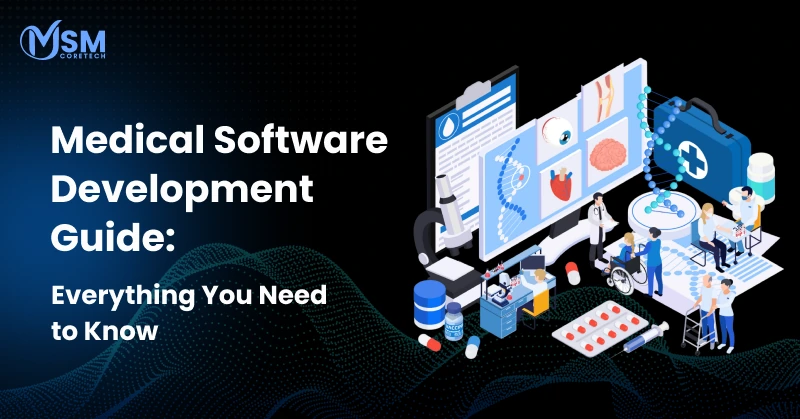
The change in the healthcare industry has apparently taken a colossal turn. Imagine a future in which medical devices are perfectly connected with the latest software applications that allows making more precise diagnoses, provides more accurate treatment, and finally, better results. Medical device software development is the field that has influenced this motivating reality.
There's much more to medical software development than just writing a code. It is the creation of tools that save lives, enhance patient outcomes, and make healthcare processes easier. The global Healthcare IT market is estimated to be US$663 billion in 2023 and is expected to exceed the levels of about US$1,834.3 billion by 2030, with the CAGR (~15.8) projected to be between 2024 and 2030.
Thus, when introducing EHR systems, telemedicine platforms, or AI-driven healthcare applications, each stage of the medical software development process will contribute to the software being of the required standards and responding to the needs of both healthcare providers and patients in particular.
It is through this post that we will know what it actually takes to create appliation that works within the theoretical and practical context of healthcare.
What Is Medical Software Development?
Medical software development is a process of creating, implementing, and upholding digital solutions, particularly for medical practitioners. It aims to understand more closely their patients' conditions and offer accurate diagnoses. This method of development comprises every aspect of patient care, from integrating systems that capture patient health records/medical history to analytics capabilities, enabling better decision-making. Therefore, medical software development services assist in creating solutions that significantly enhance the efficiency and quality of healthcare services for both providers and patients.
How It Differs from Generic Software
In contrast to traditional software, security-compliant medical applications must:
- Merge with legacy healthcare systems like PACS or EHRs
- Maintain compliance with strict security and data privacy protocols like HL7, GDPR, SOC2 or HIPAA
- Undergo clinical validation
- Keep traceability for CE or FDA approval
Key Stakeholders
- Healthcare providers like telehealth services, hospitals, or clinics.
- MedTech manufacturers who are emphasizing on developing software solutions as a medical device.
- Payers and administrators like insurers or third-party billing systems.
- One of our clients, a healthcare professional in the USA, implemented a medical answering system integrated with HIPAA-compliant infrastructure. It helps improve the patient care and enhance the overall system efficiency.
Why Hospitals Still Need Medical Software Development
Hospitals still require medical software development because digital transformation may have started 10 years back, but the healthcare needs have evolved far beyond EHRs and billing solutions. Therefore, even if your organization still uses medical software developed years ago, it may be outdated due to the emergence of data and AI solutions.
Here, choosing software modernization services or rebuilding it completely from the ground up seems like the best alternative.
- Your organization is nevertheless relying on legacy systems, third-party apps, and siloed data, making seamless care coordination difficult.
- Expectations of patients have shifted; they want digital care as convenient as consumer apps.
- The fascinating benefits of AI in healthcare operations are creating a new normal in leveraging AI to predict cases, suggest diagnostics, and automate some of the repetitive, tedious tasks.
- Regulatory bodies are adopting new practices faster than before, asking to build proactive medical systems to secure patients’ data.
Back then, having medical software in a healthcare facility was the best solution to have. However, it's a must-have future-ready, interoperable medical system that solves current inefficiencies while preparing them for what’s next in healthcare.
Most Common Medical Software Solutions
Healthcare organizations have chosen to adopt software solutions to expand their services and make healthcare more accessible to people. The most common sectors that connect with our software development company are:
- Electronic Health Records (EHR)
- Electronic Medical Records (EMR)
- AI-Driven Clinical Decision Support Systems (CDSS)
- Medical Imaging Software
- Remote Patient Monitoring Systems
- Diagnostic Software Integrated with Medical Devices
- Telehealth/Telemedicine Platforms
- Patient Management System
- Practice Management Systems (PMS)
- Hospital Management Systems
So, if you are looking ahead to expanding your healthcare services for a better purpose, you can associate with our medical software development company.
Factors to Consider for Medical Software Development
If you are developing medical software, then, there are few certain things that you need to keep in mind to get it right—
Regulatory Compliance:
Healthcare is among the most scrutinized industries across the world. And in order to strictly follow the rule, your software must meet with regulations such as HIPAA in the U.S. or the EU’s Medical Device Regulation (MDR). Here compliance is not all about a box but it's huge for ensuring patient safety and private information.
Security and Data Privacy:
You are handling confidential information like patient data; therefore, security cannot be ignored. Your software finds top-tier encryption, secure data storage and possibly multi-factor authentication to secure privacy. One violation could undermine the trust of both patients and providers.
User Experience (UX):
As this app is run and managed by doctors, nurses and patients, the software needs to be easy to use. If your users won’t understand how to navigate the system, the software won’t be helpful, no matter how many features it has.
Interoperability:
The healthcare sector is about joining the dots. So your software must be able to integrate with systems like EHRs or EMRs that hospitals and clinics already use. Frequent communication between different systems means better care coordination and less paperwork for everyone involved.
Scalability:
As the healthcare industry grows, so does its need for software that can maintain more patients, more data and more features. Scalability ensures your system doesn’t break down as your business or patient base grows.
Accuracy and Reliability:
These two factors are most important when it comes to patient care. To guarantee that medical software consistently produces accurate results, it must be tested and validated. Errors have no place because they have the potential to ruin lives.
Integration with IoT Devices:
As wearable health devices and other IOT technology become more common, your software should work well with these devices. Healthcare providers can more easily monitor and manage patient health thanks to integration, which enables real-time data collection.
Upkeep and Assistance:
The healthcare sector is constantly expanding. This means that in order to maintain compliance, improve features, and stay up to date with new technologies, your software will need to be updated on a regular basis. For bugs to be fixed and users needs to be met while on the go, a dependable support system is essential.
Why Develop CRM Software for Healthcare?
Since patient relationship management software is more of a business and customer-oriented solution, our medical software development service providers are often asked why to opt for software development for medical CRM solutions and how they can help us.
Well, here are the reasons why you need healthcare software solutions for the easy functioning of your healthcare business.
-
Know Your Audience
It helps you identify your ideal audience by applying robust analytics to your rich marketing database, medical CRM technology helps hospitals create a list of targeted consumers who are most likely to require & respond to service-line or procedure-based marketing campaigns. -
Track Real-Time Reports
Patient relationship management software tracks & reports in real time. It allows you to review your marketing and engagement efforts, thus allowing you to attain a higher ROI by connecting campaign activity to leads to appointments and process revenue.
Medical CRM development has made great changes in the sector. Over the years technology has transformed the way health workers interact with patients. The sector must offer assistance to the patients for the best results. -
Enhance Patient Engagement
A well-designed medical CRM system empowers communication between healthcare providers and patients. It allows hospitals to send automated appointment reminders, follow-up messages, wellness tips and personalized health updates. This not only enhances patient satisfaction and trust but also encourages frequent interaction, ensuring patients stay informed and involved throughout their care journey.
What Are the Use Cases of Medical CRM Software?
Here is the list of use cases from small, mid-size, and large hospitals as well as from outpatient centers. In the case of medium & small hospitals, they head to CRMs to optimize their internal proceedings instead of external communication efforts, so to:
Monitor medical equipment
It helps hospitals in tracking and managing medical devices in real time, ensuring proper maintenance, lowering downtime, and enhancing patient safety and care quality.
Enhance scheduling & alerts
This helps in simplifying appointment booking, staff scheduling and automated reminders, ensuring timely patient care and productive use of hospital resources.
Optimize case management
This device features patient records, treatment history and follow-ups in one place, helping healthcare teams manage each case efficiently and accurately.
Over the years, hospital CRM implementation consulting services have been assisting people and making things easier in general. To upscale your business and reach a wider audience, you can connect with a custom medical software development company to build and integrate an all-inclusive CRM solution for your hospitals.
How Much Does It Cost to Develop Medical Software?
Medical software development costs in 2025 could vary from ~USD 100K to USD 5M or even more, which majorly relies on compliance and functionality needs. Complex systems like AI medical diagnosis software or EHR often need extensive validation, FDA clearance, and ongoing maintenance—each driving up expense.
Let's now go through the key factors in determining software development cost:
- Types of healthcare apps (telehealth platforms, EHR systems, medical CRMs, etc.)
- Compliance requirements (HIPAA, HL7, GDPR)
- Third-party and device integrations
- Security layers for sensitive data
- UI/UX requirements for different user roles
- Approach to software development in the medical field (MVP vs. full-scale, in-house vs. outsourced)
Here's the cost breakdown:
- Basic wellness or simple patient portal - $100K –$300k
- EHR / integrated hospital systems – $ 500K – $ 2M+
- AI medical software or regulated SaMD – $ 1M – $ 5M+
Conclusion
Healthcare software solutions offer easier access to care while assisting medical providers in delivering services more efficiently. With the right system in place, distance, delays, and manual processes no longer hinder your healthcare services back.
However, building an impactful solution requires more than just a good idea and moreover, it demands technical expertise, industry understanding, and the ability to craft software that truly suits your workflows and compliance needs.
MSM Coretech specializes in custom healthcare software solutions tailored to real-world clinical operations, built on proven engineering principles, and focused on improving both care delivery and operational efficiency.
These solutions also contribute directly to quality improvement in healthcare by reducing errors, improving communication, and streamlining patient management.

Related Blogs

Innovative Dating App Ideas for Startups in 2026
Explore innovative dating app ideas for startups in 2026. Discover trends, features, costs, and development insights to build a successful dating app.
Read More

Mobile App Development Cost in USA
Explore mobile app development costs in USA for 2026. Learn pricing by platform, features, stages, and hiring models to plan your app budget.
Read More
Mobile App Development in 2026: Trends Every Business Must Know
Explore the latest mobile app development trends in 2026, including AI, super apps, security, and cross-platform tech shaping the future of mobile apps.
Read More
