

Share this article


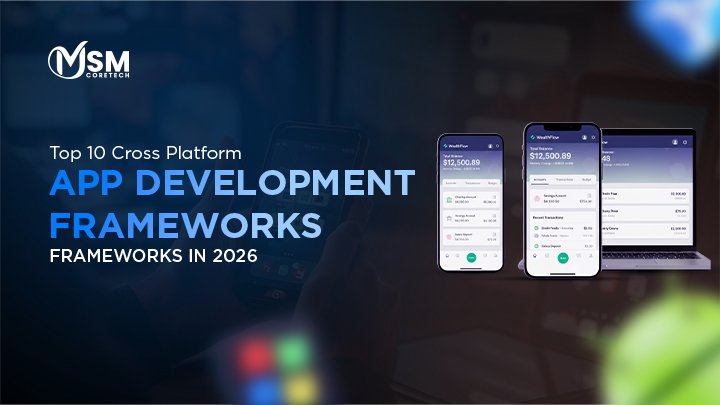
Top 10 Cross Platform App Development Frameworks in 2026
“The industry of cross platform app development is increasing at a fast pace. Also, today developers need to match this changing demand. This can be achieved by understanding all about the latest development frameworks. In this blog we have discussed all about the latest cross platform app development frameworks.”
Mobile apps today require greater reach without doubling the workload of development. Also, developers today focus on developing mobile apps for both Android and iOS. Therefore, it drives the demand of cross platform app development frameworks. Today, the popularity of cross platform app development exists because it provides numerous advantages to developers. Additionally, the market has also witnessed a slow adoption of cross platform app development tools and frameworks.
Moreover, due to the wider reach and advantages today, every other cross-platform app development company has started exploring this new and interesting technology. In this blog we will talk about different cross-platform frameworks that developers can use to improve their development workflows. Further, we will also see how the technique is taking over the market and what it actually means.
What is Cross Platform App Development?
Cross-platform app development services are a systematic strategy of building software apps that can work on multiple operating systems (iOS and Android). Additionally, these applications are platform-agnostic. Therefore, they can be utilized regardless of the operating system powering the mobile device.
Quick Fact: Today, Google Play Store has around 2.06 million active apps. Whereas, the Apple Store has nearly 1.91 million apps.
Mobile App Market Stats and Trends For 2026
The app development market is growing because of the increased adoption of smartphones, use of the internet, and demand for smart technology. Also, a recent report by Mordor Intelligence says that in 2026, mobile app development was valued at US$ 264.96 billion. Additionally, it was estimated to expand from US$ 305.18 billion in 2026 to arrive at US$ 618.65 IN 2031. Moreover, a compound annual growth rate of 15.18% is seen over the period of 2026 and 2031.

Key Takeaways of Recent Cross-platform App Development Trends:
- Low-code, or no-code platforms are anticipated to grow 29.65% by 2031, while native mobile apps will have a revenue share of 37.92% in 2025.
- Cloud-based delivery is responsible for 57.35% of the app development market share by deployment model in 2025 and is thus expected to expand at a CAGR of 21.8%.
- Mobile apps are responsible for contributing 64.55% of the app development market in 2025.
- Health and fitness apps are growing at a 19.9% CAGR, while gaming contributed 39.6% of end-user industry revenue in 2025.
- With a revenue share of 38.05% in 2025 and a CAGR of 17.9% through 2031, Asia-Pacific led the region.
What are Cross Platform App Development Frameworks?
Cross-platform app development tools and frameworks are software sets of tools. Also, it allows developers to build mobile apps for multiple OS (iOS and Android) using a single codebase. Therefore, here is the list of the 10 best framework for cross platform app development:
Flutter
Flutter is Google’s open-source UI software development kit, also known as SDK. Additionally, it is one of the popular cross platform app development frameworks used to build natively compiled apps for both iOS and Android. Moreover, the development requires only a single codebase (ARM code). Also, the framework is known for its high performance and robust ecosystem.
Features of Flutter
- Flutter’s hot reload functionality lets you view how your app changes when you alter your code, without having to rebuild it.
- Flutter uses Google’s Material Design, which assists developers in building digital experiences.
- Flutter doesn’t depend on web browser tech. Instead, it has its in-built rendering engine for creating widgets.
React Native
React Native is an open-source framework launched by Meta. Therefore, it allows developers to create native-like cross platform apps for both iOS and Android. It is one of the top cross platform mobile app development frameworks that also uses JavaScript and the React library. React Native has a huge and powerful community of developers who share their technical knowledge.
Features of React Native
- Developers can view their changes in their React elements in no time because of its Fast Refresh feature.
- One of its benefits is that it focuses on the UI. React elements render to native platform UI elements. Therefore, it lets you build a customized and responsive UI.
- In versions 0.62 and later, implementation between React Native and the mobile applications debugger Flipper is enabled by default.
Ionic
Ionic was launched in 2013 and works as an open-source mobile UI toolkit. Also, it lets developers create cross platform mobile apps from a single codebase. Therefore, it uses technologies like CSS, JavaScript, and HTML with the implementation of Angular, React and Vue frameworks. Also, it is one of the best cross-platform mobile app development frameworks that allow community members to share knowledge to solve development challenges.
Features of Iconic
- Ionic is built on a SaaS UI framework made especially for mobile OS. Therefore, it offers multiple UI elements.
- The Ionic framework utilized the Cordova and Capacitor extensions to deliver access to the device’s pre-built features.
- Ionic has Ionic CLI that works as a primary tool for creating Ionic applications.
.NET MAUI
.NET Multi-platform App UI or also known as .NET MAUI is one of the popular cross platform app development frameworks. Additionally, it was released by Microsoft in the year 2022. Also, this .NET MAUI lets companies create native desktop as well as mobile apps using C# and XAML UI. Thus, it is one of the features of Xamarin that gives native controls for the platforms provided by Xamarin.
Features of .NET MAUI
- .NET MAUI offers cross-platform APIs for using native device functionalities, like the GPS, or battery/network states.
- It has a single project system that allows using multi-targeting to target various OS systems.
- It has .NET hot reload that allows developers to alter their handle source code while the app is open.
NativeScript
NativeScript is one of the best open-source cross platform app development frameworks. Also, it was launched in 2014. Additionally, NativeScript lets you create Android and iOS apps with the help of JavaScript or languages that transpile to JavaScript. Therefore, these languages are TypeScript or frameworks like Angular and Vue.js.
Features of NativeScript
- This framework lets developers simply use native Android and iOS APIs.
- NativeScript renders platform-native UIs. Applications created using NativeScript work directly on a native device.
- NativeScript provides many different plugins and existing app templates, removing the need for third-party solutions.
Kotlin Multiplatform
KMP, also known as Kotlin Multiplatform, is an open-source framework that allows sharing code on multiple platforms. Moreover, it also retains the advantages of native development. Also, it allows developers to use and reuse the code. Further, it lets developers write code where needed and smoothly integrate Kotlin code in different projects. Moreover, it is one of the modern cross platform app development frameworks that allow sharing the entire app code.
Features of Kotlin Multiplatform
- Developers can reuse code across various operating systems, devices, and servers while maintaining native code where needed.
- Developers can use platform-based APIs while enjoying benefits of both native and cross-platform development.
- It allows developers to have complete code-sharing flexibility and the capability to share logic and UI.
Capacitor
Capacitor is a cross-platform app development framework that is created by Ionic. Also, it is a runtime utilized to create cross platform native web applications. Moreover, it allows web apps to use the abilities of devices. In simple terms, it minimizes the gap between web and native applications.
Features of Capacitor
- It gives stable APIs for iOS, Android, and web.
- This framework is compatible with Ionic, Angular, and React.
- It boosts debugging and live reloading to speed up development.
Xamarin
Xamarin has cross platform mobile app development frameworks that are quite different from other frameworks previously mentioned. Additionally, it is a framework that developers use to create apps for different platforms (iOS, Android, Windows or MAC). Also, it creates apps with the help of C# and .Net. It lets developers use 90% of the code to create an app.
Features of Xamarin
- It minimizes the cost and time of developing a mobile app as it follows the “Write Once, Run Anywhere” approach.
- Xamarin provides robust build-time checking that results in fewer run-time errors.
- Xamarin has an outstanding native UI and controls that let developers design a native-looking app.
Node.js
Node.js is used for creating cross-platform apps. Also, Node.js is a JavaScript execution framework that is based on the Chrome V8 JavaScript engine. Additionally, this framework has the capability to manage many concurrent connections. Moreover, it is one of those cross-platform app development tools that is loaded with a rich library of numerous JavaScript modules.
Features of Node.js
- It instantly moves on to a different API after calling it. It has a notification mechanism that lets the server receive a response from the former API call.
- A mobile app development company uses Node.js, as its app does not buffer and give data in pieces.
- Applications based on Node.js reduce reaction time for slow requests.
Electron
Electron is a framework that allows developers to build cross-platform apps for desktops. Also, it uses languages like HTML, CSS, and JavaScript. Moreover, VS Code and Slack are great examples that showcase that Electron can develop well-performing apps using a single codebase.
Features of Electron
- This framework uses native desktop APIs and different web technologies.
- Electro is compatible with Windows, macOS, and Linux.
- It offers packaging systems to create installers on all mainstream platforms.
Final Thoughts
Using cross platform app development frameworks allows companies to create an application that can acquire a greater reach. Thus, these apps can be run on multiple platforms and operating systems. Also, picking frameworks like Flutter, Ionic or Node.js helps create a shared codebase. Therefore, it provides a reliable experience across iOS and Android. If you choose the right framework, it will improve the device features and deliver feature growth.
MSM offers mobile app development services to help you develop both complex and simple cross platform apps and web apps. Also, our apps perform seamlessly and are easy to maintain. So, Contact us today to turn your idea into a high performing app.
FAQs
Cross platform frameworks are the most adopted today, as they minimize development time by 30 to 40%. Also, React Native and Flutter are the most used mobile app development frameworks in 2026.
The best choice for app development depends on specific requirements. Yet, the leading options today are Kotlin, Dart and JavaScript with React Native.
Yes, one can share the code between web and mobile apps with the help of cross-platform app development tools.
Cross platform is better for startups looking for an app with a low budget and a single codebase. But native development gives high-performing apps using specific device features.
If you are planning to develop an enterprise-grade app, the best cross platform frameworks are Flutter, React Native, Kotlin and .NET MAUI.

Related Posts

Top 10 Dating App Development Companies in Australia
The way Australians meet and build relationships has changed dramatically over the past decade. Mobile dating apps have become a...
Read More
Top 7 React Native App Development Companies in Australia
Mobile apps are now a vital part of business growth across Australia. From fintech startups in Sydney and healthcare providers...
Read More
Top 5 Android App Development Companies in Australia
Android is the world’s most widely used mobile operating system, making it an ideal platform for businesses looking to reach...
Read More


 Verified Review




 +44 7427829444
 71-75, Shelton Street, Covent Garden, London, United Kingdom, WC2H 9JQ