

Share this article


Top 10 Web Development Frameworks in 2026
Are you stuck in different frameworks? Do you find it difficult to decide which framework is perfect for your project? Therefore, you are at the right place. In this blog, we will understand different frameworks and their pros and cons.
Are you on the lookout for the best web development framework of 2026 for your project? Well, it is indeed a difficult task that demands careful consideration and decisions.
One right decision can help you create futuristic web experiences for your audience. Therefore,opting for the wrong technology might drag you into unfavorable situations.
It is a crucial task, therefore, choose the best web development frameworks wisely. Also, we have mentioned when and where these technologies seamlessly fit into web development services.
In this blog, we will explore 10 different web development frameworks, which will ultimately help you choose one.
What Are Web Development Frameworks and Why Are They Important?
A web development framework is software that assists in the development of websites, web APIs, web applications, and other web resources. It helps in creating and managing codes in a more simplified manner, allowing you to develop feature-rich and secure apps in less time.
These frameworks facilitate developers in building websites with already-written code or components to save time and money. Additionally, there are several features and benefits differentiate one web framework from another.
And relying on its architecture pattern, programming languages, code reusability, and third-party plugin/library availability, you may find one framework is more appealing than others.
Top Stats of Web Development Framework
- The global web development frameworks market was valued at approximately USD 959.67 million in 2025 and is anticipated to grow to about USD 1,028.76 million in 2026.
- As of January 2026, Microsoft ASP.NET held a 63% share in web framework usage, followed by Next.js (11.65%), Ruby on Rails (8.39%), and Laravel (4.07%).
- As per the report, Node.js slightly overtook React as the most used web framework globally, with around 40.8% using Node.js and 39.5% using React.

Website Frontend vs Backend Development: Which One Fits Your Project?
Before we dive into the latest framework for web development, let’s first discuss the difference between a website’s front-end and back-end.
| Aspect | Front-end Development | Back-end Development |
|---|---|---|
| Description | The user-facing interface is where a business presents its products, services, and brand experience. | The admin and server-side system is accessed by business teams or authorized personnel. |
| Programming Languages Used | HTML, CSS, JavaScript | Python, Java, Ruby, PHP |
| Also Known As | Client-side development | Server-side development |
| Primary Responsibilities | UI/UX design, building reusable components, SEO optimization, performance enhancement, and scalability improvements. | System architecture design, URL routing, database management, server operations, security, and application logic. |
Now, you must have understood that web front-end vs. backend helps you evolve better requirements.
Do you still have a website, and do you want to update its front end only? This causes, you don’t have to go for full-stack development. You can hire front-end developers and renovate your website’s frontend.
If you are happy with how your website looks and works on the front end, but you find the back end difficult to manage or understand, then you may need backend development help. You can ask developers to create a rather simple and user-friendly backend for you. However, if you are developing and launching your first website from the ground up, you need to create both front-end and back-end.
Apart from these, you also have to consider these things to select the best web development framework:
- Industry
- Developer availability
- Time available
- Hosting needs
- Installation ease
- Core code library
Top Frameworks for Web Development
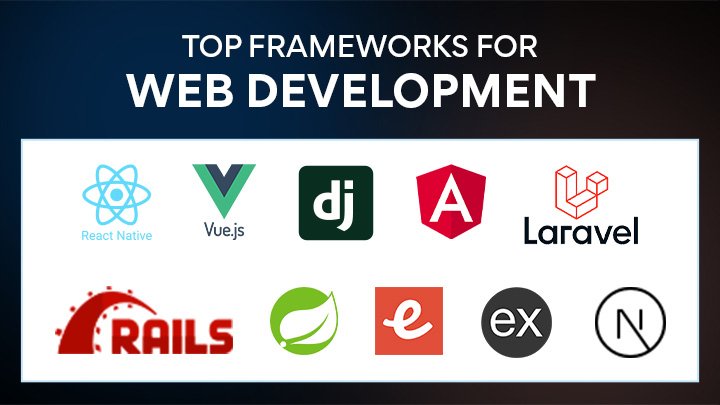
Please find the list of modern web development tools here:
React
It is a JavaScript library used for creating effortless and interactive web development frameworks with the help of UI components. The open-source library is made and maintained by Meta and the community.
React seamlessly combines with other libraries to support operations such as state management, API integration, routing, etc. Therefore, once you can hire React.js developers, you can leverage the best features and get added benefits if you have to work with React Native.
Examples: Yahoo, WhatsApp, Instagram, BBC, and Facebook.
Advantages
- Mobile app development support with React Native.
- Simple integration with other libraries.
- Instant manipulation with virtual DOM.
Disadvantages
- Complex structure.
- Low documentation.
Vue.js
The latest framework for web development is created and managed by Evan You and is a JavaScript-based open-source framework. It follows MVVM (model, view model, and view) architecture for development. It is among the best frameworks for the front, as it is easy in learning curve and the availability of several tools.
Examples: Netflix, VICE Video, Grammarly, Chess.com
Advantages
- Lightweight
- Easy Learning curve
- Simple third-party integrations.
- Seamless development
Disadvantages
- Lack of support from brands such as Google, Microsoft, etc.
Django
It is a Python-based, open-source web development framework that relies on the MVT (model, view, template) architecture. It can be preferred for both front-end and back-end development of web apps because of the features like authentication, code reusability, and built-in validation.
Examples: Spotify, Instagram, YouTube, and Dropbox.
Advantages
- Huge Community support
- Speedy development
- Organized documentation
- Secure and updated
Disadvantages
- Slow processing
- Not ideal for smaller projects
- Steep learning curve
Angular
Angular was initially used for JavaScript coding when it was first released. However, the best framework for web development was transformed in 2016 to use TypeScript as its programming language.
It allows MVC architecture to build unique web applications and contains components, directives, libraries, controllers, etc. It is backed by Google and has a massive community to help your project.
Examples: Upwork, Deutsche Bank, Forbes, Whether, and The Guardian
Advantage
- MVC architecture.
- Speedy development process.
- AngularJS development support.
Disadvantage
- No proper documentation.
- Heavily weighted.
- Steep learning curve.
Laravel
Laravel was first released in 2011 by its developer, Taylor Otwell. It is a PHP-based open-source framework for creating a powerful backend for web designing services.
The platform maintains MVC (model, view, controller) architecture to simplify the method of coding. It comes with numerous packages and API support to further enhance its usability.
Examples: Barchart, MyRank, Alison, and Invoice Ninja
Advantages:
- Quick time to launch
- Analyze documentation
- Secure authentication and unauthorized alternatives
- Combined mail services
Disadvantages
- Massive development cost
- Limited Support
- Payment gateway support is limited
Ruby on Rails
It was launched in 2004 and is among the oldest backend web frameworks available. By enabling the MVC architecture, it is considered one of the best web frameworks for several reasons. For instance, extensive tools & libraries, quick development, and consistency.
Advantages
- Highly encrypted
- Flexible
- Open source
Disadvantages
- Slow Processing.
- Improper documentation
Spring
The Spring web development framework uses one of the most popular programming languages for web development, such as Java. Any Java-based application can simply use its core features. Also, you can extend its capabilities to create impactful web applications.
Examples: Ticketmaster, BillGuard, and Wix.
Advantages
- Support MVC architecture
- Open Source
- Simple testability
- Works well with Java
Disadvantages
- Few guidelines
- High learning curve
Ember
These JavaScript-based frameworks go with developing feature-rich SPAs. With its MVVM architecture and best JS practices, creating an engaging front-end becomes much simpler.
Examples: Netflix, Google, and Microsoft
Advantages
- Well-documented
- High performance
- Code debugging support.
Disadvantages
- Steep learning curve.
- Not usable for smaller projects.
Expresses JS
Also known as the de facto standard for Node. js, it is one of the best web development frameworks. The Node.js API is highly flexible and can be utilized for developing web applications of any size.
Composing built-in features like server-side scripting, third-party integrations, and templating, building feature-rich applications will be simpler.
Examples: Twitter, Kevin, Accenture, Netflix.
Advantages
- Great flexibility
- Affordable price
- Time-efficient
- Easy to learn
Disadvantages
- Monitoring code might cause trouble.
- Challenging mistakes detection
- Callback problems.
Next.js
Next.js is an advanced and the latest framework for web development maintained by Vercel. It is famously known as one of the best frameworks for web development in 2026, particularly for high-performance, scalable applications that are SEO-friendly.
Next.js is a modern, open-source React-based framework developed and maintained by Vercel. It is widely regarded as one of the best frameworks for web development in 2026, especially for SEO-friendly, high-performance, and scalable applications.
The framework encourages server-side rendering (SSR), static site generation (SSG), incremental static regeneration (ISR), and API routes, making it best for both front-end and backend development needs.
Examples: Netflix, TikTok, Hulu
Advantages
- Outstanding SEO optimization with SSR and SSG.
- Effective automatic code splitting.
- Built-in API routes for backend features
Disadvantages
- Needs React knowledge.
- Complex configuration for large-scale projects.
- Regular updates may need maintenance adjustments.
What Are the Latest Web Development Frameworks for Modern Projects?
Web development for 2026 will use the latest framework for web development that delivers better performance and improved functionality. Web stacks have evolved from their original website construction purpose to create interactive digital systems that use artificial intelligence to evolve according to user behavior. Let’s explore upcoming developments in web stacks:
Features of Future-Ready Web Development Tech Stacks
Mentioned below are the features of the upcoming web tech stacks:
1. AI-Powered Web Development Tools
Django, Next.js, and FastAPI provide web developers with built-in AI capabilities that automate workflows and enable predictive user experience operations.
2. Serverless and Edge Deployments
The future of web development will be determined by global web delivery services that operate with low latency through the combination of edge computing and serverless architecture solutions that replace conventional hosting methods.
3. Composable and Secure Architecture
API-first design, together with zero-trust security measures, creates modular web stacks that transform the understanding of complete web development frameworks.
4. Developer Experience as Differentiator
Developers will choose modern tech stacks because these stacks provide faster project delivery through better collaboration and clearer design.

How to Choose a Web Development Framework That Supports Business Growth?
Your current situation leaves you unable to select between different technology stacks. The majority of organizations make errors during this particular period. Organizations usually pursue their current popular trends. Web development technology stacks need to become your main focus because they match your business objectives, team strengths, and capacity expansion strategies.
Here’s a quick reference table that maps common business goals to the latest framework for web development in 2026 to help you decide better:
| Business Goals | Recommended Web Stacks |
|---|---|
| Static and Content-Heavy Websites | JAMstack, Next.js |
| Dynamic SaaS or Startup Applications | Next.js, MERN, Ruby on Rails |
| APIs and Enterprise Backends | MEAN, Spring Boot + React, Django + React |
| High-Performance User Interfaces | SvelteKit, Laravel + Vue.js |
| Cross-Platform or Global-Scale Applications | AI-Native Stack, Serverless Stack |
Final Thought
The complete list of technologies that improve your development work will be presented here. Your ability to select the most suitable website framework depends on two factors, which include your understanding of these technologies and your specific project needs. You should hire dedicated, best web development framework developers to obtain essential technical support after you make a proper decision for your business needs. MSM Coretech is among the top web development companies and has highly professional web developers to assist you with business needs.
Frequently Asked Question(FAQs)
The most robust web development stacks in 2026 are MEAN, MERN, Next.js, JAMstack, Ruby on Rails 7, AI-Native Stack, Django + React, Serverless Stack, Spring Boot + React, Laravel + Vue.js, and SvelteKit. However, they serve different business goals that range from startup MVPs to large-scale AI-driven applications.
The current trends in web development point to a rise in serverless architecture, AI-based operations, and edge computing technology. It can be noted that there is an emergence of a trend in web development frameworks such as Next.js, Remix, and SvelteKit, which offer users sheer design flexibility and performance. Similarly, technologies such as TypeScript, headless CMS, and GraphQL assist development teams in creating digital experiences with expanded performance potential.
The backend frameworks used by Node.js with Express/NestJS, Laravel, Django, Spring Boot, and FastAPI will define the future of web development in 2026 and beyond. These systems will offer stable performance and meet growing needs, and all these requirements can be considered vital in accordance with contemporary web development needs like AI web apps, enterprise systems, and API development.
Select your project needs, which include project objectives, project duration, and team expertise. You should select your framework according to your existing knowledge if you need fast development. Next.js and Spring Boot become the best options when you need a stack that supports your system’s growth needs.
The frontend development field this year is dominated by React, Next.js, SvelteKit, and Vue.js. React and Next.js are popular for SEO and scalability, while the Vue.js framework provides easy-to-use features, and SvelteKit delivers fast and lightweight performance.

Related Posts

Top 10 Blockchain Development Companies in Australia
Australia has emerged as one of the leading destinations for blockchain innovation in the Asia-Pacific region. As organisations embrace digital...
Read More
Top 7 Gaming Website Development Companies in Australia
Australia’s gaming industry is growing rapidly, driven by mobile gaming, esports, online casino platforms, browser-based games, and independent game studios....
Read More

Top 5 Education Website Development Companies in Australia
In 2026, a school’s website is often the first place parents, students, and educators interact with the institution. Before scheduling...
Read More


 Verified Review




 +44 7427829444
 71-75, Shelton Street, Covent Garden, London, United Kingdom, WC2H 9JQ