

Share this article


How to Develop a Food Delivery App: Step-by-Step Guide for Businesses
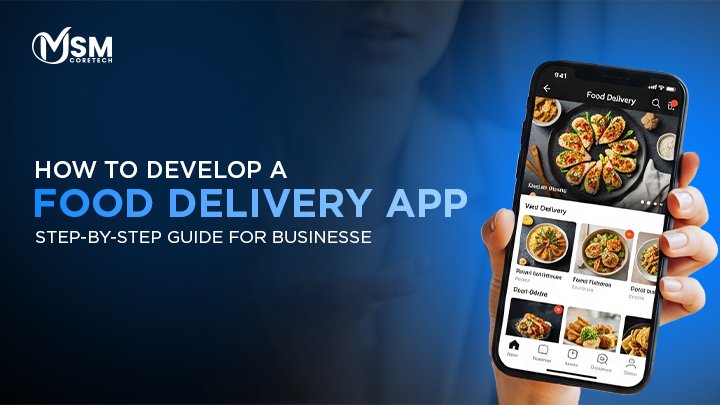
The rise of food delivery app development has been exponential recently and has changed the way people eat and how restaurants function across the board. The reliable food delivery app development can solve several issues for both businesses and investors. The use of a customized app for smaller and medium-sized restaurants will open new revenue channels and markets.
However, for big startups and big chains, it offers a means to connect with loyal customers, collect information, and remain ahead of the competition.
Since these food ordering apps are mostly focused on customers’ convenience & experience, users can easily search for the food they choose to order, avail themselves of special deals, & get the food delivered from local restaurants.
Top Stats and Market Insights of Food Delivery App Development
- Experts predict an annual growth rate (CAGR 2026-2030) of 7.20% for revenue, leading to a projected market volume of US$2.03 trillion by 2030.
- The Asia-Pacific region is the largest market, with revenue expected to reach $717.7 billion in 2025.
- Research shows that 40% of diners prefer to order delivery and takeout through a restaurant’s website and app.
Also Read: Food Delivery App Development Cost: Features, Factors, and Pricing Breakdown
Who Needs a Food Delivery App?
All food-related businesses can use food delivery app development services to grow their business, but the way each of them will benefit differs. For smaller cafes and restaurants, a delivery app will enhance their market reach by allowing them to quickly and easily expand at a low cost. Since they are no longer limited to just attracting people in their physical customer base, all customers within the area can see and order from their menu.
This gives them a new method of making sales that can increase the number of orders they receive without having to maintain an actual store. Independent restaurants often operate on small budgets, so having an online ordering platform is extremely valuable, as it allows them to reach more customers than they previously had access to directly.

Types of Food Delivery Models
Now that you have decided to create a food delivery mobile app, you must first choose the model that best fits your business concepts. As mentioned, each model comes with its own set of needs.
Single-Location Applications
This type of application is designed for a single location, or business, which would be considered a single brand (e.g., Domino’s Pizza or a separately owned pizza restaurant). With this on-demand food delivery app development, you have complete control over your customers’ menu and the entire customer experience.
Single-location applications are usually easier to develop because they have fewer features to build, which makes them perfect for businesses where the brand is getting traction and popularity.
Multi-Vendor Marketplaces
An example of this type of application is one that contains multiple food or restaurant providers integrated into one single application (such as Uber Eats or DoorDash). Multi-vendor marketplaces are somewhat more complex than single-location applications because of the added complexity of vendor onboarding, the management of each vendor’s menus, and the logistics of getting products from vendor to customer.
However, to create a food delivery app, it can be much more appealing to customers due to the overall variety of products available, which allows them to choose from a wider selection of cuisines and dining options compared to single-location applications.
Aggregator
An aggregator is a type of application that is similar to a marketplace in that it focuses on connecting delivery drivers with delivery orders but may not manage the order itself. Examples of this type of application are those that route deliveries between customers and multiple restaurants or manage the fleet of delivery drivers.
Cloud Kitchen/Ghost Kitchen
By partnering with a large best food delivery app development company that specializes in food delivery applications, a restaurant can develop high-quality applications for its ghost kitchen or cloud kitchen. Most ghost kitchens don’t have a physical area where a dining room or a customer service area is present. These applications enable a restaurant to offer several different brands in the same space (and thus offer a greater variety of products and services to their customers) without having to physically relocate to another area and establish several different restaurants.
One of the downsides of this is that a restaurant would have to provide efficient routing of orders to registered kitchens since it would have to be “connected” and “integrated” into the kitchen’s inventory management system using technology. If this is not done, there would be a delay in fulfilling customer orders, and this would lead to a poor customer experience; thus, a restaurant would have to ensure that it has efficient routing systems in place to ensure that customers are able to consume their food in a timely fashion.
Specialized or Hybrid Apps
There are many apps available to cater to the needs of specific markets, such as dessert-specific or allergen-specific and high-quantity delivery order apps. However, some of these apps can be regarded as ‘loyalty’ or ‘super’ apps, linking food to other services such as transport (Uber Eats, Postmates).
Also Read: Food Delivery App Development Process: From Idea to Launch
Step-by-Step Process for Food Delivery App Development
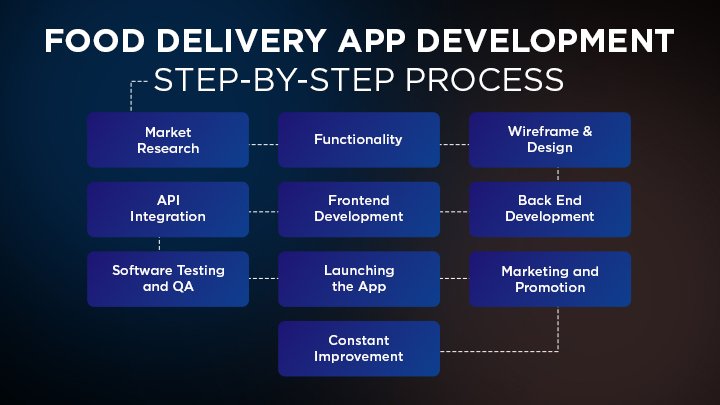
There are several steps involved in food delivery mobile app development. Here are the important steps required for developing a successful food delivery app:
1. Conduct Market Analysis
Market research should be carried out to determine the target customer and competitors in the marketplace before the food delivery business is established. This will enable you to have a clear picture of your unique selling idea and what the customers desire in a food delivery app.
2. Features and Functions
After this market research, you will be in a position to have a list of the basic features and functionalities that you will need in your food delivery app development services. You would then prioritize these functions/features in terms of priority to your target audience, time, and money required to put them in place.
3. Wireframe & Design
The visual representation of the app is known as a wireframe. It consists of the application structure and the navigation. Upon development, it is possible to proceed to the next stage of building the UI and UX of the food delivery app.
4. Back End Development
At this stage, we shall develop the backend infrastructure of the app. This includes coding the movements of the fingers into relevant servers, building key databases where data will be saved, establishing an API to integrate apps with other systems, and making the right decision on third-party services.
5. Front End Development
Here, we shall design the user interface of the app, whereby all the functionalities and features are involved to design a smooth user experience. Moreover, it is possible to develop a food delivery app with React Native, Swift, or Kotlin, depending on the nature of the targeted user.
6. Integration of Third-Party APIs
It will be necessary to add third-party services APIs, e.g., restaurant database APIs, payment gateways, etc. This is needed so as to achieve efficient communication between your application and other non-proprietary services like restaurant services.
7. Testing and Quality Assurance
Before launching the food delivery mobile app development, the company will have to carry out a comprehensive test on the app. It is important to ensure that the entire operation is not filled with defects or failures. Functional testing will help ensure that the app performs the way it is expected to, whereas usability testing will help evaluate how user-friendly the app is.
8. Launching the App
Prior to launching the app, you should prepare the packaging of the app in the App Store. Having submitted to both App Stores, confirm each platform’s process of submitting its apps according to the guidelines for app submission on the respective platform.
9. Marketing and Promotion
Develop an advertisement campaign/adverts to advertise to potential users via social media platforms like Twitter, Instagram, and Facebook. Increase the ranking of the app store in which you are selling your app, and enlist the services of a social media influencer to market the same and make people download it.
10. Continuous Improvement
In order to understand the interaction between the users and your app and its problems, one should observe and analyze how it is used and how users respond to it. Due to this information, you will be capable of making updates to your app. Bug fixes and feature additions have been made to the app, and this has enhanced the user experience.
Also Read: Top 10 Food Delivery Apps in 2026
Significant Features of a Food Delivery Service App
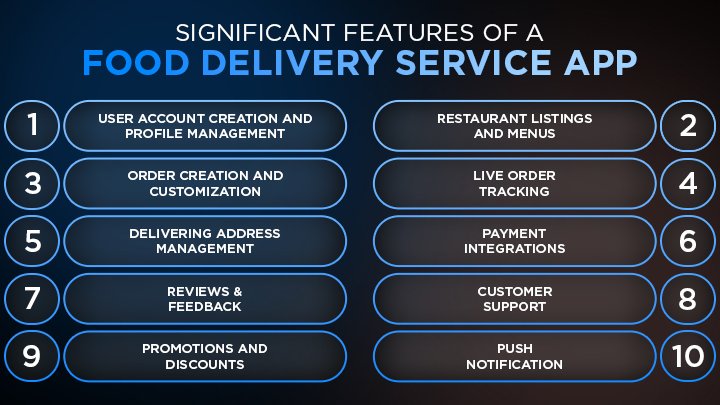
Building a food delivery mobile app development requires the accessibility of certain key features to ensure a seamless and easy user experience. Here is a list of some of the primary features:
1. User Account Creation and Profile Management
Customers must be able to sign up, modify, and update their account details. It involves payment methods and shipping addresses, among many others, such as contact information and preferences for communication.
2. Restaurant Listings and Menus
A user should be able to view which restaurants are present in this area and display their menus, along with associated details such as hours of operation and location.
3. Order Creation and Customization
When ordering food at a restaurant, customers need to have the ability to select food items from the restaurant’s menu, customize them by substituting different ingredients, and then create an order. The customers should have an easy process to follow in creating their order, with a visual aid and a well-laid-out, organized structure for easy navigation.
4. Live Order Tracking
The goal of creating a food delivery app development is to provide customers with information about their food order and allow them to track when they can expect delivery via real-time tracking. When ordering, customers can see the order’s status, get an estimated delivery time, and contact the driver with questions about the food or delivery.
5. Delivering Address Management
Users should be able to save several delivery addresses (i.e., home, office, or when convenient) so that upon placing an order, each user can choose the ideal delivery address for that order.
6. Payment Integrations
There will be multiple payment integrations available: cash on delivery, credit/debit cards, and mobile wallets in the food delivery app development services.
7. Reviews & Feedback
Users will rate and review restaurant locations/dishes according to their satisfaction to make an educated decision while also encouraging restaurants to keep their service at a high standard.
8. Customer Support
There must be a customer support channel included with their app, either through chat or by phone. This is to ensure that users can receive assistance with their inquiries and file complaints.
9. Promotions and Discounts
The numerous promotions, discounts, or loyalty programs attract and reward users, thereby enhancing their engagement and stimulating repetitive business.
10. Push Notification
Push notifications help users get notified on time about order confirmation, estimated delivery time, special promotions, and new menu items. It helps to keep users engaged and informed with the app.
Visit: Leading Mobile App Development Company
Revenue Models of On-Demand Food Delivery Apps
Here are some of the best revenue models of food delivery app development services:
Commission from Restaurants
The applications take a percentage of the total order value as a commission fee from restaurants for using the app’s service to get orders and reach a wide spectrum of customers.
Delivery Charges
The customers are charged a fee for the delivery service provided by the app. It especially applies to smaller orders or during peak hours, which includes the app revenue.
Subscription Plans
The apps can generate revenue from premium subscription plans where the application charges subscribers for services such as free deliveries, exclusive discounts, and priority services.
Advertising and Promotions
The restaurants pay to have their listings on the app’s home page, advertise, or have special promotions, adding another revenue stream to the app’s business model.
Peak Pricing
The food delivery app development cost customers extra for deliveries during peak hours or high-demand periods to generate more revenue.
Each of the above revenue streams enables the on-demand food delivery apps to remain in business while providing efficient services to customers and partner restaurants.

Conclusion
Creating an app for food delivery can be an exhausting job, but if you start with caution and focus on the customer’s requirements, business model, and technology, it will lead you to the right path.
At MSM Coretech, we are the best on-demand app development company. We have a team of professionals who have worked for several food delivery apps. Also, after gaining a proper understanding of the project, our expert provides the best solution.
FAQs
When estimating costs for creating a food delivery application, it can be determined by analyzing the complexity of features, the platform, and the overall complexity of the project. A simple MVP may cost somewhere between $15 and $25. However, if you want to build the entire functionality of your food delivery app, advanced functionality can increase the project cost to $50+. This comprehensive development process may take significantly longer, potentially extending the timeline to 16-24 weeks, depending on the complexity of the features implemented.
Developing a minimum viable product is the most cost-effective approach to initiating your food delivery application. A minimum viable product includes features that allow someone to search for food available for purchase, place an order, receive order status updates, and pay for delivery. As your business grows and receives more customers, you can add additional features to your food delivery application.
MSM Coretech leverages powerful frameworks in the development of our food delivery apps, such as React Native/Flutter for mobile development and Node.js/Django for backend development, along with PostgreSQL/MongoDB for database management. These multiple technologies create a seamless food delivery experience through effective payment gateways, mapping services, and third-party services/APIs for reliable order tracking.
The mobile food delivery application must include four components (user, restaurant, delivery partner, and admin), and when each component is designed accurately, it will result in a successful mobile food delivery application.
The total time frame for a simple MVP is typically 8-12 weeks. If you are looking at building a feature-rich cross-platform application with a lot of complicated functionality, then it could take an estimated 4–6 months to have a completed product ready for launch.

Related Posts
How Much Does It Cost to Build A FinTech App Like Revolut?
Today, many people want to manage their money using just one mobile app. With an app like Revolut, users can...
Read More
How to Build A Veterinary Medicine Online Shopping App?
Pet owners today don’t want to drive across town every time their dog needs a flea tablet, or their cat...
Read More
5 Ways Restaurant Technology Is Transforming the Industry
The restaurant industry is changing fast, and technology is now an important part of this change. Restaurants are using technology...
Read More


 Verified Review




 +44 7427829444
 71-75, Shelton Street, Covent Garden, London, United Kingdom, WC2H 9JQ