

Share this article


5 Ways Restaurant Technology Is Transforming the Industry
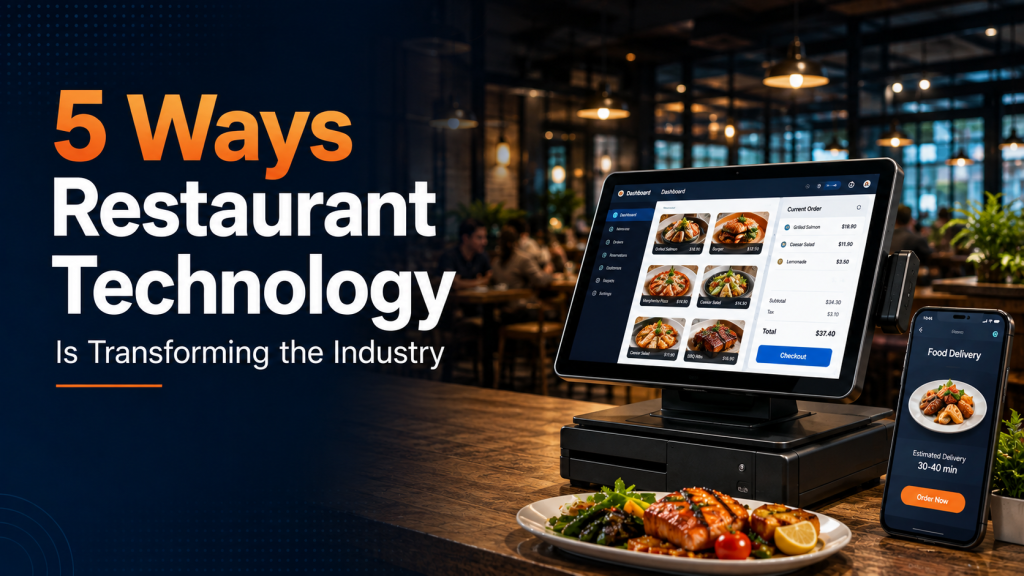
The restaurant industry is changing fast, and technology is now an important part of this change. Restaurants are using technology for online ordering, digital payments, smart kitchen tools, and AI. These tools help make daily work easier and give customers a better experience.
Today, serving good food is not enough. Customers also want quick service, easy ordering, simple payment options, and convenient delivery.
The numbers also show how important technology has become. According to the National Restaurant Association, 76% of restaurant operators say technology gives their business a competitive advantage. The report also found that customers mainly like technology that helps them order and pay faster and more easily.
Off-premises dining is another big reason restaurants are using more technology. In 2025, 57% of adults had recently used mobile ordering. Also, nearly 75% of restaurant traffic happened off-premises, including takeout, delivery, and drive-thru orders.
Restaurant technology is also going beyond simple online ordering. Many restaurants are now looking at AI, self-service kiosks, digital loyalty programs, automated staff scheduling, and smart inventory systems.
In this blog, we will explore five key ways restaurant technology is changing the industry. These technologies can help restaurants save time, provide better service, understand their customers, and grow their business.
What Is Restaurant Technology?
Restaurant technology means using digital tools to make restaurant work easier, faster, and better organized. It includes POS systems, online ordering, QR-code menus, self-service kiosks, digital payments, kitchen display systems, inventory software, loyalty apps, and AI tools.
These tools help restaurants handle their daily work more easily and give customers a better dining experience. For example, customers can order food using their phones, pay without cash, track their deliveries, or use a self-service kiosk instead of waiting in line.
Restaurants can also use technology behind the scenes to check stock, manage staff schedules, handle orders, and understand customer information. This helps save time, reduce mistakes, and keep restaurant operations running smoothly.
Restaurant technology is growing very quickly. According to the National Restaurant Association, 83% of restaurant operators said that technology helps their business stay ahead of competitors. In 2025, 28% of restaurant operators planned to invest in AI, while 40% planned to invest in smartphone app development.
Also Read: 10 Profitable Restaurant Business Ideas You Can’t Afford to Miss
Revolutionary Technologies Transforming the Restaurant Industry
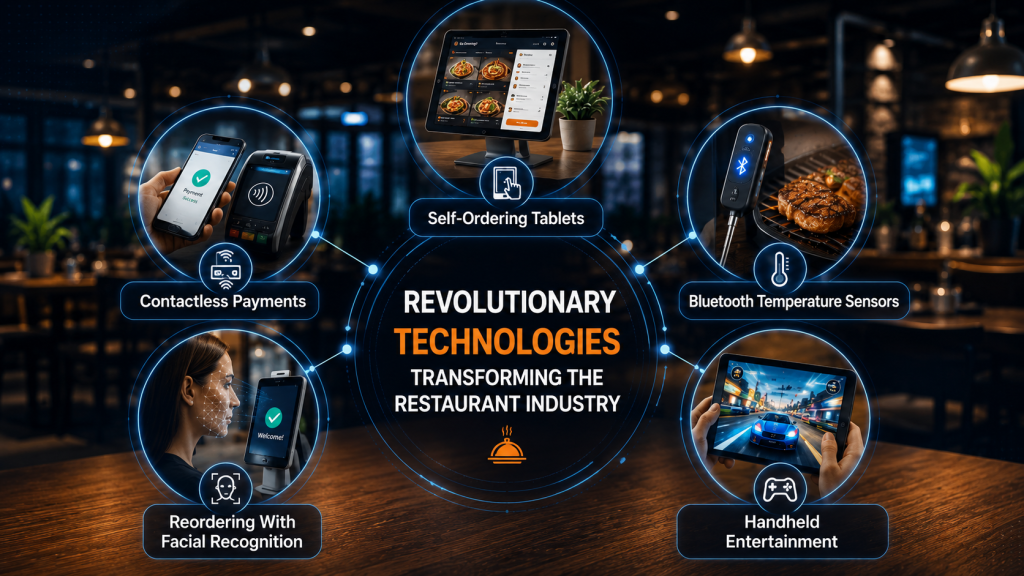
Technology is changing how restaurants take orders, receive payments, manage food safety, and keep customers happy. Today, customers want quick service, easy ordering, and simple payment options. Restaurant technology helps businesses provide all of these while also reducing small, everyday tasks for staff.
1. Self-Ordering Tablets
Self-ordering tablets allow customers to view the menu, choose and customize their meals, place orders, and sometimes make payments without waiting for a server. This can make busy hours easier for restaurants and help reduce long waiting lines.
According to Tillster’s 2026 data, 64% of diners use in-store self-service kiosks several times a month. Also, 71% of diners are equally or more satisfied with kiosks compared to cashiers.
These tablets can also help restaurants increase sales. They can suggest extra items, such as drinks, desserts, or additional toppings, while customers are placing their orders. Tillster found that 76% of kiosk users sometimes buy more than they first planned to. This means self-ordering tablets can make ordering easier for customers while also helping restaurants sell more.
2. Contactless Payments
Nobody likes waiting for a card machine or dealing with cash after a meal. Contactless payments make checkout faster and easier. Customers can pay using cards, smartphones, QR codes, or digital wallets.
According to the National Restaurant Association, 79% of restaurant customers prefer contactless or mobile payments, while 73% prefer digital wallets.
This makes the payment process easier for customers. It also helps restaurants serve people faster at tables and counters.
3. Bluetooth Temperature Sensors
Food safety is one area where simple technology can make a big difference. Bluetooth temperature sensors can continuously track the temperature inside refrigerators, freezers, and food storage areas.
Instead of checking temperatures manually again and again, staff can receive alerts when something gets too warm. This helps restaurants react before food gets spoiled.
A study of 238 restaurants in Dammam found that although 88.1% used thermometers for refrigerators and freezers, only 13% had regular temperature-monitoring records for both. This shows why automatic monitoring can make food-safety work easier and more consistent.
4. Reordering With Facial Recognition
Facial recognition is making restaurant ordering more personal and convenient. With the customer’s permission, this technology can recognize a returning customer, connect them to their account, and help make ordering or payment faster.
For example, Steak ’n Shake has used facial recognition at its self-ordering kiosks. According to its technology provider, biometric check-in and checkout can take just two to three seconds, making the process much faster.
Facial recognition can also work with loyalty programs and remember customer preferences. This can help restaurants offer a smoother and more personalized experience.
However, restaurants need to be very careful when using facial data. They should clearly tell customers what data is collected, how it is used, and how it is protected.
5. Handheld Entertainment
Restaurant tablets are not just used for menus and payments anymore. They can also keep guests busy with games, quizzes, videos, and other fun activities while they wait.
For example, Ziosk says its restaurant games are used by 2.5 million diners every day, with more than 200,000 games played each day.
This can make waiting time feel shorter, especially for families with children. It also gives restaurants more ways to connect with customers and show them special offers and promotions.
Overall, these technologies are helping restaurants become faster, safer, and more convenient. The main goal is not to replace restaurant staff. Instead, technology takes care of boring and repetitive tasks, giving staff more time to focus on customers and provide better service.
Also Read: Cost to Develop a Restaurant App Like Resy
Ways Restaurant Technology Is Transforming the Industry
Restaurant technology is changing the way restaurants manage daily tasks, serve customers, and work with their teams. Tools like digital ordering systems and inventory software help restaurants save time, avoid mistakes, and give customers a better experience. According to the National Restaurant Association, 76% of restaurant operators say technology helps give their business a competitive advantage.
Supplier and Employee Onboarding
Technology makes it easier for restaurants to add new suppliers and employees to their systems. Digital forms, online training, e-signatures, and automatic checks can reduce paperwork and make the onboarding process faster.
Managers can also keep employee details, work schedules, training records, and supplier information in one place. This keeps everything organized and makes daily management easier to handle and track.
Employee management is very important for restaurants. In 2025, 77% of restaurant operators said that finding and keeping employees was still one of their biggest challenges.
Material Handling
Restaurants use many ingredients every day, so managing stock can be hard. Inventory management software helps restaurants see what items they have, what is running low, and what needs to be ordered. Barcode scanners, smart sensors, and automatic alerts can make this job quicker and easier.
Good inventory tracking can also help reduce food waste. ReFED reports that restaurants and other foodservice businesses created 12.5 million tons of surplus food in 2024.
By keeping a close eye on stock, restaurants can order the right amount of food and avoid buying more than they need. This can save money and reduce food waste.
Reservation Management
Online reservation systems make booking a table much easier. Customers can check available times, book a table, cancel a booking, or change their reservation using their phones. At the same time, restaurant staff can see bookings in real time and manage tables more easily.
These systems can also send booking reminders, save customer preferences, and show restaurants when they are busiest. This helps reduce missed bookings and makes the dining experience more organized and convenient.
Food and Beverages
Technology is changing the way customers order food and drinks. QR-code menus, self-ordering kiosks, mobile apps, digital payments, and online delivery systems make the ordering process faster and easier.
There is already a strong demand for digital ordering. According to the National Restaurant Association, 57% of adults had recently used mobile ordering, while 74% of millennials had used it. Digital ordering also sends orders directly to the kitchen, which helps reduce mistakes and confusion between customers, servers, and kitchen staff.
Restaurants that want to create custom ordering or restaurant management solutions can also work with a restaurant app development company to build features that match their specific needs.
Quality Control
Technology helps restaurants maintain better food quality and provide more consistent service. Digital checklists, temperature sensors, kitchen monitoring tools, and food safety software help staff follow the right steps every time.
Managers can also use reports to find problems early. For example, they can see if service is slow, orders are often wrong, or too much food is being wasted. AI can make this process even better by finding patterns in restaurant data and showing where improvements are needed.
Overall, restaurant technology is no longer just an extra option. It is becoming an important part of daily restaurant operations. From staff onboarding and inventory management to reservations, ordering, and quality checks, the right technology can help restaurants work faster, reduce waste, and keep customers happy.
Also Read: AI in Restaurant Industry: A Complete Guide
Future of Restaurant Technology
Restaurant technology is changing quickly. It is no longer only about digital payments. Today, restaurants are using smarter tools to serve customers faster and make daily work easier.
Mobile ordering, QR-code menus, self-service kiosks, digital payments, and food delivery apps are already changing the way people order food.
The demand for these tools is also growing. According to the National Restaurant Association, 57% of adults have recently used mobile ordering. This number is even higher among younger customers, with 74% of millennials and 65% of Gen Z adults using mobile ordering.
Role of AI, IoT, Robotics, and Automation
AI will become more useful in restaurants. It can help businesses understand what customers like, suggest menu items, predict how much food will be needed, and manage stock. IoT devices can connect kitchen equipment, refrigerators, sensors, and other systems. This allows restaurant owners to check and manage their operations in real time.
Robots and automation can also do many repetitive tasks, such as preparing food, delivering orders, cleaning, and tracking inventory. These technologies can save time and reduce some of the manual work for restaurant staff.
The National Restaurant Association found that more than half of millennials and Gen Z consumers would consider ordering through an AI chatbot. This shows that customers are becoming more comfortable with smart technology in restaurants.
Growing Use of Smart Restaurants
Smart restaurants use technology to manage different parts of their business. Customers can order food through an app or kiosk, pay online, get special offers based on their interests, and track their deliveries on their phones. At the same time, restaurants can use technology to manage staff, check stock, track sales, and understand customer demand.
This change is already taking place. According to the National Restaurant Association, 76% of restaurant operators say that technology helps them stay ahead of their competitors.
Importance of Adopting the Right Technology
Restaurants do not need to use every new technology available. The best approach is to choose technology that solves real problems and meets customer needs. Simple ordering, fast payments, reliable POS systems, proper inventory tracking, and strong data security can make a big difference.
The future is for restaurants that use technology in a smart way while still keeping the human touch of hospitality. The right technology should make service faster and easier. It should help restaurants serve customers better without making them feel less welcome.
Also Read: Cost To Develop A Restaurant App Like OpenTable
Why Choose MSM CoreTech for Restaurant App Development?
Choosing the right development partner is important when building a restaurant app. MSM CoreTech creates simple, useful, and reliable restaurant apps that help businesses serve their customers better.
Our team understands what modern restaurants need. We can add features like online food ordering, table booking, digital menus, secure payments, delivery tracking, and customer notifications.
We build apps that are easy to use for both restaurant staff and customers. This helps restaurants manage their daily work more easily while giving customers a smooth and convenient experience.
As an experienced mobile app development company, MSM CoreTech uses the latest technology to build fast and smooth apps. We also focus on simple designs, strong security, and good app performance on different devices.
Every restaurant has its own needs and goals. That is why we create customized solutions instead of using the same setup for every business. Whether you have a small restaurant, a cloud kitchen, or a growing food business, we can add features based on your needs.
We also offer support after the app is developed. This helps keep your app updated and working properly. Our main goal is to build a restaurant app that gives customers a better experience, saves time, and helps your business grow.
Conclusion
Restaurant technology is changing the industry in many useful ways. From self-ordering tablets and contactless payments to smart inventory systems, temperature sensors, online reservations, and AI, technology is helping restaurants work faster and serve customers better.
These tools can reduce manual work, improve food safety, manage stock, reduce waste, and make ordering and payment easier. Technologies such as AI, IoT, robotics, and automation will make restaurants even smarter in the coming years.
However, restaurants do not need to adopt every new tool. The right technology depends on the restaurant’s size, budget, staff, and customer needs. Choosing simple and useful solutions can bring better results than using too many tools at once.
As customer expectations continue to change, technology will become an even bigger part of restaurant operations. Restaurants that use it wisely can save time, improve service, reduce costs, and create a smoother experience for their customers.
FAQs
MSM CoreTech creates customized restaurant apps with useful features such as online ordering, table booking, digital menus, secure payments, delivery tracking, and notifications.
Yes. MSM CoreTech develops restaurant apps based on your business needs. You can choose features according to your restaurant type, target customers, and business goals.
A restaurant app can include online food ordering, table reservations, digital menus, payment integration, order tracking, push notifications, customer accounts, offers, reviews, and an admin panel.
The cost depends on the app’s features, design, platform, integrations, and development time. A basic restaurant app may cost around $15,000–$30,000, while a more advanced app can cost $30,000–$80,000 or more.
A basic restaurant app may take around 2–4 months. Apps with advanced features, multiple panels, payment systems, delivery tracking, or third-party integrations may take 4–8 months or more.

Related Posts
How to Build A Veterinary Medicine Online Shopping App?
Pet owners today don’t want to drive across town every time their dog needs a flea tablet, or their cat...
Read More
Top 10 FinTech APIs for Every Startup
If you’re building a startup today, chances are money needs to move somewhere inside your product payments, payouts, identity checks,...
Read More

How to Build a Dating App Like Badoo: Complete Guide
Finding a match is no longer limited to meeting people through friends or social events. Dating apps have made it...
Read More


 Verified Review




 +44 7427829444
 71-75, Shelton Street, Covent Garden, London, United Kingdom, WC2H 9JQ