

Share this article


Different Types of eCommerce Businesses You Should Know in 2026
eCommerce has changed the way people shop, compare products, and buy services. In simple words, an eCommerce business sells products or services online. Customers can buy things through websites, mobile apps, online marketplaces, or social media platforms. Depending on the business model, a company may sell directly to customers, sell to other businesses, or offer products through an online marketplace.
The eCommerce market continues to grow in 2026. Global eCommerce revenue is projected to reach around $3.88 trillion in 2026, with the market expected to grow at a 6.84% CAGR from 2026 to 2030.
As customer shopping habits change, eCommerce business models are changing too. Businesses are no longer limited to traditional online stores. Today, there are many types of eCommerce businesses, including B2C, B2B, D2C, C2C, subscription-based stores, marketplaces, dropshipping, social commerce, and on-demand businesses. Social commerce is also becoming more popular, with sales through social networks expected to make up 15.2% of total eCommerce sales in 2026.
Choosing the right eCommerce business model is important because it affects how a business sells products, reaches customers, manages its products, sets prices, and grows. A clear business model can also help reduce extra costs and make it easier to expand the business in the future. Whether you want to start a small online store or build a large marketplace, knowing the different types of eCommerce businesses can help you choose the model that best matches your business goals.
Why Understand Different eCommerce Business Types?
It is important to understand different types of eCommerce businesses before starting an online business. Each business model works in a different way. Knowing these options can help you choose the right one for your needs. Whether you want to sell products directly to customers, sell to other businesses, or create an online marketplace, choosing the right model can make your business journey easier.
First, it helps you choose the right business model based on your products, budget, and goals. For example, a small brand may choose a direct-to-consumer model, while a business that sells products in large quantities may choose the B2B eCommerce model.
It also helps you understand and target your customers better. When you know who your customers are and what they want, you can create better offers, content, and shopping experiences. This can help bring more people to your store and turn them into customers.
Knowing your business model also makes it easier to plan your products, prices, and marketing. You can decide what to sell, how much to charge, and where to promote your products. For example, social media can work well for a fashion store, while email marketing may be more useful for a B2B business.
Finally, choosing the right model can help your business grow in the future. As your orders, customers, and product range grow, you can add new features and improve your online store. Working with an experienced e-commerce development company can also help you build a flexible store that easily supports your future growth.
Also Read: The Role of AR in eCommerce
Major Types of eCommerce Businesses in 2026
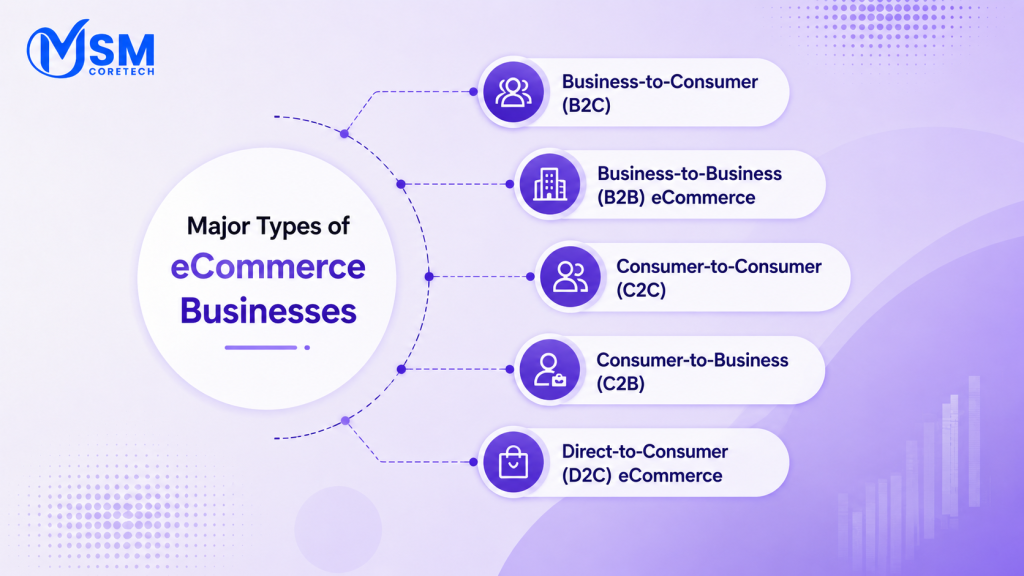
Business-to-Consumer (B2C)
Business-to-Consumer (B2C) is one of the most common eCommerce business types. In this model, a business sells products or services directly to customers through an online store, mobile app, or online marketplace. Customers can view products, compare prices, place orders, and pay online without going to a physical store.
B2C businesses can sell many different products, such as clothes, electronics, beauty products, groceries, furniture, food, and digital products. Large online shopping websites and individual brand stores are common examples of B2C businesses.
One of the main benefits of B2C eCommerce is easy and convenient shopping. Customers can shop at any time and from almost anywhere. Businesses can also reach more customers, collect feedback, offer special deals, and build long-term relationships with their customers. In 2026, features such as AI product recommendations, chatbots, and easy payment options can make online shopping faster, simpler, and more convenient.
Business-to-Business (B2B) eCommerce
Business-to-Business (B2B) eCommerce is when one business sells products or services to another business through an online platform. Unlike regular online shopping, B2B orders are often larger and may happen regularly. For example, a restaurant may buy food supplies from a wholesaler through an online store, or a retailer may purchase products in bulk from a manufacturer.
Wholesale and bulk purchasing are important parts of B2B eCommerce. Businesses can order large quantities at special prices, compare products, check stock, and manage repeat orders online. This saves time and makes buying easier.
A good B2B eCommerce platform usually includes features such as bulk ordering, customer-specific pricing, business accounts, quotation requests, multiple payment options, order tracking, and inventory management. Many platforms also offer different prices for different customers.
As more companies move their buying process online in 2026, B2B eCommerce is becoming a simple and useful way to manage business purchases and build long-term customer relationships.
Consumer-to-Consumer (C2C)
Consumer-to-Consumer (C2C) is a type of eCommerce where one person sells products or services directly to another person online. People can sell used items, new products, or handmade goods through online marketplaces. Resale websites, auction platforms, and local selling apps help buyers and sellers connect easily.
Online marketplaces are very important in C2C eCommerce. They provide useful features like product listings, search options, secure payments, customer reviews, messaging, and delivery support. These features make the buying and selling process simple and convenient for everyone.
One of the biggest advantages of C2C is that sellers can start selling with very little investment and reach many customers. Buyers can also find unique, second-hand, or affordable products at lower prices. However, C2C platforms can sometimes face problems such as fake product listings, payment fraud, low-quality items, and delivery delays. A reliable ecommerce app development company can create secure features that build trust and make online buying and selling safer and easier.
Consumer-to-Business (C2B)
Consumer-to-Business (C2B) is an eCommerce model where people sell their products, skills, or services to businesses. It is different from the common model where businesses sell products or services to customers. In C2B, the individual is the seller or service provider, and the business is the buyer.
Freelancing is a simple example of the C2B model. For example, a graphic designer can create a logo for a company, a writer can write blog content, or a photographer can sell photos to a brand. Influencers and content creators can also work with businesses by promoting their products through social media, videos, blogs, and other online platforms.
The C2B model is becoming more popular because many people now work independently and use online platforms to connect with businesses. Websites and online marketplaces make it easy to find clients, show work, and get paid online. For businesses, C2B provides access to skilled professionals without the need to hire them as full-time employees. This makes the model flexible, useful, and easy to grow.
Direct-to-Consumer (D2C) eCommerce
Direct-to-Consumer, or D2C eCommerce, is a business model where brands sell their products directly to customers. They do not need to depend on third-party retailers or big online marketplaces. For example, a clothing brand can sell its products through its own website or mobile app instead of selling them through a retail store.
With the D2C model, a brand manages the full buying process. This includes showing products, deciding prices, accepting payments, managing delivery, and helping customers. This allows businesses to build a closer relationship with their customers.
One of the biggest benefits of D2C eCommerce is better customer relationships. Brands can understand what their customers like by looking at shopping data and customer feedback. They can also provide personalized offers and product recommendations. D2C businesses have more control over their brand image, prices, and overall customer experience.
The D2C model can also reduce the need for middlemen and give businesses more chances to grow. As online shopping continues to grow in 2026, D2C eCommerce can be a useful way for brands to connect directly with their customers and build long-term growth.
Also Read: Top AI Chatbot Development Platforms for eCommerce Businesses
Types of eCommerce Businesses Based on What They Sell
Not every eCommerce business sells the same type of product. Some online stores sell physical products, while others sell digital products, services, courses, or subscriptions. In 2026, businesses have many ways to sell products and services online. With the right platform, payment methods, and e-commerce web development, almost any product or service can be sold through an online store.
Physical Products
Physical products are one of the most common types of eCommerce businesses. These businesses sell products that customers can order online and get delivered to their homes. Clothing, shoes, electronics, furniture, beauty products, groceries, and auto parts are some common examples.
These businesses need to manage product stock, packaging, shipping, and returns. A simple and easy-to-use website with quick product search and a smooth checkout process can make online shopping easier and more convenient for customers.
Digital Products
Digital products do not need to be shipped or delivered physically. Customers can buy them and download or use them online. Some common examples are eBooks, music, templates, software, stock photos, graphics, and digital tools. This model is useful because businesses do not need to manage storage or shipping. After creating a digital product, they can sell it to many customers without making or shipping a new physical item each time.
Services
eCommerce is not only about selling physical or digital products. Many businesses also sell services online. These services can include web design, consulting, marketing, fitness coaching, online tutoring, legal help, and repair bookings. Customers can choose the service they need, pick a suitable time, pay online, and then receive the service either online or offline.
Subscription-Based Products and Services
Subscription eCommerce lets customers pay for products or services on a regular basis, such as every month or every year. In return, they receive products or get continued access to a service. Meal boxes, beauty boxes, streaming services, software, and online memberships are common examples. This model helps businesses earn regular income and makes it easy for customers to get what they need regularly.
Online Courses and Educational Products
Online learning is now a popular part of eCommerce. Teachers, experts, and businesses can sell video courses, workshops, study materials, training programs, and learning memberships online. Customers can learn from home and access the content whenever they want. Businesses can also include quizzes, certificates, live classes, and discussion areas to make learning more useful and engaging.
Rental and On-Demand Products
Some eCommerce businesses allow customers to rent products instead of buying them. These products can include cars, furniture, clothes, tools, cameras, and other equipment. On-demand businesses work in a similar way. They provide products or services when customers need them. Food delivery, home cleaning, transportation, and beauty services are common examples.
In 2026, deciding what to sell is just the first step. Businesses also need to know their customers, set the right prices, manage delivery, and provide a smooth online shopping experience. A clear business model and an easy-to-use online store can help attract visitors and turn them into regular customers.
Popular eCommerce Business Models in 2026
In 2026, eCommerce is more than just selling products through a regular online store. Businesses can choose from different eCommerce models based on what they sell, who their customers are, their budget, and their business goals. Here are some popular eCommerce business models that are becoming more common.
Marketplace Model
A marketplace is an online platform where many sellers can sell their products to many buyers. Sellers add their products to the platform, while the marketplace handles things like payments, orders, and customer support. Amazon and Etsy are popular examples of this model. It allows businesses to offer many different products without having to keep all the products in stock themselves.
Dropshipping
Dropshipping is a simple business model where you sell products without keeping them in your own warehouse. When a customer places an order, the supplier packs the product and sends it directly to the customer. This model is a good choice for beginners because it requires less money to get started.
Subscription Model
In this model, customers pay to receive products or services regularly, such as every month or every few weeks. Common examples include meal boxes, beauty products, software, and streaming services. Subscriptions can give businesses regular income and help them build long-term relationships with customers.
Private-Label eCommerce
Private-label eCommerce means selling products made by another manufacturer under your own brand name. For example, a company can buy skincare products from a manufacturer and sell them using its own logo and packaging. This model gives businesses more control over their brand and product prices.
Wholesale eCommerce
Wholesale eCommerce means selling products in large quantities, usually to other businesses. Customers often pay less when they buy more products. This type of business needs simple ordering, bulk pricing, and easy invoice management.
Print-on-Demand
Print-on-demand allows businesses to sell custom products without keeping products in stock. Items like T-shirts, mugs, bags, and phone cases are made only after a customer places an order. This helps reduce storage costs and makes it easy to try new designs.
Social Commerce
Social commerce means selling products through social media platforms. Customers can find products, read reviews, and buy items directly through social media. Short videos, creator recommendations, live shopping, and customer-created content can help brands attract more buyers.
On-Demand Commerce
On-demand commerce means providing products or services to customers whenever they need them. Food delivery, grocery delivery, medicine delivery, and quick-commerce services are common examples. In this model, fast delivery, real-time tracking, and an easy mobile experience are very important.
For businesses that want to build or improve their online store, shopify ecommerce development can be a good option. It can help create a flexible and easy-to-use shopping experience. The best model depends on what you sell, who your customers are, and how you plan to grow your business.
Also Read: 10 Best Ecommerce Mobile Apps for Seamless Shopping
How to Choose the Right eCommerce Business Model
Choosing the right eCommerce business model is an important step when starting an online store. There are many business models to choose from, but the right one depends on your products, customers, budget, and future goals. Having a clear plan can help you avoid common problems and make your online business easier to manage.
Identify Your Target Customers
First, understand who your customers are. Think about their age, location, interests, shopping habits, and how much they usually spend. For example, an online store selling office supplies may target businesses, while a fashion store may focus on individual shoppers. Knowing your target customers will help you choose the right products, set suitable prices, and use the right marketing methods.
Decide What You Want to Sell
First, decide what you want to sell online. You can sell physical products, digital products, subscriptions, services, or handmade items. The type of product you choose will affect your store design, delivery method, payment options, and business model. Choose something you know well and that people are likely to buy.
Consider Your Budget
Your budget is also important when starting an online store. A small store usually costs less than a large online marketplace. You may need to spend money on website development, hosting, payment gateways, marketing, inventory, packaging, and delivery. If you have a limited budget, start with the basic features and add more as your business grows. You can also consider e-commerce app Development to give customers an easy and convenient way to shop from their mobile devices.
Check Competition and Market Demand
Before starting your online store, see what other businesses are selling. Check their products, prices, customer reviews, and services. This can help you find what they are missing and where you can offer something better. Also, check if people really want to buy your products. Having a good business idea is not enough if customers are not interested in it.
Choose the Right Technology and Platform
Choose an eCommerce platform that fits your business needs. Look at things like ease of use, payment options, security, customization, and future growth. The right platform should help you easily manage your products, orders, customers, and payments.
Plan for Future Growth
Finally, think about your business’s future growth. Choose a business model and technology that can support more customers, products, and orders as your business grows. A flexible setup will help you avoid making big changes when your store becomes larger.
Also Read: Explore the Future of eCommerce with Adobe Commerce
Why Choose MSM CoreTech for Ecommerce Development
Choosing the right mobile app development company is important for building a successful eCommerce app. MSM CoreTech helps businesses create simple, useful, and reliable apps that make online selling easier and help businesses stay connected with their customers.
We know that every business is different. So, we build eCommerce apps based on your products, customers, and business needs. We do not use the same setup for every business. Our team focuses on easy navigation, fast performance, secure payment options, and a clean design. This helps customers browse products and shop online without any confusion.
We use modern technologies to build eCommerce apps that can grow with your business. Whether you are starting a new online store or improving your existing one, we can help you add the features you need.
We cover all the important features of an eCommerce app, including product browsing, shopping carts, order tracking, payment integration, push notifications, and customer accounts.
At MSM CoreTech, our goal is not just to build an app but to create a useful shopping platform that helps your business grow. We focus on clear communication, on-time development, and long-term support to make the entire process simple and easy for you.
Conclusion
eCommerce is not limited to just one type of online store. In 2026, businesses can choose from different models, such as B2C, B2B, D2C, marketplaces, dropshipping, subscription stores, private-label businesses, and social commerce. Each model works in a different way, so businesses should choose the one that best fits their products, customers, budget, and future goals.
Choosing the right eCommerce model is an important decision. The right model can help businesses reach the right customers, manage daily work more easily, control costs, and grow over time. Before starting an online business, it is important to understand what customers need and how they like to shop online.
Technology is changing eCommerce in many ways. AI helps businesses suggest the right products, answer customer questions, understand what customers like to buy, and manage stock. Mobile shopping, digital payments, automation, and personalized shopping experiences are also becoming more important.
For long-term success, businesses should build an eCommerce store that is simple, fast, secure, and easy to use. A scalable and customer-friendly store can help a business serve more customers, add new features, and stay ready for future changes in the online market.
FAQs
The main types include B2C, B2B, C2C, C2B and D2C. Businesses can also use models such as dropshipping, marketplaces, subscriptions, and social commerce.
There is no single best model for everyone. The right choice depends on your products, target customers, budget, competition, and business goals.
B2C businesses sell products or services directly to individual customers, while B2B businesses sell to other companies, often through bulk or wholesale orders.
AI helps businesses provide personalized product recommendations, improve customer support, understand shopping behavior, manage inventory, and create better shopping experiences.
A successful eCommerce business should have a fast and mobile-friendly store, secure payments, simple navigation, good customer support, personalization, and a scalable platform that can grow with the business.
eCommerce app development is the process of creating a mobile app where customers can browse products, place orders, make secure payments, track deliveries, and manage their accounts. A well-designed app can help businesses provide a faster and more convenient shopping experience.
The cost of eCommerce app development depends on features, design, platform, integrations, and app complexity. A basic app may cost around $15,000–$30,000, while a medium-level app can cost $30,000–$70,000. Advanced apps with AI, custom features, and complex integrations may cost $70,000–$150,000+

Related Posts
The Role of AR in eCommerce: 10 Benefits, Use Cases, and Examples
Imagine buying a sofa online and seeing how it will look in your living room before you buy it. You...
Read More
Top AI Chatbot Development Platforms for eCommerce Businesses
If you run an online store today, chances are your customers already expect instant answers, day or night. That is...
Read More
10 Best Ecommerce Mobile Apps for Seamless Shopping in 2026
Shopping has changed a lot in the past few years. People don’t wait until they’re at a computer to buy...
Read More


 Verified Review




 +44 7427829444
 71-75, Shelton Street, Covent Garden, London, United Kingdom, WC2H 9JQ