

Share this article


How Telemedicine App Development Is Revolutionizing Patient Care and Medical Services
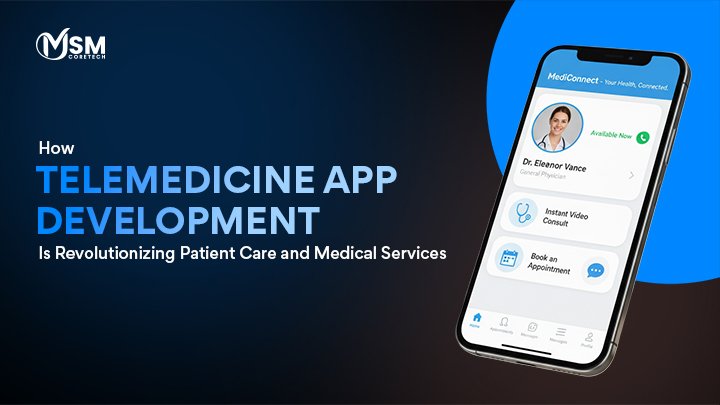
Telemedicine software development creates an app for patient check-ups and remote doctor consultations. These apps integrate healthcare professionals with patients through video calls, an engaging interface, and secure messages. That assists practitioners in providing care without the hassle of face-to-face interactions; therefore, it simplifies access to medical care. Furthermore, the telemedicine application manages appointment scheduling, e-prescribing, and sending reminders.
This app does not conduct only remote consultations, but they also merge with entire healthcare platforms such as patient forums, insurance claims processing, and providing medical information libraries. In this post, we will understand how telemedicine app development is assisting in patient care and medical services.
What is a Telemedicine App?
A telemedicine app provides patients with access to healthcare professionals via a remote platform for medical consultations, diagnoses, and follow-up appointments. The creation of telemedicine apps provides a platform for safe and effective remote medical services through real-time communication. The telemedicine app development services enable healthcare providers to serve patients in both urban and rural areas, strengthening patient relationships through improved access to care.

Global Market Stats of Telemedicine App Development
- The last recorded value of the global telemedicine market was 160.13 USD billion in 2025. And now it is speculated to rise from 188.93 USD billion in 2026 to around 806.89 USD billion in 2035.
- There are about 58% patients who prefer to undergo virtual consultations due to convenience and less waiting time.
- More than 60% healthcare providers are now offering telehealth services.
Why Are Telemedicine Apps So Popular?
The use of telemedicine apps in the field of healthcare is increasingly becoming popular. Many people are using mobile apps to access healthcare services. The COVID-19 pandemic has also contributed to the use of mobile app development services. People are investigating how to access medical services without leaving their homes.
There are various benefits of using telemedicine apps compared to visiting a doctor in person. Firstly, telemedicine apps are more convenient and cost-effective. People can access medical attention from the comfort of their homes. Secondly, telemedicine apps allow patients to avoid waiting in line for long periods. Waiting in line can be frustrating and time-consuming. Thirdly, telehealth software development apps are more accessible to patients who reside in rural areas. People who reside in rural areas sometimes find it challenging to access healthcare services. However, it is important to note that there are some limitations associated with telemedicine apps.
What Are The Types Of Telemedicine Apps?
It is possible to leverage telemedicine app development solutions and transform the traditional processes of healthcare services with the help of digital advantages available, such as store-and-forward, remote monitoring, and real-time interactive methods. By incorporating these features in your on demand mobile app development, it is possible to develop an interoperable healthcare system. Now, let’s understand these telemedicine apps and the remaining four in detail.
1. Store And Forward
The concept of store-and-forward telemedicine entails the use of medical information, which may be in the form of images or videos. The medical information is captured and sent to the healthcare provider at a later time. During the telemedicine app development services process, the use of the store-and-forward concept allows the user to conveniently send medical data to the healthcare provider for analysis and interpretation.
2. Remote Monitoring
The concept of remote monitoring in telemedicine entails the ability of the healthcare provider to monitor the health of the patient remotely. This is done using various devices that monitor the patient’s health and record the data. The data is sent to the healthcare provider for analysis and interpretation. During the development of the telemedicine app, the concept of remote monitoring is integrated into the app to allow the user to remotely monitor the patient’s health.
3. Real-Time Interactive
The presence of real-time interactive features within a telemedicine application development allows users to interact and communicate with healthcare providers in real time. This allows users to consult healthcare providers through live video conferencing or instant messaging services. This feature allows users to virtually interact with healthcare providers. With the help of such features, users can interact with Healthcare providers in real time, and patients can seek medical advice or undergo a virtual examination.
4. Teleneuropsychology
Teleneuropsychology is described as “the application of audio and visual technology to remotely conduct clinical encounters for purposes of conducting neuropsychological evaluations.” It is one of the fastest-growing and most promising areas in the field of telemedicine. It is a well-accepted form of telemedicine service by patients and practitioners alike, with a 98% patient satisfaction rate among adults.
5. Telenursing
Telenursing is another fastest-growing telemedicine segment that facilitates communication between patients and nurses. This type of telemedicine app development company is gaining popularity among chronic patients, who require continuous assistance in monitoring their health conditions and managing their treatment plans. Telenursing application development services are also enabling healthcare organizations to lower the cost of nursing and increase value.
6. Telepharmacy
During the COVID-19 pandemic, software development services such as Telepharmacy applications have helped in reducing the potential risks of infectious diseases. Patients and practitioners have widely accepted it, increasing its popularity in terms of pharmacological recommendations. These applications are advantageous in regulating patients’ medication through video conferencing and phone calls.
7. Telerehabilitation
Another kind of telemedicine practice is telerehabilitation. It uses the latest technological advances to talk to the patient and carry out clinical assessments and therapy. Webcams and videoconferences are the main tools used to communicate the patient’s symptoms and clinical progress. The development of a telerehabilitation app involves developing features and functionalities that include evaluation, assessment, monitoring, prevention, intervention, supervision, education, consultation, and coaching.
3 Common Healthcare IT Integrations Crucial For Telemedicine App
Integration is nothing but connecting two or more healthcare IT systems in a way that these two, together, perform optimally and achieve the purpose for which they are designed. One of the common reasons for the need for IT integrations in a telemedicine app development company is the exchange of crucial data, efficiency, and reduction in healthcare time and costs. Now, let’s look closer at the most common integrations in the healthcare IT industry.
EHR And EMR Integration
The integration of a telemedicine app with EMR and EHR is a crucial aspect to consider. It has the potential to improve the quality of healthcare services and increase the efficiency of healthcare providers. It allows bidirectional workflow between two systems. Therefore, physicians can use a single system to maintain workflow records instead of duplicating them in two or more systems. This enablesproviders of telehealth software development to make quick and accurate diagnoses, reduce errors in prescriptions, and make science-based decisions.
IoT And Wearable Device Integration
Since the app is supposed to provide on-demand healthcare services, the integration of IoT and wearable devices with it will allow the flow of health-related data. It will empower the patient to take an active role in the management of their health. The app will allow healthcare providers to monitor patients’ health remotely.
Hospital Management System Integration
The next and third integration that your telemedicine application development needs is the hospital management system. If you are planning to invest in telehealth software development services to enhance your hospital and healthcare services, integrating a hospital management system with your telehealth app will allow you to access all the hospital’s real-time operational management data through a handheld device.
Benefits of Telemedicine App Development
The telemedicine app development services provide healthcare practitioners with an opportunity to provide treatment services to patients at places other than traditional facilities. This technology provides healthcare practitioners with an opportunity to implement advanced features, including AI medical coding, thus creating an intelligent digital healthcare system.
Increased Accessibility
The telemedicine applications provide patients in remote areas with an opportunity to seek medical attention from medical specialists without moving from their places.
Improved Patient Engagement
The integration of online booking, communication, reminder, and record features enables patients to comprehend and participate in their medical conditions.
Cost Savings
The telemedicine software development provides patients with an opportunity to save on costs, while healthcare practitioners can save on costs due to automation, thus improving operations and reducing practice costs.
Enhanced Efficiency
The healthcare team can efficiently reduce the complexities of their daily activities through the various features of the system, which offer built-in tools for scheduling, billing, and documentation.
Better Health Outcomes
The use of telemedicine in conjunction with ongoing patient monitoring helps medical professionals identify problems at an early stage. These telemedicine app development services help in the effective treatment of patients.
Telemedicine Momentum Update
India’s RMLIMS Lucknow launched a telemedicine pilot service in which patients can upload reports and consult with doctors through video calls. This indicates a rapid uptake of telemedicine services in the country.
What are the Trending Technologies Influencing the Growth of Telemedicine Apps
The world of healthcare, with the help of a telemedicine app development company, is no longer a geographical or logistical challenge. The modernization in technologies, involving development methods, hosting, and customer-oriented innovation, has made it possible to transform virtual care into a comprehensive solution. Let’s understand here some of the best technologies influencing the growth of telemedicine apps.
Artificial Intelligence (AI)
AI or artificial intelligence allows telemedicine apps to offer the latest features, such as natural language processing for voice recognition and chatbot engagement, image and pattern recognition for diagnostic support, and predictive analytics for tailored patient care. AI algorithms can evaluate huge amounts of patient data to detect patterns, accurately diagnose, and provide treatment guidance.
Cloud Storage
Cloud storage enables secure and adaptable storage of patient data in the telemedicine software development apps. Healthcare providers can safely access and share patients’ records, test results, medical images, and treatment plans anywhere and anytime.
Internet of Things (IoT)
IoT devices such as wearables and remote patient analysis devices can transmit real-time patient data to telemedicine apps. This data involves vital signs, medication adherence, activity levels, and other health-related information. Integrating IoT with telemedicine apps allows healthcare providers to monitor patients remotely, provide timely interventions, and deliver customized care based on frequent data collection.
Blockchain
The use of blockchain technology provides greater security and privacy in telemedicine app development. Unauthorized parties cannot access sensitive information due to the secure sharing and storage of patient health records enabled by this technology. This technology also has the potential to support the secure exchange and transaction of data.
Big Data
The telemedicine application development apps are capable of collecting and generating a large volume of data from patients, for example, medical records, images, and real-time monitoring data. Big data analytics tools analyze this data, generating patterns, trends, and insights from it.
Deep Learning
Deep learning, a type of AI, analyzes images like X-rays, CT scans, and pathology slides. These images can be used to help healthcare providers diagnose diseases, identify abnormal features, and make recommendations on how to treat patients. This technology is useful in telemedicine applications to improve efficiency in image analysis and reduce the need to physically see patients.
Chatbots
Chatbots are used in telemedicine applications to virtually help patients. It can be used to answer patients’ questions about diseases, describe patient symptoms or medication information, and book patient appointments. Chatbots are useful in patient engagement and help healthcare providers manage patient flow by answering frequent patient questions.
How We Build a Telemedicine App
We use a structured and systematic approach to telemedicine application development that is user-friendly, compliant, and scalable while ensuring effective communication between doctors and patients.
Telehealth App Planning & Requirements
Our approach begins by understanding your needs, market requirements, compliance requirements, and whether there is a need to migrate from existing legacy systems.
Project Planning & Scope Definition
Our project planning stage is where we define the project scope along with project timelines, budget, and other important milestones. This telemedicine software development structure is important for maintaining order and ensuring everyone adheres to the project’s initial understanding.
UX/UI Experience Design
Our design team uses professional tools to create user-friendly experiences in the telemedicine app that ensure patients and doctors can use it without facing any challenges.
Telemedicine App Development
Our development team is able to develop a secure system through its various features, such as video consultations, chats, prescriptions, and payment options like PayPal.
QA Testing & Validation
We test the telemedicine application development app rigorously to ensure it meets performance, security, and compliance criteria so that it works flawlessly and securely in a real-world healthcare environment.
Launch, Support & Continuous Enhancement
After launch, we monitor the app’s performance, address problems, and continually update the app to ensure it remains secure, stable, and up-to-date.
Wrapping Up
The telemedicine app is the coming future of virtual healthcare services. As patients and doctors are now more interested in using digital services for all types of healthcare, health tech solutions need to adapt and consider different parts of traditional healthcare services.
And here, MSM Coretech is the most reliable telemedicine app development company to partner with and get your telepath app on handheld devices for your target users. Furthermore, our telemedicine app development cost is very affordable and fits your budget.
FAQs
It can take 3 to 6 months to build a telemedicine software development, depending on the features, complexities, and requirements. However, the more experienced the developer, the sooner the app can be built with better compliance built right in.
The telemedicine app development cost depends on the features, technology stack, backend, and compliance requirements. The cost can range from lower for simple solutions to higher for more complex telemedicine app development, including AI and IoT-based options. The cost can be analyzed after understanding the requirements.
Yes, modern telemedicine software development supports integration with existing EHR/EMR systems, pharmacy systems, payment systems, and insurance systems, allowing for a cohesive system where clinicians do not have to “switch back and forth” between systems.
The telemedicine platform needs to follow HIPAA, GDPR, HL7, and other local regulations regarding the storage of health data. The platform needs to have features. This includes data encryption, MFA, and other measures to ensure data safety. A specialized partner for telemedicine platform development can ensure full compliance with regulations.
Yes. We can tailor telehealth software development solutions to meet the needs of individual doctors, small practices, and large hospital groups. The advantage for smaller practices is the lower costs involved in the operation of the clinic.

Related Posts

10 Key Applications of AI in the Food Industry (2026)
Walk into any restaurant kitchen, grocery warehouse, or food delivery control room today, and you will find something quietly running...
Read More
How To Develop An App Like YouTube Music: A Complete Guide
Music is now a part of our everyday life. People listen to songs while getting ready in the morning, working,...
Read More
Must-Have Features in Fintech Apps & Digital Financial Platforms
Think about how often you use your phone to pay bills, send money, shop online, or check your bank balance....
Read More


 Verified Review




 +44 7427829444
 71-75, Shelton Street, Covent Garden, London, United Kingdom, WC2H 9JQ