

Share this article


10 Key Applications of AI in the Food Industry (2026)
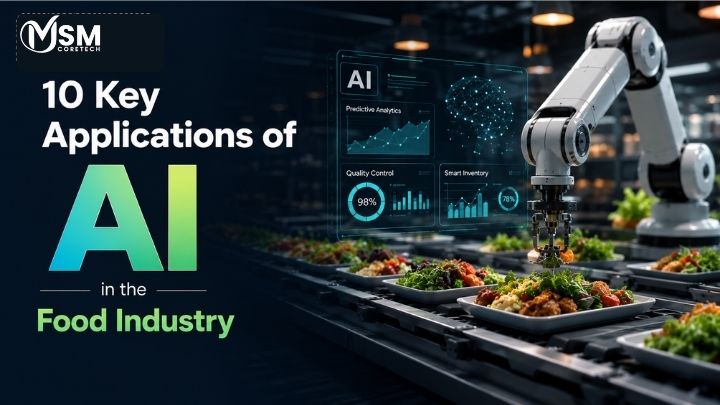
Walk into any restaurant kitchen, grocery warehouse, or food delivery control room today, and you will find something quietly running in the background that was not there five years ago: artificial intelligence. The food industry is going through a rapid digital transformation, driven by customers who now expect personalization, speed, quality, and efficiency all at once, and by businesses that are under constant pressure from rising food waste and fragile, unpredictable supply chains. From predicting how many burgers a restaurant will sell on a rainy Friday to spotting a damaged apple on a fast-moving conveyor belt, AI is moving from an experimental technology to a practical business tool across the entire food ecosystem. It is helping food businesses make faster, more confident, data-driven decisions instead of relying on guesswork and gut feel.
This pressure is showing up clearly in the numbers. The global AI in food and beverages market was valued at roughly $19.38 billion in 2026 and is projected to reach $79.38 billion by 2030, growing at a CAGR of about 42.3%. At the same time, roughly one-third of all food produced for human consumption still ends up wasted every year, according to the Food and Agriculture Organization, much of it traceable to inefficient supply chains, poor inventory planning, and weak cold-storage management. Put together, these numbers explain why so many food businesses are investing in AI right now, not as an experiment, but as a direct response to real, measurable problems.
In this article, we will walk through ten real, practical AI applications in food industry settings, from demand forecasting and quality control to personalization, pricing, waste reduction, customer service, product innovation, and robotics, in plain, simple language, so you can see exactly where the opportunity lies for your own business.
Also Read: Develop a Food Delivery App Like Deliveroo
What Is AI in the Food Industry?
Simply put, AI in the food industry means using smart computer systems to help food businesses make better decisions, work faster, and reduce mistakes. Instead of one single technology, it is really a mix of several tools working together: machine learning that learns patterns from past data, computer vision that can “see” and inspect products, natural language processing that understands customer questions, generative AI that can create content and ideas, predictive analytics that forecasts what is likely to happen next, recommendation engines that suggest the right product to the right person, robotics and automation that handle physical tasks, and IoT sensors that feed real-time data into all of the above.
Together, these technologies support almost every stage of the food journey: production, processing, quality control, supply chain, retail, restaurants, delivery, and finally customer experience. Think of it as a chain of checkpoints, and at every checkpoint, AI in food technology is quietly helping someone make a smarter, faster call, from the farm all the way to the customer’s plate.
Also Read: Cost to Build a Food Delivery App Like Uber Eats
10 Key Applications of AI in the Food Industry
Now let us get into the main part of this article. Below are ten of the most impactful ways Artificial Intelligence in the food industry is being used today. For each one, we will look at what it actually does, how the AI behind it works, why it matters for the business, and a real-world style example of it in action.
1. AI-Powered Demand Forecasting
Every food business, whether it is a five-table cafe or a nationwide grocery chain, faces the same basic question every single day: how much should we make, stock, or order? Get it wrong in one direction, and you run out of stock, disappoint customers, and lose sales. Get it wrong in the other direction, and you are stuck with unsold food that eventually gets thrown away. AI-powered demand forecasting takes the guesswork out of this decision.
Machine learning models are fed years of historical sales data, then trained to look for patterns connected to seasonality, weather conditions, public holidays, local events, ongoing promotions, and shifts in customer behavior. Once trained, the model can predict how much of a particular item is likely to sell on a given day or week. The scope covers straightforward sales forecasting, seasonal trends such as ice cream demand climbing in summer, and event-based forecasting around holidays or major local events. Restaurants use this to predict next-shift order volume, while grocery chains forecast demand across thousands of SKUs at once, something that would be impossible to do accurately by hand.
Business benefits: Reduced overproduction, fewer stockouts, tighter inventory planning, less food waste, and healthier profit margins, since businesses stop tying up cash in food that never gets sold.
Real-world example: A quick-service restaurant chain uses demand forecasting to predict a spike in delivery orders ahead of a big local sports event, so it schedules extra kitchen staff and pre-preps ingredients rather than scrambling once the orders start pouring in.
2. Smart Inventory and Supply Chain Management
Once you know how much demand to expect, the next challenge is making sure the right ingredients and products are actually available at the right place and time. Traditional inventory management tends to be reactive: someone notices stock is running low and places an order, often after it is already too late. AI flips this into a proactive process.
AI-driven inventory systems continuously track stock levels, sales velocity, and supplier lead times, flagging exactly when a product needs to be reordered before a shortage actually happens. Automated inventory tracking cross-checks stock counts against sales data continuously instead of relying on periodic manual audits. These systems can also optimize which supplier to use based on price, reliability, and delivery speed, plan deliveries more efficiently, and flag supply-chain risks early, such as a supplier that has been consistently late. When paired with IoT sensors, AI can monitor cold-chain conditions, keeping an eye on temperature and humidity for perishable goods as they move from farm to warehouse to store.
Key angle: This is really about moving inventory management from reactive firefighting to predictive planning, so businesses are acting ahead of problems instead of cleaning up after them.
Real-world example: A grocery distributor uses AI-based supply-chain monitoring to detect that a shipment of dairy products is running warmer than it should be mid-transit, allowing the team to reroute or reject the shipment before it reaches store shelves.
3. Food Quality Control and Safety
For food manufacturers, this is one of the strongest and most immediately valuable applications of AI. Traditionally, quality checks have relied heavily on human inspectors scanning products as they move down a production line, which is tiring, slow, and prone to human error, especially at high production speeds.
Computer vision paired with machine learning changes this by placing cameras along the production line that can spot defective products, contamination indicators, packaging defects, inconsistent sizes or shapes, unusual coloring, and other quality deviations, all in real time and at a speed no human eye could match. AI can also help monitor broader food-safety processes, such as tracking temperature logs or flagging unusual patterns that might indicate a process is drifting out of spec.
It is important to be clear here: AI does not replace human food-safety experts, quality assurance teams, or regulatory inspection processes. What it does is act as an extra, tireless set of eyes that catches problems earlier and more consistently, so human experts can focus their attention where it is needed most. A camera system does not get tired at the end of a ten-hour shift, and it applies exactly the same standard to the millionth item on the line as it did to the first.
Real-world example: A packaged-snack manufacturer installs a computer-vision system on its packaging line that automatically flags bags with uneven seals or incorrect fill levels, pulling them aside before they ever reach a delivery truck.
4. Personalized Food Recommendations
Anyone who has ordered food through an app has probably noticed that the suggestions on the home screen feel oddly relevant, whether it is a favorite dish resurfacing at exactly the right time or a new restaurant that matches their usual taste. That is AI-powered recommendation engines at work.
These systems analyze a customer’s previous orders, stated preferences, dietary choices, purchase history, browsing behavior, and even the time of day or their current location to recommend meals, products, or restaurants that are genuinely likely to interest that specific person. This shows up across restaurant ordering apps, grocery apps, meal-planning platforms, food delivery platforms, and personalized promotional offers.
Business benefits: Higher customer engagement, a noticeably better customer experience, increased average order value as customers discover more items they actually want, and improved long-term retention.
Real-world example: A meal-kit delivery service uses AI recommendations to suggest recipes based on a subscriber’s past ratings, gently introducing new cuisines the customer is statistically likely to enjoy rather than repeating the same handful of meals.
5. AI-Powered Restaurant Operations
AI in restaurants goes well beyond the chatbot that takes your order. Behind the scenes, AI is increasingly involved in the operational decisions that determine whether a restaurant runs smoothly or falls behind during a rush.
This includes AI-assisted menu planning based on what is actually selling well, smarter staff scheduling that matches predicted footfall so restaurants are neither overstaffed nor understaffed, streamlined order management across dine-in, takeaway, and delivery channels at once, better table management to reduce wait times, and kitchen operations support that helps sequence orders efficiently. AI also feeds into customer demand prediction and day-to-day operational decision-making, and can help managers spot operational inefficiencies they might otherwise miss, such as a particular time slot where orders consistently take longer to prepare than they should.
The bigger picture here is that restaurant management has traditionally relied heavily on a manager’s gut feel and years of on-the-job experience. AI does not replace that experience, but it gives managers something concrete to check their instincts against, backed by actual historical data rather than memory alone.
Real-world example: A mid-sized restaurant chain uses AI-based staff scheduling to automatically adjust weekend shift patterns based on predicted customer demand pulled from historical sales and local event calendars, cutting down on both overtime costs and understaffed rushes.
6. Dynamic Pricing and Promotion Optimization
Pricing in the food industry is rarely one-size-fits-all, and AI helps businesses fine-tune it based on real conditions rather than fixed rules set months in advance. By demand levels, current inventory, customer behavior patterns, time of day, and other business variables, AI can help identify when a discount will actually drive incremental sales, or when a promotion is not needed at all.
This shows up as personalized offers tailored to individual customers, demand-based promotions that kick in during slower periods, inventory-based discounts on items nearing their sell-by date, smarter timing for when promotions go live, and pricing insights for menu items that may be underpriced or overpriced relative to demand.
One important note here: pricing strategies powered by AI should always be implemented transparently, and in line with applicable consumer-protection and competition regulations in the relevant market. AI can inform pricing decisions, but businesses remain responsible for ensuring those decisions are fair and compliant.
Real-world example: A supermarket chain uses AI-driven dynamic discounting to automatically apply a deeper markdown on fresh bakery items a few hours before closing, based on how much stock remains and typical end-of-day footfall.
7. Food Waste Reduction
Food waste deserves to be treated as its own dedicated application, not simply a side benefit of other AI tools, because so much of the food industry’s environmental and financial pressure comes down to this one problem. AI tackles food waste by predicting demand more accurately, estimating expiration risk on perishable stock, flagging overstock before it becomes unsellable, forecasting unsold inventory patterns, and refining production requirements so businesses make closer to what they will actually sell.
When AI is combined with IoT sensors and existing inventory systems, businesses gain much better visibility into exactly where waste is happening and why. This kind of AI-powered waste prediction is being applied across restaurants managing daily prep quantities, supermarkets managing perishable shelves, food manufacturers managing production runs, and warehouses managing bulk storage.
Real-world example: A large catering operation uses AI-based waste prediction to adjust daily food preparation quantities for a corporate cafeteria, cutting down on unused prepared food at the end of each day while still keeping enough variety on the counter.
8. AI-Powered Customer Service and Food Chatbots
Customer service in the food industry has quietly evolved through several stages, and it is worth understanding the difference because it adds real technical depth. A basic rule-based chatbot can only respond to a fixed set of pre-programmed questions and breaks down the moment a customer asks something slightly different. An AI chatbot goes a step further, using machine learning to understand a wider range of phrasing and intent. A generative AI assistant goes further still, capable of holding a natural, flowing conversation, understanding context across multiple messages, and even personalizing its tone.
These AI-powered assistants help customers with menu questions, order assistance, reservations, delivery status updates, product information, frequently asked questions, and thoughtful upselling or cross-selling suggestions. Choosing the right level of AI for the actual volume and complexity of customer questions is often more important than chasing the most advanced option available.
Real-world example: A food delivery platform deploys a generative AI assistant that can handle a customer asking about a delayed order, check the live delivery status, and proactively offer a partial refund or credit, all within the same chat conversation, without needing a human agent to step in.
9. AI in Food Product Development and Recipe Innovation
This is one of the most exciting and genuinely 2026-relevant applications of AI in food technology. Food companies are now using AI to help shape entirely new products by analyzing consumer preference data, exploring ingredient combinations, studying flavor profiles, checking nutrition requirements, tracking market trends, and reviewing how similar past products have actually performed once launched.
Generative AI tools can help product development teams brainstorm faster, suggesting recipe variations, ingredient substitutions, or entirely new product concepts based on patterns picked up from vast amounts of food and consumer data. That said, this is a starting point for human creativity and rigor, not a replacement for it. Food scientists and R&D teams remain fully responsible for validating any AI-suggested idea, testing it for safety, checking nutritional accuracy, and managing the entire path to commercialization.
Real-world example: A snack brand uses a generative AI tool to explore dozens of flavor-pairing combinations based on trending taste preferences, narrowing a long list down to a handful of promising directions that its food scientists then develop, test, and refine into an actual product.
10. AI-Powered Robotics and Automation
The final application on this list brings together AI, computer vision, robotics, and automation to handle the physical, repetitive work that runs throughout the food industry. This includes automated food sorting based on size, ripeness, or quality, precision packaging, picking and placing items in warehouses, kitchen automation for repetitive prep tasks, warehouse operations more broadly, certain food preparation steps, and automated quality inspection running alongside human staff.
What makes this different from older, purely mechanical automation is the AI layer sitting on top. A robotic arm guided by computer vision can identify and adapt to variation, such as slightly different shapes of fruit on a sorting line, in a way that a fixed, pre-programmed machine cannot. The result is AI-powered robotics that improves speed, consistency, workplace safety by taking over physically repetitive or hazardous tasks, and overall operational efficiency.
Real-world example: A large fruit-packing facility uses AI-guided robotic sorting arms that scan each piece of fruit for ripeness and surface quality, automatically directing premium-grade produce to one packing line and lower-grade produce to another, at a speed far beyond manual sorting.
Also Read: Develop a Food Delivery App Like Hungerstation
AI Across the Food Industry Value Chain
To see just how far-reaching this technology has become, it helps to look at AI’s role across every stage of the food value chain in one place:
| Food Industry Area | AI Application |
|---|---|
| Agriculture | Crop and yield prediction |
| Food Manufacturing | Quality control and automation |
| Warehousing | Inventory optimization |
| Supply Chain | Demand and logistics forecasting |
| Restaurants | Operations and personalization |
| Grocery | Recommendations and inventory |
| Food Delivery | Demand and route optimization |
| Consumers | Personalized food experiences |
Key Benefits of AI in the Food Industry
Having walked through the individual applications, it is worth stepping back and looking at the benefits that tie them all together. These are the outcomes food businesses can expect once AI moves from pilot project to everyday operations.
- Reduced food waste: Businesses throw away less unsold or spoiled food, protecting margins while supporting sustainability goals.
- Better demand forecasting: Fewer stockouts and less overproduction, leading to smoother day-to-day operations and happier customers.
- Improved food quality: Fewer defective or inconsistent products reach customers, protecting brand reputation and lowering recall risk.
- Lower operational costs: Smarter planning and automation reduce wasted labor hours and overproduction-related losses.
- Better inventory management: Businesses spend less on emergency reordering and carry less dead stock sitting unsold in storage.
- Personalized customer experiences: Translate into higher order values and stronger customer loyalty over time.
- Faster decision-making: Managers get data-backed insight instantly instead of waiting on manual reports or end-of-week summaries.
- Improved supply-chain visibility: Makes it easier to spot risk before it becomes a real problem, protecting business continuity.
- Increased operational efficiency: Staff spend their time on higher-value work instead of repetitive manual checks and paperwork.
- New product innovation opportunities: Businesses can launch new products with more confidence, backed by real data on what customers actually want.
Also Read: Develop a Food Delivery App like Postmates
Technologies Powering AI in the Food Industry
AI in the food industry is not a single tool; it is a toolkit. Here is a brief look at the individual technologies behind the applications covered above, and where each one actually shows up in day-to-day food business operations.
Machine Learning
Machine learning is the foundation behind demand forecasting, where models learn from years of historical sales data to predict what is likely to sell next.
Deep Learning
A more advanced form of machine learning, deep learning powers the pattern recognition behind computer vision systems used in quality control and inspection.
Computer Vision
Computer vision lets cameras and software ‘see’ products on a line, spotting defects, packaging issues, and quality deviations in real time during quality control.
Generative AI
Generative AI creates new content and ideas, powering conversational customer service assistants and helping product teams brainstorm new recipes and flavor concepts.
Natural Language Processing
NLP allows software to understand human language, which is what makes AI chatbots and voice-based ordering assistants able to understand customer questions in plain English.
Predictive Analytics
Predictive analytics looks at current and historical data to estimate what is likely to happen next, which is central to food waste reduction and expiration-risk prediction.
Internet of Things (IoT)
IoT sensors capture real-time data such as temperature and humidity, which AI then uses for cold-chain monitoring during the transport and storage of perishable goods.
Robotics
Robotics, guided by AI and computer vision, physically carries out tasks like sorting, packaging, and picking in warehouses and food processing facilities.
Cloud Computing
Cloud infrastructure gives food businesses the computing power to run AI models at scale, without needing to maintain expensive hardware in-house.
Big Data Analytics
Big data analytics combines sales, inventory, supply-chain, and customer data from multiple sources, giving AI models a richer, more complete picture to learn from.
Recommendation Systems
Recommendation systems are the engine behind personalized food recommendations, matching customers with products, meals, or restaurants they are likely to enjoy.
Also Read: Key Trends Shaping Food Delivery Apps
Real-World AI Use Cases in the Food Industry
Rather than list company names without context, it is more useful to look at how different types of food businesses are actually applying AI in practice:
- Restaurant: AI predicts peak ordering periods and staffing requirements, helping managers schedule the right number of staff for a busy Friday night versus a quiet Tuesday afternoon.
- Food Manufacturer: Computer vision identifies packaging or product defects on the production line, catching issues before they reach distribution.
- Grocery Business: AI forecasts demand and recommends replenishment, helping stores keep shelves stocked with the right products in the right quantities.
- Food Delivery Platform: AI predicts delivery demand and improves operational planning, from driver allocation to estimated delivery windows.
If your business is considering referencing specific named companies or case studies in your own content, always verify each example against a current, primary, or highly authoritative source before publishing, rather than relying on secondhand claims.
Challenges of Implementing AI in the Food Industry
AI adoption in the food industry is not without its hurdles, and being upfront about these challenges is part of setting realistic expectations.
Data Quality
AI is only as good as the data it learns from. Inaccurate, incomplete, or inconsistent sales, inventory, or operational data will lead to unreliable predictions, so cleaning up data quality is often the first real step in any AI project.
Integration With Existing Systems
Most food businesses already run on legacy POS, ERP, inventory, CRM, and supply-chain systems, and getting a new AI tool to talk to all of them cleanly can require real technical integration work rather than a simple plug-and-play setup.
Implementation Cost
AI development, infrastructure, integration, ongoing maintenance, and employee training can all add up, increasing the initial investment required before a business sees a return.
Data Privacy and Security
Customer and business data used to train and run AI models must be handled responsibly, with appropriate security measures and privacy safeguards in place at every step.
Workforce Adoption
Employees need appropriate training and clear workflows to actually use new AI tools effectively; even the best system delivers little value if staff do not trust it or know how to act on its output.
Model Accuracy
AI predictions are not always perfect, especially early on or during unusual conditions the model has not seen before, so outputs should be monitored and adjusted rather than followed blindly.
Regulatory and Compliance Considerations
Food businesses must continue meeting applicable food safety, data privacy, consumer-protection, and other regulatory requirements regardless of how much of the process AI is involved in.
Also Read: How to Launch a Food Delivery App
How to Implement AI in a Food Business
For food businesses wondering where to actually begin, here is a practical, step-by-step path from idea to working AI system.
Step 1: Identify the Business Problem
Start with a measurable problem, not the technology. Is it food waste, unpredictable staffing, slow customer support, or inconsistent quality? A clear problem statement keeps the whole project focused.
Step 2: Collect and Prepare Data
Gather relevant sales, inventory, customer, operational, or production data, and clean it up so it is accurate and consistent enough for an AI model to actually learn from.
Step 3: Select the Right AI Use Case
Prioritize applications with clear ROI potential rather than trying to tackle everything at once; an early win builds the case for further investment.
Step 4: Choose the AI Technology
Select machine learning, computer vision, generative AI, predictive analytics, or another approach based on the specific use case you are solving for.
Step 5: Integrate With Existing Systems
Connect the AI solution with POS, ERP, CRM, inventory, delivery, or other platforms your business already relies on, so it fits into existing workflows rather than sitting apart from them.
Step 6: Build a Pilot
Start small and validate the business impact with a limited rollout, whether that is one restaurant location, one product line, or one warehouse, before expanding further.
Step 7: Monitor Performance
Track accuracy, cost savings, customer engagement, waste reduction, or other relevant KPIs to confirm the AI solution is actually delivering the value it promised.
Step 8: Scale the Solution
Once a pilot proves its value, expand the successful AI use case across more locations, product lines, or operations.
Also Read: Develop a Food Delivery App
How Much Does It Cost to Implement AI in the Food Industry?
There is no single, universal price tag for adding AI to a food business, and any number quoted without context should be treated with caution. Cost is genuinely project-dependent, shaped by a combination of factors:
- The specific AI use case being built (a chatbot is a very different project from a computer-vision quality-control system)
- Model complexity and how much custom training the AI needs
- Data requirements, including how much cleanup or preparation existing data needs
- Whether the business builds custom AI or uses third-party AI tools and APIs
- Computer vision requirements, including camera hardware where relevant
- IoT and robotics integration, where physical hardware is involved
- The state of existing software infrastructure and how much integration work is needed
- Number of users or locations the solution needs to support
- Cloud infrastructure and ongoing hosting costs
- Maintenance and support required after the initial launch
Recommended approach: Treat AI implementation cost as project-dependent, and get a scoped estimate based on your specific use case and existing systems, rather than assuming a fixed, universal price applies to every AI project.
Future of AI in the Food Industry
Looking ahead, the direction of AI in food industry is firmly toward practical business adoption rather than speculative, far-off science fiction. Some of the trends worth watching in 2026 and beyond include:
- Generative AI for food businesses: Expanding beyond chatbots into marketing content, menu design, and product concepting.
- AI-powered restaurant assistants: Handling a growing share of reservations, order-taking, and customer support conversations.
- Autonomous kitchen technologies: Taking on more repetitive food-prep tasks alongside human kitchen staff.
- Predictive food safety: Shifting quality monitoring from reactive inspection to early-warning prediction.
- AI plus IoT: Deepening real-time visibility across cold chains, warehouses, and production lines.
- Computer-vision-based quality control: Becoming standard rather than optional across food manufacturing.
- Hyper-personalized food recommendations: Getting sharper as recommendation engines learn from richer customer data.
- AI-driven supply chains: Becoming more resilient and adaptive to sudden disruptions.
- Sustainable food production: Benefiting from AI-driven waste reduction and more efficient resource use.
- AI-assisted food product innovation: Helping brands bring new products to market faster and with more data-backed confidence.
Also Read: Food Delivery Apps
AI in the Food Industry vs Traditional Methods
A side-by-side comparison makes the shift easy to see at a glance:
| Traditional Approach | AI-Powered Approach |
|---|---|
| Manual forecasting | Predictive demand forecasting |
| Manual inspection | Computer vision inspection |
| Fixed promotions | Data-driven promotions |
| Manual inventory checks | Automated inventory insights |
| Generic recommendations | Personalized recommendations |
| Reactive supply management | Predictive supply management |
How MSM Coretech Can Help You with Smart AI Solutions
Reading about these applications is one thing; actually building and deploying them inside a real food business is another. Most of these use cases depend on custom software: a forecasting model trained on your specific sales data, a computer vision system tuned to your specific product line, a recommendation engine wired into your specific app, or a chatbot connected to your specific order management system. This is where working with an experienced AI development company makes a real difference, since off-the-shelf tools rarely fit a food business’s exact workflow, menu, supply chain, or customer base out of the box.
MSM Coretech works with restaurants, grocery businesses, food manufacturers, and food delivery platforms to design and build exactly this kind of custom AI functionality, from demand forecasting dashboards to computer-vision quality checks to conversational ordering assistants. For businesses specifically looking to modernize their ordering and delivery experience, MSM Coretech also acts as a food delivery app development company, building apps that combine AI-powered recommendations, real-time order tracking, and smart delivery-route planning into one smooth customer experience.
A good technical partner also helps a food business avoid a common mistake: trying to adopt every AI application at once. In practice, it almost always works better to start with the one or two use cases that address the most painful, measurable problem a business is currently facing, and then expand from there once the first project proves its value. MSM Coretech can help identify that starting point, build a working pilot, and integrate it cleanly with the point-of-sale, inventory, or delivery systems a business already uses, turning these applications from an interesting idea into a working part of daily operations.
Also Read: Food Delivery App Development Process
Conclusion
AI is no longer limited to experimentation in the food industry; it is a practical, working part of how modern food businesses forecast demand, manage inventory, inspect quality, personalize experiences, price products, reduce waste, serve customers, innovate on new products, and automate physical work. The ten applications covered in this article show just how wide-reaching this shift really is, touching everything from a single restaurant’s staff schedule to a nationwide grocery chain’s entire supply chain. What ties all of these use cases together is a simple idea: better data, understood well, leads to better decisions, made faster.
The businesses that will benefit most going forward are not the ones chasing AI as a trendy feature to bolt on, but the ones that treat it as a genuine strategic tool, chosen deliberately to solve a real, measurable problem. Whether that means starting small with a single forecasting model or planning a broader rollout across operations, the opportunity in front of food businesses today is significant. The question for 2026 is no longer whether AI belongs in the food industry, but which application a business should start with first, and how quickly it can be turned from a promising idea into a working, measurable part of daily operations.
FAQs
AI is used across the food industry for demand forecasting, inventory management, quality control, personalized recommendations, restaurant operations, pricing, waste reduction, customer service, product development, and robotics.
The top applications include demand forecasting, smart inventory management, food quality control, personalized recommendations, restaurant operations, dynamic pricing, waste reduction, chatbots, product innovation, and robotics.
AI predicts demand, expiration risk, and overstock more accurately, helping businesses produce and order closer to what will actually sell rather than what might sell.
Restaurants can use AI for demand forecasting, staff scheduling, menu planning, order management, personalized recommendations, and AI-powered customer service chatbots.
Yes, computer vision and machine learning can detect defects, contamination indicators, and packaging issues, though AI supports rather than replaces human food-safety experts and regulators.
AI improves supply chains by predicting stock needs, optimizing supplier and delivery choices, flagging risks early, and monitoring cold-chain conditions with IoT sensors.

Related Posts

How To Develop An App Like YouTube Music: A Complete Guide
Music is now a part of our everyday life. People listen to songs while getting ready in the morning, working,...
Read More

Must-Have Features in Fintech Apps & Digital Financial Platforms
Think about how often you use your phone to pay bills, send money, shop online, or check your bank balance....
Read More
15+ Top Video Live Streaming App Ideas for Business in 2026
Live streaming has become an easy way for businesses to connect with people in real time. Whether users are watching...
Read More


 Verified Review




 +44 7427829444
 71-75, Shelton Street, Covent Garden, London, United Kingdom, WC2H 9JQ