

Share this article


Online Store Explained: Features, Pricing & Factors
Consider that a customer can buy your products at any time and from anywhere, without coming to your physical store. This is the main benefit of having an online store. Today, businesses of all sizes are moving online because customers want quick, simple, and convenient shopping. The global eCommerce market is growing very fast and is expected to reach around $3.86 trillion in revenue by 2026. This shows that online selling has become very important for businesses around the world.
Creating an online store is not only about making a website and adding products. The total cost depends on many things, such as store design, features, technology, payment methods, security, and regular maintenance. A simple online store with basic features can be built at a lower cost, while a large eCommerce platform with advanced features like AI recommendations, automation, and different integrations needs more investment.
Many businesses are choosing eCommerce platforms because they help them reach more customers, grow sales, and offer a better shopping experience. An online store allows businesses to sell products anytime, manage inventory easily, and understand customer needs with the help of useful data.
The cost of creating an online store depends on your business needs and goals. Different factors like the type of store, number of products, design requirements, development method, third-party tools, and plans for future growth can affect the total cost.
A well-designed online store can help your business grow and reach more customers. Selecting the right technology and features helps build a store that is secure, easy to use, and ready to meet future market needs.
What Is an Online Store?
An online store is a website or digital platform where businesses sell their products or services on the internet. It works like a physical shop, but customers can access it anytime using their mobile phones, tablets, or computers. Through an online store, users can view products, check prices, read customer reviews, add items to their shopping cart, make safe payments, and get their orders delivered to their homes.
Nowadays, eCommerce websites play an important role in helping businesses grow. They allow companies to sell their products to more customers without being limited to a specific location. A well-designed online store provides a simple and smooth shopping experience, allowing customers to find products easily, compare different options, and complete their purchases quickly.
Many businesses choose to work with an e-commerce development company to create secure, easy-to-use, and scalable online stores that meet their specific business requirements.
Building an online store offers several benefits for businesses:
Global Customer Reach
Unlike physical stores that can only serve people in a limited area, online stores help businesses reach customers from different cities and countries. This allows brands to become more visible, connect with more buyers, and increase their sales beyond local customers.
24/7 Sales Opportunities
An online store is open all the time, allowing customers to shop whenever they want. Businesses can receive orders even after normal working hours, which helps create more chances to earn revenue and grow the business.
Better Customer Experience
A user-friendly eCommerce website makes shopping easy and comfortable for customers. Features like product search filters, personalized product suggestions, different payment options, and order tracking improve the shopping experience and help build customer trust.
Easy Inventory and Order Management
An online store makes it easier for businesses to manage their products, stock, and customer orders. Store owners can check available stock, update product information, handle orders, and track sales from a simple admin dashboard. This helps save time, reduces manual work, and improves daily business operations.
As more people are shopping online, creating an online store has become a good choice for businesses of all sizes. The cost of building an online store depends on different factors, such as design, features, technology, and development needs. A well-planned eCommerce platform can help businesses grow and achieve long-term success.
Also Read: How to Build a Smart eCommerce Store Using AI and IoT
Types of Online Stores and Their Development Costs and Impact
The cost of building an online store depends on the type of store you want to create. A basic online store costs less, while a large online marketplace with advanced features costs more. Before you start, think about your business goals, who your customers are, and your future growth plans. Choosing the right type of online store helps you avoid extra costs and spend money only on the features your business really needs.
Quick Cost Comparison Table
| Type of Online Store | Estimated Cost | Development Time | Best For |
|---|---|---|---|
| Basic Online Store | $5,000 – $15,000 | 4–8 Weeks | Startups, small businesses, and local shops |
| Medium-Level eCommerce Store | $15,000 – $40,000 | 2–4 Months | Growing businesses with more products and customers |
| Advanced eCommerce Marketplace | $40,000 – $150,000+ | 4–9 Months | Large businesses and multi-vendor marketplaces |
Basic Online Store
A basic online store is a good option for startups, small businesses, and local shops that want to sell their products online. It comes with all the basic features needed to start an online business. Customers can easily browse products, add items to their cart, pay securely, and place orders. Store owners can also manage products and customer orders through a simple and easy-to-use admin panel.
A basic online store usually includes product pages with images and prices, product categories, a shopping cart, secure payment options, order management, a contact page, and a mobile-friendly design. These features are enough for businesses that are starting their online journey.
Medium-Level eCommerce Store
A medium-level eCommerce store is a good choice for businesses that already have customers and want to grow their online sales. It includes more useful features that make shopping easier for customers and help business owners manage their stores more efficiently. It is perfect for businesses with more products and a growing number of customers.
Customers can create an account, save their details, write product reviews, use discount coupons, save products to a wishlist, and pay using different payment methods. Business owners can easily manage products, track orders, check sales through a dashboard, and send automatic email updates to customers. Advanced search filters and shipping integrations also help customers find products quickly and receive their orders smoothly.
Many businesses also choose e-commerce App Development so customers can enjoy a smooth shopping experience on both the website and mobile app. This type of online store is a great option for businesses that want to grow steadily and manage their operations more easily.
Advanced eCommerce Marketplace
An advanced eCommerce marketplace is made for large businesses that want to create a website where many sellers can sell their products in one place. These platforms are more complex because they manage thousands of products, many sellers, and a large number of daily customers. They need powerful technology, strong security, and fast performance to run smoothly.
An advanced marketplace comes with many useful features. These include support for multiple sellers, separate dashboards for each seller, AI-based product recommendations, detailed business reports, third-party integrations, automatic order management, inventory syncing, multiple shipping partners, multiple payment gateways, customer loyalty programs, smart product search, real-time notifications, customer reviews, and advanced security. These features make shopping easier for customers and help sellers manage their business more efficiently.
Development Cost Impact
The total cost of building an online store depends on its size, features, and complexity. A basic online store is the most affordable option and is ideal for new businesses. A medium-level eCommerce store costs more because it includes advanced features such as customer accounts, wishlists, discount coupons, and shipping integrations. An advanced eCommerce marketplace has the highest development cost because it supports multiple sellers, AI-powered features, automation, advanced security, and large-scale business operations. Choosing the right type of online store based on your business goals and future growth helps you control development costs while investing only in the features you really need.
Also Read: B2B eCommerce Website Development Guide: Features, Cost, and Best Platforms
Factors That Affect the Cost of Building an Online Store
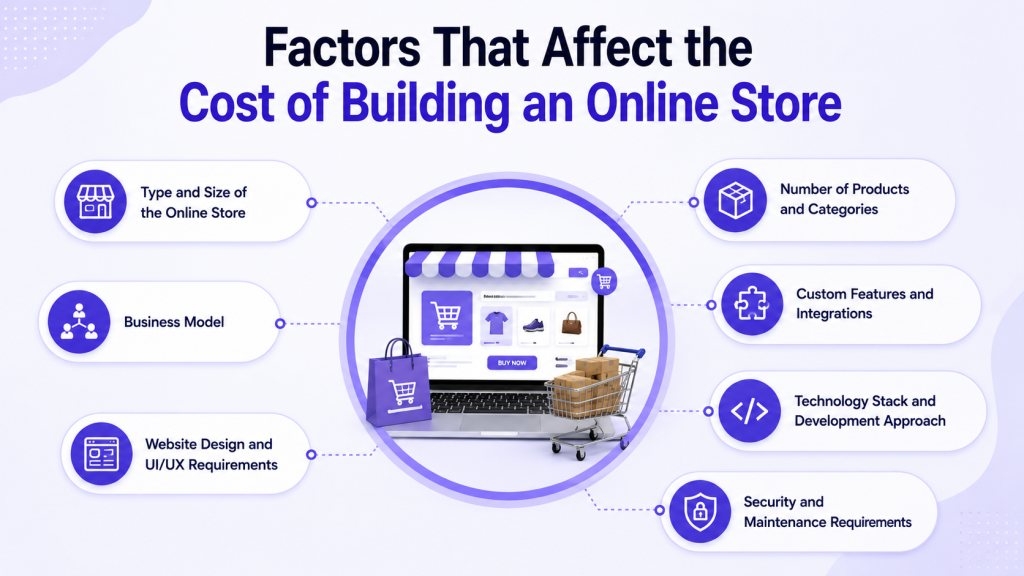
The cost of building an online store is not the same for every business. It depends on many things, like the type of store, features you need, design requirements, technology used, and security needs. A small business website may require a simple design and basic features, which costs less. However, a large eCommerce marketplace needs advanced features, better technology, and more security, which increases the overall cost.
Below are the main factors that affect the cost of developing an online store.
Type and Size of the Online Store
The type and size of an online store play an important role in deciding the development cost. A small store with a few products needs fewer features, less time, and fewer resources to build. However, a large eCommerce platform with thousands of products, different categories, and advanced management features requires more development time, effort, and resources.
| Store Type | Cost Impact | Estimated Cost |
|---|---|---|
| Basic Online Store | Simple design, fewer products, basic shopping features | $10,000 – $15,000 |
| Medium-Level Store | More products, advanced features, better customization | $15,000 – $30,000 |
| Large eCommerce Marketplace | Multiple sellers, complex features, high scalability | $30,000 – $75,000+ |
Business Model (B2C, B2B, Marketplace, Subscription-Based)
Your business model decides which features your online store should have. A B2C store that sells products directly to customers needs simple features like product search, ordering, and payments. A B2B platform needs features like bulk orders, quotation requests, and business account management. A marketplace needs extra features like seller panels, commission tracking, and tools to manage vendors.
| Business Model | Cost Impact | Estimated Cost |
|---|---|---|
| B2C Store | Basic customer shopping and payment features | $15,000 – $50,000 |
| B2B Store | Requires bulk orders, pricing rules, and business accounts | $40,000 – $100,000 |
| Multi-Vendor Marketplace | Needs seller dashboards and advanced management | $80,000 – $200,000+ |
| Subscription Store | Includes recurring payments and membership features | $30,000 – $100,000 |
Website Design and UI/UX Requirements
A simple and easy-to-use website design helps customers find products quickly and complete their purchases without any difficulty. A ready-made template design can reduce the cost, while a custom UI/UX design needs more time and a higher budget. It is also important to create a responsive website that works well on mobile phones because many customers prefer shopping through their smartphones.
| Design Type | Cost Impact | Estimated Cost |
|---|---|---|
| Ready-Made Template Design | Faster development with limited customization | $500 – $5,000 |
| Customized Design | Unique layouts and brand-focused experience | $5,000 – $20,000 |
| Advanced UI/UX Design | Personalized experience, animations, and user research | $20,000+ |
Number of Products and Categories
The number of products and categories in your store can affect the app development process, database setup, and store management. A small store with fewer products is simple to build and manage. However, a store with many products needs advanced features like search options, filters, inventory management, and better product handling tools to keep everything organized.
| Product Volume | Cost Impact | Estimated Cost |
|---|---|---|
| Small Catalog (Up to 100 products) | Basic product listing and management | $15,000 – $30,000 |
| Medium Catalog (100–1,000 products) | Requires better filters and inventory tools | $30,000 – $70,000 |
| Large Catalog (1,000+ products) | Needs advanced database and automation | $70,000+ |
Custom Features and Integrations
Every business has its own needs and goals. Adding special features like AI-based product suggestions, chatbots, loyalty programs, CRM integration, and advanced reports can increase the overall development cost. Businesses that want to build their store faster can use platforms like Shopify. With shopify e-commerce development, businesses can create a customized online store with useful features according to their requirements.
| Custom Feature | Cost Impact | Estimated Cost |
|---|---|---|
| Payment Gateway Integration | Secure online payment setup | $1,000 – $5,000 |
| Third-Party API Integration | Connects shipping, CRM, ERP, and other tools | $5,000 – $20,000 |
| AI and Advanced Features | Smart recommendations and automation | $10,000 – $50,000+ |
Technology Stack and Development Approach
The technology you choose for building an online store plays an important role in its speed, growth, and overall cost. Ready-made eCommerce platforms are a more affordable option and help you launch your store quickly. On the other hand, custom development gives you full control over your store’s features and design, but it needs more time and a higher budget.
| Development Approach | Cost Impact | Estimated Cost |
|---|---|---|
| eCommerce Platforms (Shopify, WooCommerce) | Faster setup and lower development cost | $5,000 – $50,000 |
| Custom Development | Fully personalized features and design | $50,000+ |
| Enterprise Solutions | High performance and advanced security | $75,000+ |
Also Read: A Complete Guide to Merchant Payment Solution Development
Security and Maintenance Requirements
Security is very important for every online store because it stores customer details and processes online payments. Things like SSL certificates, data encryption, regular software updates, data backups, and security checks help protect the website from online threats. These features also increase the development cost. Regular maintenance is also needed to keep the store safe, fix problems, and make sure everything works properly.
| Security and Maintenance Service | Cost Impact | Estimated Cost |
|---|---|---|
| Basic Security Setup | SSL, basic protection, backups | $500 – $5,000 |
| Regular Maintenance | Updates, bug fixing, performance checks | $3,000 – $15,000/year |
| Advanced Security Management | Monitoring, audits, and enterprise protection | $15,000+/year |
Understanding these cost factors helps businesses plan their budget properly and choose the right approach for building a successful online store. A well-planned eCommerce platform can provide a better customer experience, improve sales, and support long-term business growth.

Cost Breakdown of Building an Online Store
The cost of building an online store depends on many factors. These include the platform you choose, the website design, the features you need, third-party integrations, and future maintenance. Some businesses only need a simple online store, while others need advanced features like AI product recommendations, multiple payment options, and automatic inventory management. Knowing these costs in advance helps you plan your budget better and avoid unexpected expenses.
Below is a simple breakdown of the main costs involved in building an online store.
Domain Name and Hosting Cost
A domain name is your website’s address on the internet, like yourstore.com. It is one of the first things you need to start an online store. You have to pay for your domain name every year. The cost depends on the domain extension, such as .com, .net, or .store, and whether the name is available.
Hosting is the service that keeps your website online so customers can visit it anytime. It stores all your website files and data. There are different types of hosting, such as shared hosting, VPS hosting, cloud hosting, and dedicated hosting. Shared hosting is a low-cost option and is good for small online stores. Cloud hosting and dedicated hosting provide better speed, stronger security, and improved performance for large stores with more visitors.
Choosing a good hosting service is very important. It helps your website load faster, stay online without problems, and gives customers a better shopping experience. A fast website can also help increase sales and improve your ranking in search engine results.
Website Design and UI/UX Cost
The design of your online store is the first thing customers notice. A clean, modern, and attractive website helps people trust your business and makes shopping simple.
A custom website design costs more than using a ready-made template. This is because designers create a unique layout, colors, banners, and pages that match your brand and make your store look different from others. If you want a fully customized shopping experience, the design cost will be higher.
A responsive design is also very important. Many customers shop on their phones and tablets. A responsive website automatically fits different screen sizes, so people can easily browse products and buy from any device.
Good UI (User Interface) and UX (User Experience) make your website easy to use. Simple menus, clear product pages, an easy search option, and a fast checkout process help customers find products quickly and complete their purchases without any confusion. This also helps reduce cart abandonment and improve customer satisfaction.
eCommerce Development Cost
Development is usually the biggest cost when building an online store. It includes creating the website that customers use and the system that helps you manage your business.
Frontend development is the part customers see and use. It includes the homepage, product pages, shopping cart, checkout page, and user account section. Developers make sure the website looks good and works smoothly on mobile phones, tablets, and computers.
Backend development works behind the scenes. It manages customer accounts, products, orders, payments, and other important business functions. A strong backend helps your store run smoothly, even when many people visit at the same time.
Database setup stores all your important business data, such as product details, customer information, order history, inventory, and payment records. A well-designed database keeps your website fast and your data organized.
Admin panel development gives you full control of your online store. Using the admin dashboard, you can easily add or update products, change prices, manage stock, process orders, track sales, and check customer activity without needing technical skills.
The total app development cost also depends on the features you need, the technology used, your custom requirements, and the experience of the development team.
Payment Gateway Integration Cost
Every online store needs a safe payment system so customers can pay easily using credit cards, debit cards, digital wallets, or online banking.
A payment gateway connects your online store with payment providers and securely processes customer payments. The cost depends on the payment gateway you choose, the payment methods you want to offer, and any setup or transaction fees.
Keeping payment information safe is very important. Your website should use SSL certificates, data encryption, and secure payment standards to protect customer details. A secure payment system helps customers trust your store and reduces the risk of fraud and data theft.
If you want to accept payments from customers in different countries, you may also need support for multiple currencies and international payment methods. These features can increase development costs, but they also help you reach more customers around the world.
Third-Party Integration Costs
Modern online stores often connect with other business tools to make daily work easier and faster.
Shipping API integration lets customers see shipping costs, estimated delivery dates, and track their orders in real time. It also helps store owners manage shipping companies more easily.
CRM and ERP integration makes it easier to manage customers and business operations. A CRM stores customer details and helps build better relationships, while an ERP manages inventory, orders, accounting, purchasing, and other business tasks in one place.
Marketing tool integration helps businesses send email campaigns, run social media promotions, send customer notifications, and track marketing performance. These tools help attract new customers and encourage existing customers to buy again.
Inventory management integration automatically updates stock levels whenever products are sold or new stock is added. This saves time, reduces manual work, prevents overselling, and keeps product availability accurate.
Although these integrations increase the initial development cost, they save time, reduce mistakes, improve business operations, and help your online store grow more efficiently.
Maintenance and Support Cost
Launching your online store is just the first step. To keep it running smoothly, you need regular maintenance and support.
Bug fixing helps solve technical problems quickly before they affect your customers or reduce your sales. Even a small checkout issue can make customers leave without buying.
Security updates keep your website safe from hackers, viruses, and new online threats. Regularly updating your website, plugins, and server helps protect your customers’ personal and payment information.
Feature updates help your store stay up to date with changing customer needs. You can add new payment options, loyalty programs, AI-based product recommendations, better search filters, and other useful features to improve the shopping experience.
Regular maintenance also includes website backups, speed improvements, performance checks, and technical support. These services help your website work faster, stay secure, and avoid unexpected problems.
By investing in regular maintenance and support, you can provide a better shopping experience, keep your customers happy, and help your online store grow successfully over time.
Also Read: Cost to Build a Car Rental App like Hertz
Technology Options for Building an Online Store
Choosing the right technology is an important step when building an online store. The platform you choose affects your website’s cost, speed, features, and how easily it can grow in the future. Every business has different needs, so it is a good idea to compare different technology options before making the final choice.
Shopify
Shopify is one of the easiest platforms to create an online store. It is a fully hosted platform, so you do not need to manage the server or handle any technical setup. It provides ready-to-use themes, secure payment options, and many useful apps that let you add new features quickly and easily.
Shopify is a great option for startups and small businesses that want to launch their online store quickly. It works on a monthly subscription plan, so the starting cost is lower than building a custom website. However, if you use premium themes, paid apps, or advanced features, the total cost can increase over time.
WooCommerce
WooCommerce is a popular tool that helps you create an online store on a WordPress website. It is easy to use, simple to customize, and a good choice if you already have a WordPress site. You can use many themes and plugins to design your store the way you want.
WooCommerce is free to use, but you still need to pay for web hosting, a domain name, premium plugins, and website maintenance. It is a great option for small and medium-sized businesses that want an affordable online store with flexible customization options.
Magento
Magento is a powerful eCommerce platform made for businesses that need advanced features and strong performance. It is a good choice for businesses with a large number of products, multiple online stores, and high website traffic. Many large businesses choose magento e-commerce development because it gives them the flexibility to build a fully customized online store based on their needs.
However, Magento is more complex than Shopify or WooCommerce. It usually needs experienced developers to build and manage the store, and the overall development cost is also higher.
Custom eCommerce Development
Custom eCommerce development is a good choice for businesses that want an online store made just for their needs. Every part of the store, including the design, features, and shopping experience, is built to match your business goals.
A custom online store gives you full control over how your website works. It also offers better security and makes it easier to add new features as your business grows. You can easily connect your store with tools like CRM software, ERP systems, payment gateways, and inventory management software.
Although a custom eCommerce store costs more than a ready-made solution, it gives you more flexibility, better performance, and can grow with your business. This makes it a smart long-term investment for businesses planning future growth.
Also Read: Top 15 Best Cash Advance Apps for Instant Money
Essential Features That Affect the Cost of an Online Store
The features you add to your online store have a big impact on the total cost. A store with only basic features costs less to build. If you want advanced features and automatic tools, the cost will be higher because they take more time and work to develop. Choosing only the features your business really needs helps you save money and gives your customers a better shopping experience.
Customer Panel
The customer panel is the part of the online store that customers use for shopping. It should be simple, fast, and easy for everyone to use. Customers should be able to sign up, log in, search for products, browse categories, and use filters to find what they need quickly. They should also be able to view product details, add items to the cart or wishlist, complete secure payments, and track their orders. Other useful features include viewing past orders, saving delivery addresses, and writing product reviews. An easy-to-use customer panel makes shopping smooth, keeps customers happy, and encourages them to buy again.
Admin Panel
The admin panel is where the store owner manages the entire online store. It helps manage products, categories, stock, orders, customers, payments, discounts, coupons, and sales reports from one place. Store owners can easily add new products, update prices, check stock, and view business performance. A simple and well-organized admin panel saves time, reduces manual work, and makes it easier to run the online store every day.
Advanced Features
Advanced features make an online store more powerful and improve the shopping experience, but they also increase the development cost. These features can include AI product recommendations, personalized shopping suggestions, live chat, chatbots, voice search, image search, loyalty and rewards programs, subscription plans, multi-vendor marketplace support, and multiple language and currency options for customers from different countries. Other helpful features are automatic email notifications, abandoned cart recovery, social media login, strong security, and detailed business reports.
You do not need to add all these features at the start. Many businesses begin with the most important features and add advanced ones later as their store grows. This helps keep the initial development cost lower while making it easy to upgrade the online store in the future.
Also Read: How To Build an Online Store for Shoe Selling and Make Money
Why Choose MSM CoreTech for eCommerce Development?
Building an online store is a big decision, so choosing the right development company is very important. At MSM CoreTech, we build secure, fast, and easy-to-use eCommerce websites based on your business needs. Whether you have a startup, a small business, or a large company, we create online stores that are simple to manage and can grow as your business grows.
Our team builds websites that give customers a smooth shopping experience on both computers and mobile phones. We use the latest technologies to create fast-loading websites with secure payment methods, easy product management, and simple navigation. We also build SEO-friendly websites so more people can find your business on search engines and help you get more customers.
Every business is different, so we create a custom eCommerce store based on your needs instead of using the same solution for everyone. We help you through every step, including planning, designing, development, testing, launch, and ongoing support. We also add important features like inventory management, order tracking, customer accounts, and third-party integrations to make your online store work better.
At MSM CoreTech, we focus on providing high-quality work on time and within your budget. We keep you updated throughout the project and maintain clear communication at every stage. Even after your store is launched, our team is always ready to provide technical support whenever you need it. Our goal is to build an online store that brings more customers, increases your sales, and helps your business grow for many years.
Conclusion
The cost of building an online store depends on many things. It mainly depends on the type of store you want, how many products you will sell, the website design, the features you need, the payment options, third-party tools, and the technology used. A simple online store costs less, while a large online marketplace with advanced features costs more. If you plan your budget carefully and start with only the features you really need, you can save money and avoid extra costs in the future.
Choosing the right technology and features is also very important. A good platform helps your website run fast, stay secure, and work smoothly on all devices. Features like secure payment options, easy navigation, a mobile-friendly design, product search, and order tracking make shopping easier for customers. They also help you manage your online store more easily and grow your business with confidence.
A well-designed eCommerce store helps your business grow. It brings more customers, increases sales, and builds trust in your brand. It also makes it easy to manage your products, orders, and customer details from one place. As your business grows, you can add new features to your website without creating it again from the beginning.
In the end, building a strong online store is a smart investment for any business. With good planning, the right technology, and a focus on your customers, you can create an online store that grows with your business and supports your success for many years.
FAQs
The cost of building an online store depends on its size, features, design, and technology. A basic online store may cost between $5,000 and $15,000, while a custom or advanced eCommerce platform can cost $50,000 or more.
Several factors influence the total cost, including website design, custom features, payment gateway integration, number of products, third-party tools, technology stack, and ongoing maintenance.
A simple online store usually takes 4 to 8 weeks to build. A medium-sized store may require 2 to 4 months, while a large custom marketplace can take 6 months or more.
The best platform depends on your business needs. Shopify is great for quick setup, WooCommerce works well with WordPress, Magento is suitable for large businesses, and custom development offers complete flexibility.
Yes. A well-developed online store can be upgraded over time. You can add features like AI product recommendations, loyalty programs, multiple payment options, advanced analytics, and mobile apps as your business grows.

Related Posts
E-Commerce vs Retail Business: Features, Benefits, and Trends
If you have thought about starting a business, or you already run one, you have probably asked yourself a simple...
Read More
How to Build a Smart eCommerce Store Using AI and IoT?
Online shopping is getting smarter every year. Today, people expect online stores to know what they want, suggest the right...
Read More
How to Build an eCommerce Store for Selling Auto Parts Online?
Buying auto parts has become much easier than before. Today, customers do not want to spend hours visiting different shops...
Read More


 Verified Review




 +44 7427829444
 71-75, Shelton Street, Covent Garden, London, United Kingdom, WC2H 9JQ