

Share this article


How to Build A Veterinary Medicine Online Shopping App?
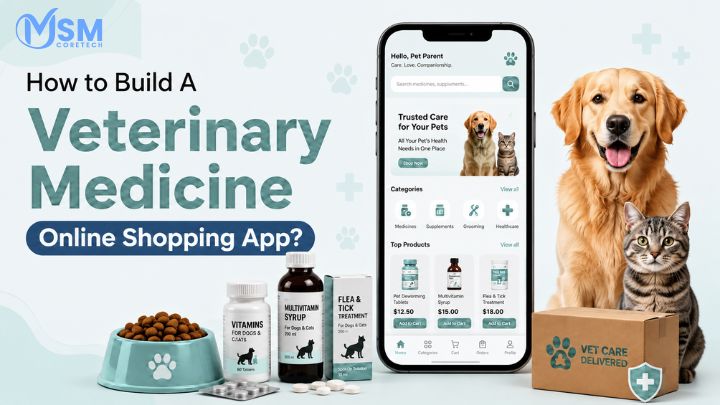
Pet owners today don’t want to drive across town every time their dog needs a flea tablet, or their cat runs low on prescription food. They want to open an app, tap a few buttons, and have the medicine show up at their door. That simple shift in behavior is exactly why veterinary medicine app development has become one of the busiest corners of the pet care industry. The numbers back this up too. The global veterinary medicine market is expected to grow from around USD 52.91 billion in 2025 to USD 98.51 billion by 2033, and online stores are projected to be the fastest-growing sales channel in that period. If you run a pharmacy, a veterinary clinic, or you’re simply an entrepreneur who has spotted this gap, this is a great time to build a veterinary medicine delivery app.
In this guide, we’ll walk through everything in plain, simple language what this kind of app actually is, how it works behind the scenes, which features you need, what it costs, the legal side of selling animal medicines online, and how to pick the right medicine delivery app development company to build it with you. By the end, you’ll have a clear, practical roadmap instead of a vague idea.
Also Read: Ultimate Guide to Medicine Delivery App Development
What Is a Veterinary Medicine Online Shopping App?
Let’s start simple. A veterinary medicine online shopping app is a mobile or web platform where pet owners, farmers, or animal caretakers can browse, order, and get animal medicines delivered things like flea and tick treatments, dewormers, vaccines, prescription drugs, supplements, and even specialized pet food. Think of it as the pet-health version of an app like PharmEasy or 1mg, but built specifically around the needs of animals rather than humans.
These apps usually connect three groups of people. First, there’s the pet owner or livestock keeper who needs the medicine. Second, there’s the pharmacy, veterinary clinic, or manufacturer that stocks and dispenses the product. And third, there’s the delivery partner who gets the package from the shelf to the doorstep. A well-built app also often includes a licensed veterinarian somewhere in the loop, because a large chunk of animal medications legally require a valid prescription before they can be sold more on that later.
Some of these apps are stand-alone e-commerce stores built by a single pharmacy or clinic. Others are larger marketplaces that bring together multiple sellers, similar to how Amazon brings together multiple vendors under one roof. Either way, the core idea is the same: make it fast, easy, and safe for someone to get the right medicine to the right animal without leaving home.
Why the Pet Care Industry Needs This App Right Now
It’s easy to assume pet medicine is a small, sleepy niche. It isn’t. Pet ownership has exploded over the last few years, and the money people are willing to spend on their animals has grown right along with it. A closer look at the data makes the opportunity very clear.
A market that keeps climbing: The worldwide veterinary medicine market is projected to grow at a CAGR of 8.11% between 2026 and 2033, eventually crossing USD 98.51 billion, according to SNS Insider.
The U.S. pet population keeps growing: An estimated 65 million U.S. households own at least one dog and 40 million own at least one cat, per the American Pet Products Association’s figures reported by Global Market Insights, and that translates directly into recurring demand for flea and tick prevention, dewormers, joint supplements, and chronic-condition medication.
Put all of that together, and you get a picture of a market that is large, growing quickly, and shifting online in real time. For anyone considering veterinary medicine app development, this is not a bet on a future trend; the shift is already happening, and the businesses that move now will be the ones pet owners default to later.
Also Read: Develop a Medicine Delivery App Like 1mg
How Does a Veterinary Medicine Delivery App Work?
Before jumping into features and costs, it helps to understand the journey a single order takes from start to finish. It’s actually not that different from ordering human medicine online, with a few animal-specific steps added in.
- Sign-up and pet profile: The user creates an account and adds a profile for each pet species, breed, age, weight, and any existing health conditions. This profile matters a lot, because dosage and drug safety in animals depend heavily on these details.
- Browsing and search: The user searches or browses categories like flea and tick control, dewormers, vaccines, prescription drugs, supplements, or grooming and hygiene products, often filtered by animal type.
- Prescription upload: For prescription-only medicines, the app asks the user to upload a photo or PDF of a valid prescription from a licensed veterinarian, or to consult a vet directly inside the app.
- Verification: A licensed pharmacist or veterinarian on the backend reviews the prescription and confirms the order is safe and legitimate before it’s approved.
- Payment and checkout: The user pays through the in-app wallet, card, UPI, or other supported payment method, and chooses a delivery slot or express option.
- Order fulfillment: The pharmacy or warehouse packs the order, often with cold-chain packaging for vaccines and temperature-sensitive drugs, and hands it to a delivery partner.
- Delivery and tracking: The customer tracks the order in real time and receives it at their doorstep, with delivery confirmation and, ideally, dosage instructions attached.
- Refill and follow-up: For chronic conditions, the app can remind the owner when a refill is due and let them reorder in a single tap, sometimes automatically through a subscription.
Once you see the flow this way, it becomes much easier to plan the features you actually need instead of guessing at what a “pet pharmacy app” should include.
Also Read: Merchant Payment Solution Development
Types of Veterinary Medicine Shopping Apps
Not every veterinary medicine delivery app is built the same way, and picking the right model early on will shape almost every decision that follows, from your tech stack to your compliance requirements.
Single-Pharmacy or Single-Clinic App
This is the simplest model. A single veterinary pharmacy, hospital, or clinic builds its own branded app to sell directly to its existing customers. It’s the fastest and cheapest option to build because there’s only one inventory source and one set of business rules to manage. This model works well for clinics that already have loyal clients and just want to make reordering more convenient.
Multi-Vendor Marketplace App
This model brings multiple pharmacies, clinics, and even manufacturers onto one platform, similar to how Amazon or Flipkart host many sellers. It requires more complex backend logic for vendor onboarding, commission handling, multi-seller inventory, and dispute resolution, but it can scale much faster because you’re not limited to one seller’s stock.
Vet-Led Telehealth-and-Pharmacy Hybrid
This model combines a video or chat consultation with a licensed veterinarian and an integrated pharmacy checkout. The vet examines the pet’s symptoms, writes the prescription inside the app, and the same app fills and delivers the order. This is increasingly popular because it removes the friction of getting a prescription from an outside clinic first.
Subscription-Based Auto-Refill App
Built around chronic and preventive medications, think monthly flea treatment or long-term arthritis medication, this model focuses on recurring subscriptions rather than one-off purchases. It’s a strong option if your goal is predictable, repeat revenue rather than large one-time orders.
Also Read: Build an Online Store for Shoe Selling
Must-Have Features for Pet Owners (Customer App)
These are the features your end users, the pet owners, will actually touch every day. Skimping here is the fastest way to lose users to a competitor’s app.
- Easy registration and pet profiles: Sign up via phone, email, or social login, plus the ability to create multiple pet profiles under one account with species, breed, weight, and medical history.
- Smart search and categories: Search by medicine name, condition, animal type, or brand, with filters for prescription-only versus over-the-counter products.
- Prescription upload and validation: A simple camera or file-upload option for prescriptions, with a status tracker so users know whether it’s pending, approved, or rejected.
- In-app vet consultation: Chat or video consultation with a licensed veterinarian for users who don’t already have a prescription, so they aren’t forced to leave the app.
- Detailed product pages: Clear dosage information, active ingredients, side effects, species suitability, and manufacturer details for every product.
- Cart, checkout, and multiple payment options: A smooth checkout flow supporting cards, digital wallets, UPI, and cash on delivery where applicable.
- Order tracking: Real-time status updates from order confirmation through packing, shipping, and delivery.
- Refill reminders: Push notifications reminding owners when a recurring medicine is about to run out, based on the dosage schedule.
- Subscription and auto-delivery: The option to set up recurring monthly or quarterly deliveries for ongoing medications without reordering manually each time.
- Reviews and ratings: Verified customer reviews on products and on the pharmacy or vendor fulfilling the order.
- Loyalty and rewards: Points, discounts, or cashback for repeat purchases to encourage long-term retention.
- Customer support: In-app chat support and a clear returns or refund policy, especially important for a category where trust matters this much.
Must-Have Features for the Pharmacy and Admin Panel
The customer-facing app is only half the story. The backend is where inventory, prescriptions, and vendor operations actually get managed, and it needs to be just as carefully designed.
- Inventory management: Real-time stock tracking across products, batch numbers, and expiry dates, with automatic low-stock alerts.
- Prescription review dashboard: A queue where licensed pharmacists or vets can review, approve, or reject uploaded prescriptions with notes.
- Order and vendor management: A central view of every order’s status, plus tools to onboard and manage multiple pharmacy or clinic vendors if you’re running a marketplace.
- Pricing and discount controls: The ability to set prices, run promotions, and manage bulk or wholesale pricing for veterinary clinics and farms.
- Delivery and logistics management: Assignment of orders to delivery partners, route optimization, and cold-chain tracking for temperature-sensitive products like vaccines.
- Reports and analytics: Sales trends, best-selling products, customer behavior, and vendor performance dashboards to guide business decisions.
- Compliance and audit logs: A record of every prescription approval, controlled-substance sale, and regulatory document, since these may be requested during an audit.
- Notification management: Tools to send targeted push notifications, SMS, or email for restocks, refill reminders, and promotions.
Advanced Features to Make Your App Stand Out
Once the core app is solid, these advanced features are what separate a good veterinary medicine app from a genuinely great one. You don’t need all of them on day one, but it’s worth planning your architecture so they can be added later without a rebuild.
AI-Based Product and Dosage Recommendations
Using a pet’s profile species, age, weight, and known conditions AI can suggest suitable products and flag potential drug interactions or dosage mismatches. This is genuinely useful, but it should always be treated as a supporting suggestion and never a replacement for a licensed vet’s sign-off on prescription medicine, since getting animal dosages wrong can be dangerous.
OCR-Based Prescription Scanning
Instead of a human manually reading every uploaded prescription image, optical character recognition can pull out the drug name, dosage, and vet details automatically, speeding up approval while still routing the final decision to a licensed reviewer.
Telemedicine Integration
Built-in video consultations let a pet owner talk to a vet, get a diagnosis, receive a prescription, and order the medicine all without ever leaving the app. This single flow is one of the biggest differentiators in the current market.
Smart Refill Prediction
By tracking dosage frequency and pack size, the app can predict almost exactly when a customer will run out of a medication and prompt a reorder a few days in advance, which both improves pet health outcomes and increases repeat revenue.
IoT and Wearable Integration
For apps targeting more tech-forward pet owners, syncing with pet wearables that track activity, heart rate, or temperature can trigger proactive health alerts and medicine suggestions based on real data rather than guesswork.
Multi-Language and Multi-Currency Support
If you’re planning to operate across regions or countries, building in multi-language and multi-currency support from the start avoids a painful rebuild later.
Tech Stack You’ll Need
The right technology choices depend on your budget, timeline, and how complex your feature list is, but here’s a realistic starting point most veterinary medicine app development teams work from.
| Layer | Common Technology Choices |
|---|---|
| Customer app (iOS & Android) | Flutter or React Native for cross-platform, or native Swift/Kotlin for platform-specific performance |
| Admin & pharmacy web panel | React.js or Angular for the frontend |
| Backend & APIs | Node.js, Python (Django/FastAPI), or Java (Spring Boot) |
| Database | PostgreSQL or MySQL for structured data; MongoDB for flexible catalog data |
| Cloud hosting | AWS, Google Cloud, or Microsoft Azure |
| Payments | Stripe, Razorpay, PayPal, or region-specific gateways |
| Prescription OCR & AI | Google Cloud Vision, AWS Textract, or a custom-trained OCR model |
| Push notifications | Firebase Cloud Messaging or OneSignal |
| Telemedicine/video | Twilio, Agora, or WebRTC-based solutions |
| Logistics & tracking | Google Maps API or a dedicated logistics platform integration |
None of these choices are set in stone; a good medicine delivery app development company will adjust this stack based on your specific scale, region, and budget.
Step-by-Step Development Process
Here’s how a veterinary medicine online shopping app typically gets built from the first conversation to the app store launch.
1. Market Research and Business Model Selection
Before any code is written, you need clarity on your target audience (pet owners, farmers, or both), your geography, and which of the app models discussed earlier single-pharmacy, marketplace, or telehealth hybrid fits your business.
2. Regulatory Mapping
Because you’re selling medicine, this step has to happen early, not at the end. You need to understand exactly which drugs require a prescription in your target region, which require controlled-substance licensing, and what data-privacy rules apply to storing prescriptions and pet health records.
3. Feature Planning and Wireframing
Your team maps out the exact feature list for version one versus later releases, then builds low-fidelity wireframes showing how a user moves through the app screen by screen.
4. UI/UX Design
Wireframes are turned into polished, branded designs. For a healthcare-adjacent app like this, clarity and trust matter more than flashy visuals; dosage details, warnings, and prescription status need to be impossible to miss.
5. Backend and API Development
Developers build the server-side logic: user accounts, inventory systems, order processing, payment integration, and the prescription-review workflow.
6. Frontend/App Development
The customer-facing app and the admin/pharmacy dashboard are built and connected to the backend APIs.
7. Third-Party Integrations
Payment gateways, delivery/logistics APIs, SMS and push notification services, and telemedicine tools are integrated and tested.
8. Quality Assurance and Compliance Testing
The app is tested for bugs, performance under load, and security vulnerabilities, with a specific compliance pass to confirm prescription handling and data storage meet regulatory requirements.
9. Deployment
The app is submitted to the Apple App Store and Google Play, and the web-based admin panel is deployed to production servers.
10. Post-Launch Support and Iteration
After launch, the team monitors performance, fixes issues quickly, and rolls out new features based on real user feedback and usage data.
Regulatory and Compliance Considerations
This is the part many first-time founders underestimate, and it deserves real attention. Veterinary medicines are not the same as pet toys or pet food; many of them fall under prescription drug laws, and some are classified as controlled substances.
- Prescription requirements: In most regions, dewormers, antibiotics, and several parasiticides legally require a veterinarian’s prescription before sale. Your app’s approval workflow needs to enforce this without exception.
- Controlled substances: Certain sedatives and pain medications are classified as controlled substances and may require special licensing to store, sell, and ship, with rules that vary significantly by country and even by state or province.
- Pharmacy licensing: Depending on your jurisdiction, the entity fulfilling orders may need to be a licensed pharmacy, and the app itself may need to register as an online pharmacy platform.
- Data privacy: Prescription documents and pet health records are sensitive data. Your app should follow relevant data-protection regulations such as GDPR in Europe or equivalent regional laws, with encrypted storage and restricted access.
- Cold-chain and shipping rules: Vaccines and some biologics need temperature-controlled storage and transport, which may involve additional logistics licensing or partnerships.
- Advertising restrictions: Many regions restrict how prescription veterinary medicines can be marketed or advertised, so your marketing and app-store listing copy needs a compliance review too.
None of this should scare you away from building the app; it just means compliance needs a seat at the table from day one rather than being bolted on later. Because these rules differ so much by country and even by state, it’s worth having a legal advisor review your specific market before launch, alongside your development partner.
How Much Does It Cost to Build a Veterinary Medicine Online Shopping App?
There’s no single number that fits every project, because cost depends heavily on your feature list, your platforms, and your region. That said, here’s a realistic breakdown to help you budget.
| Development Scope | Estimated Cost Range |
|---|---|
| Basic single-pharmacy app (browse, order, pay, track) | $15,000 – $30,000 |
| Mid-level app (prescription upload, admin panel, notifications) | $30,000 – $60,000 |
| Advanced marketplace app (multi-vendor, telehealth, AI features) | $60,000 – $120,000+ |
| Ongoing maintenance & support (annual) | 15% – 20% of build cost |
A few factors that push these numbers up or down include the number of platforms you target (iOS, Android, web), whether you build native apps or use a cross-platform framework, how much custom design work is involved, how many third-party integrations you need, and which country your development team is based in. Teams in North America and Western Europe generally charge more per hour than teams in South Asia or Eastern Europe, though the total project cost also depends on how many hours the work actually takes.
Monetization Models for a Veterinary Medicine App
Once your app is live, you’ll want more than one way to generate revenue. Here are the models most veterinary medicine delivery apps rely on.
- Direct product sales: The most straightforward model; you earn margin on every medicine or product sold through the app.
- Vendor commissions: If you’re running a marketplace, you charge partner pharmacies or clinics a commission on each sale made through your platform.
- Subscription plans: Recurring auto-refill subscriptions for chronic medications generate predictable monthly revenue and improve customer retention.
- Telemedicine consultation fees: Charging a flat or per-minute fee for in-app veterinary consultations, separate from product sales.
- Delivery and express-shipping fees: Standard delivery can be free or low-cost, while same-day or express delivery becomes a paid add-on.
- Advertising and sponsored placement: Manufacturers and pharmacy partners can pay for featured placement on category and search pages, as long as this is clearly disclosed and doesn’t interfere with prescription requirements.
- Premium membership: A paid tier offering perks like free delivery, priority vet consultations, and extra discounts for frequent buyers.
Challenges You Might Face and How to Handle Them
Verifying Prescriptions Reliably
Manually checking every prescription is slow, but skipping verification is a legal and safety risk. The practical fix is a hybrid approach: OCR to speed up data extraction, paired with a licensed pharmacist or vet who makes the final call.
Building Trust With a Health-Sensitive Product
Pet owners are naturally cautious about medicine for their animals. Clear product information, verified reviews, visible pharmacist credentials, and transparent return policies all go a long way toward earning that trust.
Managing Cold-Chain Logistics
Vaccines and certain biologics need consistent temperature control from warehouse to doorstep. This usually means partnering with a logistics provider that already has cold-chain capability rather than trying to build it from scratch.
Navigating Regional Regulatory Differences
If you plan to operate in more than one country or state, prescription rules, controlled-substance laws, and pharmacy licensing requirements can all differ. Build your compliance logic to be region-aware from the start instead of hardcoding one set of rules.
Standing Out in a Growing Market
As more players enter this space, differentiation matters. Features like integrated telehealth, smart refill predictions, and genuinely helpful customer support are often what separate the apps people stick with from the ones they delete.
Future Trends in Veterinary Medicine Delivery Apps
- AI-driven personalization: Smarter product recommendations and dosage guidance based on a pet’s full health history, not just a single order.
- Wearable-linked health monitoring: Deeper integration with pet wearables to trigger proactive medicine suggestions based on real activity and vital-sign data.
- Growth of telehealth-first models: More apps are expected to lead with a vet consultation and treat the pharmacy as the natural next step, rather than the other way around.
- Expansion into livestock and farm markets: As livestock producers digitize, apps that serve farms alongside household pets stand to capture a much larger share of the veterinary medicine market.
- Stronger regulatory tooling: As online veterinary pharmacies mature, expect more built-in compliance automation, automatic license checks, region-specific prescription rules, and audit-ready reporting.
None of these trends require you to build everything on day one. The smart move is designing your app’s architecture so these capabilities can be added incrementally as your business grows.
Why Choose MSM Coretech to Build Your Veterinary Medicine App?
Getting this kind of app right takes more than writing code; it takes a team that understands healthcare-adjacent compliance, e-commerce logistics, and mobile app performance all at once. MSM Coretech works across mobile app development, web design, and software development, and has built e-commerce, marketplace, and healthcare-related delivery platforms for clients across multiple industries.
As a medicine delivery app development company, MSM Coretech’s team can help you choose the right business model, design a compliant prescription-verification workflow, integrate payment and logistics partners, and launch on both iOS and Android without the guesswork. Whether you’re a single veterinary pharmacy looking for your first app or an entrepreneur planning a multi-vendor marketplace, the team can scope a solution that matches your budget and your timeline, then support the app well after launch as your user base grows.
Conclusion
Building a veterinary medicine online shopping app isn’t just about writing code; it’s about combining e-commerce convenience with the trust and care that pet health deserves. As we’ve seen, the market is genuinely moving in this direction, with online channels projected to grow faster than any other distribution method in the veterinary medicine space (SNS Insider), and pet owners are already shifting their buying habits toward digital-first pharmacies.
Whether you choose a simple single-pharmacy app, a full multi-vendor marketplace, or a telehealth-and-pharmacy hybrid, the fundamentals stay the same: get compliance right from day one, design a checkout experience pet owners can trust, and build features around real recurring needs like refills and preventive care.
If you’re serious about turning this idea into a working product, the fastest path forward is working with a development partner who has already solved these problems before. A capable medicine delivery app development company can help you avoid costly mistakes, launch faster, and build something pet owners will actually keep coming back to, not just download once and forget.
FAQs
A basic app typically takes 3- 4 months, while a full marketplace with telehealth and AI features can take 6- 9 months.
Yes, in most regions, a licensed pharmacist or veterinarian must review and approve prescription-only orders before they’re fulfilled.
Yes, if your architecture is planned well, telemedicine and other advanced features can be added after your initial launch without a full rebuild.
A single-pharmacy app sells one vendor’s inventory, while a marketplace app hosts multiple pharmacies or clinics and usually earns revenue through commissions.
No, many medicines require a valid prescription or special licensing, and rules vary by country and state, so legal review is essential before launch.
Most teams budget 15–20% of the original development cost per year for updates, bug fixes, and server maintenance.

Related Posts

5 Ways Restaurant Technology Is Transforming the Industry
The restaurant industry is changing fast, and technology is now an important part of this change. Restaurants are using technology...
Read More

Top 10 FinTech APIs for Every Startup
If you’re building a startup today, chances are money needs to move somewhere inside your product payments, payouts, identity checks,...
Read More

How to Build a Dating App Like Badoo: Complete Guide
Finding a match is no longer limited to meeting people through friends or social events. Dating apps have made it...
Read More


 Verified Review




 +44 7427829444
 71-75, Shelton Street, Covent Garden, London, United Kingdom, WC2H 9JQ