

Share this article


AI in Dating Apps: Benefits, Use Cases, and Key Challenges
You open a dating app and swipe through 40 profiles in eight minutes. You get one match. They say, “hey.” You say “hey,” Then nothing.
Sound familiar?
This is the reality of online dating for millions of people in 2026. Ghosting, swipe fatigue, and fake profiles have turned what should be an exciting experience into a digital chore. But things are changing fast and artificial intelligence is at the center of that change.
AI in dating apps is no longer just a marketing buzzword. It is the engine behind smarter matches, safer conversations, and more meaningful connections. From Hinge using a Nobel Prize-winning algorithm to Bumble launching an AI coaching hub, the apps people use every day are becoming genuinely intelligent.
In this blog, we break down exactly how AI is transforming online dating, what benefits it brings, where the real challenges lie, and what the future looks like for this $12 billion industry.
The Online Dating Industry in 2026
Online dating is not a niche hobby anymore. The global dating app market was valued at approximately US$12.52 billion in 2026 and is expected to reach $24.85 billion by 2035, growing at a CAGR of 7.91%. Over 380 million people worldwide use dating apps today, and that number keeps climbing.
The United States alone generates $1.45 billion in annual dating app revenue. Tinder leads the pack at $58.3 million in monthly revenue, followed by Bumble at $28.96 million and Hinge at $18.54 million a gap that shows just how much brand recognition matters in this space.
What Users Actually Want
The data paints a clear picture of what people are looking for when they log on:
- More than 52% of Gen Z users say they are using dating apps to find a serious relationship, not casual dates
- 27% of couples who got engaged in 2024 met through a dating app
- 60% of dating app users believe they have encountered at least one AI-written conversation
People want real connections. They are tired of shallow swiping. AI is stepping in to bridge the gap between the two.
Also Read: Dating Apps in the USA
What Is AI in Dating Apps? A Plain-English Explanation
Artificial Intelligence in online dating apps refers to the use of intelligent algorithms, data analysis, and automation to improve how people find and connect with potential partners.
Instead of simply matching people who swiped right on each other, AI-powered systems study behavior, learn preferences over time, and continuously refine suggestions. A dating app development company helps build AI powered apps to increase the chances of a meaningful match.
The Core Technologies Behind AI Dating Apps
| Technology | What It Does in Dating Apps |
|---|---|
| Machine Learning (ML) | Learns from your swipe history and messaging behavior to improve match quality over time |
| Natural Language Processing (NLP) | Analyzes conversation tone, generates icebreakers, detects harmful messages |
| Computer Vision | Verifies profile photos, detects fake images, selects your best selfie |
| Recommendation Systems | Suggests compatible profiles based on interests, activity, and mutual behavior |
| Predictive Analytics | Forecasts compatibility based on patterns across millions of user interactions |
Traditional Apps vs AI-Powered Apps
Here are the key difference between a traditional app vs an AI powered App
Traditional Dating Apps
- Work on simple, rule-based filters (age, location, preferences)
- Show profiles based only on what you select
- Rely heavily on manual swiping
- Limited personalization over time
AI-Powered Dating Apps
- Learn from your behavior, not just your stated preferences
- Track actions like swipes, messages, and time spent on profiles
- Adjust recommendations based on patterns (e.g., interests, photo types)
- Continuously improve match quality as you use the app
Also Read: Technology Behind Popular Dating Applications
How AI Is Transforming the Dating Industry
From Static Filters to Behavioral Matchmaking
Old-school dating apps treated everyone as a checklist. Height: 5’10”. Age: 25-32. Within 10 miles. Check, check, check.
The problem is that attraction and compatibility are far more nuanced than any filter can capture. AI changes this by analyzing hundreds of behavioral signals, like which profiles you linger on, who you message first, how quickly you respond, and what language you use.
Hinge uses the Gale-Shapley stable matching algorithm, the same mathematical framework that won a Nobel Prize, to pair users based on mutual preference patterns rather than just surface-level overlap.
Real-Time Personalization
AI-driven apps do not show everyone the same set of profiles. Your feed is personalized in real time. If you are more active on Sunday evenings, the app may prioritize showing you profiles of users who are also active at that time, increasing the chances of a conversation starting.
Predictive Compatibility Scoring
Some platforms now go beyond swiping to score compatibility before you even interact. By analyzing communication patterns, shared interests, and behavioral data from millions of past matches, these systems can estimate the likelihood that two people will have a meaningful connection.
Tinder’s “Chemistry” feature does exactly this it pairs users based on behavioral signals rather than just physical attraction.
Engagement and Retention
Higher quality matches mean people stick around longer. When users feel like the app actually understands them, they engage more. Hinge’s revenue grew 26% year over year in 2024, and much of that growth is attributed to their investment in AI-driven matching.
Read Also: How to Develop a Dating App for Gamers
Key Use Cases of AI in Dating Apps
This is where things get specific. Here is a breakdown of exactly how AI is being used across modern dating platforms.
AI-Powered Matchmaking
Compatibility Prediction Models
These models analyze patterns across tens of millions of users to predict which pairings are most likely to result in actual dates. They go beyond shared interests to evaluate communication compatibility, lifestyle alignment, and even personality indicators drawn from how someone writes.
Behavioral Data Analysis
Every interaction generates data. Who you swipe right on, how long you look at a profile before deciding, whether you start conversations or wait, what time of day you are most active. AI systems aggregate all of this to build a continuously updating picture of your preferences.
Continuous Learning Algorithms
The more you use the app, the better it gets at finding you matches. These systems update in real time, so if your tastes change, the algorithm adjusts. A user who started looking for something casual but is now open to something serious will find their feed shifting accordingly over time.
Real example: Hinge’s “Most Compatible” feature uses AI to surface one highly compatible match per day rather than flooding you with options. Internal data shows that users are eight times more likely to go on a date with their Most Compatible match than with a regular suggestion.
Read Also: Cost to Develop an App Like Happn
Profile Optimization and Enhancement
AI Photo Selection
Tools like Tinder’s Photo Selector use on-device AI to analyze your camera roll and identify which photos are most likely to attract attention, based on lighting, clarity, facial expression, and composition.
Bio and Caption Generation
Bumble rolled out AI-generated profile prompts and bios in 2025. The system analyzes what high-performing profiles in your demographic write and helps you craft something more compelling. Hinge’s Prompt Feedback feature reviews your existing answers and tells you where you can do better.
Profile Scoring Systems
Some platforms internally score profiles to determine how much visibility they get. AI evaluates photo quality, bio completeness, response rates, and engagement history to decide how prominently your profile is shown.
Read Also: 7 Principles to Create a Dating App That Rocks
AI Chat Assistants and Conversation Starters
One of the most visible and talked-about uses of AI in dating is conversation assistance.
Icebreaker Suggestions
Hinge’s “Convo Starters” feature scans a potential match’s profile and suggests three personalized opening messages based on their photos and prompts. Hinge’s own research found that users are twice as likely to go on a date when a like is accompanied by a message. The feature directly addresses the most common point where connections die: the blank text box.
Smart Reply Systems
AI can now suggest follow-up responses mid-conversation. These suggestions are based on the tone and content of the ongoing exchange and are designed to keep conversations moving naturally.
Tone and Sentiment Analysis
NLP tools can read the emotional tone of messages. Some platforms use this to flag conversations that are becoming aggressive or uncomfortable and to offer users guidance on how to redirect or exit the chat.
Visit: Dating App Development Company
Fraud Detection and User Safety
This is one of the most critical and underappreciated applications of AI in dating.
Fake Profile Detection
AI systems scan newly created profiles against known patterns of fake accounts, looking at photo metadata, writing style, account behavior, and sign-up patterns. Computer vision tools can reverse-image-search profile photos to detect stolen images.
Bot Identification
Bots are a major problem on dating apps. AI can identify bot-like behavior by analyzing response timing, message repetition, and unnatural conversation flows.
Content Moderation Systems
AI reviews messages and images for explicit content, harassment, and policy violations at a scale no human team could match. Tinder’s FaceCheck feature compares live selfies against profile photos using facial recognition to verify identity.
Personalized Recommendations
Dynamic Match Suggestions
Rather than a static stack of profiles, AI creates a dynamic, personalized queue that shifts throughout the day based on who is online, who is most likely to respond, and which profiles best match your evolving preferences.
Interest-Based Filtering
AI can detect shared interests from the way people write their bios and answer prompts, even when those interests are not explicitly tagged. Two people who both mention cooking in casual, conversational ways may be matched even if neither listed “cooking” as a formal interest.
Location and Context Awareness
Apps can factor in not just where you live but where you spend your time. Someone who frequents the same neighborhood coffee shop as a potential match may surface more prominently, even if they live across the city.
Visit: Dating App Development Company In USA
AI Dating Coaches and Virtual Companions
Dating Advice Systems
Bumble launched an AI-powered coaching hub in 2025 specifically to address dating fatigue. The system offers personalized advice based on your recent activity, like why a conversation may have gone quiet or how to improve your approach.
Conversation Practice Bots
Tinder’s “Game Game,” built on OpenAI technology, allows users to practice flirting and conversation in a low-stakes environment before taking it to real matches. Think of it as a safe space to find your voice.
Emotional AI Companions
Some emerging platforms take this further by offering AI companions for users who want connection without the pressure of dating. These tools serve a real emotional need, though they raise important questions about dependency that we cover in the challenges section below.
Also Read: Challenges in Dating App Development
Benefits of AI in Dating Apps
AI enhances the application workflow and makes the processes seamless. Here are the few benefits of AI in dating apps.
| Benefit | What It Means for Users |
|---|---|
| Higher Match Accuracy | Less time swiping through bad matches, more time connecting with compatible people |
| Improved Safety | Faster detection of fake profiles, bots, and abusive behavior |
| Time Efficiency | Automated profile help, icebreakers, and smart recommendations reduce effort |
| Deep Personalization | The app learns your taste and improves over time |
| Better Conversations | AI suggestions help people who struggle to start chats |
| Inclusive Matching | Systems designed to reduce superficial bias and surface compatible people |
Key Challenges of AI in Dating Apps
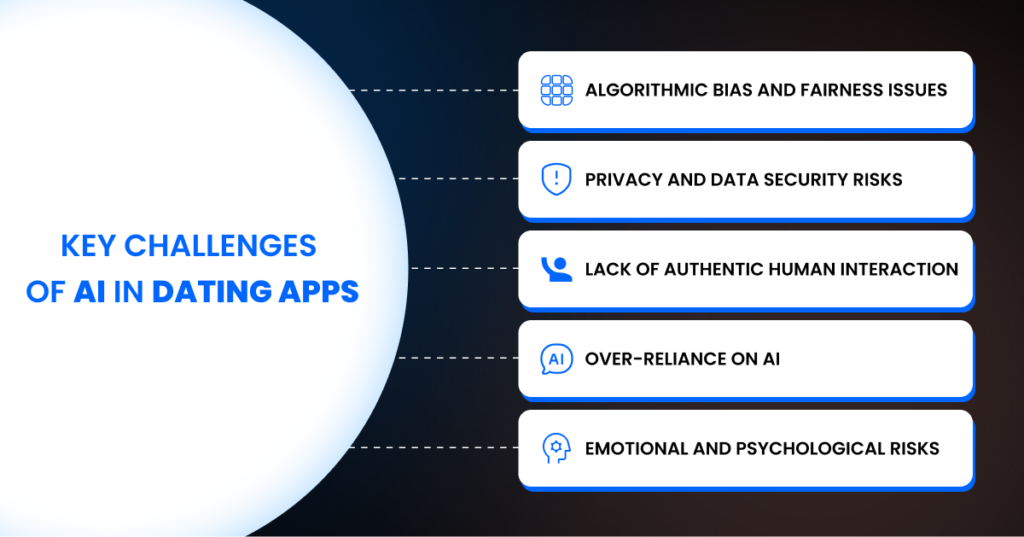
AI is powerful, but it is not perfect. Here are the real challenges the industry is working through.
Algorithmic Bias and Fairness Issues
AI systems learn from historical data. If past user behavior reflects racial, cultural, or physical biases, the algorithm can reinforce those biases. Research has shown unequal reply rates and messaging patterns across demographics on major platforms. When an algorithm optimizes for engagement, it may end up amplifying preferences that disadvantage certain groups.
Privacy and Data Security Risks
Dating apps collect some of the most sensitive personal data imaginable: your location history, relationship preferences, sexual orientation, and detailed behavioral patterns. This data is incredibly valuable and also incredibly risky if mishandled. Users in many jurisdictions have limited visibility into how their data is used or shared.
Lack of Authentic Human Interaction
As AI takes over more of the conversation process, from opening lines to follow-up replies, a real question emerges: who is actually talking to whom? A January 2026 report from Coffee Meets Bagel warned that bot-assisted flirting can create expectation mismatches when people finally meet in person. If your charming opener was written by an algorithm, the first real date can feel like meeting a stranger.
Over-Reliance on AI
When apps do too much of the work, users may gradually lose confidence in their own ability to start conversations or make decisions about people. There is growing concern that AI-assisted dating could erode the social skills it is meant to support.
Emotional and Psychological Risks
Attachment to AI companions is a real phenomenon. Some users, particularly those experiencing loneliness, can develop meaningful emotional bonds with AI chat systems that do not translate to real-world relationships. Setting healthy expectations around what AI can and cannot provide is increasingly important.
Also Read: Technology Is Shaping Modern Dating Applications
Real-World Examples of AI in Dating Apps
How Tinder, Bumble, and Hinge Use AI
| Platform | AI Features in Dating Apps 2025-2026 |
|---|---|
| Tinder | Chemistry matching, Photo Selector, FaceCheck identity verification, Game Game conversation practice |
| Bumble | AI-generated bios and prompts, AI coaching hub, report AI images tool, photo picking |
| Hinge | Most Compatible daily match, Convo Starters, Prompt Feedback, AI Core Discovery Algorithm |
Hinge’s approach stands out for how carefully it integrates AI. Rather than replacing human conversation, it positions AI as a confidence booster. The “Convo Starters” feature suggests ideas users can adapt in their own voice. According to Match Group, this approach contributed to a 15% lift in matches and contact exchanges since the feature launched in March 2025.
Emerging AI-First Platforms
A new wave of dating platforms is being built around AI from the ground up rather than adding it on top. These apps use deep personality assessments, voice analysis, and real-time conversation coaching to match people on dimensions that traditional swiping never could. Happn’s “Perfect Date” AI tool, launched in mid-2025, suggests date ideas based on mutual interests and location, helping users bridge the gap from digital connection to real-world meeting.
Ethical Considerations in AI Dating Apps
Transparency in Algorithms
Users largely have no idea how they are being scored or why they see certain profiles. Platforms should be clearer about how their systems work, even at a high level.
Bias Mitigation
Building fair AI requires deliberate effort. Teams need to test their systems across demographic groups and actively work to identify and correct patterns of unequal treatment.
User Consent and Data Control
People should have meaningful control over their data: what is collected, how long it is kept, and whether it can be used to train AI models. GDPR in Europe sets a benchmark here that other regions are beginning to follow.
Responsible Use of Emotional AI
AI companions and coaches operate in emotionally sensitive territory. Platforms that deploy these tools have a responsibility to be transparent about what they are and to discourage unhealthy dependency.
Also Read: Dating App Algorithms Work
The Future of AI in Online Dating
The future of AI in online dating is shifting from simple, swipe-based matching toward highly personalized, AI-driven curation and, in some cases, direct AI-to-AI interaction. Here is the future of AI in the digital gating era.
AI and Virtual Reality Dating
VR dating environments are moving from science fiction to early product launches. Imagine going on a first date as avatars in a virtual coffee shop before committing to meeting in person. This removes the physical safety concern and lowers the emotional stakes for early-stage connections.
Emotion Recognition Technology
Future apps may use real-time emotion recognition through video to give users feedback on how a conversation is going, or to flag signs of discomfort before a situation escalates.
Hyper-Personalized Matchmaking
As AI models become more sophisticated, matching will go beyond shared interests or behavioral patterns to incorporate deeper compatibility indicators like attachment style, communication preferences, and long-term relationship goals.
AI-Driven Relationship Coaching
The role of AI will not stop at the match. Future platforms will support the relationship itself, offering coaching, communication prompts, and check-ins designed to help people build stronger connections over time.
Market Growth Projections
The global dating app market is projected to reach $24.85 billion by 2035. AI-powered features will be the primary driver of this growth as platforms compete on intelligence rather than just user volume.
Visit: Hire dating app developer
Why MSM Coretech Is the AI-Powered Dating App Development Company You Need
Building a competitive dating app in 2026 means building an AI-powered one. The platforms winning market share are not winning on design alone. They are winning on the quality of their matching, the safety of their environment, and the personalization of their experience.
At MSM Coretech, we are a full-service AI dating app development company that understands this landscape inside and out. Our teams have experience across machine learning integration, NLP-based conversation systems, behavioral recommendation engines, and real-time content moderation.
Whether you are building the next AI-first dating platform or adding intelligent features to an existing product, we bring the technical depth and product thinking to make it work.
Conclusion
AI in dating apps is not a replacement for human connection. It is infrastructure for it.
The best applications of AI in this space do not automate romance. They remove the friction that prevents real connection from forming: the awkward first message, the fake profile, the mismatch of intentions, the endless scrolling. When AI is used well, it gives people a better chance at finding someone genuinely compatible and makes the whole experience feel less exhausting.
The challenges are real too: bias, privacy, emotional manipulation, and the risk of losing something authentic in the process. Getting this right matters, not just for business reasons but because the stakes are personal.
The future of dating apps will be defined by how thoughtfully this technology is applied. The goal should always be to help real people have real conversations that lead to real relationships.
For companies looking to build in this space, working with an experienced AI development company who understands both the technology and the human element is essential. That combination is what turns a dating app from a swipe machine into something people actually trust.
FAQs
AI improves matchmaking by analyzing behavioral signals rather than relying only on static profile filters. It studies which profiles you engage with, how you communicate, and what patterns are consistent in your successful matches, then uses this data to surface more compatible suggestions over time.
AI contributes to safety by detecting fake profiles, flagging suspicious behavior, moderating harmful content, and verifying user identity through photo comparison. However, the level of safety depends on how seriously each platform invests in these systems.
No. AI can improve the process of finding a match and starting a conversation, but it cannot replace the depth, vulnerability, and growth that come from real human relationships. AI companions serve a function but are not a substitute for genuine connection.
The main risks include algorithmic bias that reinforces unfair preferences, privacy concerns around sensitive personal data, emotional dependency on AI companions, and the potential for AI-generated conversations to create misleading impressions before a real-world meeting.
Tinder, Bumble, and Hinge are the most prominent examples, each deploying AI for matching, profile optimization, conversation assistance, and safety. Hinge in particular has been recognized for its thoughtful integration of AI that complements rather than replaces human interaction. Grindr is also building a heavily AI-driven premium experience
The future points toward hyper-personalized matching using deep behavioral and personality data, VR dating environments, emotion recognition in video chats, AI-driven relationship coaching that extends beyond the first match, and stronger safety systems powered by real-time fraud detection.

Related Posts

How to Start an Online Handyman Business? A Complete Guide
Home services have quietly become one of the busiest corners of the on-demand economy. People no longer want to flip...
Read More
Top Music Streaming App Trends To Follow In 2026
Music streaming has changed how people find, share, and listen to their favorite songs. Today, listeners want more than just...
Read More

Top Benefits Of Medicine Delivery Apps In Healthcare 2026
Buying medicine used to mean the same thing everywhere: get in the car, wait in line at the pharmacy counter,...
Read More


 Verified Review




 +44 7427829444
 71-75, Shelton Street, Covent Garden, London, United Kingdom, WC2H 9JQ