

Share this article


Top Tech Stack for Dating App Development in 2026
Do you know? The tech stack used in dating app development is a key factor that directly affects all aspects of your dating app projects. It directly influences the cost, time, and complexity of your development projects. Not only that, but the success of your dating app is also dependent on your dating app tech stack.
The key to the success of dating apps like Tinder, Bumble, and Hinge is the technology they use to build them. Yes, it’s just like the foundation or framework of a building. This technology will decide the growth, expansion, and scope of your dating app.
If you are an entrepreneur who wants to develop a dating app or a dating app owner who wants to revamp your dating app, then this article is for you. In this article, we will discuss the best tech stack for dating app development, which technologies are used by the top dating apps like Tinder and Hinge, and how technology affects the functionality and user experience of your dating app.
What is a Tech Stack?
Don’t let this tech term confuse you. A tech stack consists of:
- Programming languages
- Frameworks
- Libraries
- Tools
- Software
A dating app development system consists of:
- Frontend (client-side): UI & UX
- Backend (server-side): Business logic, user authentication, database management, and so on.
- Database: User data, messages, preferences, and so on
- APIs & SDKs: Maps, chat, payments, and social login
- AI & ML: Personalization, matchmaking, and content filtering
Also Read: Dating App Revenue and Usage Statistics
Why the Right Tech Stack Is Crucial for Dating App Success?
The tech stack you choose is a major factor in the performance of your dating app. If you are using outdated tech stacks, you can already predict what will happen. More sophisticated tech stacks are required if you want a better user experience. Additionally, these tech stacks also determine the functionality you want to implement, which adds complexity to your dating app.
It will also impact the overall cost of your dating app development. Yes, if you choose the latest tech stack, you will have to pay more. However, you can be certain that it will yield the highest return on investment. Security and privacy are very important in dating apps, and so your tech stack should be efficient enough to safeguard the data of your users.
The availability of a development team for your dating app also depends on the tech stack that you choose. If you choose an unpopular or outdated tech stack, then you have to search a lot for a development team or experts. Your tech stack also affects the ease with which you can maintain and scale your dating app. If you choose the right tech stack, then scaling your app later becomes stress-free.

How to Choose the Right Tech Stack for Dating App Development?
Now comes the big question: how to select the most suitable tech stack for my dating App development? This single choice can have an amazing impact on your business. So, take advantage of the following 9 tips:
- Define Your App’s Core Features First.
- Decide Between Native or Cross-Platform.
- Pick a reliable backup technology.
- Choose a Scalable & Secure Database
- Think About Real-Time Communication.
- Use APIs and Third-Party Tools Wisely.
- Don’t Ignore Security & Privacy.
- Plan for Future Maintenance & Growth.
- Balance Cost and Performance.
Visit: Dating app development company in USA
Core Components of a Modern Dating App Tech Stack
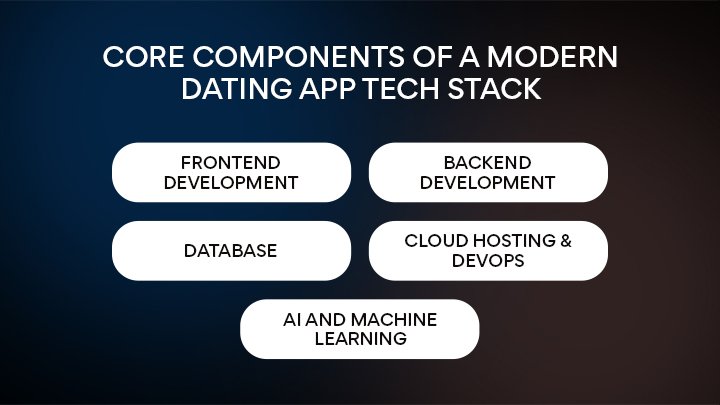
Here are the top components of a dating app tech stack:
1. Frontend Development
The front-end elaborated on how users engage with an app:
Proposed technologies:
- Swift (iOS) and Kotlin (Android) for native apps.
- For cross-platform dating apps (iOS & Android): React Native or Flutter
- Redux or Bloc for state management
2. Backend Development
Manages user authentication, matching logic, real-time chat, and more.
Proposed Technologies:
- Ruby on Rails for rapid development
- Node.js or Django (Python) for flexibility and scalability
- Express.js for minimalist Node.js applications
- Firebase provides a real-time database and backend as a service.
3. Database
Dating app database design should ensure the following:
- Data integrity
- Speed
- Real-time access
Proposed Technologies
- PostgreSQL (relational, supports complex queries).
- MongoDB (NoSQL for flexibility).
- Redis (for caching and fast retrieval).
- Redis (for coaching and rapid retrieval).
- Firebase Realtime DB for live messaging features.
4. Cloud Hosting & DevOps
Make sure your app is swift, secure, and highly available.
Proposed Platforms
- Docker and Kubernetes for containerization and adaptability
- AWS or Google Cloud Platform.
- CI/CD tools such as Jenkins or GitHub Actions.
5. AI and Machine Learning
Modern dating apps heavily depend on dating app algorithms to understand compatibility.
Use Cases:
- Image recognition for profile filtering
- Match suggestions depend on behavior.
- NLP for chat moderation
Tools & Frameworks
- Scikit-learn
- TensorFlow, PyTorch
- Amazon SageMaker
AI: Must-Add to Your Tech Stack
Most dating apps now use AI to provide smarter matches. It understands user behavior and preferences to suggest better connections and enhance the complete experience. From chatbots to secured features, AI includes several smart tools for dating apps. It assists users in finding genuine people faster and enjoying smoother, more personalized app journeys.
Get a Free Quote: Hire Dating App Developer
Why Is Investing in Dating App Development Profitable for Businesses?
There are wide-ranging benefits to developing dating applications that help them generate significant revenues and recognition. Entrepreneurs who achieved satisfactory growth have developed and operated most of the top-rated dating applications.
Here are the three basic advantages of developing your own dating app.
1. Wide-Scale Demand
Dating applications have an exponentially rising market, which in turn creates a ‘hyped demand’ for online dating applications. It is reported that the overall user demand may increase from 4.9% in 2021 to 5.7% in 2024. From 44.2 million in 2020 to 53.3 million in 2025, we might see a notable increase in the user base.
2. Multiway Earnings
The dating app offers its developers various ways to earn money. There are enough resources to earn money for the managing companies. They can earn as much as they want from any of these sources, so there is no primary source. This flexibility is the reason for the rapid growth of this industry and its sustainability.
3. Wide-Scale Demand
The demand for dating apps has been increasing exponentially, which will eventually lead to a hyped demand for online dating applications. According to reports, the gross user penetration can increase up to 5.7% by 2024, compared to 4.9% in 2021. We might experience a drastic rise of 44.2 million users by 2025, compared to 2020.
Also Read: Mobile App Development Cost in Australia
Essential Features to Include in Dating App Development
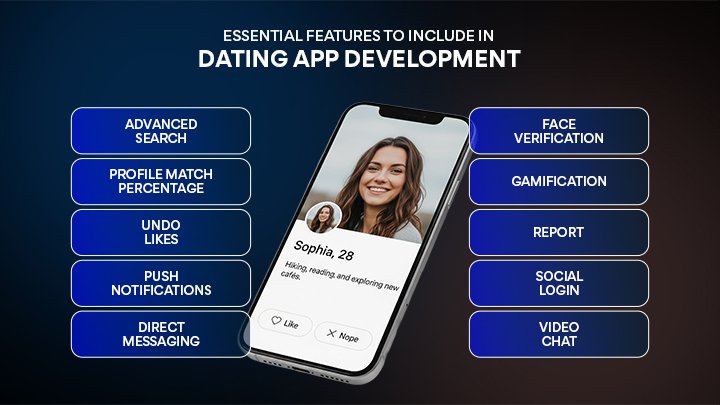
Online dating application users expect a simpler and faster response. It is of significant importance for organizations to personalize the needs of their users and indulge in features that focus on the multilateral needs and expectations of the users.
1. Advanced Search
No dating application allows you to search for users directly; instead, it shows users from its application in your nearby location or other locations based on algorithms that use the information provided in your profile. Different dating applications have different search algorithms based on their features.
Read Also: How to Market and Grow a Dating App
2. Face Verification
Dating applications use face recognition technology to verify your profiles. Users are asked to show the facial movements according to the instructions provided by the application. The AI technology verifies your face with the images you have uploaded to your profile. Once your real face matches one of the images you have uploaded, your profile gets verified with a blue tick.
3. Profile Match Percentage
As soon as you log in to the application, you are given a questionnaire in which several questions are asked, considering your interests and your perspective on things. The same questions are asked of other application users. You have the option to skip the questions without answering them. But the application system says that answering most questions will help them give you better results.
4. Gamification
Gamification in dating apps has made it easier for people to find their dates. Gamification has changed the entire app structure into an interactive app, which connects people across the world to their dates using simple, lightweight, and fun features. The feature of finding your matches through profiles is available in the form of scores, points, and coins. The features for sending and receiving requests for matches are available for the app’s users in the form of swiping and winking.
5. Undo Likes
Sending your interest to someone is just a matter of swiping right or winking at them with a single tap. There might be instances where you end up sending your interest to the wrong person. In such a case, you can get it back or undo your likes. However, some dating apps do not have this feature. In some apps, you can just shake to undo your request, while in some apps, it is done manually by tapping specific buttons.
6. Report
Dating applications are used for different interests. To maintain the actual purpose of the applications, users can report profiles that they don’t think are appropriate at any given time. The application will instantly block the profile for your account and begin to investigate the matter. You can view the status of your reports in the dedicated profile sections.
7. Push Notifications
Push notifications are a form of interactive communication that involves sending short notes of information through a simple interface in any mobile application. Dating applications use push notifications to communicate information to users when a person indicates their interest in your profile, or you get a match because they have liked it. Push notifications serve as a feature-packed tool in numerous application sections.
Read Also: Target Audience for Dating Apps in 2026
8. Social Login
Users can use their social media accounts to get registered with various online dating applications. There are various online dating applications, like Tinder, which allow you to integrate your Instagram account. These online dating applications will display content from the integrated social media accounts. Integration of online music streaming sites, like Spotify, has been a common feature in almost every online dating application, allowing users to add their playlists or favorite songs to their online dating profiles. An efficient app development company for social media can help you integrate social login efficiently.
9. Direct Messaging
Every online dating messaging application has to include the facility of direct messaging, and no dating application can afford to miss this feature. Once the two user profiles have matched, they can instantly move to the messaging section through the facility of direct messaging. There are a few online dating applications that require users to subscribe to the premium version of the online dating application, and there are a few that do not.
10. Video Chat
Virtual dating has taken a new turn with some applications offering their users video chat facilities. Nevertheless, video chat is not available in many of the dating applications, including some of the top ones. There may be any number of reasons for not offering video chat facilities to their users, but from the data records, it is clear that offering video chat facilities has brought in growth for these applications for dating.
As the technology changes, there are many personalized facilities that can be offered by these applications for dating. While offering any facilities in this particular application, it is critical to ensure security, which no one can ignore.
Also Read: Dating App Ideas
Tech Stack of Top Dating App
1. Tinder Tech Stack
Tinder is among the most popular and thus holds a leading position, which can be seen in 400+ million downloads as per the latest data. But have you ever thought about its 75+ million users? Their tech stack is the biggest reason behind it. They use :
- Fronted: React Native
- Backend: Node.js and Express.js
- Hosting: AWS
- AI/ML: Machine learning models for match optimization.
- Other Tools: Kafka for event management, Elasticsearch for search.
Special Features:
- Smart matching algorithms based on user behavior and location.
- Real-time chat using WebSockets for quick texting.
Read Also: Cost to Build a Dating App Like Tinder
2. Bumble Tech Stack
Bumble has 50 million active users and a 2% revenue increase in the last year. This is how Bumble grabbed a leading position in the industry. Also, they have achieved success with a strong tech stack.
- Frontend: Swift (iOS), Kotlin (Android)
- Backend: Node.js
- Database: Amazon DynamoDB, Redis
- Hosting: AWS
Special Features:
- Women-first messaging feature for best user control.
- Real-time chat and swipe-based matching.
- Integration of geolocation and push notifications for engagement.
Read Also: Develop a Mobile App Like Bumble
3. Tech Stack of Hinge
Hinge is yet another top-leading dating app with 23+ million users. There was almost $550 million in revenue in the last year. Furthermore, this app shows the relevance of the tech stack.
- Frontend: React Native
- Backend: Python (Django)
- Database: PostgreSQL
- Hosting: AWS
Special Features:
- Uses Machine Learning for customized match recommendations
- Advanced filtering options for preferences
Read Also: Cost to Develop an App Like Hinge
How Do Search and Matching Algorithms Work in Dating Apps?
To showcase profiles that users might take more interest in, the app development uses the latest algorithms that are involved in efficient and faster extraction of data. These algorithms play a significant role in the data-efficient search algorithms used by a smart online dating app.
Here is the list of important parameters used to define four different types of algorithms by the online dating apps:
1. Behavioural Algorithms
Dating apps analyze user behavior by using analytical tools to provide more relevant outcomes. Users record their behavior through their activities and actions.
2. Location-Oriented Algorithm
Dating apps use users’ locations to provide them with a list of profiles in their nearby locations. It is the most genuine phenomenon of search and match algorithms in modern-age dating apps.
Read Also: How to Develop a Dating App for Gamers
How are Cost Factors Considered While Creating a Dating App?
The cost of creating an app and launching a comprehensive dating app will rely on multiple factors, such as geographical, process-related, technological, and post-development factors.
Mentioned below are the important factors that estimate the cost of a dating app development project.
- Prototype
- Design
- Development of Native Apps
- Testing
- Integration of APIs
- Distribution
- Maintenance
The cost of dating app development services varies across different projects. There can also be geographical changes, as it may cost less to hire a dating app development company. However, integration of APIs will always elevate the costs of your project, secure your time, and make your app more efficient.
1. Artificial Intelligence
AI has completely transformed the way enterprise mobility engages with its users; it has implemented a humanoid nature to create more precise solutions. Dating apps utilize AI algorithms to show profiles that remain the same on several parameters. Since many dating apps feature verification of profiles by matching the real face pattern and uploading pictures, AI plays a major role.
2. Mathematical Algorithm
The dating apps use mathematical algorithms to feature some outcomes based on their basic profile reach. A user profile gains popularity as its reach increases.

Final Words
The dating app tech stack plays a prominent role in a dating app’s success. Therefore, it is important to choose the right tech stack as per your goals and budget, which brings favorable results. And for assistance, you should always hire a dating app development company like MSM Coretech. It is among the prominent companies that has a team of skilled developers who understand well what tech stack perfectly fits dating app development.
Frequently Asked Questions(FAQs)
A dating app development time depends on the project’s size and complexity. However, an app with basic functionality may take between 4 to 8 months to complete, and adding complex capabilities could take longer.
The dating app cost might vary depending on the features, platforms, complexity, and the rates of the development team. However, it falls somewhere between $25,000 and $150,000.
Implementing measures such as secure authentication procedures, data encryption, regular security audits, and compliance with data protection laws such as GDPR and CCPA are all crucial to make sure user data security and privacy in dating applications are maintained.
It is necessary to take legal and regulatory considerations into account when developing dating apps. It entails, among other things, terms of service and user agreements, observing anti -spam rules, age verification, content moderation, and compliance with privacy laws. It’s been advised to get legal advice from qualified individuals.
The challenges and factors involved in crafting your own dating involve:
- Market research
- Creating a distinctive value proposition.
- Designing an intuitive user interface.
- Putting perfect matching algorithms into practice.
- Building a user base.

Related Posts
How Much Does It Cost to Develop a Medicine Delivery App Like 1mg?
Getting medicines delivered to your home is now a normal part of daily life. Apps like 1mg make it simple...
Read More

A Complete Guide to Merchant Payment Solution Development
Every time a customer taps a card, scans a QR code, or checks out on a website, a merchant payment...
Read More
How Much Does It Cost to Build a Car Rental App like Hertz?
Think about booking a rental car in just a few minutes using your phone, without standing in long queues. That...
Read More


 Verified Review




 +44 7427829444
 71-75, Shelton Street, Covent Garden, London, United Kingdom, WC2H 9JQ