

Share this article


How Much Does it Cost to Develop an App Like Hinge?
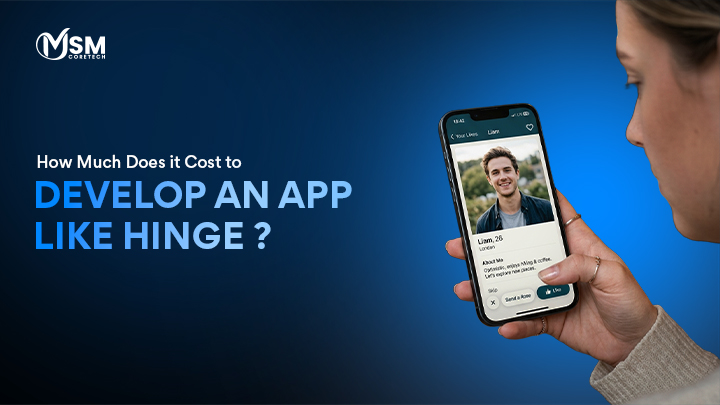
Online dating has completely changed the way people find love, and apps like Hinge are right at the center of this revolution. If you have ever scrolled through a dating app and thought, “I could build something like this,” you are not alone. A lot of entrepreneurs and startups are asking the same question: how much does it cost to develop an app like Hinge?
Before we get into the numbers, let’s look at why this market is worth entering in the first place.
The global online dating market was valued at $9.65 billion in 2022 and is projected to reach $17.7 billion by 2030, growing at a CAGR of 7.4%. Hinge alone saw a 40% increase in revenue year-over-year, and dating apps collectively generated over $5.34 billion in revenue in 2023.
These numbers tell a clear story: the market is booming, and there is still plenty of room for new players. But building an app like Hinge is not something you can do overnight. It takes careful planning, the right team, and a smart budget. In this guide, we will walk you through everything you need to know, from features and tech stacks to timelines and costs, so you can make informed decisions before leaping.
Also Read: AI in Dating Apps
Exploring Hinge: A Modern Approach to Dating
Before we get into budgets and timelines, it’s worth understanding what makes Hinge so different, because to build an app “like Hinge” means understanding the philosophy, not just the features.
The Vision Behind Hinge
Launched in 2012 and acquired by Match Group in 2019, Hinge was built on an unusual idea: most dating apps are engagement devices, built to make sure users spend all their time swiping. Hinge has gone the other way. Its main objective is to help its users form meaningful connections and then leave the platform.
Hinge is different from other dating apps like Tinder, Bumble, and OkCupid in that it takes an anti-addiction approach.
Key Differentiators of Hinge
- Profiles with prompts: Instead of simply uploading photos, the user answers three creative prompts (e.g., “The most spontaneous thing I have ever done”), giving potential matches a conversation starter right off the bat and eliminating the generic “hey” pickup line.
- “Built to be deleted” brand promise: Unlike other dating apps that measure success by daily active users or time-on-screen stats, Hinge measures the number of dates users go on. This counterintuitive strategy has turned out to be one of the most effective marketing tools the app has.
- Likes on specific elements: On Hinge, users like or comment on a specific photo or prompt, adding context and depth to the initial interaction, as opposed to swipe-based apps.
- Dealbreakers & filters: Users can define their dealbreakers for religion, kids, politics, and other factors, so that any matches they find are matching on life fundamentals, not just looks.
- The Standouts feature is really cool. It shows you people that Hinge thinks you will really like. They figure this out by looking at what you do on the site.
Most Compatible is another thing Hinge does. Every day, they suggest one person they think is a match for you. They use a way to pick this person. It is called the Gale-Shapley matching algorithm. This algorithm actually won a Nobel Prize. Hinge uses the Gale-Shapley matching algorithm to find the Most Compatible person for you.

Hinge’s Market Performance
| Metric | Value |
|---|---|
| Global Downloads | 23+ million |
| Paying Subscribers (2024) | 3 million+ |
| Revenue (2023) | $396 million |
| YoY Revenue Growth | 41% |
| Average Session Time | 6–8 minutes |
| Date Likelihood vs Competitors | 3x more likely |
The numbers are really clear: when you make something that is well thought out, people are more likely to stick with it. They are more likely to pay for it. When you decide to make an app like Hinge, you are not just making something where people swipe through; you are making something that people can trust, like Hinge.
Also Read: Technology Behind Popular Dating Applications
Features to Develop a Hinge-Like App
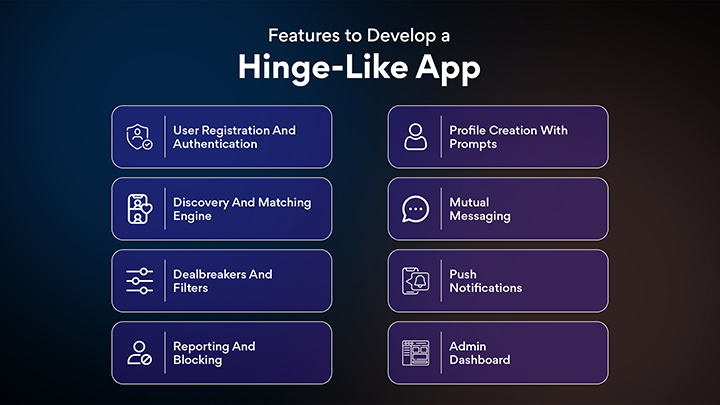
The features you put in your dating app are what really make the cost go up. Here is what you need to know about the basic, extra, and money-making features of your dating app.
1. User Registration And Authentication
We need to make it easy for people to sign up for our service. This means we should have sign-in options like Apple, Google, and Facebook. We should also have phone number verification, email registration, and two-factor authentication. People these days want to be able to sign up easily. If it takes many taps, they will probably give up.
2. Profile Creation With Prompts
This is what makes our service special, like Hinge. People can upload three to six photos. Answer three questions from a list of over 100 questions. When people are making their profiles, they should be able to change the order of their photos, edit the captions, and switch out the questions they answered.
3. Discovery And Matching Engine
This is the part that helps people find each other. At first, we can just have some filters like age, distance, and gender. People should also be able to set their preferences and like or pass on specific photos or questions, not just the whole profile.
4. Mutual Messaging
When two people like each other, we create a match. They can start chatting. Our messaging system should let people send text, GIFs from Giphy, emoji reactions, and photos. It should also show when someone has read their message.
5. Dealbreakers And Filters
People should be able to filter out profiles based on things like what they want in a relationship, their religion, ethnicity, height, politics, education, and habits. They should also be able to set dealbreakers, which means they can hide profiles that do not meet criteria.
6. Push Notifications
We should send people notifications in time when they get a new like, match or message. We should also send them suggestions from the app. If we design our notification system well it will help keep people using the app after a week and a month.
7. Reporting And Blocking
We have to make sure our service is safe. People should be able to report profiles that’re not okay, block contacts, and flag content for us to review. We need to have a system that automatically checks for content and also has real people review it.
8. Admin Dashboard
We need a dashboard for managing our users, looking at reports, checking the app’s health, managing content moderation, and seeing analytics over time. This will help us keep everything running smoothly.
Read Also: How to Develop a Dating App for Gamers
Advanced Features
1. Finding The Compatible People With AI
The system uses special computer programs that look at how people interact with each other on the app. It checks who you like, who you talk to, and how long you talk to them. This helps find people who’re really compatible with you. It takes a lot of work to make this system. It is what makes a good app really great.
2. Special People To Check Out
There is a section where the computer program picks people it thinks you will really like. It does this by looking at what you do on the app.
3. Video On Profiles And Video Calls
Hinge has a feature where people can add videos to their profiles. You can also have video calls with people you match with. In today’s world, people expect to be able to use video to talk to each other. It helps turn matches into real dates.
4. Leaving Voice Messages
You can send voice messages to people you match with. You can also answer questions on your profile with your voice. This makes you seem more authentic than just sending text messages.
5. Reminders To Respond
The app sends you a reminder when it is your turn to respond to someone. This helps keep the conversation going and stops people from ignoring each other.
6. Verifying People Are Real
The app asks you to take a photo or video of yourself to prove you are who you say you are. This helps people trust each other, women.
7. Special Way To Show You Are Really Interested
Hinge has a feature called Roses. It is like a like, and it shows someone you are really interested in them. The app has its own money system, where you can buy and use Roses to show people you are interested. This takes a lot of work to set up and make sure it works properly.
Monetization Features
1. Subscription Tiers like Hinge+ and HingeX
These are features that you have to pay for. When you pay, you can like as many people as you want, and you get to use advanced filters. You also get to see who liked you. You will show up first when people are looking through the app.
2. A La Carte Purchases
You can buy things one time, like Roses or Boosts. Boosts make your profile show up more for a while. You can also make your profile stand out more. These things make a lot of money from people who do not pay for a subscription to Hinge+ or HingeX.
3. Referral Program
We want you to tell your friends about our app, so we will give you rewards if you do. For example, you can get some time to use the special features. This is a cheap way for us to get new people to use our app because you are telling your friends about Hinge+ and HingeX.
Also Read: Challenges in Dating App Development
How Much Does It Cost to Develop an App Like Hinge?
The cost to develop an app like Hinge relies on four main factors: the range of features, the platform (iOS, Android, or both), the location of the team, and the development method.
Cost by Development Phase
| Development Phase | Estimated Cost |
|---|---|
| Discovery & UX Research | $5,000 – $15,000 |
| UI/UX Design | $12,000 – $30,000 |
| Frontend Development (iOS + Android) | $30,000 – $80,000 |
| Backend Development & APIs | $25,000 – $70,000 |
| AI/ML Matching Engine | $20,000 – $60,000 |
| Admin Dashboard | $8,000 – $20,000 |
| QA & Testing | $10,000 – $25,000 |
| Deployment & DevOps | $5,000 – $15,000 |
| Post-launch Maintenance (Year 1) | $15,000 – $40,000 |
Visit: Hire Dating App Developer
Cost by Feature Complexity
MVP (Basic Dating App 3-4 Months) A basic dating app that includes registration, profile creation, basic matching, messaging, and an admin panel. Estimated cost: $40,000 to $80,000.
Mid-Level App (5-7 Months) This version adds prompt-based profiles, contextual likes, advanced filters, push notifications, video calls, identity verification, and basic subscription monetization. Estimated cost: $80,000 to $150,000.
Full-Feature Hinge Clone (8-12 Months) This option offers AI-powered matching, all premium features, a Roses currency system, background checks, curated discovery, video prompts, complete admin analytics, and deployment on multiple platforms. Estimated cost: $150,000 to $300,000 or more.
Cost by Development Team Location
| Region | Avg. Hourly Rate | Full App Estimate |
|---|---|---|
| USA / Canada | $100 – $200/hr | $200,000 – $400,000+ |
| Western Europe | $80 – $150/hr | $150,000 – $300,000 |
| Eastern Europe | $40 – $80/hr | $80,000 – $180,000 |
| India | $20 – $50/hr | $40,000 – $120,000 |
| Southeast Asia | $25 – $55/hr | $50,000 – $130,000 |
Indian-based dating app development companies like MSM Coretech Innovation offer a compelling combination of technical expertise and competitive pricing, delivering Fortune-500-quality development at startup-accessible rates.
Hidden Costs Founders Often Overlook
- Third-party API Integrations: Services like Twilio, Sendbird, Agora, and Stripe each have costs that go up every month as more users join. You should plan to spend between $500 and $5,000 every month when your app is just starting out.
- Cloud Infrastructure: Using AWS, Google Cloud or Azure will typically cost you between $1,000 and $10,000 every month. The exact cost depends on how many users you have.
- App Store Fees: Apple charges 30% of what you earn from in-app purchases. If you are a developer, this fee is 15%. You need to think about this when you set up your subscription prices.
- Marketing & User Acquisition: It usually costs between $3 and $8 to get one user to join your dating app if you use methods. If you pay for ads, it can cost between $15 and $40 to get one user. This is based on data from AppsFlyer.
- Legal & Compliance: You need to follow rules like GDPR and CCPA. You also need to have a data privacy policy and terms of service. This means you might need to hire a lawyer. The initial cost for this can be between $3,000 and $10,000.
- Content Moderation: You need to have people or AI services that can look at content that users flag and make sure your platform is safe.
ROI Perspective
While $100,000–$300,000 seems significant, consider:
• Hinge generated $396 million in revenue in 2023 alone
• A niche dating app can generate $1M–$10M ARR with smart execution
• The dating app development cost is an investment with proven, outsized returns

Also Read: Dating App Revenue and Usage Statistics
Tech Stack for Dating App Development Like Hinge
When you start making decisions about the technology you want to use, it will really affect how well your app works, how well it can handle a lot of users, and how easy it is to add things to it later on. Here is what people think you should use for a tech stack.
Mobile Development
If you want to make an app that works on both Apple and Android phones, a Dating mobile app development company usually chooses React Native or Flutter. This means you only have to write the code once, and it will work on both kinds of phones, which saves you around 30 to 40 percent of the time it would take to write the code twice. If you want your app to work fast and feel like it was made just for the phone you are using, you should use Swift for Apple phones and Kotlin for Android phones.
Backend Development
A lot of people use Node.js with Express.js or NestJS to make the backend of their dating app because it can handle a lot of people using it at the same time without slowing down. This is really good when you have thousands of people trying to use your app all at. If you need to use intelligence or machine learning to make your app work, you should use Python with Django or FastAPI because they can handle really hard jobs.
Database Architecture
| Database | Use Case |
|---|---|
| PostgreSQL | User profiles, relationships, subscriptions, transactions, geospatial queries |
| Redis | Session caching, match queues, pub/sub messaging pipelines |
| Elasticsearch | Fast, fuzzy profile search with complex filter combinations |
| MongoDB | Prompt responses, activity logs, and behavioral data for ML models |
Real-Time Communication
We use WebSockets, which’s available via Socket.io for real-time chat and those little typing indicators that show when someone is writing. For push notifications, we use FCM and APNs. When it comes to in-app video calls, we like to use Agora.io or Twilio Video because they have tools that make it easy to get started in a few days, so we do not have to build our own video system from scratch.
Visit: Dating App Development Company In USA
Machine Learning
We use TensorFlow or PyTorch to build and train models that help us figure out who is a match for someone. We also use AWS SageMaker or Google Vertex AI to train and use these models on a scale. To make sure we find matches, we use a few different methods like collaborative filtering and content-based filtering, and something called reinforcement learning. We also use Natural Language Processing to look at how people respond to messages and see if their communication style and personality are compatible with someone.
Cloud & DevOps
Most people choose to use Amazon Web Services, which we will just call AWS. We use EC2 to do all the computing work, S3 to store all our media files, RDS to manage our databases, and CloudFront to make sure our content is delivered quickly. We also use Docker and Kubernetes to make sure all our systems are working together smoothly and can handle a lot of users at the same time, which is really important when we have a lot of people using our service at the same time.
Security
- JWT (JSON Web Tokens) for stateless authentication
- AES-256 encryption for data at rest
- TLS 1.3 for all data in transit
- OWASP Top 10 compliance as baseline security standard
- OAuth 2.0 for third-party social authentication
Also Read: Dating App Development Cost in the USA
Estimated Tech Stack Cost for a Dating App Like Hinge
| Layer | Recommended Tech | Purpose | Estimated Monthly Cost (MVP) | Estimated Monthly Cost (Scale) |
|---|---|---|---|---|
| Mobile App | React Native / Flutter | Cross-platform iOS + Android app | $0–$500 | $2,000–$10,000 |
| Backend Framework | Node.js + NestJS | APIs, authentication, matchmaking logic | $200–$1,000 | $5,000–$25,000 |
| Primary Database | PostgreSQL | User profiles, subscriptions, geo queries | $100–$600 | $3,000–$15,000 |
| Caching Layer | Redis | Session caching, queues, and real-time matching | $50–$300 | $2,000–$8,000 |
| Search Engine | Elasticsearch | Profile discovery & filtering | $100–$500 | $4,000–$20,000 |
| Behavioral/Analytics DB | MongoDB | Activity logs, prompts, ML data | $50–$400 | $2,000–$10,000 |
| Real-Time Chat | Socket.io | Messaging & typing indicators | $100–$700 | $3,000–$12,000 |
| Push Notifications | Firebase Cloud Messaging + Apple Push Notification service | Push notifications | Mostly Free | $500–$3,000 |
| Video Calling | Agora / Twilio | In-app video dates | $300–$2,000 | $10,000–$80,000 |
| AI/ML Infrastructure | TensorFlow / PyTorch | Recommendation engine | $500–$3,000 | $15,000–$100,000 |
| AI Hosting | Amazon Web Services SageMaker / Google Cloud Vertex AI | Model deployment & inference | $300–$2,000 | $10,000–$60,000 |
| Cloud Infrastructure | Amazon Web Services (EC2, S3, CloudFront, RDS) | Hosting & scaling | $500–$3,000 | $20,000–$150,000 |
| Containerization | Docker + Kubernetes | Scalability & deployment | $200–$1,000 | $5,000–$25,000 |
| Authentication & Security | JWT, OAuth 2.0, TLS 1.3, AES-256 | Secure login & data protection | $100–$500 | $2,000–$10,000 |
| Monitoring & Analytics | Datadog / New Relic | App monitoring & logs | $100–$800 | $5,000–$30,000 |
Steps to build a dating app like Hinge
Building a dating app like Hinge requires careful planning, smart technology choices, and a user-friendly experience. If you are planning to launch your own matchmaking platform, understanding the app development process is just as important as knowing the cost. A professional dating app development company can help businesses create scalable and feature-rich applications successfully. Below are the key steps involved in developing a dating app like Hinge.
Market Research and Planning
The first step is understanding your target audience and studying competitors in the dating app market. Research helps you identify what users expect from modern dating applications, such as smart matchmaking, video profiles, secure chatting, and personalized recommendations. At this stage, businesses also decide the app’s goals, monetization strategy, and core features.
Define Features and Functionality
The success of a dating app depends heavily on its features. Essential features usually include user registration, profile creation, matching algorithms, chat systems, geolocation, push notifications, and privacy settings. Advanced apps like Hinge also include AI-based recommendations, profile prompts, and video calling features to improve user engagement.
UI/UX Design Development
A clean and interactive design is extremely important for dating apps because users spend a lot of time browsing profiles and communicating. Designers create wireframes, prototypes, and app layouts to ensure smooth navigation and an attractive user experience. A simple and modern interface increases user retention and engagement.
Backend and Frontend Development
Once the design is finalized, developers begin building the application. Frontend development focuses on the mobile app interface, while backend development handles databases, APIs, servers, and user management systems. Developers also integrate important technologies like real-time messaging, GPS tracking, and payment gateways for subscriptions. Choosing an experienced dating app development company ensures smooth development and better app performance.
Testing and Security Implementation
Testing is one of the most critical steps in dating app development. The app must be tested for bugs, crashes, performance issues, and security vulnerabilities. Since dating apps handle personal user data, implementing strong security measures such as encrypted chats and secure authentication is essential.
Launch and Ongoing Maintenance
After successful testing, the app is launched on platforms like Google Play and the Apple App Store. However, the app development process does not stop after launch. Regular updates, feature improvements, and server maintenance are necessary to keep users engaged and ensure smooth app performance.
Read Also: Ultimate Guide to Korean Dating App Development in the USA
Why Choose MSM Coretech Innovation for Dating Apps Like Hinge?
When you want to build a dating application that is big and can be used by many people, MSM Coretech Innovation is one of the best companies in India that makes dating apps.
Deep Domain Expertise in Social & Dating Applications
MSM Coretech Innovation has made social platforms and dating apps with a lot of features, including systems that use artificial intelligence to match people’s ways for people to send messages in real time, and systems to keep people safe.
End-to-End Development Capability
MSM Coretech Innovation can help you from the beginning, when you are still thinking about what your app should look like, to the end, when your app is finished, and you want to make it better. This means you do not have to work with different teams, which can be confusing.
AI-First Development Approach
MSM Coretech Innovation is a company that uses artificial intelligence to make dating apps in India. They build apps that can match people together, suggest things to them, and score how well people are compatible. They do not just add intelligence to the app later; it is a part of the app from the beginning.
Transparent, Agile Delivery Process
MSM Coretech Innovation works in two-week periods, and they have a manager for each project. They talk to you every day. Show you what they have done every week. You can see what is happening with your project at all times. You will not get any surprises.
Competitive Pricing Without Compromising Quality
MSM Coretech Innovation is a company that makes mobile apps in India, and they charge a price that is fair. They do not sacrifice quality to charge a price. They can work with you in ways so you can choose what works best for you.
Post-Launch Growth Partnership
MSM Coretech Innovation does not stop working with you when your app is finished. They keep helping you so your app can work well on devices, run fast, and be safe. They can also help you add features and make your app bigger as more people start using it.
Client-First Culture
MSM Coretech Innovation puts their clients first. They do not care if you are just starting out and want to make an app, like Hinge, or if you are a company that wants to make a dating app. They have the knowledge, the team, and the commitment to make your vision a reality.

Also Read: Build a Dating App Like Tinder
Conclusion
The dating app market is changing rapidly. It is highly profitable but also very competitive. Hinge became successful because of its smart product design and user-focused experience. When you develop an app like Hinge that solves real problems and delivers a smooth experience, users are more likely to pay for it, keep using it, and recommend it to others.
Quick Cost Summary
- Basic version of the app (3 to 4 months development time): $40,000 to $80,000
- Mid-level app with advanced features (5 to 7 months development time): $80,000 to $150,000
- Fully featured app with premium functionality (8 to 12 months development time): $150,000 to $300,000 or more
The most important part of building a dating app is not deciding which features to add first; it is choosing the right development partner. The company you choose will determine whether you launch a market-ready product or simply spend money on trial and error.
MSM Coretech Innovation has the technical expertise, dating app development experience, AI integration knowledge, and client-focused approach needed to build a successful dating platform. If you want to develop an app like Hinge or create a unique dating platform of your own, now is the right time to turn your idea into reality.
FAQs
The cost to develop an app like Hinge typically ranges from $40,000 to $400,000+, depending on features, platform (iOS/Android), development team location, and complexity. An MVP version with basic features can start around $40K–$80K, while a full AI-powered app can exceed $150K–$300K+.
Core features include user registration, profile creation with prompts, matching algorithms, real-time chat, dealbreakers/filters, push notifications, reporting/blocking, and an admin dashboard. Advanced apps also include AI matchmaking, video calls, voice notes, and subscription systems.
Development typically takes 3 to 12 months, depending on scope.
- MVP: 3–4 months
- Mid-level app: 5–7 months
- Full-feature AI-based platform: 8–12 months or more
Common tech stacks include:
- Frontend: React Native or Flutter
- Backend: Node.js (NestJS/Express) or Python (FastAPI/Django)
- Database: PostgreSQL, Redis, MongoDB
- AI/ML: TensorFlow or PyTorch
- Cloud: AWS, Google Cloud, or Azure
- Real-time features: WebSockets, Socket.io, Agora/Twilio
Key cost drivers include feature complexity, UI/UX design quality, AI integration, platform choice (iOS, Android, or both), third-party APIs, developer location, and ongoing maintenance and infrastructure costs.
Yes, starting with an MVP is the most cost-effective approach. You can launch with essential features like profiles, matching, and messaging, then gradually add AI recommendations, video features, monetization tools, and advanced filters based on user feedback.
Yes, the dating app market is highly profitable if executed well. Revenue comes from subscriptions, premium features, and in-app purchases. Successful apps can scale to millions in annual revenue, but success depends heavily on user acquisition, retention, and differentiation.

Related Posts

10 Key Applications of AI in the Food Industry (2026)
Walk into any restaurant kitchen, grocery warehouse, or food delivery control room today, and you will find something quietly running...
Read More
How To Develop An App Like YouTube Music: A Complete Guide
Music is now a part of our everyday life. People listen to songs while getting ready in the morning, working,...
Read More
Must-Have Features in Fintech Apps & Digital Financial Platforms
Think about how often you use your phone to pay bills, send money, shop online, or check your bank balance....
Read More


 Verified Review




 +44 7427829444
 71-75, Shelton Street, Covent Garden, London, United Kingdom, WC2H 9JQ