

Share this article


Flutter App Development Cost – A Complete Guide 2026
Struggling to estimate your Flutter app development budget for 2026? Our comprehensive cost breakdown helps you plan accurately and avoid expensive surprises.
Flutter has gained instant popularity after its release in 2017, emerging as a comprehensive software development kit. Moreover, its open source capabilities allow developers to stay relevant in today’s highly competitive digital markets. The framework offers efficiency, cost-effectiveness and has the capability of producing high-quality applications. Using a single codebase, Flutter allows applications to run on different platforms effectively. However, with its growing demand, businesses which are seeking to develop cross-platform applications are worried about one thing: how much does the Flutter app development cost in 2026?
So, to clear this question, this comprehensive guide will help businesses in determining the true cost of Flutter app development. We’ll break down the pricing structure by complexity and share some expert strategies to minimise development budget with increasing ROI.
Market Statistics Shaping Flutter Mobile App Development Pricing in 2026
The mobile app development market has seen unprecedented growth in recent times. Moreover, this wide growth was promoted by the rapid adoption of smartphones, enterprise systems and significant transformation in cross-platform frameworks. These growth statistics powered up the need for Flutter app development within this expanding ecosystem.
Key Statistics:
- The mobile app development market is expected to grow from USD243.55 billion in 2025 to USD 278.58 billion in 2026 and is set to reach USD 545.76 billion by year 2031 with a CAGR of 14.38%.
- By organisation size, large enterprises account for 69.05% of the global mobile application market in 2025, whereas SMEs are growing at a CAGR of 18.33%.
- Another statistic suggested that by geography, North America is holding 34.12% of the global mobile app development, whereas the Asia-Pacific region is growing at a CAGR of 17.47%.
What is Flutter App Development?
Flutter is an open-source framework, best for developing natively compiled applications for web, mobile and desktop. Moreover, it has a single Dart codebase that provides fast and multi-platform support that reduces cost and saves time. Additionally, in 2026, the framework has become more dominant because of its high-end capabilities and versatility that support integration of AI, IoT and AR/VR. With the help of Flutter, both startups and large enterprises build high-performing applications that are best for long-term results with constant support from Google. However, the cost to develop a Flutter app might differ depending on the complexity and features.
Flutter vs Native App Development Cost Overview
In 2026, the cost of Flutter app development can range from $15,000 for a basic MVP to over $150,000 for enterprise-level developments. However, one of the most significant advantages of Flutter is its cost-effectiveness. Flutter apps cost 30-40% less than native development because of their single codebase for iOS and Android. Also, remember the cost can vary according to the complexity, features and integrations you need in your application.
Difference of Cost Between Flutter and Native App Development
| Elements | Cross Platform (Flutter) | Native (iOS and Android) | Key benefits of using Flutter |
|---|---|---|---|
| Development Cost | Usually lower (by 30-40% for both platforms) | Higher (requires separate codebase and teams) | One single codebase for both iOS and Android, it saves money and time both. |
| Basic App (MVP) | $15,000-$30,000 | $25,000-$50,000+ (for both platforms) | Basic apps have core features, simple UI and limited backend capabilities. |
| Medium complexity | $30,000-$70,000 | $60,000-$120,000+(for both platforms) | Consists advance features, custom UI, APIs and some third party integrations |
| Enterprise level | $70,000-$150,000+ | $150,000-$300,000+ (for both platforms) | Large-scale applications with high security, scalability and with high-backend security. |
Key Factors Affecting Flutter App Development Cost
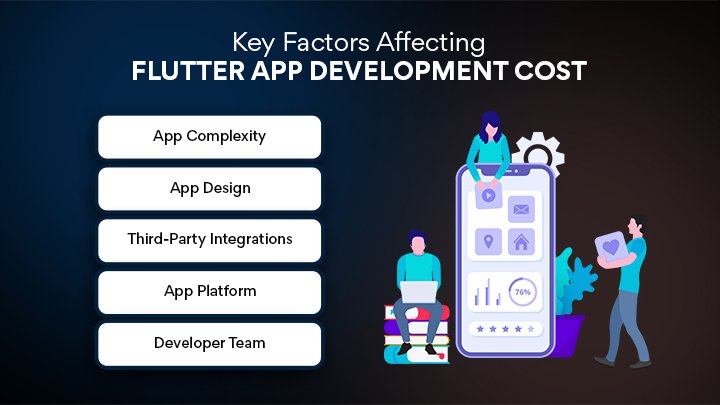
Flutter app development includes different complexities and features. However, the cost to develop a Flutter app might vary according to different requirements like UI/UX, location and expertise of the development team, with ongoing support and maintenance assistance.
Here is a breakdown of major factors:
1. App Complexity
The integration features decide the complexity of any application. Whether you build simple applications with limited features, or want to build applications that have complex functionality. The cost can significantly differ according to the functioning of the application.
2. App Design
The design of the application acts as the main interface through which users interact. Moreover, it includes functions like app navigation, brand identification, typography, colour schemes and overall user experience. Hence, while developing cross-platform applications, one should consider the crucial factors which play a crucial role in Flutter app development.
3. Third-Party Integrations
The APIs and tools that provide external services to developers to develop mobile applications for different platforms with a single unified codebase. Moreover, it is necessary that the application can freely work with other applications. Hence, the greater number of integrations within the application results in more associated development costs.
4. App Platform
Yes, for sure, as Flutter is a cross-platform framework, it allows developers to make an application that works on the major platforms like iOS and Android. However, you will face some challenges if you want to run your application on wearable devices or on TV. Overcoming these challenges will require some extra development efforts and will ultimately result in increased costs to develop Flutter apps.
5. Developer Team and Locations
The size and skillset of developers, along with their location, also play a vital role in assessing the Flutter mobile app development pricing. There are several options from which the business can choose, like freelancers, outsourced companies and in-house teams. Each of the developer options has different pricing, depending on the complexity and features you require in your application.

Flutter App Development Timeline
Flutter mobile app development timeline can span from 3 to 9+ months, depending upon the complexity of the application. A simple MVP can be delivered in 6-10 weeks. However, the development cycle includes different phases like planning, UI design and coding in Dart with post-launch maintenance and support.
| Development Phase | Simple App Timeline | Complex App Timeline |
|---|---|---|
| Planning and research | 1-2 weeks | 3-5 weeks |
| UI/UX design | 2-3 weeks | 4-6 weeks |
| Development and coding | 4-6 weeks | 12-20 weeks |
| Testing and Q&A | 2-3 weeks | 5-8 weeks |
| Deployment and Launch | 1-2 weeks | 4-6 weeks |
| Total estimated time | 2-3 months | 6-12+ weeks |
Strategies to Reduce Flutter App Development Cost
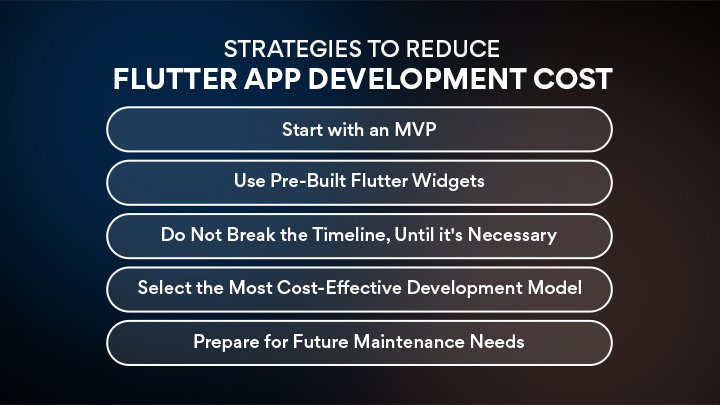
Let’s be clear, reducing the cross-platform app development cost does not mean compromising the quality and other functions of the application. It just clearly means overcoming unnecessary expenses and other irrelevant cost mistakes.
However, most of the development teams do not overspend money because the framework is costly; they spend more money due to their rushed decision-making or because of unclear project goals.
1. Start with an MVP (Minimum Viable Product)
Without building everything at one time, you should focus on developing the basic version of the required application first. Moreover, the Flutter framework is very good for this as it offers fast launch and changes without redeveloping the app from scratch.
Key advantages:
- Lower mobile app development budget
- Decreased development time
- Learn more effectively with real usage
2. Use Pre-Built Flutter Widgets
Integrating pre-built Flutter widgets is a basic fundamental strategy for controlling and managing costs by speeding up the development cycle. Moreover, by using built-in features and functionality, the application ensures code quality and stability with effective Flutter development pricing.
Key advantages:
- Faster development time
- Effective code quality and security
- Enhances maintainability
3. Do Not Break the Timeline, Until it’s Necessary:
A highly pushed timeline always costs more money and effort. Adding new developers to the team, neglecting regular testing, can lead to risks and affect coordination. Flutter already provides a good speed friction that can work uncontrollably if you don’t focus.
Key advantages:
- Lower long-term maintenance
- Effective MVP development
- Reduced testing and Q&A efforts
4. Select the Most Cost-Effective Development Model:
Different types of development teams, like in-house, agencies and freelancers, all make sense, but have different pricing structures and working styles. Initial stage applications can benefit from a good external team. However, developing in-house teams at an early stage leads to high Flutter project cost estimation.
Key advantages:
- Lower labour costs
- Decreased overhead expenses
- Access to a wide talent pool
5. Prepare for Future Maintenance Needs:
Flutter mobile app development pricing is very easy to manage when it is expected, as instead of fixing all the issues, you should plan for regular updates. Small and constant enhancements cost less than the actual fixes.
Key advantages:
- Minimise bug-fixing expenses
- Avoidance of costly rewrites
- Lower future implementation costs
Choosing the Right Flutter App Development Company
Choosing the right mobile app development company requires a holistic evaluation of the company’s technical expertise, with an assessment of past experiences in that field.
Moreover, it is also crucial to analyse the communication practices with certain post-launch support offerings. You should look out for a partner that perfectly aligns your business goals and offers scalable mobile app development services that are low in cost and provide high-quality support. Additionally, by regularly analysing potential development partners across these key factors, you can find a good company that is truly strategic. This effective partnership can help you in assessing a good Flutter app development cost breakdown, which is good and budget-friendly for you.
At MSM Coretech Innovations, we offer end-to-end Flutter app development services with post-launch support and maintenance. Our exclusive team of developers are skilled in developing high-performing cross-platform applications that can help your business in achieving long-term growth and success.

Future of Flutter Development (2026 and Beyond)
The future of Flutter app development is beyond its maturity, as a single code framework and multi-platform powerhouse. The framework includes deep integration of AI, high-performing web assembly applications and robust tooling support for enterprise-scale applications.
Moreover, as it supports multi-platform assistance, it significantly reduces the cost of Flutter app development by 30-40% as compared to native app development. Moreover, the rendering engine provides 60-120 FPS performance support, which eliminates all lagging issues.
Additionally, the future of the Flutter project cost estimation mainly depends on the architectural design and discipline of the developing team. The role of the developing team has evolved into an architect who can develop robust systems. However, there is a strong focus on integrating new technologies like AI and ML for creating privacy-sensitive applications.
Conclusion
In 2026, the validity of modern frameworks like Flutter has increased among businesses which are seeking to build cross-platform applications. Moreover, it provides sustainable cost-saving advantages over native development.By using a single codebase, Flutter decreases the development cost 30% to 40% as compared to the development of applications natively. However, there are certain factors that need to be considered while creating a mobile application through Flutter.
App development hourly rates, custom UI/UX designs, third-party integrations and post-launch maintenance. All these factors can impact development cost, and to overcome these measures, you need a good mobile app development partner who has good knowledge and a good skill set.
MSM CoreTech Innovations can help you in developing scalable mobile applications that can perfectly align with your business vision.
FAQs
In 2026, developing a Flutter application can generally cost between $15,000 to $150,000+. However, the cost might slightly increase based on the app complexity, UI/UX design and developer team skillset and location.
Yes, the cost of developing a Flutter app is 30-40% less than that of native app development, as it uses a single codebase. Moreover, it offers faster development and allows for reducing costs by adding integrations of AI and third-party applications.
Flutter app costs consist of different phases, where each phase consists of different pricing structures. The phases include planning and research (12%), UI/UX designs (25%), development (40%), testing and Quality assessment (15%) and deployment and maintenance (8%).
Yes, you can easily reduce the Flutter development costs without compromising the quality of the application by integrating a strategic approach. Key strategies include the development of a Minimum Viable Product (MVP), focusing on important features and outsourcing developers with low hourly rates.
Building a Flutter application can take up to 1 to 6 months, depending on the complexity of the application. However, basic applications just require 4-6 weeks, medium and complex applications might require more time (2-4 months or more). The main development process is driven by complexity, UI and backend integration of the application.

Related Posts

Top 10 Dating App Development Companies in Australia
The way Australians meet and build relationships has changed dramatically over the past decade. Mobile dating apps have become a...
Read More
Top 7 React Native App Development Companies in Australia
Mobile apps are now a vital part of business growth across Australia. From fintech startups in Sydney and healthcare providers...
Read More
Top 5 Android App Development Companies in Australia
Android is the world’s most widely used mobile operating system, making it an ideal platform for businesses looking to reach...
Read More


 Verified Review




 +44 7427829444
 71-75, Shelton Street, Covent Garden, London, United Kingdom, WC2H 9JQ