

Share this article


How to develop a food delivery app like Postmates
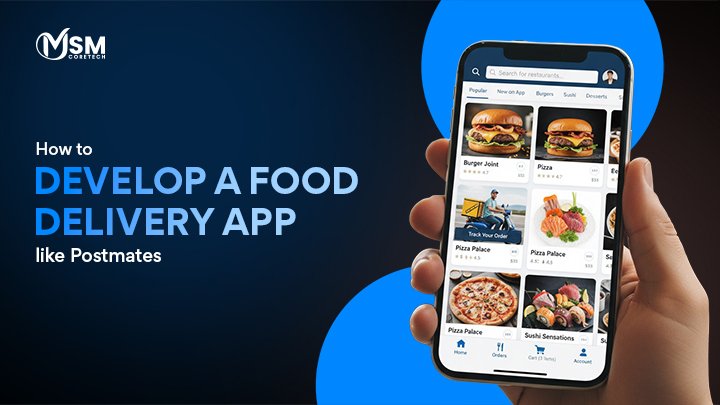
The new digital world has changed the way that humanity consumes products and services. It is no longer an option; it’s an expectation. One of the most transformative developments of the last decade has been the rise of online logistics platforms. If you’re planning to get into this lucrative market, developing a food delivery app like Postmates involves more than copying the interface of a competitor.
It is a matter of creating a sophisticated real-time system that can meet the demands of hungry consumers, busy restaurant owners and mobile couriers. This comprehensive guide outlines the exact steps required for launching, scaling, and profiting from a leading platform.
The Postmates Blueprint: Why the “On-Demand” Model Wins
To comprehend the enormous potential of this business, it is necessary to take a look at the facts that define the market. The worldwide market for online food delivery is estimated at $198.99 billion as of 2026. The market is projected to grow at a compound annual growth rate (CAGR) of 6.24% between 2026 and 2031, reaching an estimated value of US$2.05 trillion by 2031.
A pivotal moment in the industry’s history was when Uber officially purchased Postmates for $2.65 billion in the year 2020. This huge acquisition gave a powerful warning to the tech industry that hyperlocal logistics networks have incredible, long-term value for businesses. Postmates not only delivered meals cooked by restaurants, but they also pioneered the concept of multi-vertical delivery, which carries alcohol, groceries, as well as retail products and convenience products under a single brand.
For startups in the modern age who wish to develop a food delivery app by implementing this multi-service method, provides powerful compounding benefits. First, the unit costs are extremely attractive when scaled. Platforms typically pay 15%-30% commission for each restaurant transaction, along with dynamic customer delivery charges as well as subscription-based retention strategies (such as Postmates Unlimited).
In addition, the habits of consumers have remained constant; repeat ordering habits result in a high lifetime value (LTV) that is often greater than the initial costs of acquiring a customer. However, taking advantage of this market share will require complicated real-time mapping restrictions, split-second route optimisation, and huge levels of concurrency in peak times for dining. Examining the historical data of the industry and the success metrics provides a detailed roadmap you need for your own implementation of technology.
Understanding the Business Model: How Does a Food Delivery App Work?
Before committing capital to software development or calculating the exact cost to build a food delivery app, you must finalise your operational strategy. Not all food applications function the same way; choosing the right model dictates your overhead, profit margins, and logistical responsibilities.
The Aggregator Model
The model of aggregator functions as a digital directory intermediary. Local restaurants are listed and menus, handle incoming orders and forward orders to kitchens. The restaurant handles the fulfilment and delivery processes.
- Pros: Lower initial setup cost, no liability for the management of fleets, and easier restaurants to onboard.
- Cons: Lower cap on commissions and weak brand loyalty (customers remain faithful to the place, but not to the app) and no control over delivery time or the quality of food.
The Full-Service Logistics Model (The Postmates Approach)
This is a 3-sided marketplace which handles order processing and also manages an entire group of independent couriers (drivers by bicycle, drivers walking, and bicyclists).
- Pros: Complete control over the experience of the end-user and multiple revenue streams (service costs + delivery charges and commissions) as well as an extremely high capacity.
- Cons: Complex operation, the need for advanced dispatch algorithms and a greater cost of capital.
The Cloud/Ghost Kitchen Model
A new era where you run centralised commercial kitchens without the need for a physical dine-in restaurant by collaborating with a variety of virtual restaurant brands that operate entirely inside your application. This approach maximises profit margins by removing front-of-house real estate costs, allowing you to concentrate on online order fulfilment.
Essential Features for a Competitive Food Delivery App
A well-designed platform is divided into four distinct interfaces for software. If you wish your app to be noticed, skilled mobile app developers should create each panel without friction and with lightning-fast time synchronisation.
The Customer App Interface
This is the storefront that you can show to the public. It must be visually engaging, quick, lightning-fast and user-friendly.
- Smart Search and Filtering: Advanced search options allow users to filter their search by food, dietary restrictions, price tier, as well as the estimated time to delivery.
- Real-Time GPS Tracking: Live tracker of maps powered by WebSockets. Customers can track their courier’s movements in real-time.
- Secure Payment Gateways Integration seamless with credit cards and digital payment wallets (Apple Pay and Google Pay), and payment protocols for regional locations.
- Personalisation and AI Recommendations: Machine learning programs that recommend restaurants based upon previous ordering records, the time of day and weather patterns in the local area.
The Restaurant/Partner Panel
Restaurants need an efficient dashboard to manage their kitchen workflow without getting overwhelmed during rush hours.
- Menu Management System: Real-time toggles to mark items as “sold out,” update pricing, or add daily specials instantly.
- Order Acceptance & Prep Control: Simple interface to accept incoming orders, specify accurate preparation time estimates, and print kitchen tickets automatically.
- Sales & Analytics Dashboard: Detailed reporting tools tracking daily revenue, popular menu items, cancellation rates, and customer feedback ratings.
The Courier (Driver) App
The heartbeat of logistics for your platform. It is required to optimise battery life while also maintaining a super-accurate track of location.
- Order Dispatch and Acceptance: Push notifications notify local couriers of new deliveries, with estimated earnings and distance.
- Integrated Turn-by-Turn Navigation: Built-in routing through Google Maps or Mapbox to help drivers navigate through the dense urban traffic.
- Earnings & incentive tracker: Clear breakdown of daily payments as well as bonuses, tips and status toggles for online and offline.
The Admin Dashboard (The “God View”)
The centralised portal on the internet where your team of operations manages the entire market.
- Customer & Merchant Management: Capability to check restaurant licenses, take on new drivers, settle disputes with customers as well as issue refunds.
- Dynamic Commission & Surge Pricing Control Tools for adjusting charges for delivery and restaurant commissions in accordance with the weather, traffic or peak demand times.
- Heatmap Analytics overlays of data visuals that show areas of high demand where couriers are required to be positioned.
The Tech Stack: Engineering for Scalability
The right infrastructure for your technology is essential when you are calculating the total cost of developing an app for food delivery. When Friday evening dinner is a rush your backend will see huge traffic spikes. If your servers fail or fail, you’ll lose your revenue immediately.
| Layer | Recommended Technology | Why Choose It? |
|---|---|---|
| Mobile Frontend | Flutter or React Native | Allows cross-platform deployment, significantly reducing initial code maintenance overhead. |
| Backend Architecture | Node.js or Python (FastAPI/Django) | Excellent for handling asynchronous requests and real-time socket connections. |
| Database Systems | PostgreSQL + MongoDB | PostgreSQL handles secure transactional data; MongoDB offers flexible schema design for menus. |
| Real-Time Logistics | WebSockets / Socket.io | Mandatory for live map tracking and instant push alerts. |
| Cloud Infrastructure | AWS, Google Cloud, or Azure | Provides auto-scaling server clusters that expand during traffic surges. |
| Mapping & Routing | Google Maps Platform or Mapbox | Industry gold standard for geocoding and route optimisation. |
Advanced Tech Integrations for 2026 and Beyond
To really distinguish your product, it is essential to go beyond the standard CRUD (Create, Read, Update and Delete) capabilities. Modern apps are using advanced AI layers to improve this “last-mile” delivery problem.
- Predictive Demand Forecasting: Make use of previous data to determine the areas that will experience large volumes of orders before they actually happen, which allows you to prepare drivers for demand-driven “hot zones.”
- Automated Batching Algorithms: Instead of distributing one order to each driver, make use of AI to combine multiple orders from the same area or restaurant to boost the efficiency of couriers and cut costs for delivery by up to 20%.
- Computer Vision for Food Quality: Certain premium platforms are testing AI-based quality checks. Drivers take a photograph of the bagged item, and a computer-generated model determines if the container is sealed or if it contains the right quantity of food items.
- Chatbots & Chatbots and Conversational AI: Implement AI-driven customer support to answer frequently asked questions such as “Where is my order?” and “I have a dietary restriction” immediately, reducing the load on your human support team.
Step-by-Step Guide: How to Build a Food Delivery App
Executing a complex software project requires a structured, multi-phase roadmap. Rushing development without a clear validation strategy often leads to bloated codebases and wasted budgets.
Phase 1: Market Research & Competitive Benchmarking
Begin by analysing existing players in your target geographical region. Identify what frustrates local users—are competitors notorious for late deliveries? Do restaurants complain about unfair commissions? Pinpoint these market gaps and build your unique value proposition around solving them.
Phase 2: UX/UI Prototyping and Wireframing
Design user flows focusing heavily on the “Three-Click Rule”—a customer should be able to open the app, select a meal, and complete checkout within three intuitive screens. Wireframes allow you to test usability with real users before writing any code.
Phase 3: MVP (Minimum Viable Product) Development
Do not try to build every advanced feature on day one. A strategic MVP should include user registration, basic restaurant search, a simplified cart, secure checkout, basic order tracking, and manual courier assignment. This lets you test the market quickly and economically.
Phase 4: Rigorous Quality Assurance (QA) and Stress Testing
Before opening your platform to the public, conduct intensive QA testing. Simulate thousands of simultaneous orders to test server stability. Check edge cases: What happens if a customer drops their internet connection mid-payment? What if a courier loses GPS signal in a tunnel?
Phase 5: Soft Launch and Iteration
Launch your app in a single, well-defined neighbourhood or university campus. Gather feedback from early adopters, fix immediate software bugs, optimise courier response times, and refine your operational playbook before investing heavily in city-wide marketing campaigns.
Decoding the Cost: What is the Real Investment?
Understanding financial commitments is vital to make a proper budget. The cost of developing a food delivery application requires looking at a variety of variables that change, such as the complexity of features, geographical the location that, your team of developers and API subscription models from third-party APIs.
Estimated Budget Breakdown by Project Phase
- Prototyping and UI/UX Design: $5,000 to 12,000 (User studies, wireframes along with branding).
- MVP Development: $ 45,000 to $80,000 (Core code for Customer, Restaurant and Driver applications).
- Advanced Features and AI: $20,000 to $40,000 (Automated dispatch and predictive demand, rewards programs).
- Quality Assurance & Deployment: $8,000 – $15,000 (Security audits and App Store publishing).
Hidden and Ongoing Operational Costs
Making the application is just half the challenge. It is essential to consider the ongoing costs, such as cloud server hosting as well as Third-party SMS verification services (Twilio) and Map API query costs, and regular maintenance updates. A qualified mobile app for food delivery firm makes sure these hidden costs are clearly mapped out from the start.

Strategic Growth: Marketing and Customer Acquisition
Even the best-engineered app will fail without a strategic go-to-market plan. In the hyper-competitive food delivery space, you are battling for “real estate” on the user’s home screen.
- Hyper-Local Marketing: Focus your budget on specific zip codes initially. Utilise geo-fenced social media ads to target residents during lunch and dinner hours.
- The “Double-Sided” Referral Program: Offer significant discounts to both the referrer and the referee. This creates a viral loop that lowers your Customer Acquisition Cost (CAC) significantly.
- Strategic Restaurant Partnerships: Offer lower commission rates to “exclusive” restaurant partners who agree to list only on your app for a set period. This content exclusivity is a powerful moat against larger competitors.
- Loyalty and Gamification: Implement a points-based system where frequent users unlock “Gold Status,” granting them priority support, free deliveries, or exclusive access to limited-time menu items from popular local chefs.
How to Choose the Best App Development Company?
Selecting the right food delivery app development company can make or break your startup venture. When vetting potential software agencies, you need a rigorous evaluation framework to separate mediocre coders from elite engineers.
1. Evaluate Relevant Food-Tech Portfolios
Never hire an agency that has never built a multi-sided marketplace or real-time tracking application. Ask for case studies, live app store links, and verified client testimonials demonstrating their experience with geolocation APIs and WebSockets.
2. Assess Development Methodology
Ensure the company follows Agile and Scrum methodologies. Food delivery projects are complex; you want bi-weekly sprint reviews where you can test working software increments, provide feedback, and pivot features dynamically based on real-time testing results.
3. Verify Post-Launch Support and Maintenance
Software is never truly “finished.” Operating systems update annually, security patches must be applied, and user feedback will demand iterative feature rollouts. Ensure your contract includes a comprehensive post-launch SLA (Service Level Agreement) for bug fixes and server monitoring. Partnering with the best app development company guarantees your platform scales smoothly as your user base multiplies.
Challenges and Scaling Strategies in Food Delivery
Every successful tech company faces difficulties in its operations. Be prepared for these issues to protect your brand’s reputation and increase your margins of profit.
- Balancing the Three-Sided Market: When you have too many couriers but not enough orders, couriers quit due to their low earnings. If you’re overwhelmed by orders but there aren’t enough delivery services, your food will arrive cold, and customers leave the platform. Utilising predictive analytics and clever batching algorithms helps to balance demand and supply.
- Controlling the impact of surge pricing and customer pushback: When there is a lot of rain or during peak holiday hours, the demand for delivery increases while the availability of couriers decreases. Utilising clear surge price models can help increase the number of drivers on the road, without causing churn.
- Regulatory Compliance and Labour Laws: The gig economy is under severe scrutiny by regulators worldwide regarding independent contractor classifications, minimum wage guarantees, as well as the safety of workers. Becoming aware of local laws and regulations ensures that your company is compliant and viable over the long haul.
Conclusion
The development of an on-demand food delivery system is a daunting task, and the huge scale of the food tech industry worldwide is one of the most profitable investments an entrepreneur can make. It requires a careful blend of solid business strategies as well as a flexible technical architecture and a flawless customer experience.
Through mapping out your functions, understanding the financial implications and avoiding common mistakes and pitfalls, you can turn the idea of a small startup into a successful market leader. If you’re ready to transform your idea into a reality, working with a reputable mobile app for food delivery business can provide the technical know-how and strategic guidance required for bringing your app to life. Is the market waiting for you to be willing to change the game?
FAQs
A white-label or clone-based solution can be ready in 3 to 6 weeks, while a fully custom app typically takes 4 to 12 months, depending on complexity and features required.
The cost ranges from $8,000 for a basic MVP to $150,000 or more for a full-featured enterprise platform, depending on the feature set, development region, and technology choices.
Real-time order tracking, multiple payment gateways, restaurant and driver panels, AI-powered recommendations, push notifications, and an admin dashboard are the essential features for any competitive food delivery app in 2026.
The most effective strategy combines delivery fees, restaurant commissions of 15% to 30%, and a subscription plan for regular users, which helps create a predictable and recurring revenue stream.
The global food delivery market is projected at $1.40 trillion with a steady growth trajectory through 2030; mobile app usage is at an all-time high, and consumer habits around on-demand delivery are now deeply established, making it an ideal time to enter or scale in this space.

Related Posts
10 Key Applications of AI in the Food Industry (2026)
Walk into any restaurant kitchen, grocery warehouse, or food delivery control room today, and you will find something quietly running...
Read More
How To Develop An App Like YouTube Music: A Complete Guide
Music is now a part of our everyday life. People listen to songs while getting ready in the morning, working,...
Read More
Must-Have Features in Fintech Apps & Digital Financial Platforms
Think about how often you use your phone to pay bills, send money, shop online, or check your bank balance....
Read More


 Verified Review




 +44 7427829444
 71-75, Shelton Street, Covent Garden, London, United Kingdom, WC2H 9JQ