

Share this article


Challenges of Building a Music Streaming Mobile App
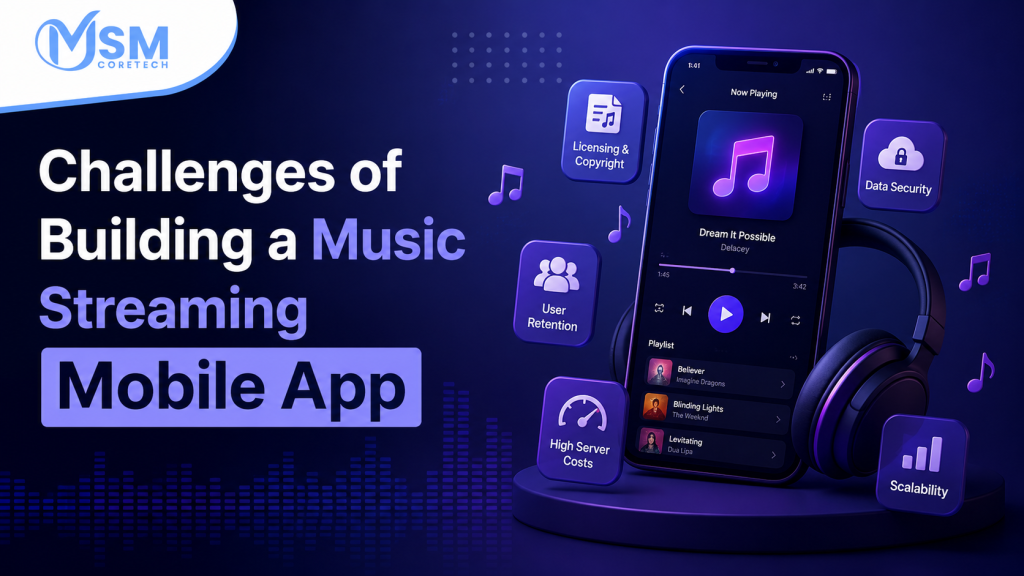
What makes people keep using a music streaming app? It’s not just having millions of songs. The real reason is a smooth, fast, and enjoyable listening experience. Today, millions of people use music streaming apps to listen to their favorite music anytime and anywhere. As smartphone use and internet access continue to grow, more people want music apps that are fast, easy to use, and offer high-quality audio. Users also expect features like smooth music playback, personalized song recommendations, offline listening, and a simple, user-friendly design.
But building a successful music streaming mobile app is not easy. Developers have to deal with many challenges. They need to get the right music licenses, provide high-quality audio streaming, keep user data safe, manage a large collection of songs, and offer smart music recommendations based on user preferences. They also need to make sure the app works smoothly on different devices and performs well even with different internet speeds, so users can enjoy a seamless music listening experience.
To build a successful music streaming app, businesses need the right technology, experienced developers, and a proper plan. Using technologies that can grow with the business, creating a simple and easy-to-use design, and adding useful features like AI-based music recommendations and offline listening can make the app better. Good planning also helps avoid problems during development and saves time and money in the future.
When businesses understand these challenges from the start, they can build a music streaming app that is reliable, easy to use, and full of useful features. This helps attract more users, keeps them engaged, and supports long-term success in the fast-growing digital music industry.
Global Music Streaming Market Statistics
The global music streaming market is growing very fast because more people now listen to music online whenever and wherever they want. Smartphones, affordable internet, and easy online payment options have made music streaming apps a part of everyday life. Today, users want features like personalized playlists, offline listening, high-quality sound, podcasts, and smart music recommendations. Because of these growing user needs, many businesses are investing in feature-rich music streaming apps to provide a better listening experience.
The global music streaming market was valued at USD 54.1 billion in 2025 and is expected to reach USD 158.1 billion by 2033, growing at a CAGR of 14.2%. This strong growth shows that the demand for music streaming services will continue to rise in the coming years.
Another big reason for the growth of the music streaming market is the increasing use of subscription plans. More people are choosing premium memberships because they can listen to music without ads, download songs for offline listening, and enjoy better sound quality. The growing number of smartphone users and the availability of fast internet have also made music streaming easy for people around the world.
This fast-growing market gives businesses a great chance to build successful music streaming apps. By adding features like AI-based song recommendations, personalized playlists, social sharing, podcasts, and engaging listening experiences, companies can attract and keep more users. In the future, technologies such as Artificial Intelligence (AI), voice search, spatial audio, AR/VR experiences, and smarter recommendation systems will continue to improve music streaming apps and help businesses stay ahead of the competition.
Read Also: How AR/VR in Music Apps is Transforming the Industry
Top Challenges Faced During Music Streaming App Development
Building a successful music streaming app requires careful planning, advanced technology, and a deep understanding of user needs. Developers often face several challenges while creating a smooth, secure, and engaging music streaming experience. Here are some of the top challenges involved in music streaming app development:
1. Managing Music Licensing and Copyright Issues
One of the biggest challenges of building a music streaming mobile app is handling music licenses and copyright rules. Before adding any songs to the app, businesses must get the proper permission from the people or companies that own the music. If they stream copyrighted music without permission, they can face legal issues, pay heavy fines, and harm their company’s reputation.
Another challenge is making licensing agreements with artists, record labels, music publishers, and copyright organizations. Every group may have different rules, payment terms, and conditions for using their music. Managing all these agreements can be difficult, especially if the app is available in different countries.
Music streaming apps also need to calculate and pay royalties correctly. Every time someone plays a song, the artist and the people who own the music should get their share of the earnings. A proper royalty management system helps make sure payments are accurate, avoids problems, and builds trust with artists and rights holders.
Also, music copyright rules are different in every country. Businesses must make sure their app follows the licensing rules, copyright laws, and data protection requirements of each region. Working with experienced legal experts and a trusted music streaming app development company can make it easier to handle these legal requirements and avoid future issues.
2. Creating a Smooth and Easy User Experience
A good user experience is one of the most important reasons why people like and keep using a music streaming app. Users want an app that is simple, fast, and easy to use. Designing such an app can be difficult because all the features should be easy to find without making the screen look too busy. Whether users want to search for songs, play music, or create playlists, they should be able to do everything in just a few taps.
Another challenge is making the app work smoothly. If the app takes too long to load, has confusing menus, or makes it hard to find songs, users may stop using it. That is why developers need to make sure the app runs fast, works well on different devices, and performs smoothly even with different internet speeds.
Personalization is also very important. Users like to see song recommendations, playlists, and favorite music based on what they listen to. To provide this experience, the app uses technologies like AI and data analysis to understand user preferences.
A simple and attractive app design also helps keep users engaged. When the app is easy to use, works smoothly, and offers personalized features, users enjoy spending more time on it and are more likely to come back. This helps businesses grow their music streaming app successfully.
Read Also: How AI Is Shaping the Future of Music Streaming Apps
3. Developing Smart Music Recommendation Systems
One of the biggest challenges in building a music streaming app is giving users the right music recommendations. Every user has different music choices, favorite artists, and listening habits. It takes time to understand what each user likes because the app needs to collect and study a lot of user data. If the app suggests songs that users do not like, they may stop using it and move to another music app.
To solve this problem, many music streaming apps use Artificial Intelligence (AI). AI helps the app understand what users like by looking at their listening history, liked songs, skipped songs, search history, and favorite music genres. Based on this information, the app recommends songs and creates personalized playlists that match each user’s interests.
Machine learning helps the app learn what each user likes by looking at their listening habits. It uses this information to suggest new songs, artists, albums, and music styles that match their interests. As users continue listening, the recommendations become more accurate over time.
Another challenge is finding the right balance between showing users the music they already love and helping them discover new songs. People enjoy listening to their favorite tracks, but they also like finding new music and upcoming artists. A good music streaming app should recommend both familiar songs and fresh music to keep the listening experience fun, interesting, and enjoyable for every user.
4. Ensuring High-Quality Audio Streaming
Providing high-quality music without interruptions is one of the biggest challenges when building a music streaming app. Users want songs to play quickly and smoothly without buffering or stopping. If the music keeps pausing or takes too long to load, many users may stop using the app and choose another one.
Another challenge is making the app work well with different audio formats and internet speeds. People use different devices and network connections, so the app should support multiple audio formats and give the best possible sound quality. It should also automatically change the streaming quality based on the user’s internet speed, so music keeps playing smoothly without any playback problems.
It is also important to make the app work well on different internet connections. Some users use fast 5G or Wi-Fi, while others use slower mobile networks. The app should play music smoothly and without interruptions, no matter what type of internet connection users have.
Features like HD audio and offline listening also make the app more difficult to build. HD audio uses more internet data and phone storage, while offline listening needs a secure way to download songs and protect the content. If these features are built properly, they give users a smooth, safe, and high-quality music listening experience.
Read Also: Best Music Streaming App Features To Boost User Engagement
5. Handling Large-Scale Data Management
Managing a large amount of data is one of the biggest challenges when developing a music streaming mobile app. A popular music streaming app stores millions of songs, albums, playlists, podcasts, artist profiles, and user activity every day. As more people start using the app, it must handle all this data smoothly without becoming slow.
To do this, the app needs a strong and reliable backend system. It should quickly store and manage music files, user preferences, listening history, playlists, downloaded songs, and personalized recommendations while keeping all data safe and accurate. If the data is not managed properly, users may face slow loading, missing songs, or even app crashes.
Fast search is also very important in a music streaming app. Users want to find songs, artists, albums, or playlists quickly. To make this possible, developers use powerful search systems, well-organized databases, and smart indexing methods so users get accurate results in just a few seconds.
As the number of users grows, the app also needs to grow without slowing down. Developers use scalable cloud services and modern databases to handle this growth. Cloud platforms can automatically add more storage and processing power when needed. This helps the app run smoothly, provides reliable music streaming, and gives users an uninterrupted listening experience, even when many people are using the app at the same time.
6. Building Real-Time Features
Real-time features make a music streaming app more fun and interactive, but they are also one of the biggest challenges to build. Features like live music streaming, instant song sharing, social interactions, and collaborative playlists need users and the server to communicate instantly. Even a small delay can make the app feel slow and affect the user experience.
For example, during live music streaming, the app must play high-quality audio with very little delay so users can enjoy the music without interruptions. Instant song sharing lets users quickly share songs, playlists, or what they are listening to with friends. Social features like comments, likes, and live chat should update immediately to keep users engaged. Collaborative playlists also need to work smoothly, allowing multiple users to add, remove, or edit songs at the same time without creating any data conflicts.
Building these features needs the right technology, powerful servers, and a stable internet connection. Developers also need to make sure the app can support thousands of users at the same time without slowing down. A well-developed real-time system helps the app run smoothly and gives every user a fast, reliable, and enjoyable music streaming experience.
7. Protecting User Data and App Security
Keeping user data safe is one of the biggest challenges in music streaming app development. Users share personal details like their name, email address, phone number, payment information, and listening history. They expect all of this information to stay private and secure. If the app has a data leak or security problem, users can lose trust and may stop using the app.
Another challenge is stopping unauthorized people from accessing user accounts and important data. Hackers may try to steal login details, payment information, or other sensitive data. To keep the app safe, developers need to regularly check for security issues, fix any problems quickly, and keep the app’s security systems updated. This helps protect user information and builds trust in the platform.
To keep a music streaming app safe, developers should protect user data with strong encryption while it is stored and shared. They should also use secure login methods like multi-factor authentication (MFA), strong passwords, and safe login sessions to stop unauthorized access.
If the app includes subscriptions or in-app purchases, it should use secure payment gateways and follow industry security standards to keep payment information safe. A strong security system protects users, builds their trust, and helps the music streaming app grow successfully over the long term.
8. Creating a Competitive App in a Crowded Market
One of the biggest challenges in building a music streaming app is competing with many popular apps that are already in the market. Well-known platforms have millions of users, huge music collections, and many advanced features. This makes it difficult for a new app to attract users and keep them coming back. To succeed, businesses need to offer something unique that makes their app different from others.
A great user experience is one of the best ways to stand out. An app with a clean and simple design, fast loading speed, easy navigation, and personalized music recommendations gives users a better experience. When people enjoy using the app, they are more likely to continue listening and stay loyal to the platform.
Adding new and smart features can make a music streaming app more attractive and enjoyable to use. AI-powered recommendations suggest songs based on what users like to listen to. Voice search helps users find songs quickly without typing. AR and VR features make the music experience more fun and interactive. Smart playlists automatically create and organize playlists based on users’ listening habits. Adding podcasts lets users enjoy both music and podcasts in one app. All of these features help create a modern, engaging, and competitive music streaming app.
Read Also: Cost to Build a Music Streaming App Like Pandora
9. Choosing the Right Technology Stack
Choosing the right technology stack is one of the biggest challenges when developing a music streaming mobile app. The technologies you choose directly affect the app’s speed, performance, security, and future growth. If you choose the wrong technology, the app may load slowly, crash often, and cost more to maintain over time.
Developers need to select the right frontend technology to build a smooth and user-friendly app for Android, iOS, or both platforms. They also need a strong backend that can easily manage user requests, stream music, handle user login, and manage playlists without slowing down the app.
Selecting the right database is also very important because a music streaming app stores a lot of data, such as songs, user profiles, playlists, favorite tracks, and listening history. Cloud services help store this data safely and deliver it quickly to users. They also make it easy for the app to handle more users as the business grows. At the same time, streaming technology should provide high-quality audio with very little buffering, even on slow internet connections.
Using scalable and reliable technologies from the start makes it easier to add new features, support more users, and keep the app running smoothly as your business grows.
10. Managing Development Costs and Time
Managing development costs and finishing the project on time is one of the biggest challenges when building a music streaming app. The total cost depends on many things, such as the number of features, app design, whether the app is built for Android, iOS, or both, third-party integrations, cloud services, and the technology used. Advanced features like AI-based music recommendations, offline listening, high-quality audio streaming, and real-time syncing can make the app take longer to build and cost more.
Another challenge is balancing features, quality, and budget. Adding too many features at the start can increase costs and delay the app launch. A smarter approach is to first build a Minimum Viable Product (MVP) with only the most important features. This helps businesses launch the app faster, test their idea with real users, collect feedback, and improve the app before adding more advanced features.
Read Also: Cost to Build a Music Streaming App Like Shazam
Partnering with an experienced Music Streaming App Development Company like MSM CoreTech can help make the development process easier and safer. An experienced team can choose the right technologies, reduce development costs, follow the best development methods, and build a secure, scalable, and high-quality music streaming app that is delivered on time.
Conclusion
Building a music streaming mobile app comes with many challenges. Businesses need to manage music licensing, ensure smooth audio streaming, protect user data, handle large amounts of content, and create a simple and engaging user experience. They also need to choose the right technology, build smart recommendation features, and make sure the app performs well even as the number of users grows.
Careful planning, the right technology, strong security, and a user-focused approach are essential for creating a successful music streaming app. Paying attention to these areas helps improve app performance, increase user satisfaction, reduce technical issues, and keep users coming back. It also allows businesses to stay competitive in the fast-growing music streaming market.
By understanding and overcoming these challenges, businesses can build reliable, scalable, and feature-rich music streaming platforms that meet user expectations and support long-term growth. Partnering with an experienced Music Streaming App Development Company like MSM CoreTech can make the development process easier. Their skilled team can help build secure, high-quality, and scalable music streaming solutions that deliver a great listening experience and support business success.
FAQs
Some of the biggest challenges include managing music licensing, ensuring high-quality audio streaming, protecting user data, building personalized recommendations, handling large amounts of music content, and creating a smooth user experience.
Music licensing is important because it gives your app the legal right to stream songs. Without the proper licenses and royalty agreements, a music streaming app may face legal issues and financial penalties.
The cost depends on the app’s features, design, platform, and complexity. A basic app may cost less, while an advanced app with AI recommendations, offline listening, live streaming, and premium features requires a higher investment.
Businesses can improve user experience by offering an easy-to-use interface, fast loading times, personalized music recommendations, high-quality audio, offline playback, and smooth navigation across all devices.
An experienced Music Streaming App Development Company has the expertise to build secure, scalable, and feature-rich music streaming apps. They can help reduce development risks, choose the right technologies, and deliver a high-quality app that supports long-term business growth.

Related Posts
10 Mobile Banking Trends That Will Redefine Finance in 2026
Banking looks nothing like it did even five years ago, and 2026 is shaping up to be the year mobile...
Read More

10 Profitable Restaurant Business Ideas You Can’t Afford to Miss
The restaurant industry is growing rapidly and creating new opportunities for entrepreneurs who want to start a profitable business. With...
Read More
Top 10 Digital Payment Apps for Secure Online Transactions in 2026
Cash is quietly fading into the background, and 2026 is the year digital payment apps have taken over almost every...
Read More


 Verified Review




 +91 9426029999
 311, 3rd Floor, Space 7, Sector 7, Shipra Path, Mansarovar, Jaipur, Rajasthan 302020