

Share this article


10 Mobile Banking Trends That Will Redefine Finance in 2026
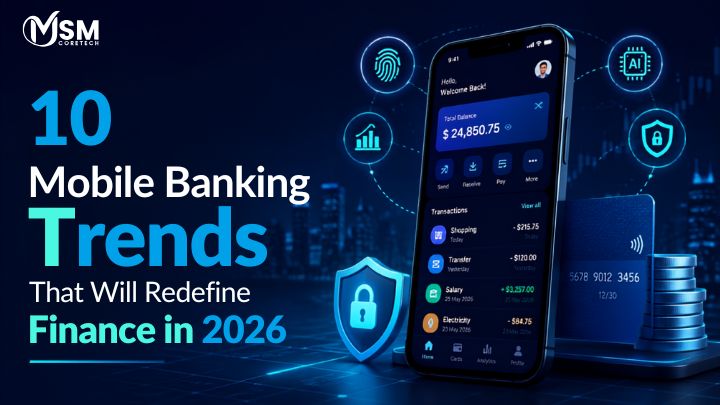
Banking looks nothing like it did even five years ago, and 2026 is shaping up to be the year mobile finally takes over completely. Branches are quieter, passbooks are gone, and almost every money decision from checking a balance to applying for a loan happens on a smartphone screen. This shift hasn’t happened overnight. It’s the result of years of steady investment in apps, AI, and security, and it’s now reaching a tipping point where mobile banking isn’t just an option anymore; it’s the default way people manage their money.
In this guide, we’ll walk through what mobile banking really means today, look at the market numbers behind the hype, and break down the 10 biggest mobile banking trends, digital banking trends, and banking technology trends shaping 2026, plus what businesses and banks need to do to keep up.
Also Read: Top 10 Digital Payment Apps
What is Mobile Banking?
Mobile banking, in the simplest terms, is the ability to handle your banking through an app on your phone instead of visiting a branch or even logging into a desktop website. It covers everything from checking your balance and transferring money to paying bills, applying for loans, investing, and talking to customer support, all from a device that fits in your pocket. What makes mobile banking different from just “online banking” is the experience. It’s built specifically for touchscreens, smaller screens, and quick, on-the-go actions, using things like fingerprint login, push notifications, and camera-based check deposits that a desktop site simply can’t offer in the same way.
How Mobile Banking Has Evolved
Mobile banking didn’t start as the smooth, feature-packed experience we see today. In the early 2000s, it began with basic SMS alerts telling you your balance or reminding you about a due payment. Then came WAP-based mobile sites, which were clunky and slow but at least let you check your account without calling the bank. The real shift happened with the arrival of smartphones and dedicated banking apps around 2010 onwards, when banks started building native apps with real functionality: transfers, bill payments, and card controls.
Over the last few years, that evolution has sped up dramatically. Apps now come with AI chatbots, biometric logins, personalized spending insights, and even investment tools built right in. What used to be a simple tool to check your balance has turned into a full financial command center that lives on your home screen.
Why Mobile Banking Matters in 2026
In 2026, mobile banking matters because it’s no longer a “nice to have” feature for banks; it’s the main way most people interact with their money. Customers expect instant account opening, real-time alerts, and AI-driven advice, and if a bank’s app doesn’t deliver that, customers simply switch to one that does.
For banks and financial institutions, mobile banking is also a huge cost-saver: digital transactions cost a fraction of what branch or call-center transactions cost, and a good app keeps customers engaged and loyal. On top of that, government-backed digital payment pushes, open banking regulations, and the rise of AI have all converged in 2026 to make mobile the centerpiece of every serious banking strategy, not just a side channel.

Mobile Banking Market Overview (2026)
The mobile banking market has grown into a genuinely massive industry. Depending on how the research firm defines the scope, estimates vary, but the direction is the same everywhere: strong, consistent growth. One widely cited estimate puts the global mobile banking market at roughly $1.93 billion in 2026, on its way to $3.3 billion by 2030 for the core mobile banking software segment specifically. Looking at the broader mobile banking industry, including transaction revenue, the market generated about $1.92 trillion in revenue in 2025 alone, a 28% jump year over year, showing just how much money is now moving through mobile channels.
Key Market Drivers
A handful of forces are pushing this growth, and they reinforce each other rather than working in isolation.
- Smartphone penetration: More people than ever own smartphones capable of running full-featured banking apps, especially in emerging markets where mobile phones skipped past desktop computers entirely.
- Digital payment adoption: Contactless payments, UPI-style instant transfers, and QR codes have made cashless transactions the norm rather than the exception in most countries.
- AI-powered banking: Banks are using AI to personalize offers, detect fraud, and automate customer support, making mobile apps smarter and more useful with every update.
- Government initiatives: Programs promoting financial inclusion and digital payments, especially in Asia, Africa, and Latin America, are pulling millions of new users into mobile banking for the first time.
- Open Banking regulations: Rules like PSD2 in Europe and similar frameworks elsewhere are forcing banks to open up their data through APIs, which has directly fueled new mobile-first financial products.
Also Read: FinTech App Design
Why Mobile Banking is Growing Faster Than Traditional Banking
People simply don’t want to wait in line anymore, and honestly, why would they when a transfer that used to take a branch visit now takes ten seconds on a phone? Customer expectations have shifted permanently toward instant, self-service experiences. This isn’t limited to younger users either; even older customers who once resisted digital banking have gotten comfortable with mobile apps, especially after being nudged toward them during branch closures and reduced in-person hours over the past several years.
Rise of Cashless Payments
Cash is quietly disappearing from everyday transactions. Digital wallets, tap-to-pay cards, and QR-code payments have made cashless the default in cafes, taxis, and even small local shops. This shift feeds directly into mobile banking growth because every cashless transaction usually touches a mobile app at some point, whether it’s checking a balance right after a purchase or setting up a recurring payment.
Improved Banking Security
Ironically, one of the things that used to hold mobile banking back security fears is now one of its biggest growth drivers. Biometric logins, real-time fraud alerts, and encrypted transactions have made mobile banking feel safer than carrying cash or even using a physical card, which has removed a major psychological barrier for cautious customers.
Better Customer Experience
Traditional banking often meant filling out forms, waiting for approvals, and dealing with rigid business hours. Mobile apps have flipped that experience completely, with instant account opening, 24/7 access, and interfaces designed to feel more like a favorite consumer app than a stiff financial tool.
AI-Driven Personalisation
AI has made banking feel less generic. Instead of every customer seeing the same static dashboard, apps now show tailored spending insights, personalized product offers, and smart nudges based on individual financial behavior, which keeps people coming back to their app far more often than they’d ever visit a branch.
Also Read: Crypto Wallet App Development Guide
10 Mobile Banking Trends Transforming Finance in 2026
Mobile banking isn’t just getting new features tacked on anymore; it’s being rebuilt from the ground up around AI, security, and convenience. The trends below aren’t small updates either; they’re reshaping how people bank day to day and what customers now expect from any app they trust with their money. Here’s a look at the 10 trends leading that shift in 2026.
1. AI-Powered Personal Finance Assistants
AI has moved from being a backend tool to a front-and-center feature that customers interact with directly inside their banking apps. These AI-powered assistants don’t just answer basic questions anymore they actively help manage money.
How AI is Revolutionising Banking
AI assistants inside banking apps now analyze spending patterns, predict upcoming bills, and flag unusual account activity in real time, essentially acting like a financial coach that’s available 24/7 without any extra cost to the customer.
Intelligent Budgeting
Instead of manually entering expenses into a spreadsheet, AI now automatically categorizes transactions and builds budgets based on actual spending habits, adjusting recommendations as income or expenses change month to month.
Automated Savings
Many apps now round up purchases or move small amounts into savings automatically based on spending patterns, making saving effortless rather than something that requires willpower or manual transfers.
Spending Insights
AI breaks down spending into categories like groceries, entertainment, or travel, and highlights patterns customers might not notice themselves, such as a slow creep in subscription costs over several months.
Financial Health Scores
Some banking apps now generate a personal “financial health score,” similar to a credit score but focused on overall money habits, giving users a simple number to track improvement over time.
Examples
Bank of America’s Erica has become one of the most widely used AI banking assistants, handling millions of customer interactions monthly. JPMorgan Chase has similarly invested heavily in AI-driven insights across its mobile app, while Revolut has built AI-powered budgeting and spending analysis tools directly into its app experience, making these features a standard expectation rather than a premium add-on.
2. Hyper-Personalised Banking Experiences
Generic, one-size-fits-all banking apps are quickly becoming a thing of the past. In 2026, personalization has become one of the most important mobile banking trends because customers expect their app to understand their specific financial situation.
AI-Based Product Recommendations
Banks now use transaction history and behavior patterns to recommend relevant products, like suggesting a savings account to someone who consistently has extra balance sitting idle, rather than pushing the same generic offers to every customer.
Personalised Investment Suggestions
Investment features inside banking apps are increasingly tailored to risk appetite and goals, offering suggestions that match a customer’s actual financial situation instead of generic “one-size-fits-all” portfolios.
Smart Loan Offers
Instead of customers applying and waiting to see if they qualify, many apps now proactively show pre-approved loan offers based on account history, cash flow, and repayment behavior, cutting down approval time significantly.
Custom Financial Planning
Some advanced apps now let users set specific goals, like buying a house or saving for a wedding, and then build a personalized savings and investment plan around that specific goal, adjusting recommendations as circumstances change.
3. Biometric Authentication & Passwordless Banking
Passwords are becoming less relevant in mobile banking, replaced by faster and more secure biometric methods that also happen to be far more convenient for everyday use.
Face Recognition
Facial recognition has become a standard login method on most modern banking apps, allowing users to access their accounts in under a second without typing anything.
Fingerprint Login
Fingerprint authentication remains one of the most widely used biometric methods, especially for quick actions like approving a transaction or checking a balance.
Voice Authentication
Some banks, especially for phone banking and voice assistant integration, are now using voice pattern recognition to confirm a customer’s identity during calls or voice commands.
Behavioural Biometrics
This is a quieter but increasingly important layer of security, where the app analyzes how a person types, holds their phone, or swipes, and flags anything unusual even if the correct password or fingerprint was used.
Multi-Factor Authentication
Combining two or more of these methods, like fingerprint plus device recognition, has become standard practice, especially for higher-risk actions like large transfers or adding a new payee.
Benefits
- Higher security: Biometric data is far harder to steal or replicate compared to a password.
- Faster login: Customers can access their accounts in seconds rather than typing and re-typing credentials.
- Reduced fraud: Combining biometrics with behavioral analysis makes it significantly harder for fraudsters to impersonate genuine customers.
4. Embedded Finance is Becoming Mainstream
One of the biggest shifts in banking technology trends is that banking is no longer confined to banking apps; it’s showing up inside the apps people already use every day.
What is Embedded Finance?
Embedded finance means financial services, like payments, lending, or insurance, are built directly into non-financial apps, so users never have to leave the app they’re already using to complete a financial transaction.
Banking Inside Other Apps
Ride-sharing apps, e-commerce platforms, and even food delivery apps now offer built-in wallets, saved payment methods, and sometimes even banking-like accounts, blurring the line between “bank” and “app.”
Buy Now Pay Later (BNPL)
BNPL has exploded as one of the clearest examples of embedded finance, letting customers split purchases into installments directly at checkout without applying for a separate loan or credit card.
Banking APIs
This entire trend is powered by banking APIs, which let non-bank companies plug directly into banking infrastructure to offer financial features without becoming a licensed bank themselves.
Embedded Lending
Small businesses using platforms like Shopify can now access financing offers based directly on their sales data, without ever filling out a traditional loan application at a bank branch.
Examples
Uber allows drivers to access instant payouts through embedded banking features. Shopify offers merchants embedded lending and payment processing tools built right into their seller dashboard. Amazon has expanded credit and lending products embedded into its marketplace experience, and Apple continues to grow Apple Pay and Apple Card as deeply embedded financial tools within its wider device ecosystem.
5. Open Banking & API Integration
Open banking has quietly become one of the most transformative digital banking trends of the decade, and 2026 is when it’s really hitting mainstream scale.
Understanding Open Banking
Open banking allows customers to securely share their financial data with third-party apps and services, with their consent, enabling things like budgeting apps that pull data from multiple banks into one dashboard.
API Ecosystem
Behind every open banking feature is a network of APIs that let different financial systems talk to each other securely, and this ecosystem is expanding rapidly, with the global open banking market projected to surpass $48 billion in 2026, continuing its steep growth trajectory.
Third-Party Financial Services
Fintech companies are increasingly building specialized tools, like better budgeting apps or faster loan comparison platforms, using banking APIs rather than building their own banking infrastructure from scratch.
Faster Innovation
Because banks don’t have to build every feature themselves, open banking allows innovation to happen faster, with fintech partners often launching new features months or years before a traditional bank could build the same thing internally.
Better Customer Control
Customers benefit directly too, since open banking gives them more control over who can access their financial data and for what purpose, rather than that data being locked entirely inside one bank’s systems.

6. Digital Wallets Continue to Dominate
Digital wallets have gone from a convenience feature to the primary way many people pay, and this trend shows no signs of slowing down in 2026.
Contactless Payments
Tap-to-pay has become the default payment method in most urban areas, with customers often preferring it over inserting a card or, obviously, paying with cash.
Mobile Wallet Growth
More banks are integrating their own wallet features directly into their apps, rather than relying solely on third-party wallets, giving them more control over the customer payment experience.
QR Payments
QR-code-based payments remain especially popular in Asia and parts of Africa, offering a low-cost way for even small vendors to accept digital payments without expensive card machines.
NFC Payments
Near-field communication technology powers most tap-to-pay transactions, and its reliability and speed have made it a trusted standard across both developed and emerging markets.
Multi-Currency Wallets
For frequent travelers and international shoppers, multi-currency digital wallets that hold and convert several currencies at once have become an increasingly requested feature in modern banking apps.
Examples
Apple Pay and Google Wallet remain the dominant players in many Western markets, while Samsung Wallet continues to grow alongside Samsung’s device ecosystem. PayPal remains a trusted option for online purchases, and in markets like India, PhonePe and Google Pay have become so widely used that they’re practically synonymous with everyday digital payments.
7. Blockchain & Tokenised Banking
Blockchain technology has moved past the hype phase and is now being applied to real, practical banking problems, making it one of the more technical but important banking technology trends of 2026.
Cross-Border Payments
Traditional international transfers can take days and involve high fees, but blockchain-based payment rails are increasingly used to settle cross-border transactions in minutes at a fraction of the cost.
Smart Contracts
Self-executing contracts built on blockchain are being used for things like automated loan disbursements or insurance payouts, removing manual steps and reducing processing delays.
Tokenised Assets
Real-world assets like bonds, real estate, or even fine art are increasingly being “tokenised,” meaning ownership is represented digitally on a blockchain, making fractional ownership and trading much easier.
CBDCs
Central Bank Digital Currencies, or CBDCs, are digital versions of a country’s official currency issued directly by its central bank, and several countries have moved from pilot programs to broader testing phases throughout 2025 and 2026.
Decentralised Finance (DeFi)
While still more niche than mainstream banking, DeFi platforms that allow lending, borrowing, and trading without traditional intermediaries continue to influence how traditional banks think about efficiency and cutting out unnecessary middlemen.
8. Voice Banking & Conversational AI
Typing and tapping aren’t always convenient, and voice banking has grown into a genuinely useful mobile banking trend rather than just a novelty feature.
Voice Assistants
Customers can now check balances, make transfers, or ask about recent transactions simply by speaking to their banking app, which is especially useful for quick checks while multitasking.
AI Chatbots
Text-based chatbots have become significantly smarter, capable of handling complex queries about disputes, card replacements, or loan status without needing to escalate to a human agent most of the time.
Banking Through Smart Devices
Smart speakers and wearables are increasingly integrated with banking apps, allowing basic banking actions to happen without even pulling out a phone.
24/7 Customer Support
Perhaps the biggest practical benefit of conversational AI is availability customers no longer have to wait for business hours to get answers to simple banking questions.
Examples
Alexa-based banking skills allow certain balance checks and payment reminders through smart speakers. Google Assistant integration offers similar convenience for Android users, and increasingly, banks are experimenting with ChatGPT-powered banking assistants capable of holding much more natural, human-like conversations about complex financial topics.
9. Sustainable & Green Digital Banking
Sustainability has moved from a marketing talking point to an actual feature set inside banking apps, reflecting growing customer interest in environmentally conscious finance.
Paperless Banking
Digital statements, e-signatures, and paperless account opening have become standard, cutting down significantly on the paper waste traditional banking used to generate.
Carbon Footprint Tracking
Some banking apps now estimate the carbon footprint of a customer’s spending based on transaction categories, giving people a rough sense of their environmental impact directly within their banking app.
ESG-Focused Banking
Environmental, Social, and Governance (ESG) focused banking products, like green savings accounts or ethical investment portfolios, are increasingly available directly through mobile banking apps.
Green Investment Features
Investment tools within banking apps increasingly let customers filter or choose funds specifically focused on renewable energy, sustainable companies, or other environmentally responsible sectors.
10. Stronger Cybersecurity & Fraud Prevention
As mobile banking has grown, so has the sophistication of fraud attempts, making cybersecurity one of the most critical banking technology trends heading further into 2026.
AI Fraud Detection
AI systems now analyze transaction patterns in real time, flagging anything unusual, like a large transfer to a new payee at an odd hour, often before the transaction even completes.
Real-Time Transaction Monitoring
Rather than reviewing suspicious activity after the fact, banks increasingly monitor transactions as they happen, allowing them to block fraudulent transactions before money actually leaves an account.
Zero Trust Security
Zero trust security models assume no device or login attempt should be automatically trusted, verifying identity and device integrity continuously rather than just once at login.
Device Intelligence
Banking apps now recognize trusted devices and flag logins from unfamiliar devices or locations, adding an extra layer of scrutiny for anything that looks out of the ordinary.
Behaviour Analytics
By learning how a genuine customer typically behaves, apps can spot subtle deviations, like unusual typing speed or navigation patterns, that might indicate account takeover attempts even when correct credentials are entered.
Also Read: Cost to Develop a Fintech App Like Wise
Emerging Technologies Powering Mobile Banking
None of these mobile banking trends and digital banking trends would be possible without the underlying technology stack that makes them work. Artificial Intelligence continues to be the biggest driver, powering everything from chatbots to fraud detection.
Machine Learning, a subset of AI, specifically helps systems improve their predictions over time as they process more transaction data. Blockchain provides the infrastructure for tokenised assets, faster cross-border payments, and emerging CBDC projects. Cloud Computing gives banks the flexibility to scale their apps up or down instantly without maintaining expensive physical servers, while also making it easier to roll out updates and new features faster than traditional infrastructure ever allowed.
Big Data Analytics helps banks make sense of the massive amount of transaction and behavioral data generated every second, turning raw numbers into useful personalization and risk insights. The Internet of Things (IoT) is starting to play a role too, particularly through wearables and connected devices that can trigger payments or alerts. 5G Technology ensures banking apps load faster and handle real-time features like video KYC or live chat support smoothly, even in areas with historically weaker connectivity. And Edge Computing, which processes data closer to the device rather than sending everything to a distant server, is helping reduce latency for time-sensitive banking actions like fraud checks and biometric verification.
Also Read: Build Your Own Payment Gateway
Key Features Every Modern Mobile Banking App Should Have
A truly competitive mobile banking app in 2026 needs a fairly comprehensive feature set to keep up with customer expectations. This includes Instant Account Opening, so new customers don’t abandon signup halfway through a lengthy process, backed by Digital KYC that verifies identity quickly using document scanning and facial recognition. Core functionality like Fund Transfers, QR Payments, and Bill Payments needs to be fast and reliable, since these are the features customers use most often.
Card Management tools let users freeze, unfreeze, or set spending limits on their cards directly from the app, while Expense Tracking and AI Financial Insights give customers a clearer picture of their spending habits without extra effort. Investment Management and Loan Management features are increasingly expected inside the same app rather than requiring separate platforms, alongside a built-in Budget Planner that helps customers set and stick to spending goals.
Push Notifications keep customers informed of important account activity in real time, while responsive Chat Support handles questions quickly without long hold times. Finally, Digital Wallet Integration ties everything together, letting customers store cards, make contactless payments, and manage multiple payment methods from one central place.
Benefits of Modern Mobile Banking
For Customers
Customers get a genuinely better deal from modern mobile banking on almost every front. Faster Transactions mean money moves in seconds rather than days for most routine actions. 24/7 Banking removes the constraint of business hours entirely, letting people manage money whenever it’s convenient for them.
Better Security through biometrics and real-time monitoring gives customers more confidence in using their app for sensitive actions. Financial Insights generated by AI help people understand their own habits better than they typically would on their own, and Personalised Services mean the app increasingly feels tailored to individual needs rather than generic and one-size-fits-all.
For Banks
Banks benefit just as much, if not more, from investing heavily in mobile banking. Lower Operational Costs come from shifting routine transactions away from expensive branch and call-center interactions toward self-service digital channels. Higher Customer Engagement results from apps that customers actually open regularly, rather than accounts people forget about between statements.
This engagement often translates into Increased Revenue, since banks can cross-sell relevant products directly through the app based on customer behavior. Better Fraud Prevention comes from the same AI and monitoring tools that protect customers, reducing losses from fraudulent transactions. And overall, a strong mobile app strategy leads to Faster Digital Transformation, helping banks modernize their broader operations rather than just their customer-facing app.
Also Read: How to Build a Mobile Banking App?
Challenges Facing Mobile Banking in 2026
Despite all this growth, mobile banking still faces real challenges that banks and fintech companies need to take seriously. Cybersecurity Threats remain a constant concern, since fraudsters are becoming more sophisticated at the same pace as the security tools designed to stop them. Regulatory Compliance adds complexity too, especially for banks operating across multiple countries with different rules around data sharing and consumer protection. Data Privacy concerns are growing alongside personalization, since customers want tailored experiences but are increasingly cautious about how much data they’re comfortable sharing to get them.
Legacy Banking Systems continue to slow things down for many traditional banks, whose core infrastructure wasn’t built with modern mobile-first features in mind, making updates slower and more expensive than for newer digital-only competitors. Digital Inclusion remains an issue in regions with limited smartphone access or internet connectivity, where mobile-first strategies risk leaving certain populations behind. Customer Trust can also be fragile, since a single security breach or app outage can undo years of built-up confidence very quickly. And finally, Rising Fraud Techniques, including increasingly convincing scams and social engineering attacks, mean banks have to continuously evolve their defenses rather than treating security as a one-time investment.
Future of Mobile Banking Beyond 2026
Looking further ahead, mobile banking is expected to keep evolving in some genuinely exciting directions. AI-First Banking will likely mean apps are built around AI decision-making from the ground up, rather than AI being added on as a feature later. Autonomous Finance takes this further, with apps potentially handling routine financial decisions, like moving money to savings or paying bills, with minimal manual input once customers set their preferences. Invisible Banking describes a future where banking happens so seamlessly in the background of other apps and services that customers barely notice they’re using a “bank” at all.
Embedded Banking Everywhere will likely expand well beyond today’s examples, showing up in even more everyday apps and services. Smart Wearable Payments will continue growing as smartwatches and other wearables become more capable of handling secure payments on their own. Quantum-Resistant Security is likely to become an important research and investment area as quantum computing advances, since current encryption methods could eventually become vulnerable to quantum-based attacks. And Central Bank Digital Currencies (CBDCs) are expected to move from pilot testing toward more widespread real-world use in several countries, potentially reshaping how digital money moves at a fundamental level.
How Businesses Can Prepare for the Future of Mobile Banking
Financial institutions and fintech businesses that want to stay competitive need to act on several fronts at once. They should invest in AI, not just for chatbots but for deeper personalization, fraud detection, and operational efficiency. Adopting Cloud Infrastructure gives businesses the flexibility to scale and update apps far faster than legacy systems allow. Building API-First Platforms ensures they can plug into the growing open banking ecosystem and partner with fintechs rather than trying to build everything internally.
Enhancing Security needs to be treated as an ongoing investment rather than a one-time project, given how quickly fraud techniques evolve. Delivering Personalised Experiences will increasingly separate winning apps from forgettable ones, since customers have gotten used to tailored recommendations from other consumer apps too.
Staying Compliant across shifting regulations, especially around open banking and data privacy, protects businesses from costly penalties and reputational damage. And finally, businesses need to Leverage Data Analytics properly, turning the massive amount of data generated by mobile banking activity into genuinely useful insights rather than letting it sit unused.
Also Read: How Much Does It Cost To Build A Fintech App?
Why Choose MSM Coretech for Mobile Banking App Development?
Building a mobile banking app that can keep up with all these trends takes more than just good design; it needs deep technical expertise, strong security practices, and a genuine understanding of financial regulations. This is where MSM Coretech, as a mobile banking app development company, brings real value to banks, fintech startups, and financial institutions looking to build or upgrade their mobile presence.
Banking App Development Expertise
MSM Coretech has hands-on experience building finance-focused mobile and web applications, understanding the specific technical and regulatory demands that separate banking apps from typical consumer apps.
AI-Driven Banking Solutions
The team builds AI-powered features like personalized insights, smart budgeting tools, and fraud detection systems directly into banking apps, helping clients keep pace with the AI-first direction the entire industry is heading toward.
Secure & Scalable Architecture
Every banking app MSM Coretech builds is designed with security and scalability in mind from day one, using encryption, biometric authentication support, and cloud-based infrastructure that can grow alongside a growing user base.
Regulatory Compliance Support
Given how complex financial regulations can get, MSM Coretech works closely with clients to build apps that align with relevant compliance requirements around data protection and financial reporting.
Custom FinTech Development Services
Beyond just banking apps, MSM Coretech offers broader custom fintech development services, including digital wallets, payment gateways, and lending platforms tailored to each client’s specific business model.
End-to-End Development Process
From initial planning and UI/UX design through development, testing, and deployment, MSM Coretech manages the entire app development lifecycle, giving clients a single, accountable partner throughout the process.
Ongoing Maintenance & Support
App development doesn’t end at launch, and MSM Coretech continues supporting clients with updates, security patches, and feature enhancements to keep apps competitive as mobile banking trends continue evolving.
Conclusion
Mobile banking in 2026 has become the heart of how people manage money, and the pace of change shows no sign of slowing down. From AI-powered assistants and hyper-personalization to biometric security, embedded finance, and blockchain-backed innovations, the ten trends covered in this guide show just how much banking technology has advanced in a short span of time. What’s clear across all of these mobile banking trends and digital banking trends is that customers now expect speed, security, and personalization as the baseline, not as bonus features.
For banks and fintech businesses, staying competitive means investing seriously in the right technology, talent, and partnerships rather than treating mobile as just another channel. Working with an experienced mobile banking app development company like MSM Coretech gives financial institutions the technical foundation and ongoing support needed to build apps that customers genuinely trust and enjoy using. As 2026 unfolds and new banking technology trends continue emerging, the businesses that adapt early will be the ones best positioned to lead the next chapter of digital finance, while those that hesitate risk falling behind customers who have already moved on to mobile-first alternatives.
FAQs
AI-powered personal finance assistants are arguably the biggest trend right now. They’ve moved beyond simple chatbots to actively manage budgets, flag unusual spending, and predict upcoming bills. Apps like Erica from Bank of America show just how mainstream this has become.
In many ways, yes biometric logins, real-time fraud monitoring, and behavioral analytics make mobile banking harder to compromise than a lost card or stolen cash. That said, security still depends on the bank’s technology and the user’s own habits, like avoiding public Wi-Fi for transactions.
Embedded finance means banking features, like payments or lending, show up inside apps that aren’t banks at all, such as ride-sharing or e-commerce platforms. It matters because it puts financial services directly into moments where customers already need them, without extra steps.
Regular mobile banking is about accessing your own bank’s services through an app. Open banking goes further, letting you securely share your financial data with third-party apps and services with your consent. This powers tools like budgeting apps that pull data from multiple banks at once.
Probably not completely, but branches will keep shrinking in number and role. Most routine banking will stay mobile-first, while branches increasingly focus on complex needs like mortgages or business banking that still benefit from face-to-face conversations.

Related Posts
Challenges of Building a Music Streaming Mobile App
What makes people keep using a music streaming app? It’s not just having millions of songs. The real reason is...
Read More

10 Profitable Restaurant Business Ideas You Can’t Afford to Miss
The restaurant industry is growing rapidly and creating new opportunities for entrepreneurs who want to start a profitable business. With...
Read More
Top 10 Digital Payment Apps for Secure Online Transactions in 2026
Cash is quietly fading into the background, and 2026 is the year digital payment apps have taken over almost every...
Read More


 Verified Review




 +91 9426029999
 311, 3rd Floor, Space 7, Sector 7, Shipra Path, Mansarovar, Jaipur, Rajasthan 302020