

Share this article


The Technology Behind Popular Dating Applications
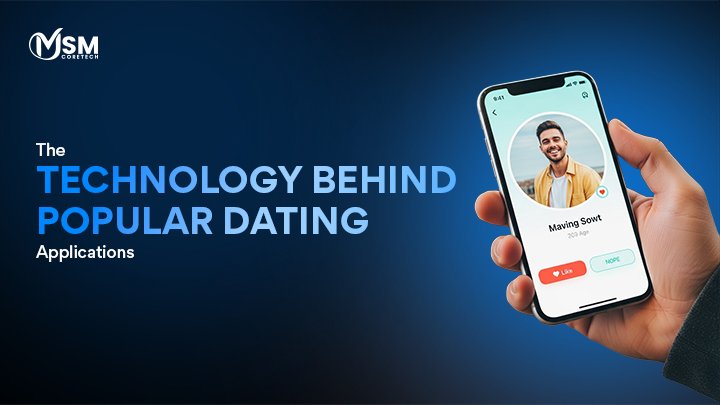
Dating apps have reshaped how people form connections, turning a simple swipe into a window of possibility for hundreds of millions of users around the world. What started as basic profile-matching websites has grown into a layered ecosystem of machine learning engines, real-time geolocation systems, behavioral analytics, and cloud infrastructure working together at impressive speed. Today, apps like Tinder, Hinge, Bumble, and OkCupid are not just social platforms; they are sophisticated technology products built to understand human preferences, predict compatibility, and create meaningful conversations at scale.
The scale of that investment is hard to ignore. According to TechCrunch (December 2025), Hinge’s AI recommendation feature drove a 15% increase in matches and contact exchanges in its first quarter of rollout alone. Match Group committed $60 million toward AI and product development at Tinder for 2026. These are not incremental feature updates; they reflect a fundamental rebuild of how dating technology works under the hood. Dating App Development Services are now in high demand as businesses look to build similar AI-powered, scalable, and user-focused platforms.
Dating App Market Statistics
The dating app industry continues to grow rapidly, driven by changing user behavior and widespread mobile adoption. Here are some key numbers that highlight the current market landscape:
- The global dating app market generates over $6 billion in annual revenue, reflecting consistent growth year after year.
- More than 350 million users worldwide actively use dating apps, making them one of the most popular social platforms today.
- Tinder remains the market leader, contributing a major share of total revenue and consistently ranking as the top-grossing dating app.
- While the United States leads the market, regions like Europe and Asia are seeing strong growth due to rising smartphone usage and evolving dating trends.
Get a Free Quote: Hire Dating App Developer

How Dating App Matching Algorithms Actually Work
At the heart of every dating app is a matching algorithm, but not all of them work the same way. Platforms have moved well beyond simple keyword or demographic filters. Modern matching systems pull from multiple data inputs simultaneously: what you write in your profile, which profiles you spend time on, who you like or skip, what you say in conversation, and even how quickly you respond to messages.
Hinge uses a version of the Gale-Shapley algorithm, a Nobel Prize-winning matching framework that weighs mutual compatibility rather than one-directional popularity. This is why Hinge feels different from a surface-level swipe app. Instead of pushing the most-liked profiles to the top, the system looks for realistic, two-sided compatibility signals. The November 2025 deep learning update added more weight to commented likes, recognizing that users who write personalized notes are signaling genuine interest rather than casual browsing.
Tinder’s approach has also shifted significantly. Its Chemistry feature, which began rolling out in late 2025, curates a smaller daily set of high-quality matches rather than serving an endless scroll. The goal is quality over volume, directly addressing the swipe fatigue that caused paying user numbers to dip 8% in 2025. OkCupid, on the other hand, has leaned deeper into values-based matching, with its Deep-Match AI system analyzing thousands of user responses to predict long-term compatibility.
Also Read: Challenges in Dating App Development
Machine Learning and Behavioral Data
Machine learning is the engine that keeps dating apps getting smarter the more you use them. Each action a user takes generates data that is fed back into the recommendation model. When you skip a profile quickly, the system notes the visual and demographic characteristics of that profile. When you spend three minutes reading someone’s prompts before liking them, that extended attention becomes a signal too.
This feedback loop allows the algorithm to refine its picture of what you actually want versus what you say you want. Research has consistently shown that people often contradict their stated preferences in practice. Someone who insists they only want to date within five miles ends up matching with someone 30 miles away. Machine learning models catch those contradictions and adjust accordingly, making the experience feel more intuitive over time.
Natural language processing is now woven into these systems as well. Apps analyze the tone and content of first messages, conversation starters, and prompt responses to identify patterns that lead to successful dates. Hinge’s AI Convo Starters tool uses this type of analysis to suggest personalized openers, backed by its own research finding that 72% of users are more likely to respond to a match that includes a thoughtful opening message.
Also Read: Top 5 WordPress Website Development Companies in Newcastle
Geolocation Technology and Proximity-Based Matching
The swipe model Tinder popularized was built on a straightforward geographic premise: match with someone nearby, start a conversation in seconds, and potentially meet in person soon after. GPS-based location technology made that possible, and it remains one of the most relied-upon features across all major platforms.
The infrastructure behind proximity matching is more complex than a basic distance filter suggests. Dating apps rely on regional data centers placed close to their highest-traffic urban markets to keep latency low. When two users in the same city interact via a locally hosted data center, their requests travel short distances, and responses feel instant. Routing that traffic through distant servers introduces delays that erode the real-time quality of the experience and push users toward competitors.
Happn takes geolocation a step further by surfacing people you have physically crossed paths with in real life, using hyper-local GPS tracking rather than a static radius filter. By 2026, its system will have been refined for accuracy in dense urban environments, creating a kind of serendipity that broader location-based matching cannot replicate.
Also Read: Technology Is Shaping Modern Dating Applications
Cloud Infrastructure and Real-Time Messaging
Behind every match notification and in-app chat is a cloud infrastructure built to handle millions of simultaneous users. Dating apps are among the most message-intensive consumer platforms in existence. A single popular app can process tens of millions of swipes, likes, and conversations every day, all of which need to be stored, delivered, and processed without meaningful delay.
Real-time messaging inside dating apps relies on WebSocket connections that keep a persistent open channel between the app and the server. This allows messages to appear instantly without the user needing to refresh or poll for new data. Cloud messaging services also handle push notifications that alert users to new matches or messages when the app is running in the background on their device.
Bumble’s decision to rebuild its entire platform as a cloud-native, AI-first system for mid-2026 reflects a growing recognition that AI capabilities cannot be layered indefinitely onto legacy codebases. A platform built from the ground up for machine learning workloads can handle recommendation engines, real-time moderation, and behavioral analysis far more efficiently than one that has had these features bolted on over years of incremental development.
Also Read: Top 10 WordPress Website Development Companies in New South Wales
Safety Technology and Identity Verification
Safety has become one of the most actively developed areas across all major dating platforms. Trust is a precondition for genuine engagement, and apps that fail to address safety concerns see user churn regardless of how refined their matching systems are.
Photo verification is now a standard expectation. Tinder’s FaceCheck feature uses facial recognition to confirm that a user’s selfie matches the photos on their profile, reducing interactions with accounts that misrepresent themselves or are entirely fabricated. Match Group reported that FaceCheck measurably reduced interactions with bad actors following its rollout, giving users a more reliable sense that the profiles they see reflect real people.
AI-driven content moderation tools now scan messages, images, and profile content in real time for community guideline violations. Human moderators review flagged material, but automation handles the initial pass at scale. Hinge introduced a comment filter in 2025 that lets users block specific words or phrases from appearing in incoming likes, with an AI-powered filtering layer added on top for content that falls outside user-defined blocks but still warrants screening.
End-to-end encryption, two-factor authentication, and secure cloud storage have become baseline expectations rather than premium features. Emerging platforms are exploring blockchain-based identity verification, where cryptographic proof can be issued without centralizing sensitive personal data on a single server, reducing both breach risk and the concentration of data that users find concerning.
Also Read: AI In Dating Apps
Premium Models and the Technology Behind Monetization
The business model underlying most dating apps requires careful technical calibration. The free tier must be good enough to attract and retain users, while premium features need to deliver measurable value that justifies a recurring payment. Getting either side of this balance wrong hurts the platform’s long-term health.
Premium features like unlimited likes, profile boosts, advanced preference filters, and early visibility into who liked you all require backend systems that track entitlements across sessions and devices. Profile boost mechanics, which temporarily elevate a user’s visibility during peak activity windows, require the app to monitor real-time traffic patterns and serve elevated profiles at precise moments without creating a degraded experience for non-paying users.
Around 35% of dating app users have paid for at least one premium feature, with higher-income users converting at rates closer to 45%. Apps increasingly use machine learning to identify when a specific user is most likely to subscribe, personalizing the timing and framing of upgrade prompts based on recent behavioral signals rather than showing the same generic paywall to everyone.
Also Read: Cross-Platform vs Native iOS
Programming Languages and Technical Stacks
Dating apps are built on a combination of mobile and backend technologies that have matured alongside the broader software industry. Swift handles native iOS development while Kotlin covers native Android. Cross-platform frameworks like Flutter and React Native have become common for teams that want to reach both platforms without maintaining two entirely separate codebases, particularly useful for startups where engineering resources are limited.
Server-side logic powering matching, messaging, and user data management typically runs on Python, Java, Node.js, or Go. Python is especially prevalent in data science and machine learning components due to its mature ecosystem of AI libraries. Databases combine relational systems for structured user data with NoSQL solutions for high-volume behavioral logs and conversation histories that would be prohibitively expensive to store in traditional row-and-column format.
App performance is non-negotiable in this category. Users who encounter slow load times or unreliable messaging leave quickly. Content delivery networks distribute profile photos and static assets globally so the experience feels fast regardless of geography. API design, intelligent caching, and efficient database query patterns all contribute to the responsiveness that keeps users coming back.
Also Read: eCommerce Mobile App Development
What Is Next for Dating App Technology in 2026 and Beyond
The direction of dating app technology in 2026 is clear, even if specific timelines remain in motion. Voice and video are moving from optional add-ons to core parts of the pre-date experience. Hinge has expanded voice note functionality as a way for users to convey personality before committing to a full match. Some platforms are testing virtual shared activity spaces where two matched users can interact inside a digital environment as a lower-stakes alternative to scheduling an in-person meeting.
Personality-based matching is gaining ground as a complement to behavioral data. Apps like Boo and Omi use MBTI personality frameworks to connect users based on psychological compatibility rather than physical proximity or demographic similarity alone. This reflects a broader industry recognition that surface-level swipe matching often fails to predict whether two people will actually enjoy spending time together.
The broader challenge facing the industry is not purely technical. A Forbes Health and OnePoll survey found that 78% of respondents reported burnout from dating apps, and 79% of Millennials and Gen Z said the process felt exhausting. Better technology can improve match quality and reduce friction, but rebuilding genuine user enthusiasm will require the platforms to be more transparent about how their systems work, what data they collect, and what they are actually designed to help users accomplish.

Get a Free Quote: Dating App Development Company In USA
Conclusion
Dating apps are among the most technically sophisticated consumer products ever built. They layer machine learning, real-time infrastructure, geolocation services, content moderation, and secure messaging into a single experience that is meant to feel completely natural. Every swipe, message, and match is backed by engineering decisions that most users never see, and that invisibility is precisely the goal.
Understanding the technology behind these platforms matters whether you are building one, investing in one, or simply trying to make informed choices about which ones to use. The apps that get this right in 2026 will not be the ones with the most features; they will be the ones that combine technical precision with a clear sense of what their users actually need from the experience.
At MSM Coretech Innovations, we build technology that works at this level of depth. If you are exploring a dating app concept or want to understand the architecture behind platforms like these, our team brings the engineering experience to turn that vision into a functional, scalable product.
FAQ
Dating apps use machine learning to analyze your preferences and behavior—like swipes, likes, and chats—to improve matches. Over time, they learn what you actually like (even beyond your stated preferences) and show profiles you’re more likely to connect with, focusing on mutual compatibility rather than just popularity.
Modern dating apps use photo verification, AI moderation, and behavior tracking to detect fake accounts and scams. Tools like facial recognition, real-time content scanning, and pattern analysis help flag suspicious activity, while encryption and two-factor authentication keep users secure.
Dating apps use a multi-layered tech stack: Swift and Kotlin for mobile apps or Flutter/React Native for cross-platform, with backend systems built on Python, Java, Node.js, or Go. They rely on PostgreSQL and NoSQL databases for data, while cloud platforms and CDNs ensure scalability and fast performance.
Dating app development costs range from $30,000–$80,000 for a basic MVP and can exceed $150,000 for advanced features like AI matching, video calls, and subscriptions. Ongoing costs include hosting, maintenance, and updates, so proper planning and prioritization are essential.

Related Posts

10 Key Applications of AI in the Food Industry (2026)
Walk into any restaurant kitchen, grocery warehouse, or food delivery control room today, and you will find something quietly running...
Read More
How To Develop An App Like YouTube Music: A Complete Guide
Music is now a part of our everyday life. People listen to songs while getting ready in the morning, working,...
Read More

Must-Have Features in Fintech Apps & Digital Financial Platforms
Think about how often you use your phone to pay bills, send money, shop online, or check your bank balance....
Read More


 Verified Review




 +44 7427829444
 71-75, Shelton Street, Covent Garden, London, United Kingdom, WC2H 9JQ