

Share this article


How to Launch a Food Delivery App: Top 10 Tips
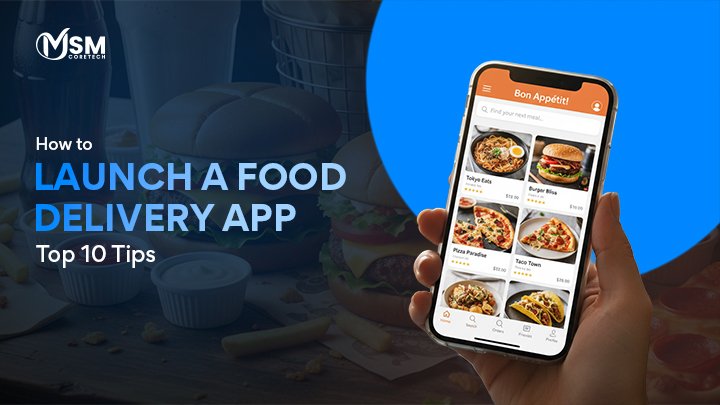
67% of the U.S. Food Delivery Market Is Owned by One App.
In 2013, a group of Stanford University students in San Francisco could not get late-night burritos delivered to their dorm. So they built their own food delivery app. That app became DoorDash. Today, it holds 67% of the U.S. food delivery app market and processes over 2.5 billion orders a year.
You read that right. One idea. One problem. One app. And a trillion-dollar industry followed.
The food delivery market is no longer a nice-to-have. It is a necessity. Whether you are a restaurant owner, a startup founder, or an entrepreneur with a bold vision, building a food delivery app in 2026 could be the smartest move you make this decade. But here is the truth: launching an app is not just about writing code. It is about strategy, timing, the right features, and the right team behind you.
If you are planning to build your own food delivery app, partnering with a reliable food delivery app development company can make all the difference between an app that flops and one that scales.
In this guide, we are breaking down the top 10 tips to launch a food delivery app successfully in 2026, backed by real market data and practical insight.
The Food Delivery Market in 2026: Why This Is the Right Time
Before jumping into the tips, let us look at where the industry stands right now.
Market Size and Growth Stats (2025-2026)
| Metric | Data |
|---|---|
| Global food delivery market revenue (2025) | $1.40 trillion |
| U.S. food delivery revenue (2025) | $429.90 billion |
| Projected U.S. revenue by 2029 | $563.40 billion |
| Global market CAGR (2025-2030) | 7.63% |
| Global market forecast by 2035 | $694.65 billion |
| Mobile app segment market share (2025) | Largest platform segment |
| Orders placed via mobile apps globally (2026) | Over 70% |
| DoorDash U.S. market share (2025) | 67% |
| Uber Eats U.S. market share | 23% |
| Grubhub U.S. market share | 16% |
Sources:Precedence Research, Business of Apps (2025-2026)
Also Read: Develop a Food Delivery App
Consumer Behavior Stats
| Stat | Figure |
|---|---|
| How often do Americans order food delivery | Once every 6.7 days |
| Annual spend per U.S. delivery customer | $1,850 |
| Gen Z and Millennials prefer DoorDash | 59% (ages 18-24) |
| Consumers who prefer low delivery fees | 35% |
| Work as top motivator for ordering | 38% of consumers |
| AI accounting for restaurant interactions by 2025 | 50% |
Top 10 Tips to Launch a Food Delivery App in 2026
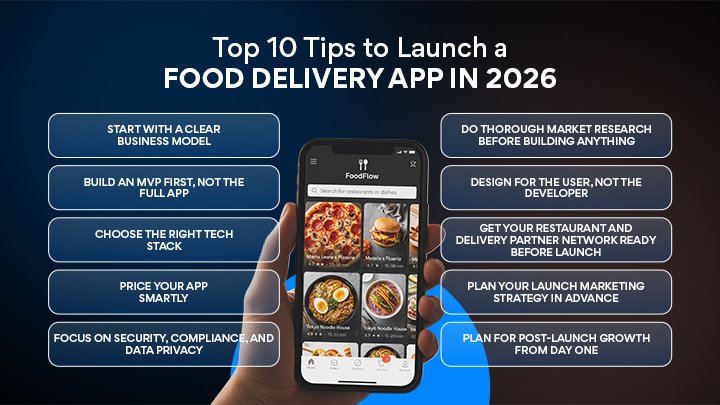
Tip 1: Start with a Clear Business Model
Before writing a single line of code, you need to decide what kind of food delivery business you are running. Your business model shapes your features, your costs, and your entire launch plan.
The Four Core Food Delivery Business Models
| Model | How It Works | Best For |
|---|---|---|
| Order-Only (Aggregator) | You connect customers with restaurants. Restaurants handle their own delivery. | Startups with limited capital |
| Order and Delivery | You manage both the ordering and the delivery fleet. | Full control over user experience |
| Cloud Kitchen / Ghost Kitchen | A delivery-only kitchen with no dine-in facility. Lower overhead, higher margins. | Food entrepreneurs |
| Meal Kit Delivery | Customers subscribe and receive pre-measured ingredients at home. | Health-focused niches |
Each model comes with different costs. An order-only platform can launch in 2 to 3 months, while a full-service platform with your own delivery fleet can take 5 to 7 months to build.
Choosing the wrong model is one of the most common reasons food delivery startups fail, not poor execution. Pick the model that matches your resources, your city, and your growth timeline.
Tip 2: Do Thorough Market Research Before Building Anything
Market research is not a nice-to-have. It is the foundation of your entire product strategy.
Here is what you need to research before development begins:
Research Checklist
| Area | What to Analyze |
|---|---|
| Competitor apps | Features, pricing, delivery time, and user reviews |
| Target audience | Age, location, income level, ordering habits |
| Local market gaps | Underserved cuisines, slow delivery zones, niche dietary needs |
| Restaurant partner landscape | Who is available and who has no current delivery partnership |
| Pricing benchmarks | Average delivery fees, commission rates, subscription models |
Focus on tier-2 cities and suburban markets that big platforms have ignored. Local and regional platforms that understand their community consistently outperform national giants in these areas.
Knowing your audience inside out will directly influence your app’s design, your marketing strategy, and the features you build first.
Tip 3: Build an MVP First, Not the Full App
This is one of the most important tips in this guide. Do not try to build everything at once.
An MVP (Minimum Viable Product) is a stripped-down version of your app that includes only the core features needed to work. It gets your app live faster, costs less, and lets you collect real user feedback before investing in advanced features.
Core MVP Features for a Food Delivery App
| Feature | Why It Matters |
|---|---|
| User registration and login | Basic access and identity management |
| Restaurant and menu browsing | The core user journey starts here |
| Real-time order tracking | Number one expectation from users in 2026 |
| In-app payment gateway | Seamless checkout is non-negotiable |
| Push notifications | Order updates keep users informed and engaged |
| Delivery partner app | Drivers need their own interface to accept and manage jobs |
| Admin dashboard | You need visibility over every order and partner |
Start with these. Get them working flawlessly. Then, in phase two, layer in AI recommendations, subscription plans, and loyalty programs. Using cross-platform app development frameworks like Flutter or React Native can save you up to 30-40% on development costs at this stage.
Tip 4: Design for the User, Not the Developer
App design in 2026 is less about how the app looks and more about how easily it gets the user from hunger to order confirmed. Friction costs you orders.
The best food delivery app design keeps three users in mind at all times: the customer, the restaurant, and the delivery partner. Each of them has a completely different set of needs from the same platform.
User Experience Priorities by Role
| User Type | Key UX Priorities |
|---|---|
| Customer | Fast browsing, easy checkout, live tracking, personalized recommendations |
| Restaurant Partner | Simple order management, clear earnings dashboard, and menu editing tools |
| Delivery Partner | Route navigation, earnings visibility, and order accept/reject options |
| Admin | Real-time analytics, dispute resolution, and user management |
Key design principles for 2026 include smooth scrolling, large clickable targets for mobile users, dark mode support, and accessibility features for a wider audience. Personalized recommendations powered by AI have become a standard expectation, not a luxury.
Tip 5: Choose the Right Tech Stack
Your technology choices determine your app’s speed, scalability, and security. The wrong stack can mean expensive rewrites six months into your launch.
Recommended Tech Stack for a Food Delivery App (2026)
| Layer | Recommended Technologies |
|---|---|
| Frontend (Mobile) | Flutter, React Native |
| Backend | Node.js, Python (Django/FastAPI) |
| Database | PostgreSQL, MongoDB |
| Real-time Tracking | Google Maps API, WebSockets |
| Payment Integration | Stripe, Razorpay, PayPal |
| Cloud Hosting | AWS, Google Cloud Platform |
| Push Notifications | Firebase Cloud Messaging |
| AI and Personalization | TensorFlow, OpenAI API integrations |
5G networks are also transforming real-time capabilities. Smarter routing, faster order updates, and AI-powered personalization are now all achievable at scale thanks to 5G and edge computing.
Also Read: Food Delivery App Development Cost
Tip 6: Get Your Restaurant and Delivery Partner Network Ready Before Launch
The biggest mistake first-time founders make is launching an app with no restaurants or no delivery drivers on it. Users download the app, see nothing nearby, and never return.
Partner Onboarding Strategy
For Restaurants:
Approach local, independent restaurants first. They are easier to onboard and more flexible on commission rates. Offer a commission-free or low-commission trial period for the first 3 months. Provide a simple onboarding kit with their dashboard, menu upload tool, and training guide.
For Delivery Partners:
Offer sign-up bonuses and guaranteed minimum earnings during your launch window. Keep the driver app simple. Drivers want to know their earnings before accepting a job, and they want turn-by-turn navigation built right in. Opacity on earnings is the top driver of partner churn.
Aim for a minimum of 20 to 30 restaurant partners and a stable driver pool before you go live. Quality over quantity in the early stages.
Tip 7: Price Your App Smartly
Revenue model and pricing strategy go hand in hand. You need to monetize without scaring away your restaurants or your customers.
Common Revenue Streams for Food Delivery Apps
| Revenue Stream | How It Works | Typical Rate |
|---|---|---|
| Restaurant Commission | You earn a percentage of every order | 15% to 30% per order |
| Delivery Fees | Charged to the customer per order | $1.99 to $5.99 |
| Subscription Plans | Monthly fee for unlimited free delivery | $9.99 to $14.99/month |
| In-app Advertising | Restaurants pay to be featured | Varies |
| Surge Pricing | Higher fees during peak hours | Dynamic |
Subscription models are growing rapidly. Customers who subscribe spend significantly more and order more frequently than those on pay-per-order plans. Building a subscription tier from day one can dramatically improve your lifetime customer value.
Apps that offer low or transparent delivery fees consistently outperform those that hide costs at checkout. Research shows that 35% of users say low delivery fees are their top priority when choosing a food delivery app.
Tip 8: Plan Your Launch Marketing Strategy in Advance
Building the app is only half the job. Getting people to use it is the other half. Many great apps have failed not because of bad technology but because of bad marketing.
Pre-Launch and Post-Launch Marketing Tactics
| Phase | Tactic |
|---|---|
| Pre-Launch | Build a waitlist, run social media countdowns, and reach out to food bloggers |
| Soft Launch | Invite a small local group, gather feedback, and fix issues quietly |
| Full Launch | Run referral programs, offer first-order discounts, and local PR outreach |
| Retention | Push notifications, loyalty points, seasonal promotions |
| Growth | Influencer partnerships, Google and Meta ads, and SEO-optimized restaurant pages |
Start with hyperlocal marketing. Running a few targeted campaigns in your specific launch city is far more effective than spending your entire budget on broad national ads. Referral bonuses work extremely well for food delivery apps because word of mouth travels fast when someone gets a free meal out of it.
Tip 9: Focus on Security, Compliance, and Data Privacy
In 2026, users are more privacy-conscious than ever. A single data breach can destroy years of brand trust.
Security Checklist for Food Delivery Apps
| Security Area | Requirement |
|---|---|
| Payment Security | PCI-DSS compliance, tokenized card data |
| Data Privacy | GDPR (EU), CCPA (US), local data protection laws |
| User Authentication | Two-factor authentication, OAuth 2.0 |
| API Security | Rate limiting, HTTPS everywhere, JWT tokens |
| Regular Audits | Quarterly security reviews and penetration testing |
Beyond security, make sure your app complies with food safety regulations in your target market. Regulations around contactless delivery, allergen disclosures, and restaurant hygiene ratings vary by country and state. Compliance is not optional, and getting it wrong can mean heavy fines or a forced shutdown.
Tip 10: Plan for Post-Launch Growth from Day One
Your app launch is not the finish line. It is the starting gun. The most successful food delivery platforms treat launch day as the beginning of a continuous improvement cycle.
Post-Launch Growth Framework
| Action | Why It Matters |
|---|---|
| Collect user feedback actively | Identifies friction points you could not see during testing |
| Monitor app analytics weekly | Track retention, order frequency, and drop-off points |
| Release updates consistently | Shows users the app is alive and improving |
| Expand to new neighborhoods | Growth happens block by block before it happens city by city |
| Add new features in phases | AI chatbots, drone delivery, and grocery add-ons after stability |
| Respond to reviews publicly | Builds trust and helps with app store rankings |
The most durable food delivery platforms are not the ones with the most features on day one. They are the ones who built trust, listened to their users, and kept improving. Value delivery and adaptability are the two things that separate platforms that scale from those that stagnate.
Also Read: Food Delivery App Development Process
How Much Does It Cost to Build a Food Delivery App in 2026?
Cost to Develop a Mobile App is always one of the first questions entrepreneurs ask. The honest answer is that it depends on your feature list, your chosen tech stack, your team’s location, and whether you are building for iOS, Android, or both.
Cost Breakdown by App Type
| App Type | Estimated Development Cost | Timeline |
|---|---|---|
| Basic MVP (single restaurant) | $15,000 to $25,000 | 2 to 3 months |
| Mid-tier multi-vendor platform | $30,000 to $60,000 | 4 to 5 months |
| Full-featured marketplace (like Uber Eats) | $60,000 to $100,000+ | 4 to 5 months |
Working with developers in regions like South Asia or Latin America can bring hourly rates from $150+ down to $30 to $50 per hour without a quality compromise. Going cross-platform with a single codebase for both iOS and Android can save an additional 30 to 40%.
Why Choose MSM CoreTech for Your Food Delivery App Development?
When it comes to food delivery mobile app development, choosing the right technology partner makes all the difference.
MSM CoreTech is a full-stack food delivery app development company that brings together deep industry expertise, modern tech stacks, and a results-driven approach. We have helped startups, restaurant chains, and entrepreneurs build scalable, high-performance food delivery platforms across multiple markets.
What sets MSM CoreTech apart is our end-to-end service model. From strategy and design to development, testing, and post-launch support, we manage every phase of your project. Our team specializes in on-demand food delivery app development and understands the nuances of building platforms that serve customers, restaurants, and drivers simultaneously.
We build for real-world scale. Our apps are optimized for performance under peak load, integrated with leading payment gateways, and designed with conversion-first UX principles. We also offer competitive pricing, transparent timelines, and a dedicated project manager for every engagement. If you are ready to turn your idea into a live, revenue-generating food delivery platform, MSM CoreTech is the partner you need.

Conclusion
The food delivery industry is not slowing down. With the global market projected to surpass $694 billion by 2035 and over 70% of all orders already being placed through mobile apps, the opportunity for new players is enormous. But opportunity alone does not build a business. Strategy does.
The 10 tips in this guide give you a clear, practical roadmap: start with the right business model, research your market deeply, build a focused MVP, design for real users, choose the right tech, build your partner network before launch, price smartly, market early, protect your users’ data, and commit to long-term growth.
None of this has to be done alone. Whether you are a first-time founder or an established restaurant chain going digital, working with the right mobile app development company gives you a technical partner who understands both the product and the market.
The next great food delivery app could start with exactly the problem you are trying to solve right now. The only question is, are you ready to build it?
FAQs
A basic MVP typically takes 8 to 12 weeks with a skilled development team. A full-featured platform with all four panels can take 4 to 6 months depending on complexity and scope.
Yes. Each user group has completely different needs and workflows. Combining them into one app creates poor user experience and technical debt that is hard to fix later.
For most startups, starting with the aggregator model with your own delivery fleet in a focused geographic area is the most cost-effective way to launch. It limits your initial investment while letting you test product-market fit quickly.
Revenue streams include restaurant commissions (typically 15% to 30%), subscription memberships, in-app restaurant advertising, surge pricing, and white-label licensing to other operators.
Specialized companies have pre-built modules, proven architectures, and real-world experience handling the complexity of multi-panel food delivery platforms. This saves time, reduces risk, and delivers a better product faster.

Related Posts
10 Key Applications of AI in the Food Industry (2026)
Walk into any restaurant kitchen, grocery warehouse, or food delivery control room today, and you will find something quietly running...
Read More
How To Develop An App Like YouTube Music: A Complete Guide
Music is now a part of our everyday life. People listen to songs while getting ready in the morning, working,...
Read More
Must-Have Features in Fintech Apps & Digital Financial Platforms
Think about how often you use your phone to pay bills, send money, shop online, or check your bank balance....
Read More


 Verified Review




 +44 7427829444
 71-75, Shelton Street, Covent Garden, London, United Kingdom, WC2H 9JQ