

Share this article


How DoorDash Makes $12.64B: DoorDash Business Model and Revenue Sources
If you have ever opened an app at 9 PM, ordered a burrito, and received it at your doorstep within 25 minutes, then you have already used DoorDash. It is one of those companies that has become a regular part of everyday life without most people ever thinking about how it actually works. At first glance, the idea seems very simple. You place an order, DoorDash delivers the food, and everything goes smoothly. However, behind that simple experience is a well-planned business model with several different parts working together to make the entire system run efficiently and profitably.
DoorDash began as a small startup idea in a Palo Alto apartment in 2013. Since then, it has grown into the largest food delivery platform in the United States. Over the years, the company has expanded beyond restaurant deliveries to include groceries, retail products, and even international markets through its acquisition of Deliveroo. Its revenue has increased from less than $1 billion in 2019 to more than $12 billion in recent years. In 2024, DoorDash also achieved a major milestone by becoming consistently profitable for the first time in its history.
In this article, we will explain the DoorDash business model in a simple and easy-to-understand way. There is no complicated business language or hard-to-follow financial terms. We will explore what DoorDash is, how the platform works, who its important partners are, and most importantly, the different ways DoorDash earns money. We will break down each revenue source that contributes to the company’s billions of dollars in annual earnings. We will also take a look at DoorDash’s latest position in 2026, including its growth, market presence, and current business performance. In addition, we will compare DoorDash with other major food delivery platforms to see how it stands out in the competitive market. By the end of this article, you will have a clear understanding of how DoorDash grew from a food delivery app into a multi-billion-dollar global business.
Also Read: Food Delivery App Development Companies in the USA
What is DoorDash?
DoorDash is an online platform that helps people get food, groceries, and other items delivered to their doorstep. It connects three different groups of people in one place: customers who want to order something, restaurants or stores that sell those products, and independent delivery drivers called “Dashers” who pick up and deliver the orders. You can think of DoorDash as a digital middleman. On one side, people are sitting at home who want food or other items delivered quickly. On the other side, there are restaurants and local stores that want to reach more customers but may not have their own delivery team. DoorDash brings both sides together and makes the entire process simple, fast, and convenient through its mobile app and website.
The company was started in 2013 by Tony Xu, Stanley Tang, Andy Fang, and Evan Moore, who were all studying at Stanford University at that time. The idea began as a simple class project when they created a basic website for a local macaron shop that was having trouble getting delivery orders. What started as a small experiment soon grew into a major logistics and delivery company. Today, it operates across the United States, Canada, Australia, Japan, Germany, and several other countries, especially after acquiring the European delivery company Deliveroo in 2024.
What makes DoorDash different from being just a regular food delivery app is that it now offers much more than restaurant deliveries. Today, people can use DoorDash to order groceries from local supermarkets, products from convenience stores, alcohol in areas where it is legally available, flowers, electronics, and even everyday household items from major retail stores. Over time, DoorDash has grown from a simple food delivery service into a much larger local delivery and shopping platform. This is an important point to understand because it plays a big role in how the company generates revenue, which we will discuss in the next section.
DoorDash is also a publicly traded company on the Nasdaq stock exchange under the ticker symbol DASH. This means that anyone can buy its shares and own a small part of the company. Since DoorDash became a public company in December 2020, investors, market analysts, and competitors have been paying close attention to its stock performance and quarterly earnings reports. This is because DoorDash is considered one of the most important companies in the food delivery market and is often seen as a key indicator of how the overall food delivery industry is performing across North America.
Also Read: Cost to Develop a Mobile App
How does DoorDash work?
To understand DoorDash properly, it helps to think of it like a three-legged stool. Each leg plays an important role, and all three need to stay balanced for the system to work smoothly. These three legs are the customer, the merchant (restaurant or store), and the Dasher (delivery driver). If even one of these groups is unhappy, unavailable, or not functioning properly, the entire process can be affected. The platform depends on all three working together at the same time. Now, let’s go through what happens when a customer places an order and see how the whole process works, step by step, in simple everyday language.
Step 1: The Customer Places an Order
It all begins when you open the DoorDash app or visit the website. From there, you can explore restaurants and local stores available in your area, choose the items you want, add them to your cart, and move on to checkout. During checkout, you will see the price of the food or products you selected, along with additional charges such as a delivery fee, a service fee, and, in some cases, taxes. You may also see a suggested tip amount for the Dasher who delivers your order. If you have a DashPass membership, many of these extra fees can be lowered or completely waived, which we will discuss in more detail in the revenue section.
Step 2: The Order Goes to the Restaurant or Store
Once your order is confirmed and the payment is completed, the order is immediately sent to the restaurant’s tablet or point-of-sale (POS) system. The restaurant staff receives the order on their screen, just like they would receive a normal order placed inside the restaurant, and they start preparing the food right away. DoorDash’s system is designed to predict how much time the restaurant will need to prepare the order, so it can schedule the driver’s arrival at the right moment and help make sure the food does not sit waiting for too long and lose its freshness or warmth.
Step 3: A Dasher is Matched to the Order
While the food is being prepared, DoorDash’s system checks for available Dashers nearby and selects the most suitable one for the delivery. The assignment is based on factors such as how close the Dasher is to the restaurant, how many orders they are currently handling, and the estimated time needed to complete the delivery. The selected Dasher then receives a notification with the pickup information and starts heading to the restaurant.
Step 4: Pickup and Delivery
The Dasher reaches the restaurant, collects the packed food order, and then uses the app’s built-in navigation to travel to the customer’s location by car, bike, or on foot. During this entire journey, the customer can track their order in real time through a live map, allowing them to see exactly where their food is at any moment and get an accurate estimate of when it will arrive.
Step 5: Delivery Completion and Payment Settlement
Once the food reaches the customer, the order is considered completed. In the background, DoorDash automatically divides the payment from that order among itself, the restaurant, and the Dasher according to the commission rates and delivery payment terms that have already been set. The entire process, starting from placing the order to successfully delivering it to the customer, generally takes around 25 to 45 minutes. DoorDash has designed its complete technology system to make sure this process stays as fast, smooth, and dependable as possible.
What makes all of this work is a huge logistics system that runs on data, machine learning, and smart route planning. DoorDash is always analyzing customer demand in different areas, making predictions about where more orders will come from, adjusting Dasher earnings so there are enough drivers available during busy times, and improving delivery estimates to make them as accurate as possible. From the customer’s point of view, the process feels simple and easy, but behind the scenes, it is actually a highly complex, real-time logistics challenge that DoorDash solves millions of times every single day.
Also Read: E-commerce App Development Companies in the USA
DoorDash’s Business Model: Explained
Now let’s get into the core of it. DoorDash operates using what is known as a multi-sided marketplace model, which is also often referred to as a platform business model. In simple terms, this means DoorDash does not cook, prepare, or sell any food on its own. It does not own any restaurants, it does not maintain a fleet of company-owned delivery vehicles, and it does not own the groceries or products that customers order through the app. Instead, DoorDash focuses on building and managing the technology platform that brings all the different participants together in one place. It connects customers, restaurants, grocery stores, and delivery drivers through its app and website, making the entire ordering and delivery process smooth and convenient. By acting as the bridge between these groups, DoorDash earns a percentage of every order and transaction that takes place through its platform.
This is actually a very smart and cost-effective way to build a business. If you compare it to a traditional restaurant chain, the difference is huge. Restaurants have to spend a lot of money on setting up kitchens, hiring full-time employees, purchasing ingredients, and managing stock every day. DoorDash avoids most of these expenses. It does not need to own any restaurants or employ delivery drivers as full-time staff. Instead, it created a software platform that connects existing restaurants with independent delivery drivers, and it earns money by bringing both sides together and managing the delivery process efficiently.
There are a few core pillars that make up this business model:
- Asset-light operations: DoorDash does not own a large delivery fleet or physical infrastructure. Instead, it depends on independent delivery workers called Dashers, who use their own cars, bikes, or scooters for deliveries. Because of this, DoorDash avoids the huge expense of buying vehicles and maintaining a company-owned delivery system.
- Multi-sided revenue: DoorDash makes money from different groups at the same time, such as restaurants, customers, and advertisers. It does not depend on only one source of income. This helps reduce risk and also gives the company multiple ways to grow.
- Network effects: DoorDash works on a system where more participation makes the platform better for everyone. When more restaurants join, more customers are attracted. When more customers come in, more Dashers join to earn money. With more Dashers, deliveries become faster, which again brings more customers. This continuous cycle is called a network effect.
- Diversified verticals: DoorDash is not limited to just food delivery. It has expanded into groceries, retail products, alcohol delivery, and also provides logistics services for other businesses through DoorDash Drive. Because of this, the company is not fully dependent on restaurant food orders.
- Technology and data: DoorDash uses large amounts of data collected from millions of orders to improve its system. This helps it predict delivery times more accurately, manage pricing better, and assign Dashers more efficiently. This strong technology layer makes it more than just a delivery service and allows it to scale like a software-driven company.
Simply put, DoorDash’s business model works like a toll booth on a busy road. It did not build the cars, the restaurants, or the roads, but it created the easiest and smartest way to connect all of them. Because of this system, it takes a small fee every time someone uses this route, like a toll. With millions of food orders placed every day, these small fees slowly add up and turn into billions of dollars in yearly revenue.
Also Read: Mobile App Development Companies in California
DoorDash’s Value Proposition
A value proposition simply means the answer to the question, “Why would a person pick this instead of another option?” DoorDash must answer this question three different times, once for every group it serves. Let us see what DoorDash provides to each side of its marketplace.
For Customers
The main value DoorDash gives customers is ease and a wide range of choices. Instead of calling five different restaurants or driving all around the city, a customer can simply open one app and pick from hundreds of restaurants and shops near them. Live order tracking takes away the worry of not knowing exactly when the food will be delivered. DashPass, which is a subscription service, gives extra value by lowering delivery fees for regular users, so in the long term, it becomes more affordable to order often. Along with restaurants, customers can also order groceries, daily household items, and even over-the-counter medicines through the same app, which reduces the need to use any separate delivery service.
For Restaurants and Merchants
For a small restaurant owner, creating a delivery system from the beginning is costly and difficult. It involves hiring delivery drivers, purchasing insurance, developing an ordering app, and managing customer support. DoorDash takes away all this trouble. Restaurants just need to register, and they immediately get access to a huge existing customer base, a well-set delivery network, and software tools to handle and manage orders. DoorDash also provides marketing tools, in-app ad placements, and data insights that help restaurants better understand their customers and increase repeat orders, which is something a small business would hardly be able to afford or build on its own.
For Dashers (Delivery Drivers)
DoorDash’s main benefit is that it gives Dashers a lot of flexibility. Anyone who has a car, a bike, or even just walking shoes in a busy city can sign up and start earning money whenever they want. There are no fixed working hours, and there is no rule that you must work a minimum number of hours. People can choose to dash for just a few hours in between their other jobs, studies, or daily responsibilities. This kind of freedom makes DoorDash, and gig work in general, very popular among students, parents, and people who want to earn some extra money along with their main job.
This three-way value exchange is actually the main reason DoorDash has been able to grow so successfully. It is not just selling one simple benefit to one type of user; instead, it is solving different real-life problems for three different groups at the same time, and that is what keeps all three groups coming back again and again.
Also Read: How Does Zelle Make Money
Key Business Partnerships
No marketplace business can grow on its own, and DoorDash has built its growth by working with a long list of strategic partners in the marketplace industry today. These partnerships help DoorDash expand quickly without needing to build every part of the system from the very beginning. Now, let us take a look at the main types of partners that keep the DoorDash system working and running smoothly and support its operations.
- Restaurant chains and independent restaurants: DoorDash has made deals with big national restaurant chains like Chipotle, Wendy’s, Taco Bell, Subway, and many other large fast-food and casual dining brands, as well as with hundreds of thousands of small local independent restaurants. These partnerships help DoorDash have a well-known presence in almost every neighborhood across the country.
- Retail and grocery chains: DoorDash has expanded a lot into grocery and convenience delivery by partnering with big retail chains such as Albertsons, Safeway, 7-Eleven, Wawa, CVS, and Walgreens. Because of these partnerships, the company is now able to directly compete in the grocery delivery market, which was earlier mainly controlled by services like Instacart.
- Deliveroo acquisition: In 2024, DoorDash bought Deliveroo, a large food delivery company in Europe, which immediately gave it a strong and solid presence in the UK, several parts of Europe, and also in the Middle East. This deal was one of the biggest and most important steps in the company’s history, as it changed DoorDash from mainly a North America–focused business into a truly global company operating worldwide.
- SevenRooms partnership: DoorDash acquired SevenRooms, a hospitality technology company, to support restaurants with table reservations, guest management, and customer relationship management tools. This makes DoorDash’s relationship with restaurants stronger than just food delivery, and it turns the company into a more complete partner that helps and supports the hospitality industry in a wider way.
- Payment and financial partners: DoorDash works together with large credit card companies and banks to offer shared benefits, such as providing free DashPass memberships to customers who have credit cards from selected banks. These partnerships act as a customer acquisition channel, helping bring in new users at a lower cost compared to traditional advertising methods.
- White-label logistics partners: With DoorDash Drive, DoorDash works with big retailers who want to provide delivery service using their own brand name instead of showing DoorDash branding. This means a customer can place an order directly from a retailer’s own app or website, and DoorDash handles all the delivery work in the background without the customer even knowing that DoorDash is involved.
These partnerships matter because they extend DoorDash’s reach far beyond what it could achieve on its own. Every chain restaurant, every grocery partner, and every bank co-branding deal acts like a new doorway, bringing fresh customers into the DoorDash ecosystem, often at very little extra marketing cost to the company itself.
Also Read: Key Trends Shaping Food Delivery Apps
DoorDash Revenue Model: How DoorDash Makes Money?
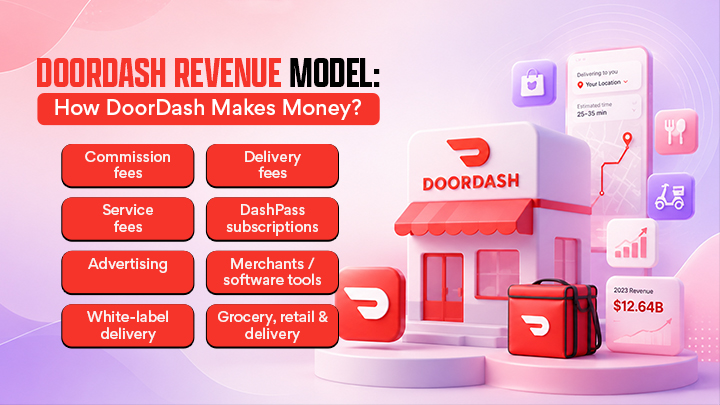
This is the part that most people are really interested in. The DoorDash revenue model is made up of several different ways of earning money, not just one single source. This is actually one of the smartest things about the whole DoorDash business model, because depending on only one income source can be risky. But when earnings come from many small fees collected from different groups, it becomes a much more stable and strong financial system. Below is a complete breakdown of all the main revenue sources of DoorDash.
| Revenue Stream | Who Pays | Roughly How It Works |
|---|---|---|
| Commission fees | Restaurants & merchants | Restaurants pay a percentage of each order’s value, often between 15% and 30%, depending on the plan they choose. |
| Delivery fees | Customers | Customers pay a delivery fee at checkout, which can change based on distance, demand, and whether they have DashPass. |
| Service fees | Customers | A separate small fee is added on top of the order, which covers operating costs. |
| DashPass subscriptions | Customers | Members pay a monthly or annual fee for $0 delivery fees and lower service fees on eligible orders. |
| Advertising | Restaurants & brands | Merchants pay to be featured higher in search results or in promoted spots on the app. |
| DoorDash for Merchants / software tools | Restaurants | Restaurants pay for point-of-sale integration, online ordering tools, and analytics. |
| DoorDash Drive (white-label delivery) | Larger retailers & chains | Businesses use DoorDash’s delivery fleet under their own branding and pay per delivery. |
| Grocery, retail & non-restaurant delivery | Customers & retailers | Fees from delivering groceries, convenience items, alcohol, and retail goods through partner stores. |
A Closer Look at Each Revenue Stream
Commission fees are the biggest source of income for DoorDash. Every time a restaurant receives an order through the platform, DoorDash takes a percentage of that order value. Depending on the service plan the restaurant chooses, such as a basic listing or premium placement along with marketing tools, this commission usually ranges from about 15% to 30% of the total order amount. Restaurants still agree to these charges because creating and running their own delivery system usually ends up costing them even more in the long run.
Delivery and service fees paid by customers are the second main source of income. These are the small extra charges that are added at the time of checkout, and they are separate from the actual price of the food. These fees can change based on how far the delivery is, how much demand there is at that time, and the local market conditions. It works in a similar way to ride-sharing apps, where prices go up or down during busy times depending on demand.
DashPass, the subscription program, needs special attention because subscription income is more predictable and stable compared to one-time order fees. Millions of users now pay a recurring monthly or yearly fee, and in return, they get reduced or free delivery fees along with lower service fees. This not only brings steady subscription income but also encourages subscribers to order more often, since they feel they are getting full value for their money, which also increases the overall order volume.
Advertising has become a very important and highly profitable way to earn revenue in recent years. Restaurants pay money to show up higher in search results or in special banner positions, similar to sponsored listings on Amazon. Advertising income usually has very high profit margins because there are very low extra operating costs once the advertising platform is built, which makes it a very attractive area for the company to grow in the future.
DoorDash for Merchants is a set of software tools that restaurants can use. It includes things like point-of-sale system integration, online ordering tools for websites, and dashboards that show customer data and analytics. Restaurants pay for these tools either through a subscription plan or based on usage. This makes DoorDash not only a food delivery partner but also a technology provider for restaurants. It helps DoorDash build a closer relationship with restaurants and also creates an additional stream of regular, ongoing income.
DoorDash Drive is a white-label delivery service that lets other businesses use DoorDash’s delivery drivers without showing the DoorDash name to customers. Big retailers pay DoorDash for each delivery to complete their online orders. This helps DoorDash earn money from its delivery network even when customers are not using or seeing the DoorDash app at all.
Finally, grocery, retail, and non-restaurant delivery has also become an important source of income on its own. As DoorDash expanded its services beyond restaurants into supermarkets, convenience stores, and special retail shops, it opened up completely new types of commission and delivery fee earnings that were not available in the company’s early years.
When you put all of these income streams together, you can clearly see how DoorDash has been able to grow so quickly. In 2019, the company was making less than one billion dollars in revenue, but in recent years, it has expanded to more than twelve billion dollars.
As per DoorDash’s own financial reports, its total revenue reached $13.72 billion in the 2025 financial year. This is an increase of about 28% compared to the previous year. At the same time, its Marketplace Gross Order Value which means the total value of all orders placed on the platform went past around $100 billion for the year.
One important highlight is that 2024 was the first full year when DoorDash made a positive GAAP net income, meaning it became profitable according to standard accounting rules. This profitability also continued in 2025, when the company’s annual net income reached $935 million. This clearly shows that DoorDash’s revenue sources are not only growing in size but are also finally turning into real and stable profits.
Also Read: FinTech App Development Companies in the USA
What Makes the DoorDash Business Model Successful?
Many food delivery startups have started and shut down over the years, so it is important to ask what exactly helped DoorDash not only stay in the market but also become the leading company in the United States. A few main reasons stand out.
- Early focus on the suburbs: In the beginning, DoorDash put a lot of effort into suburban areas and smaller towns, instead of only focusing on big cities. At that time, competitors like Grubhub were mostly working in crowded urban cities and were not paying much attention to these smaller areas.
- Because of this early approach, DoorDash was able to expand its reach and build a strong presence in many more areas across a much larger region. Later on, this turned into a major advantage for them when the demand for food delivery began increasing everywhere, not just in big cities but also in small towns and suburban areas.
- Aggressive diversification: Instead of depending only on restaurant commissions, DoorDash expanded into grocery delivery, retail partnerships, advertising, and software tools for merchants. This means that if one area slows down, for example, restaurant orders during an economic slowdown, it can be balanced by growth in another area like grocery delivery.
- Heavy investment in logistics technology: DoorDash has continuously worked on improving its systems for route planning, predicting customer demand, and efficiently assigning Dashers (delivery drivers). Faster and more reliable deliveries make customers keep coming back again and again, and when users trust the platform, it also becomes more attractive for restaurants to join, which further strengthens the network effect we talked about earlier.
- Subscription loyalty through DashPass: DashPass has become one of the most effective tools for keeping customers in the company’s strategy. People who subscribe place orders more often and are much less likely to move to another app because they have already paid for the membership benefits. This stable and loyal group of users gives a predictable income that investors really value.
- Smart acquisitions: Instead of building international operations from the beginning, DoorDash bought Deliveroo in 2024 to quickly get a presence across Europe and the Middle East. This smart acquisition approach, where companies buy already established players instead of starting from zero in new and unfamiliar markets, has helped it expand globally faster with lower risk.
- Reaching real profitability: Making a positive GAAP net income in 2024 and then increasing that profit even more in 2025 was a very important turning point for the company. It showed investors and the market that the DoorDash business model is not only focused on growing revenue at any cost, but is also able to turn that large scale into real, stable, and long-term sustainable profit, something many gig-economy companies have struggled to achieve.
When you combine all of these factors, you get a company that grew faster and in a more stable way than most of its competitors. This is not magic. It is the result of many years of patient and steady investment in logistics technology, smart expansion into different geographic areas, multiple diversified income sources, and a genuine focus on keeping all three sides of its marketplace customers, restaurants, and Dashers reasonably happy at the same time.
Also Read: Logistics App Development Companies in USA
DoorDash vs Other Delivery Companies
To understand DoorDash’s scale better, here is how it compares with some of its biggest competitors in the food and grocery delivery space, based on the latest publicly available figures today, right now.
| Company | 2025 Revenue | Core Model | Take Rate / Fee Style | Profitable? |
|---|---|---|---|---|
| DoorDash | $13.72B | Three-sided marketplace + ads + subscriptions | Commission + delivery + ad fees | Yes (GAAP, since 2024) |
| Uber Eats (Uber’s delivery segment) | ~$15.0B (segment) | Multi-vertical marketplace (rides + delivery + freight) | Commission + delivery + ad fees | Yes (company-wide) |
| Grubhub | ~$1.9B (pre going private) | Marketplace, US-focused | Commission + delivery fees | No |
| Instacart | ~$3.4B | Grocery delivery marketplace | Commission + delivery + ads | Yes |
| Deliveroo (UK/EU, now part of DoorDash) | ~£2.1B | Marketplace, Europe/Middle East | Commission + delivery fees | Mixed by market |
As the table shows, DoorDash is still the top company for revenue in the U.S. food delivery market and is one of the few big delivery platforms with steady GAAP profits. Its purchase of Deliveroo also gives it a strong global reach that local competitors like Grubhub do not have.
Do you want to build an App just like DoorDash?
After seeing how much money a well-built delivery platform can make, it is normal to start thinking whether you can build something similar for your own market, city, or niche. The good news is that the main idea behind DoorDash, which is a three-sided marketplace that connects customers, sellers, and delivery partners, can definitely be copied and adapted for many other industries, not only restaurant food. We have already seen this same model work successfully in many other areas, like grocery delivery, pharmacy delivery, flower delivery, laundry services, and even local courier businesses.
Building an app like DoorDash includes a few main parts that all work together. First, you need a customer app where people can easily browse items, place orders, and track their delivery in real time. Then you need a separate merchant dashboard where restaurant or store owners can manage their menu, accept incoming orders, and keep track of their payments and earnings. You also need a driver app for delivery partners, where they can see order details, get navigation help, and check their earnings. Along with these apps, you also need a strong backend system that works in the background to manage order matching, handle payment processing, track delivery locations in real time, and provide analytics. This backend basically works as the main engine that runs the entire DoorDash-like system.
This kind of project works best when you partner with an experienced mobile app and software development company that has already created similar marketplace platforms before, instead of starting everything from the beginning and learning each lesson through trial and error.
A team that already understands on-demand delivery systems, real-time tracking features, secure payment integration, and scalable cloud-based architecture can help you save a lot of time, money, and avoid expensive mistakes and unnecessary trial-and-error during the whole development process.
If you are thinking seriously about building your own on-demand delivery platform, whether it is for food, groceries, or any other local delivery type, it is a good idea to have a detailed contact to food delivery app development company that has real experience in this exact area, a team that can guide you through cost estimates, realistic timelines, and the right technology stack for your specific business goals.
Visit: Salon App Development Company
How Can MSM Coretech Help You Develop a Food Delivery App?
If DoorDash’s success makes you think about building your own delivery app, MSM Coretech can help you turn that idea into a real product. The team develops custom food delivery platforms, not ready-made or generic templates, and they design each app based on your specific city, budget, and business growth goals from the very beginning. A proper delivery platform needs three connected apps that work together smoothly: one app for customers to browse food and place orders, one app for restaurants to manage and accept orders, and one app for delivery drivers to handle pickups and deliveries. MSM Coretech builds all three apps as one fully connected system, including features like real-time GPS tracking, smart matching between orders and drivers, and secure payment options for cards as well as digital wallets.
The apps are also built on scalable cloud systems, so your platform can easily grow from one local area to many cities without needing to rebuild it later. After the launch, MSM Coretech also gives continuous support, fixes bugs, and adds new features, because customer needs in the delivery industry keep changing very quickly.
Whether you need a DoorDash-style app or something made for your own niche, MSM Coretech provides the hands-on experience needed to build it right the first time.
Conclusion
DoorDash started as a simple college project and has now grown into a company that earns more than $13 billion every year. It is an impressive journey, but as we have seen in this article, there is nothing hidden or complicated about how DoorDash actually makes money. The DoorDash business model is based on a very clear and repeatable system: it connects customers, restaurants, and delivery drivers (Dashers) all on one platform, and it earns a small fee every time any value is exchanged between them. What makes this model strong is not one special trick, but the way multiple DoorDash revenue streams work together at the same time, such as commissions, delivery fees, subscription plans, advertising, software tools, and white-label delivery services, all of which support and strengthen each other.
DoorDash expanded in a smart way into nearby suburban areas, invested heavily in its delivery and logistics technology, made strategic acquisitions like Deliveroo and SevenRooms, and built strong customer loyalty through DashPass. When you combine all of this, you can clearly understand why DoorDash moved ahead of many competitors that were trying to do the same basic idea. It achieved steady profitability in 2024 and continued to grow that profit in 2025 and 2026, which shows that this business model is not just focused on rapid growth for the sake of it, but is actually a stable and long-term sustainable business.
Whether you are a curious customer who just wanted to understand where your delivery fee actually goes, a restaurant owner considering whether to join the platform, or an entrepreneur dreaming of building the next big delivery app, the DoorDash story gives a clear blueprint of how a simple idea, built patiently and expanded smartly, can grow into a multi-billion-dollar business.
FAQs
DoorDash runs a three-sided marketplace connecting customers, restaurants, and delivery drivers called Dashers. It earns a small fee every time an order moves between these three groups, rather than selling food itself.
DoorDash makes money through restaurant commissions, customer delivery and service fees, DashPass subscriptions, and advertising. It also earns from merchant software tools and white-label delivery through DoorDash Drive.
DoorDash reported $13.72 billion in revenue for fiscal year 2025, up nearly 28% from the year before. The company also crossed $935 million in annual net income that same year.
Yes, DoorDash has been GAAP profitable since 2024 and has continued growing that profit through 2025. Its Q4 2025 net income alone came in at $213 million, up 51% year-over-year.
Restaurants pay DoorDash a commission on every order, typically ranging from 15% to 30% depending on their plan. They can also pay extra for advertising placement and merchant software tools like analytics and online ordering.

Related Posts
Top 15 Best Cash Advance Apps for Instant Money in 2026
Nobody expects to get a flat tire just a few days before payday or suddenly receive a medical bill they...
Read More
What Is FinTech? A Complete Guide to Financial Technology in 2026
Financial technology, or FinTech, means using software and digital tools to make financial activities easier and more convenient. Instead of...
Read More
Healthcare IT Market Size, Statistics, and Trends: A Complete Guide
Healthcare is no longer only about hospitals and clinics. Technology is now playing an important role in how people get...
Read More


 Verified Review




 +44 7427829444
 71-75, Shelton Street, Covent Garden, London, United Kingdom, WC2H 9JQ