

Share this article


Customer-Facing Apps: Examples, Benefits, and Challenges
Your customer woke up this morning, checked three apps before getting out of bed, ordered coffee through a fourth, and made a purchase before lunch, all without speaking to a single human. The question is whether your business was one of those taps or completely invisible.
Customer-facing apps are no longer a luxury reserved for large corporations with massive tech budgets. They have become the front door of modern businesses, the first touchpoint a customer often has with a brand, and in many cases, the deciding factor between a one-time buyer and a loyal advocate. From solo entrepreneurs to Fortune 500 enterprises, everyone is asking the same question: how do we build a digital experience that converts visitors into customers, and customers into communities?
This article answers that question in full. We will walk you through what customer-facing apps actually are, explore compelling real-world examples across industries, break down the tangible business benefits they deliver, and give you an honest look at the challenges you will face when building or scaling one. Whether you are evaluating your first app or looking to sharpen the one you already have, this guide is built to move you forward.
The stakes have never been higher. Mobile usage has surpassed desktop as the primary way consumers access digital content, make purchases, and interact with brands. Customers now expect frictionless, personalized, always-on digital experiences as a baseline, not a bonus. The businesses rising to meet that expectation are building substantial competitive advantages. Those that are not are watching customers walk to the door of a competitor whose app just made their life a little easier.

Also Read: How On-Demand App Development Can Drive Business Growth and Success?
What Are Customer-Facing Apps?
At the simplest level, a customer-facing app is any software application designed to be used directly by your customers rather than your internal team. It is the interface through which customers browse your products, make purchases, get support, track orders, manage their accounts, or interact with your brand in any meaningful digital way.
But let us go deeper than the dictionary definition, because understanding the full scope of customer-facing apps is what separates businesses that build something functional from businesses that build something transformational. A customer-facing app is not just a digital convenience. It is a relationship channel, a data engine, a loyalty platform, and a brand expression all operating simultaneously within a few inches of screen.
The Core Purpose: Removing Friction
Every customer-facing app, regardless of industry or complexity, has one fundamental job: to remove friction. Friction is anything that slows down, complicates, or discourages a customer from completing a desired action. Before apps, friction was everywhere. Customers had to call during business hours, wait in queues, navigate clunky websites, or physically visit a store to accomplish what now takes a few taps.
Apps collapsed that friction into a seamless, always-available, personalized experience. A well-built customer-facing app does not simply replicate a website on a smaller screen. It leverages device capabilities, including push notifications, GPS, camera, biometric authentication, and offline functionality to create experiences that are faster, more personal, and more contextually relevant than anything a desktop browser or phone call can deliver. When a customer finishes a workout, and their fitness app immediately suggests a recovery meal from a partner restaurant using their location, that is friction reduction in action. When a banking app lets you deposit a check by photographing it at midnight, that is a customer-facing app doing exactly what it was built to do.
Types of Customer-Facing Apps
Customer-facing apps come in several distinct forms, and the differences matter when you are deciding which to build, invest in, or prioritize.
Native Mobile Apps
Built specifically for iOS or Android, native apps deliver the best performance and the deepest device integration available. They access the camera, GPS, contacts, biometrics, and system notifications with minimal latency. Apps like Instagram, Uber, and Spotify are native. They require separate development for each platform, which increases cost, but they reward that investment with a superior user experience that sets the gold standard in their categories. For businesses where the app is the primary product or the primary customer touchpoint, native is almost always the right choice.
Progressive Web Apps (PWAs)
Progressive Web Apps are web applications engineered to behave like native apps. They load in a browser but can be installed on a home screen, work offline using service workers, and send push notifications. They are significantly more cost-effective to build and maintain, work across platforms without separate codebases, and have become increasingly popular with e-commerce brands and media companies looking to reach customers without requiring a download. Twitter Lite and Pinterest PWA are among the most cited examples of PWAs that achieved near-native engagement metrics at a fraction of the development cost.
Web-Based Customer Portals
These are browser-based platforms where customers log in to manage their ongoing relationship with a business: reviewing order history, submitting support tickets, accessing invoices, configuring settings, or consuming exclusive content. They are common in B2B, SaaS, insurance, utilities, and professional services, where the customer relationship is ongoing, account management is central to the experience, and the depth of functionality required exceeds what a mobile app alone can provide. Well-designed portals turn routine account management into a self-service experience that reduces support costs while increasing customer satisfaction.
Hybrid Apps
Hybrid apps are built with web technologies such as HTML, CSS, and JavaScript, but are packaged and distributed as native apps through app stores. Frameworks like React Native, Flutter, and Ionic enable cross-platform development that reaches both iOS and Android from a single codebase. They are a popular choice for startups validating their concept before committing to full native development, and for enterprises needing to ship quickly across platforms without doubling their engineering team. The trade-off is real but often acceptable: slightly less fluid animations and somewhat reduced access to native device features compared to fully native builds.
Also Read: 7 Proven UX Design Guidelines for Modern On-Demand Apps
Real-World Examples of Customer-Facing Apps Across Industries
The best way to understand what makes a customer-facing app excellent, and what separates good from great, is to study the apps that have become indispensable. These are not apps that simply exist on a phone. They are apps that have fundamentally changed how industries operate and how customers think about the brands behind them.
1. Retail and E-Commerce: Amazon Shopping App
Amazon did not invent online shopping, but its app redefined what mobile commerce could look like. Today, the Amazon Shopping app serves hundreds of millions of users with one-tap purchasing, real-time order tracking down to minute-level estimates, Alexa voice search, augmented reality product previews that let you see furniture in your room before buying, and hyper-personalized recommendation feeds that feel almost unsettlingly accurate.
What makes it a masterclass in customer-facing design is its relentless focus on reducing the number of steps between the moment a customer thinks “I want this” and the moment they have it. Saved payment methods, one-click address selection, Prime delivery promises, and Subscribe and Save automation all chip away at checkout friction. The result is not just convenience; it is compulsion. Customers return not because they have to, but because every other experience feels slower and more effortful by comparison. That feeling of ease is the brand, and the app delivers it every time.
2. Food and Beverage: Starbucks Rewards App
Starbucks turned a coffee ordering app into one of the most successful loyalty ecosystems in retail history. The Starbucks app allows customers to order ahead and skip the line, pay via mobile wallet, earn Stars on every purchase, access exclusive member offers, track rewards progress, and receive personalized drink suggestions based on past order patterns. The Starbucks Rewards program has tens of millions of active members, and research consistently shows that Rewards members spend significantly more per visit than non-members.
The genius of the Starbucks app is not the ordering functionality, which is table stakes at this point in the market. It is the gamification of loyalty. Stars accumulate visibly. Reward tiers unlock new benefits. Monthly challenges create engagement loops that bring customers back not just for coffee, but for the satisfaction of making progress toward the next milestone. The app transformed a fundamentally transactional relationship, coffee for money, into a rich experiential relationship where the customer feels seen, rewarded, and invested. That transformation is worth hundreds of millions in incremental revenue annually.
3. Financial Services: PayPal and Venmo
In financial services, trust is the entire product, and PayPal has used its customer-facing app to become one of the most trusted digital wallets in the world. The PayPal app handles peer-to-peer transfers, bill splitting, online checkout across millions of merchants, international payments in dozens of currencies, and buy-now-pay-later options, all within a clean, secure, and reassuringly familiar interface. The app has become so embedded in online commerce that “Pay with PayPal” has become a trust signal in its own right.
Venmo, PayPal’s social payments platform, took the category even further by layering a social feed over the mechanics of payment transfers. Users can see friends paying each other with expressive, emoji-filled transaction descriptions that create organic social proof and brand exposure that no advertising budget could purchase. Venmo made paying people back feel like a social activity rather than an awkward transaction, and in doing so, it captured an entire generation of users who now cannot imagine using anything else. The customer-facing experience here is not just utility; it has become culture.
4. Healthcare: Patient-Facing Apps and Telehealth Platforms
Healthcare has historically been among the most friction-heavy industries for patients. Long wait times, paper registration forms, phone-only scheduling, opaque billing, and slow result delivery made even routine care feel unnecessarily burdensome. Patient-facing apps like MyChart, developed by Epic Systems and used by thousands of health systems globally, have transformed that experience in meaningful ways. Patients can schedule appointments, view lab results and imaging reports, message their care team directly, renew prescriptions, pay bills, and review their complete medical history through a single, integrated mobile platform.
Telehealth apps like Teladoc, Doctor on Demand, and Babylon took the concept further, making it possible to consult a licensed physician within minutes from anywhere with a connection. These platforms did not just improve convenience for existing patients; they expanded access to care for populations previously underserved due to geography, mobility limitations, or the simple inability to take time off work for an in-person appointment. In the years following the pandemic, telehealth usage has remained dramatically higher than pre-pandemic levels, signaling a permanent behavioral shift that healthcare providers who delayed digital investment are now racing to catch up with.
5. Travel and Hospitality: Airbnb
Airbnb built its entire multibillion-dollar business around a customer-facing app that had to solve a fundamentally difficult psychological challenge: convincing people to stay in strangers’ homes. The app handles discovery with sophisticated filtering and map-based search, booking with transparent pricing and flexible cancellation policies, secure payment and host payout, guest-host communication throughout the stay, and review management for both parties, all within a single interface that manages to feel both transactional and warm simultaneously.
What Airbnb got uniquely right is the role of active trust-building within the app experience itself. Verified government IDs, comprehensive host profiles, multilayered review systems, Superhost designations, instant booking options for vetted hosts, and responsive in-app support messaging all work together to convert a hesitant first-time traveler into a confident repeat booker. The app does not just facilitate transactions; it manages the psychology of risk and reassurance that surrounds every booking decision. That psychological engineering is as important to the product as the search algorithm or the payment processing.
6. Fitness and Wellness: Nike Training Club
Nike Training Club is a free fitness app that gives users access to hundreds of guided workouts, structured training plans, wellness content, and expert coaching across strength, cardio, yoga, and mindfulness disciplines. For Nike, it serves multiple strategic purposes simultaneously: it builds deep brand affinity with fitness enthusiasts at every level, it creates a first-party data pipeline about how customers move and train that informs product design, and it creates natural, non-intrusive upsell pathways to Nike footwear and apparel.
NTC is a particularly instructive example of a customer-facing app that adds genuine, standalone value that is completely independent of any direct transaction. Nike is not selling you something every time you open the app. It is training with you. That positioning deepens the brand relationship to the point where switching to a competitor is not just a product decision; it means abandoning your workout history, your progress tracking, your training plans, and the community you have built within the platform. The switching cost is not price; it is identity. That is the highest form of customer retention a business can achieve.
Also Read: Target Audience for Dating Apps
Benefits of Customer-Facing Apps for Your Business
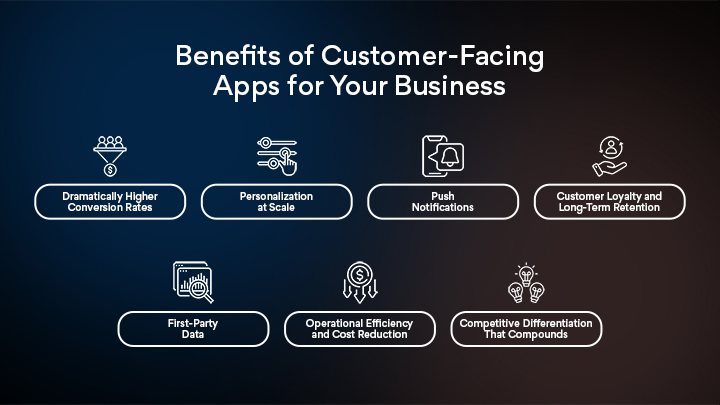
The examples above are inspiring, but inspiration alone does not justify the investment. Let us get specific about the measurable, strategic benefits customer-facing apps deliver, and why the ROI often exceeds even optimistic projections when the app is built and managed well.
1. Dramatically Higher Conversion Rates
Mobile apps consistently outperform mobile websites in conversion rates, and the gap is not marginal. Multiple studies across e-commerce and retail categories have found that apps convert at rates two to three times higher than mobile browsers. The reasons are compounding and mutually reinforcing. Apps remember user preferences and payment methods, eliminating the need to re-enter information on every visit. They load faster, removing the latency that causes users to abandon sessions. They eliminate the friction of repeated logins, session timeouts, and interrupted browsing that plague mobile web experiences.
When a customer already has your app installed and has completed a purchase before, the cognitive and mechanical path from intent to purchase is dramatically shorter. That reduction in steps is not just a convenience improvement; it is a direct revenue multiplier. Every abandoned cart triggered by a slow mobile site, a forgotten password, or a confusing checkout flow becomes a completed purchase when the experience is instant, familiar, and personalized.
2. Personalization at Scale
Apps give you a data-rich environment in which to deliver personalization that actually feels personal rather than generic. Through behavioral data, purchase and browsing history, location, time of day, notification engagement patterns, and explicit in-app preferences, you can tailor virtually every touchpoint in the customer journey. The products displayed on the home screen, the timing and content of push notifications, the offers presented at checkout, the support resources surfaced in real time, and even the visual layout of the app itself can all adapt to individual user behavior.
This kind of hyper-personalization was once possible only for businesses with large data science teams and bespoke recommendation platforms. Today, modern app frameworks, machine learning APIs, and customer data platforms have made sophisticated personalization accessible to mid-market and even smaller businesses. The result is a customer experience that feels made for one person, delivered at scale to hundreds of thousands simultaneously. Customers who feel understood buy more, return more often, and refer more friends.
3. Push Notifications: A Direct Line to Your Customer
Email open rates hover around 20 to 25% for most industries, and that number has been declining steadily as inboxes become more crowded and spam filters become more aggressive. Push notifications, when used strategically and respectfully, consistently deliver open rates between 40 and 60% and drive immediate, measurable action in ways that email and social media simply cannot match. A push notification about a price drop on a saved item, a reminder about an expiring loyalty reward, or a same-day offer tied to the user’s location can generate a conversion that feels almost instantaneous.
The keyword is strategically. Customers who install your app and opt into notifications are making a significant statement of trust and intent. They are giving you direct access to their phone, their most personal device. When you honor that trust, by sending relevant, timely, genuinely valuable messages rather than promotional noise, push notifications become one of the highest-ROI channels in your entire marketing stack. When you abuse it with excessive frequency or irrelevant content, you pay the price with uninstalls that are rarely reversed.
4. Customer Loyalty and Long-Term Retention
Acquiring a new customer costs five to seven times more than retaining an existing one. Customer-facing apps are among the most effective tools in the retention arsenal, and the mechanism is both psychological and mechanical. Psychologically, apps reduce the perceived risk of switching by embedding customers in an ecosystem of saved preferences, purchase history, accumulated rewards, and personalized experiences that a competitor simply cannot replicate on day one. Mechanically, they create habit loops: customers who open your app multiple times a week, whether to track a delivery, check a balance, or log a workout, are reinforcing a behavioral pattern that increases lifetime value with every session.
The data bears this out consistently. App users almost universally show higher purchase frequency, higher average order values, higher satisfaction scores, and lower churn rates than non-app customers across virtually every industry category measured. The relationship between app engagement and customer lifetime value is not coincidental; it is causal. The more embedded your app becomes in a customer’s daily routine, the less likely they are to leave, even when competitors offer comparable products or lower prices.
5. First-Party Data: Your Most Valuable Asset
In an era where third-party cookies are disappearing under regulatory pressure, privacy expectations are rising, and the cost of digital advertising continues to climb, first-party data has become one of the most valuable assets a business can own. Customer-facing apps are first-party data engines. Every tap, search, product view, purchase, session length, feature interaction, and notification response is a data point that tells you something specific and actionable about what your customers want, when they want it, and how they prefer to receive it.
This data powers everything from product development roadmaps to marketing segmentation to customer service improvements to pricing strategy. Businesses that build robust first-party data strategies through their apps are constructing a competitive moat that becomes harder to cross with every passing month. The depth of customer understanding that comes from two years of behavioral app data is something no newcomer can purchase or replicate quickly, and that is a form of competitive advantage that compounds over time.
6. Operational Efficiency and Cost Reduction
Customer-facing apps do not just benefit the customer; they streamline your operations in ways that meaningfully reduce cost and increase scalability. Self-service features, including account management, order tracking, FAQ access, AI-powered chatbots, appointment scheduling, and document submission, reduce inbound support volume and the associated labor costs. Automated order processing through apps eliminates manual data entry and the errors that inevitably accompany it. Digital onboarding workflows replace paper-based processes that are slower, more expensive, and harder to audit.
For businesses in hospitality, healthcare, banking, and professional services, apps have enabled significant reductions in administrative overhead by moving routine tasks to self-service models that customers actually prefer. A bank processing loan applications through a well-designed mobile app needs fewer branch staff than one processing them at the counter, and its customers submit more accurate applications because the app validates fields in real time. A hotel that offers digital check-in through an app reduces front desk queues and frees staff to focus on the higher-value personal interactions that actually drive satisfaction scores.
7. Competitive Differentiation That Compounds
In most industries, not having a strong customer-facing app is becoming a competitive liability rather than simply a missed opportunity. Your customers are comparing experiences across every brand they interact with, and those comparisons are not limited to your direct category. When a consumer can order anything on Amazon in two taps, schedule a doctor’s appointment in 30 seconds, and pay a friend without opening their wallet, they carry those experience standards into every other digital interaction they have, including the one they have with you.
Conversely, a genuinely exceptional app experience can become the primary reason customers choose you, even when competitors offer lower prices or comparable products. The experience becomes the differentiator, and experience, unlike price, is extraordinarily difficult to commoditize or replicate quickly. Businesses that invest consistently in building exceptional customer-facing app experiences are not just winning today’s customers; they are building the relationship architecture that will retain tomorrow’s customers through every competitive cycle to come.

Also Read: How to Design an Effective E-commerce Website
Challenges of Building and Scaling Customer-Facing Apps
We would be doing you a disservice if this article covered only the benefits. Building and maintaining a customer-facing app is a significant undertaking with real risks, real costs, and genuinely difficult problems to solve. The businesses that succeed are almost always the ones that went in with clear eyes about the challenges they would face.
1. Development Costs and Time-to-Market
A well-built native app for both iOS and Android can cost anywhere from $50,000 for a tightly scoped MVP to several hundred thousand dollars or more for a feature-rich consumer application, depending on complexity, the geographic location and seniority of your development team, and the number of third-party integrations required. That investment is before ongoing maintenance, which typically runs 15 to 20% of the initial development cost annually as you manage platform updates, security patches, bug fixes, and feature improvements.
For startups and smaller businesses, those numbers can feel prohibitive. The landscape has shifted considerably in recent years, however. PWAs, cross-platform frameworks like React Native and Flutter, and increasingly capable no-code and low-code app builders have brought the cost of entry down substantially. The important caveat is that cheaper development often means accepting trade-offs in performance, user experience, or scalability that can cost more to undo later than they saved upfront. Technical debt accumulated in an early build has a way of compounding with precisely the timing you can least afford it: when you are trying to scale.
Time-to-market is equally critical and often underestimated. In fast-moving markets, the difference between launching in three months versus nine months can mean the difference between capturing early adopters and playing perpetual catch-up. Building a focused MVP, launching it with real users, and iterating based on their actual behavior almost always outperforms attempting to build the perfect, complete app before releasing anything. The best app teams are learning machines that deploy fast and improve continuously.
2. User Acquisition and App Store Discovery
Building a great app is only half the challenge. Getting it in front of the right customers is the other half, and it is arguably harder than building the product itself. The Apple App Store and Google Play Store each host millions of apps, and organic discovery for new applications is intensely competitive. App Store Optimization, the practice of systematically improving your app listing for search visibility within the stores, is essential but consistently underestimated or ignored by first-time app builders.
Beyond the stores, acquiring users requires a sustained multi-channel strategy: targeted digital advertising, social media content and community building, email and SMS campaigns to your existing customer base, in-store prompts and packaging callouts, website banners and pop-ups, referral and incentive programs, and PR and influencer outreach for consumer apps. The critical metric is not how many users you acquire in total, but your cost per acquisition relative to the lifetime value those users actually generate. Many businesses discover, often painfully late, that they have been spending aggressively to acquire users who install the app once, never complete onboarding, and delete it within a week.
3. User Onboarding and Early Activation
You have approximately 30 seconds to convince a new user that your app is worth keeping. That is not hyperbole; it is an approximation of the attention window you have during a first session before a user either finds meaningful value and commits to returning, or abandons the app and never comes back. Poor onboarding is one of the most consistent and costly causes of app failure, and the statistics are sobering. Studies repeatedly show that a large proportion of downloaded apps are used only once, with abandonment occurring within the first session.
Effective onboarding is not simply about teaching users to navigate your features. It is about demonstrating genuine value as quickly as possible, removing every unnecessary step that stands between the new user and their first moment of recognizing what the app can do for them, and setting clear, honest expectations about what the ongoing experience will look like. Personalized onboarding flows, progressive feature disclosure that surfaces complexity gradually rather than all at once, well-timed contextual prompts that appear when they are relevant rather than on a fixed schedule, and an accelerated path to the core value proposition can dramatically improve activation rates and the 30-day retention that determines whether your user economics are viable.
4. Performance, Reliability, and Security
Customers have essentially zero tolerance for slow, buggy, or insecure apps, and their threshold for patience has been declining as the quality bar raised by best-in-class apps has risen. A single bad experience, a crash during the checkout flow, a product page that spins without loading, an error message that appears without explanation, can erase weeks of positive relationship-building. Research consistently shows that users who experience a crash or significant hang during an app session are substantially more likely to leave a negative review, uninstall the app, and not return, even when all prior experiences with the same app were positive.
Performance engineering is, therefore, not an optional enhancement; it is foundational product work. Every release needs testing across a representative range of device types, operating system versions, network conditions, and usage scenarios before it reaches your customers. Reliability monitoring tools, real-time crash reporting, synthetic user journey testing, and automated alerting systems are non-negotiable infrastructure for any app with a meaningful user base.
Security adds an additional, non-negotiable layer of complexity. Customer-facing apps handle sensitive information: personal identifying data, payment details, health records, financial transactions, and location history. A security breach does not just generate remediation costs; it destroys customer trust in a way that is extremely difficult and slow to rebuild. GDPR, CCPA, PCI-DSS compliance, and whatever additional regulatory frameworks govern your specific industry must be designed into the architecture from the very beginning, not bolted on reactively after a compliance audit or, worse, after an incident.
5. Sustaining Engagement Over Time
The real challenge with customer-facing apps does not begin at launch. It begins about six months after launch, when the novelty has faded, the initial surge of new installs has plateaued, and the core question becomes whether the value proposition is compelling enough to bring users back week after week. Getting someone to install an app is primarily a marketing and distribution challenge. Keeping them genuinely engaged six months and two years later is a product challenge, and it requires a fundamentally different set of capabilities, skills, and organizational disciplines.
Apps that fail to consistently deliver new value, through new features, fresh content, evolving personalization, improved user experience, or rotating loyalty incentives, experience engagement decay that follows a predictable and difficult-to-reverse curve. Sustaining engagement requires continuous product investment: regular feature releases that reflect what users actually asked for, rigorous A/B testing of in-app experiences to optimize the flows that matter most, seasonal and event-driven campaigns that give engaged users reasons to open the app at moments of high intent, and a genuine organizational commitment to listening to user feedback and demonstrating through product updates that the feedback was heard.
6. Integration Complexity
Customer-facing apps rarely operate in isolation. They need to connect in real time with your CRM, inventory management and fulfillment systems, payment gateway, customer support platform, analytics and experimentation infrastructure, loyalty program backend, marketing automation tools, and potentially dozens of third-party APIs and partner services. Each of these integrations introduces a potential failure point, a security surface, a performance dependency, and a long-term maintenance obligation.
Integration complexity routinely surprises businesses mid-build. What appears at the outset to be a straightforward API connection to an existing backend system turns out to require significant refactoring of data models, authentication architecture, rate limit management, and error handling logic. Engaging experienced backend engineers and establishing a clear, documented integration strategy from the very beginning of the project is not over-engineering; it is the kind of investment that prevents months of expensive rework when the application is already in the hands of users.
7. Platform Fragmentation and Continuous Update Requirements
Apple and Google release major mobile operating system updates annually, and each update introduces new features, deprecates existing APIs, changes design system conventions, and occasionally breaks functionality that previously worked without issue. Keeping up with platform changes requires dedicated engineering resources and proactive testing cycles, even in periods when you are not shipping new features, which can be a difficult resource allocation conversation in organizations where engineering time is always in high demand.
App store policy changes present a related and increasingly significant challenge. Both Apple and Google have introduced substantial new requirements around privacy reporting, payment processing, content moderation, data handling disclosures, and third-party SDK usage that required app developers to make consequential changes under tight deadlines. Staying close to platform developer announcements, maintaining an agile development practice, and building a culture of proactive compliance rather than reactive scramble is not optional for any app operating at a meaningful scale.
How to Build a Customer-Facing App That Actually Succeeds
Given everything above, what separates the apps that become essential from the ones that get deleted after a single use? The answer almost always comes down to four foundational principles that the best app teams internalize deeply and return to constantly.
Start With the Customer Problem, Not the Technology
The best customer-facing apps are not built because they seemed like a good idea to have an app, or because a competitor launched one, and the board asked why you had not. They are built because a specific, well-understood, deeply felt problem that real customers face is waiting to be solved in a way that digital can deliver better than any alternative. Before writing a single line of code or wireframing a single screen, invest deeply in customer research. Talk to your best customers and your churned customers. Understand what friction they experience today. Ask what tasks they need to accomplish more easily, what information would help them make better decisions, and what would genuinely change their relationship with your brand if it existed. The answers to those questions are your product brief. Everything else is execution.
Build for Retention, Not Just Acquisition
Too many businesses optimize for the metrics that look impressive in board presentations: total downloads, new user registrations, and install rates. These numbers matter, but they are leading indicators that can be deeply misleading without context. An app with 500,000 downloads and 15,000 monthly active users is vastly less valuable than an app with 50,000 downloads and 40,000 monthly active users. Design every feature, every notification, every onboarding flow, and every update with retention as the primary success metric. Ask not just whether users will use a feature, but whether it will bring them back tomorrow, next week, and next year.
Iterate Based on Real User Behavior
Opinions are universally available. Behavioral data is rarer, more honest, and infinitely more valuable. Build your analytics infrastructure before you launch, not as an afterthought after you realize you do not know why users are dropping off. Instrument every key user action, track every conversion funnel step end-to-end, monitor retention curves by acquisition cohort, and measure the delta between the features users say they want in surveys and the features they actually use. Establish regular product review rituals where the entire team interrogates the data together, challenges assumptions, and lets real user behavior override internal preferences in roadmap decisions.
Treat Security and Performance as Non-Negotiable Features
Fast apps win on engagement. Secure apps win on trust. Neither of these is a technical concern to be managed exclusively by engineers; they are customer experience imperatives that belong on the product roadmap as visibly as any new feature. If your app loads core content in under two seconds on a mid-range device on a 4G network, that is a competitive advantage worth measuring and protecting. If your app has never experienced a data breach or privacy incident, that is a trust asset worth investing in continuously. Make performance and security visible in your product metrics, celebrate improvements publicly within your team, and never allow them to be traded away for short-term feature velocity.

Also Read: How Does Zelle Make Money?
Conclusion
We are living in a defining moment for business and customer relationships, and the defining characteristic of that moment is this: the digital experience is not a supplement to the brand. It is the brand. For the majority of your customers, your app is where they will spend the most time interacting with your business. It is where trust is built or broken in seconds, where loyalty is earned through consistency and personalization, where the quiet decision to recommend you to a friend or quietly move to a competitor is made and solidified.
Customer-facing apps represent one of the most significant leverage points available to any business operating in the digital economy today. The investment required is real. The challenges are genuine and sometimes harder than expected. But for businesses that build with discipline, iterate with honesty, and stay relentlessly focused on their customers’ actual needs rather than their own assumptions, the returns are transformational. Not incremental. Transformational.
The examples in this article, from Amazon to Airbnb, from Starbucks to Nike, are not happy accidents or the exclusive domain of billion-dollar brands. They are the result of deliberate choices, made consistently over time, about what kind of experience to offer and what kind of relationship to build. Those choices are available to any business willing to make them.
Choose to build something worth keeping. Design for the customer who deserves it. Ship it, learn from it, and make it better every month. Your customers are ready for it, and in most markets, the window to build a lasting advantage through exceptional app experience is not as wide as it was yesterday. The businesses winning in the next decade will be the ones that move with intention and are built with purpose today.
FAQs
Apps create habit loops by embedding customers into a personalized ecosystem of saved preferences, rewards, and purchase history. This makes switching to a competitor feel costly and inconvenient. The more a customer uses your app daily, the stronger and more loyal the relationship becomes.
The biggest challenges include high development costs, keeping users engaged beyond the first few sessions, and managing security and performance at scale. Integration with existing business systems often adds unexpected complexity and delays. Going in with a clear strategy and a realistic budget saves enormous pain later.
A basic MVP app typically starts around $50,000, while feature-rich consumer apps can cost several hundred thousand dollars or more. Ongoing maintenance adds roughly 15 to 20% of the original build cost every year. Cross-platform frameworks and PWAs offer more affordable entry points for smaller businesses.
Track metrics like monthly active users, retention rate, session length, conversion rate, and push notification engagement. These numbers reveal whether users find genuine value or simply install and forget the app. A successful app shows consistent growth in returning users, not just total downloads.

Related Posts

Top 15 Best Cash Advance Apps for Instant Money in 2026
Nobody expects to get a flat tire just a few days before payday or suddenly receive a medical bill they...
Read More

What Is FinTech? A Complete Guide to Financial Technology in 2026
Financial technology, or FinTech, means using software and digital tools to make financial activities easier and more convenient. Instead of...
Read More

Healthcare IT Market Size, Statistics, and Trends: A Complete Guide
Healthcare is no longer only about hospitals and clinics. Technology is now playing an important role in how people get...
Read More


 Verified Review




 +44 7427829444
 71-75, Shelton Street, Covent Garden, London, United Kingdom, WC2H 9JQ