

Share this article


How to Build a Restaurant App: Features, Benefits, Cost & Timeline?
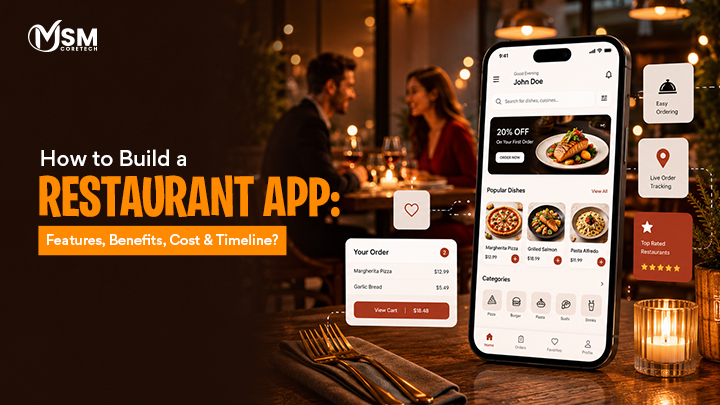
The decision to develop a restaurant app signifies a significant transformation in the relationship dynamics between food service companies and their customers. The development of digital technologies has transformed restaurants’ operations in the past few years, granting them a lot of authority and minimizing the influence of external intermediaries. The physical location of the restaurant is only one aspect in the world of technology-based services, where people want digital experiences that meet their expectations of retail clients.
Creating a restaurant app is much more than an advancement in terms of technology; it’s a necessity from a strategic perspective in today’s mobile-oriented environment. Mobile devices are responsible for over 83% of all online food orders, which drives the industry in the direction of direct-to-consumer approaches. To develop a restaurant app, you avoid paying a commission between 15% and 30% that is usually charged by other services.
Statistics show that 69% of consumers prefer to place their orders through the app or website created by the restaurant, while 93% of customers are ready to download the app created by their favorite restaurant. The app developed this way won’t only turn it into an environment for transactions, but it will also provide the restaurant’s owner with useful information about consumer behavior that will contribute to the improvement of the retention strategy.
This complete guide will cover the basics in the field of mobile app development for the food industry. We will talk about the key features, operational advantages, and budget that you need to make your application a success.
The Strategic Importance of a Restaurant App
Today, when you are building a restaurant application, you are basically saying that a major change in the way food service operators communicate with viewers has already happened. Of late, the restaurant industry has undergone a revolution due to restaurant app development and digital solutions. Owning a restaurant is now more empowering for its owners and less dependent on third-party aggregators. Today’s diners expect seamless online interactions and experiences tailored to their needs and preferences. Having a restaurant is just one element of a broader ecosystem of dining that is powered by digital technology.
If you make up your mind to develop a restaurant app, you will be effectively making a direct link to the details of your customer. Learning the cost to build a restaurant app is a saving that can provide constant income due to different features such as loyalty programs, automated ordering, and marketing based on statistics. Creating the app enables restaurants to avoid high service costs, gain useful knowledge concerning clients’ likes, and make the experience even more interesting and valuable for clients.
This informative piece of content discusses the main aspects of mobile app development in the field of the food industry. We will discuss all the vital functions the application should have, advantages of the work process, realistic budget, and important points of restaurant app development.
Read Also: Cost To Develop a Restaurant App Like TheFork
Restaurant App Development: Essential Features for Success
While working out your restaurant app’s concept, it’s significant to make sure to keep the right balance between user-friendliness and capability. The user-friendly interface helps visitors to browse through the menu, order the dishes they want and pay in a simple way. If you are keen on decreasing the rate of users leaving the site without having made a purchase, the first thing to do is to create a simple, appealing layout, which would draw users to come back to your restaurant. At this stage, the trickiest part is to find the right app development company.
Strong backend infrastructure is essential in making sure that an app for your restaurant operates as intended in real-time. This means having your restaurant’s virtual store connected to the hardware used for point-of-sale (POS) purposes so that you can avoid taking orders through manual entry and making mistakes in busy service hours. This is what turns a restaurant app into a high-performance and scalable app. It is important to synchronize the physical cooking area with the online interface.
Additionally, an excellent development strategy guarantees that your application is capable of handling high traffic volume without compromising responsiveness and stability. The infrastructure must support simultaneous users, whether on a lively Friday night or on festival days. The programmer will work on applying modular code and scaling using the cloud in order for the application to be secure, responsive and able to develop together with your cooking business. This is the standard that you should hire a restaurant app development company that handles your project.
Advanced Digital Menu and Customization
An attractive digital menu is the first thing your client sees during the ordering process. It should be inspiring, with outstanding photography and engaging text so that customers find the meal they have chosen irresistible. This feature serves as a key conversion to develop a restaurant app, as it aims at highlighting key meals and increase the total bill. A reliable restaurant app development company will make these menus fully interactive and easily adjustable.
- Customized Features: Enable customers to add or remove ingredients, which will help them tailor their dish according to their wishes.
- Quick Categorization: The menu creation process requires placing products into groups in such a quick manner that users can find their desired dishes.
- Dietary Filtering: Allow consumers to use smart tags and then filter for their plates, such as allergen-free or keto-friendly.
Read Also: Top 5 Hotel and Restaurant Website Design Companies in Australia
Secure Online Ordering and Payment Gateway
Efficient systems of ordering are able to facilitate these kinds of transactions while also earning customer trust. In today’s highly competitive age, your mobile app development partner must pay close attention to security systems that can help avoid any leakage of sensitive data. Include various payment systems (like PayPal and Stripe) that modern customers expect so that the level of cart abandonment is minimal. This one step is crucial for developing an efficient restaurant app.
- Multi-Payment Interface: enables payments through Apple Pay, Google Pay, and credit cards.
- Instant Status Reporting: informs customers via email instantly, right after a deal is done.
- Stored Profile Information: allows storing the payment information in a secure way.
Real-Time Order Tracking
Your confidence in your customers comes from being honest about your delivery process. Customers are able to follow their food from its preparation in the kitchen all through to reaching their doorsteps. This proactive communication provides less stress both for you and your staff since customers receive updates on where their orders are located. If you hire a restaurant app development company, it should give sufficient attention to implementing this aspect of the app to improve customer satisfaction and retention rates.
- Real-time Status Updates: Customers can observe a constantly updated indicator revealing the current process of their order.
- Driver Location Tracking: Customers can utilize a mapping feature to find the real-time location of the delivery person and estimate the time of arrival.
- Status Notifications: The app informs the customers about the status of their order through notifications.
Loyalty and Rewards Integration
The best means of ensuring repeat customers and increasing customer lifetime value is by having a robust loyalty program. This aspect makes customers come back for more due to the exciting incentives it offers to them, which puts the casual diners into the brand promoters’ category. The creation of a sense of joy while earning loyalty rewards gives an opportunity to create a stronger emotional connection between customers and the restaurant brand. Moreover, it is an important step while calculating the cost to develop a restaurant app.
- Points System: Let members get points after every dollar they spend that can be used for discounts or other advantages later.
- Tiered Membership: Introduce exclusive “VIP” memberships for your loyal frequent customers, helping you recognize them and build loyalty.
- Personalized Offers: Make use of purchase history to offer discounts or deals on favourite items of a customer.
Read Also: Handyman App Maintenance Guide
Table Reservation System
The feature that allows guests to reserve a restaurant table not only saves time but also makes the work easier for guests and employees of this establishment. It is a significant benefit, especially for busy full-service restaurants that aim to get the most out of their seating capacity. With this system in place, the restaurant will be better organized to handle customers while staff can be free to prepare for receiving guests thanks to automation of booking procedures. To integrate this feature, you can connect with the top-tier restaurant app development company.
- Real-time slot reservation: Watch the table availability in the calendar view. Let users choose the date and the time they want to book.
- Automated reminders: Send an automatic message to guests two hours before the reservation so that they do not forget about coming to the place.
- Special requests: Allow users to indicate whether they have a special occasion to be celebrated with the help of their booking.
Customer Feedback and Reviews
Getting direct feedback allows you to use valuable insights to ensure constant improvement of your services and the level of efficiency in your operations. Make leaving reviews convenient. Customers will understand that you care about their feedback and strive for excellence in service delivery. This feedback procedure helps you notice any potential flaws within your operations. Working with a professional mobile app development company can allow you to implement these features in your application in order to keep high standards.
- Rating Interface: Simple and straightforward star-based rating system.
- Direct Comments Section: It will allow customers to share specific comments regarding services with management and get them resolved instantly.
- Social Proofing: It gives customers the possibility to tell others about their amazing experiences with your restaurant.

How Does a Restaurant App Work?
A restaurant app makes food ordering easy for both customers and restaurant staff. Instead of calling the restaurant or standing in a queue, customers can do most things directly from their phones. Here is how the process usually works:
1. Customer Places an Order
First, the customer opens the app and checks the available restaurants or menu items. They can search for their favorite food, choose the items they want, and customize them if needed. Then, they add the items to the cart and check the order details. After that, they select a payment method and place the order.
2. Restaurant Receives the Order
After the customer places the order, the restaurant receives it through its restaurant dashboard or order management system. The staff can see the ordered items, customer details, delivery information, and payment status. They can then accept the order and start preparing the food.
3. Restaurant Prepares the Food
After accepting the order, the kitchen team starts preparing the food based on the customer’s instructions. The app can show the order status, such as “Order Accepted,” “Preparing,” or “Ready for Pickup.” This helps customers know what is happening with their order and reduces the need to call the restaurant.
4. Delivery Partner Picks Up the Order
Once the food is ready, a delivery partner is assigned to the order. The delivery person gets the pickup details through the delivery partner app. They can use GPS and maps to find the restaurant, pick up the food, and start the delivery.
5. Customer Tracks the Order
Real-time order tracking is another useful feature of a restaurant app. Customers can see where their order is and check its current status. GPS tracking can also show an estimated delivery time, helping customers know when their food is expected to arrive.
6. Order Is Delivered
The delivery partner reaches the customer’s location and gives them the order. After the order is handed over, the app changes the order status to “Delivered.” If the customer paid online, the payment is already completed during checkout. For cash orders, the delivery partner collects the payment when the order is delivered.
7. Customer Provides Feedback
After receiving the food, customers can rate their experience. They can share their thoughts about the food quality, delivery service, packaging, and overall restaurant experience. This feedback helps restaurants know what customers like and what they can improve.
Overall, a restaurant app brings the customer, restaurant, and delivery partner together in one place. It keeps the whole process organized, from placing the order to delivering the food. A well-designed app makes ordering easier and faster for customers. At the same time, it helps restaurants manage orders, deliveries, payments, and customer feedback more easily.
Types of Restaurant Apps You Can Build
Not every restaurant needs the same type of app. A small local restaurant may only need an app for online food orders. A large food business may need more features, such as delivery tracking, table booking, special offers, and support for multiple restaurant locations.
Before starting development, it is important to choose an app type that fits your business, customers, and future goals. Here are some of the main types of restaurant apps you can build.
Single Restaurant App
A single restaurant app is built for one restaurant or food brand. Customers can use the app to check the menu, order food, make payments, book tables, and get special offers.
The restaurant can also use the app to send updates and manage orders in one place. This type of app is a good choice for restaurants that want to connect directly with their customers instead of depending fully on third-party food delivery platforms.
Restaurant Chain App
A restaurant chain app is made for businesses that have multiple branches in different locations. Users can choose their preferred branch, view its menu, check available offers, place orders, or book a table. The app can also show branch locations and opening hours. On the business side, owners can manage menus, orders, customers, and offers for all branches from one central system.
Food Delivery App
A food delivery app connects customers with restaurants and delivery partners. Users can find nearby restaurants, browse their menus, add food to the cart, make online payments, and track their orders in real time. Restaurants receive and prepare the orders, while delivery partners pick up the food and deliver it to customers. This type of app is a good option for businesses that want to start their own food delivery service.
Restaurant Marketplace App
A restaurant marketplace brings many restaurants together in one app. Customers can compare menus, prices, ratings, delivery times, and offers before deciding where to order. Restaurants can reach more customers, while the app owner can make money through commissions, delivery fees, advertisements, or restaurant subscriptions. This type of app needs strong features for search, payments, order management, and delivery.
Cloud Kitchen App
Cloud kitchens do not have a traditional dining area. They mainly focus on preparing and delivering food ordered online. A cloud kitchen app can show different food brands or menus that are managed from one kitchen. Customers can choose their meals, place orders, and get delivery updates through the app. This type of app is useful for businesses that want to keep their operations simple and focus mainly on takeaway and food delivery.
Table Reservation App
A table reservation app helps customers find restaurants and book a table easily. Users can see available time slots, choose the number of guests, and confirm their booking online. Restaurants can manage reservations, seating capacity, cancellations, and customer details. Features like booking reminders, special requests, and pre-ordering can make the experience even easier and more convenient.
Benefits of Restaurant App: Why Digital Matters?
Investing in a personalized restaurant app development brings undeniable advantages, particularly that of collecting data associated with your app. You will gain direct access to customer purchase history, food restrictions, and spending habits instead of relying on third-party platforms. Such data is essential to developing marketing techniques, allowing you to abandon the idea of using generalized coupons in favor of concentrated activity-based marketing methods. While calculating how much it costs to create a restaurant app, keep in mind the importance of data in the long run.
In addition, a specialized app creates an effective branding channel that helps enhance customer loyalty, enabling you to differentiate your business from the competition. By using your own app, you ensure that your brand has more visibility than when using other programs with competitors. It also translates into a better customer experience, as all mechanisms encouraging customer loyalty are integrated into one app, allowing companies to strengthen their influence. This is exactly the level of branding control that businesses look for in a restaurant app development company.
In the end, an app developed for restaurants can also make operations more efficient, thereby optimizing people’s costs and relieving them from the busy hours. The process of taking orders can be automated to let workers devote their time to cooking and serving customers as opposed to taking orders over the phone. This increased focus leads to the improvement of efficiency, accuracy of orders and customer experience alike, thereby confirming that mobile technology is a necessary factor of future growth and progress.
Read Also: Cost to Develop a Doctor Booking App Like HealthTap
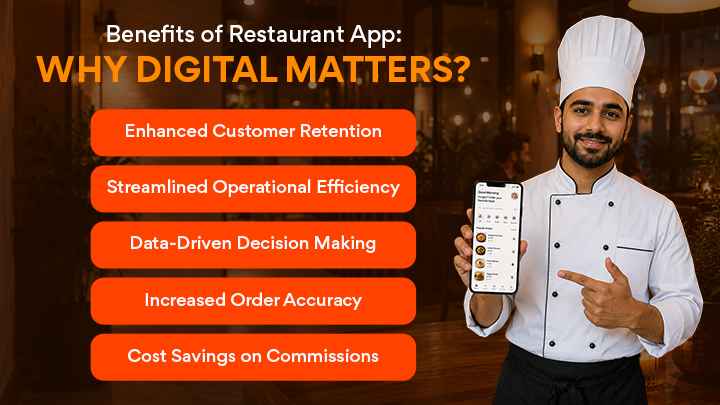
Enhanced Customer Retention
Having an application has helped you create an excellent atmosphere for building lasting relationships with your customers. Being in touch and personalizing experience will help you stay on customers’ minds even when they are not thinking about food.
- Direct Marketing Channels: Communicate with your guests directly by sending them notifications, which do not depend on other people’s algorithms.
- Special Offers through the App: Make the users of your app feel privileged, and there will be no reason for them to delete it.
- Community Creation: Organize events with digital contests and polls to turn your customers into your company’s loyal supporters.
Advice to Remember- Tailor Your Push Notifications: Instead of just broadcasting general discounts, leverage your app’s data so you can send personalized deals to users based on their purchase history. When customers see promotions for their favorite menu items, they are much more inclined to place an order, which is the quickest path to ensuring a higher retention rate.
Streamlined Operational Efficiency
Linking your restaurant app with your point of sale system will allow all orders to be directed to the kitchen, thereby minimizing the need for supervision and mistakes resulting from orders. This is the reality of automation becoming a force enhancer for current workers.
- Workflow Automation: Orders go straight to food preparation, where they are prepared immediately.
- Inventory Management: Immediate updates enable your menu to change as your inventory changes, eliminating the possibility of selling out-of-stock items.
- Staff: Adjusting staffing numbers according to existing orders enables predicting peak hours and planning employee deployment accordingly.
Data-Driven Decision Making
Having one’s platform enables them to supervise and evaluate all interactions. This allows for making informed decisions influencing the company’s profit status and menu effectiveness, an essential part of the mobile app development process.
- Customer information: Find out the most profitable items, busy hours and client base to enhance your menu.
- Sales statistics: Control sales performance depending on the location, mode of delivery or menu section to find out weaknesses.
- Individualized suggestions: Track acquisition data to offer suggestions on complementary products.
Read Also: Taxi Booking App Development: Guide
Increased Order Accuracy
The manual processing of orders can be error-prone, especially during peak hours. The application allows users to type in the orders for themselves so that their demands are adhered to all the time.
- Customization Power with More Control: Customers are able to apply their own modifications to the order since the app allows them to do it much better.
- Visual Confirmation: Users can see an overview of their order in order to avoid any errors before paying for the order.
- Reduced Waiting Time: This capability simplifies the process of ordering and reduces the waiting time considerably.
Cost Savings on Commissions
Third-party delivery services in your restaurant app usually charge high commission fees and, hence, cover most of your profits. A unique app allows you to retain higher income from your loyal clientele.
- Higher profits: You earn the entire profit on each order placed through the app.
- Control over prices: You no longer need to follow the pricing regulations imposed by delivery services.
- Long-term profitability: The initial investment may not be small, but profits from the saved commissions will allow you to get your money back quickly.
Step-by-Step Restaurant App Development Process
| Step | What It Includes |
|---|---|
| 1. Define Your Business Idea | Set your goals, target customers, and main purpose of the app. |
| 2. Choose the App Type | Select a single restaurant, food delivery, marketplace, cloud kitchen, or booking app. |
| 3. Plan Features | Add menus, ordering, payments, bookings, tracking, reviews, offers, and notifications. |
| 4. Create UI/UX Design | Design simple, clean, and easy-to-use screens and navigation. |
| 5. Select Technology Stack | Choose Flutter, React Native, Swift, Kotlin, Node.js, Python, databases, and APIs. |
| 6. Develop the App | Build customer, restaurant, delivery, and admin panels with required integrations. |
| 7. Test the App | Check features, payments, performance, security, devices, and fix bugs. |
| 8. Launch the App | Publish on Google Play Store and Apple App Store and promote the app. |
| 9. Maintain & Update | Fix issues, improve security, add features, and release regular updates. |
Building a restaurant app is not just about writing code. You need good planning, a clear idea, an easy design, and regular updates. Following the right app development process can help you avoid common problems and build an app that customers enjoy using.
1. Define Your Business Idea
First, be clear about what you want your restaurant app to do. Think about your main goal and the problem you want to solve. For example, you may want customers to order food online, book a table, check the menu, or track their orders.
You should also understand your target customers. Find out what they usually order, how they like to pay, and which features can make their experience easier. Having a clear business idea gives your development team a clear direction from the start.
2. Choose the App Type
First, decide what type of restaurant app you want to build. You can create an app for one restaurant, a restaurant chain, a food delivery marketplace, a cloud kitchen, or a table booking service.
Your choice depends on your business model. A simple restaurant app may need only a few features. However, a marketplace app may need separate panels for customers, restaurants, delivery partners, and admins.
3. Plan Features and Functionality
After choosing the app type, make a list of the features you need. Common features include user registration, digital menus, food search, shopping cart, online payments, table booking, order tracking, reviews, coupons, and push notifications.
Do not try to add every feature at the beginning. Start with the features your customers need the most. You can add more features later as your app grows.
4. Create UI/UX Design
Your restaurant app should have a simple, clean, and easy-to-use design. Customers should be able to find a restaurant, choose their food, and place an order without any confusion.
Start by designing the main screens, such as the home page, menu, food details, cart, checkout, order tracking, and profile. A smooth and simple design can make the app easier and more comfortable to use.
5. Select the Technology Stack
Choose the right technologies based on your app’s features, budget, and future needs. Flutter or React Native can be used to build an app for both iOS and Android. For native apps, you can use Swift for iOS and Kotlin for Android.
For the backend, you can use technologies such as Node.js, Python, Java, or .NET. You will also need a database, cloud platform, payment gateway, maps, and notification services.
Do not try to add every feature from the beginning. Start with the features that customers need most. You can add more features later through future app updates.
6. Develop the App
Now, the actual app development starts. Developers build the customer app, restaurant panel, delivery panel, and admin dashboard based on the approved design.
The team connects the frontend with the backend and adds important features like payment gateways, GPS tracking, notifications, and order management. Regular communication with the team helps make sure the project stays on track.
7. Test the Application
Before launching the app, test all its important features. Check user registration, menu browsing, food ordering, payments, notifications, GPS tracking, and order cancellation.
Test the app on different phones and screen sizes to make sure everything works properly. Fix bugs, slow pages, broken buttons, and payment problems before customers start using the app.
8. Launch the App
Once testing is complete, publish your app on the Google Play Store and Apple App Store. Add clear screenshots, an app description, an icon, and all other required store details.
You should also plan a small marketing campaign to tell both existing and new customers about your app and encourage them to use it.
9. Maintain and Update the App
Your work does not stop after launching the app. Keep checking customer feedback, reviews, app performance, and any technical problems.
Release regular updates to fix bugs, improve security, add useful features, and make sure the app works well on new devices and operating system versions. Regular maintenance keeps your restaurant app useful, safe, and reliable over time.
Understanding Restaurant App Development Costs
It is necessary to keep cost factors in mind while you set your budget. There are various options available in the development sphere, starting from simple, ready-made white-label solutions and ending with sophisticated, bespoke platforms. There are several cost factors to keep in mind: feature variety, design complexity, the technology stack used by the restaurant app development company, and their physical location. Thus, every one of these areas should be taken into account in the budget so you can spend your funds properly to achieve your goals.
In order to learn the cost to develop a restaurant app, you will have to understand the entire lifecycle that starts from the first build and encompasses third-party API integration and cloud infrastructure. By making the initial development of good quality, you will minimize expensive “instant” fixes in the future and ensure that your solution will develop into the massive platform you want to create.
Read Also: Top 7 Home Services App Development Companies
Detailed Restaurant App Development Cost Breakdown Table
| Development Phase | MVP (Basic) | Mid-Level | Enterprise | Description of Scope |
|---|---|---|---|---|
| UI/UX Design | $2,000 – $4,000 | $5,000 – $10,000 | $15,000+ | Includes branding, wireframes, and prototypes. |
| Frontend/Backend | $8,000 – $15,000 | $20,000 – $40,000 | $50,000 – $100,000+ | Core coding, logic, and cloud database setup. |
| Integrations | $3,000 – $5,000 | $6,000 – $10,000 | $15,000 – $30,000 | POS systems, Payment gateways, GPS/Maps. |
| Testing & QA | $2,000 – $4,000 | $5,000 – $8,000 | $10,000 – $20,000 | Extensive debugging, beta testing, and security. |
| Total Est. Cost | $15,000 – $28,000 | $36,000 – $68,000 | $90,000 – $165,000+ | Cumulative investment range. |
Note: Continuous expenditures such as hosting, fees for external API, and necessary maintenance are normally responsible for an additional 15-20% to be included in the annual budget to keep up its stability and security.
Timeline for Restaurant App Development
Restaurant App Development – A Journey of Many Stages. A professional application created from scratch would typically require four to six months to complete. Of course, it may take more or less time, depending on how complicated the application solution is and the features required by your chosen mobile app development company.
The process starts in the Discovery & Planning phase (Weeks 1-3). During this stage, the essence of your application solution is defined, as well as competitor analysis conducted and the user path mapped. Once the concept is developed, it is time to move on to the UI/UX Design phase (Weeks 4-7), where designers come up with some basic wireframes and very detailed prototypes.
The actual restaurant app development phase (Weeks 8-18) is the most labor-consuming stage of the process. During this period, the back-end part of the app is created, as well as the front-end coding of the application, and essential APIs like payment systems are integrated. Meanwhile, the testing and quality assurance team is focused on making sure the application and every feature work smoothly on different mobile platforms (Weeks 19-22). Once there are no bugs left in the application, it is time for the Deployment and Launch (from Week 24 onwards).
Read Also: Best Music Streaming App Features To Boost User Engagement
Why Choose MSM Coretech for Your Project?
It is very important to select the right partner to achieve success. We at MSM Coretech specialize in mobile app development based on advanced technologies to deal with real-world business issues. With an experience of more than 6 years, we have implemented over 700 projects and can provide you with technical knowledge to develop a secure, scalable, and easy-to-use product.
We focus on the idea of cooperation, making sure that our custom app development services correspond to your business goals. No matter what you need: complicated AI integrations, flawless POS connection, or stable cloud infrastructure, our specialists will provide you with comprehensive services to solve your task from the moment of conceptualization until after launch.
By working with MSM Coretech, you always have a partner that guarantees quality, functionality, and reliability of the product. We deliver applications that are future-proof and easy to support, thus making your restaurant app competitive on the market.

Conclusion
Custom restaurant app development is no longer a luxury; it is a necessity for brands wanting to be self-sufficient and profitable. By focusing on the core functionalities of the application, comprehending the total cost of ownership, and teaming up with skilled app developers, it is indeed possible to build a platform that successfully contributes to client loyalty and operational efficiency. The process demands thorough planning, which is not easy, but the final output denoting data ownership, increased profits per unit, and the overall experience delivered to consumers is worth the effort. Start your mobile app development journey remembering that your application is a living extension of your restaurant, as the portrayal states.
FAQs
Mobile apps play a vital role in the current digital age by allowing restaurant owners to reduce their dependence on aggregators, gain full control of their customer data, and create direct relationships with their customers. Moreover, through mobile app development, restaurateurs can enhance their efficiency processes and deliver their unique branded experience to patrons.
Creating a regular restaurant application can take anywhere between 4 and 6 months, considering that the time frame depends on the complexity of the features, design requirements, and geographical scope of the restaurant. Interested in an exact timetable for your restaurant app development? Consult with our specialists right away!
If creating a strong brand identity and ensuring scalability is your aim, custom app development is the better way to go since it allows you to implement necessary features, react to the latest trends in the market, and maintain control over your digital environment at every stage.
A successful application for a restaurant should contain such vital components as a digital menu, secure payment gateways, real-time order tracking, a reservation system and a loyalty program. Do you need assistance in choosing the right features for your restaurant app? Don’t hesitate to reach out to our specialists today!
The cost of creating the restaurant app is on the depend on many factors, such as the number and type of features, the complexity of the UI/UX design, and the technological stack used. On the whole, a simple MVP can cost you from $15,000 to more than $100,000 for an enterprise application, depending on your requirements.
Yes, certainly. Here at MSM Coretech, we create practical mobile solutions that help the food business to become successful. We incorporate trendy design while the solid back-end architecture ensures success. Interested in designing a restaurant app? Contact us right now for a free quote!

Related Posts
10 Key Applications of AI in the Food Industry (2026)
Walk into any restaurant kitchen, grocery warehouse, or food delivery control room today, and you will find something quietly running...
Read More
How To Develop An App Like YouTube Music: A Complete Guide
Music is now a part of our everyday life. People listen to songs while getting ready in the morning, working,...
Read More
Must-Have Features in Fintech Apps & Digital Financial Platforms
Think about how often you use your phone to pay bills, send money, shop online, or check your bank balance....
Read More


 Verified Review




 +44 7427829444
 71-75, Shelton Street, Covent Garden, London, United Kingdom, WC2H 9JQ