

Share this article


How to Build an eCommerce Store for Selling Auto Parts Online?
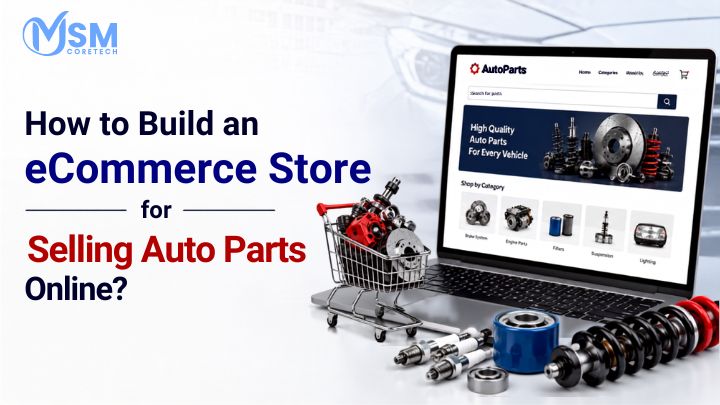
More car owners now search for brake pads, filters, and headlights online before they ever walk into a shop, and that shift is changing how auto parts businesses grow. Buying habits have moved from local counters to search bars, and sellers who are not online are quietly losing customers to the ones who are.
The numbers back this up. The global auto parts e-commerce aftermarket is valued at around $121.8 billion in 2026 and is projected to reach $318.1 billion by 2033, growing at nearly 15% a year. That is not a small niche trend; it is a full-scale shift in how parts are bought and sold.
But selling auto parts online is not the same as selling shoes or electronics. Customers need to know a part actually fits their exact vehicle, and one wrong purchase can mean a costly return and a frustrated buyer. That is why auto parts eCommerce website development calls for specific features like vehicle fitment search, VIN lookup, and real-time inventory that a generic online store simply does not need.
This guide walks you through everything involved in building an auto parts online store: the features your customers expect, the technology behind it, the development process, realistic costs, timelines, SEO strategies, and the common mistakes to avoid. Whether you run a local parts shop, a wholesale distribution business, or a manufacturing company, this guide will help you plan a store that actually works for how people buy car parts today.
Why Build an Online Auto Parts Store?
Before getting into features and technology, it helps to understand why so many auto parts businesses are investing in eCommerce right now. The reasons go beyond simply following a trend; they touch nearly every part of how a parts business operates and grows.
- Reach customers beyond your local market: A physical store limits you to people who can drive to your location. An online store lets you sell to customers across the country, or even internationally, without opening a single new branch.
- Sell 24/7: Your website keeps working while you sleep. Someone searching for a part at midnight can find it, order it, and have it on the way before your physical shop even opens the next morning.
- Automate orders and inventory: Manual order-taking over phone calls or in-store visits is slow and error-prone. An online store automates order capture, payment, and stock updates, freeing your staff to focus on service instead of paperwork.
- Improve product discovery: Customers can search, filter, and compare parts in seconds instead of flipping through catalogs or waiting for a staff member to check availability.
- Reduce operational costs: Online stores cut down on the staffing, printed catalogs, and physical space needed to serve the same volume of customers, which lowers your cost per sale over time.
- Build recurring customers: Features like order history, saved vehicles, and wishlists make repeat purchases easy, which keeps customers coming back instead of shopping around each time.
- Scale B2C and B2B sales: A well-built platform can serve individual car owners and wholesale buyers from the same system, opening up two revenue streams instead of one.
Also Read: Know About eCommerce AI Agents
Who Can Benefit From an Auto Parts eCommerce Store?
An online auto parts store is not just for big retail chains. Many different types of businesses in the automotive supply chain can benefit from moving online, including:
- Auto parts retailers looking to expand beyond foot traffic
- Wholesalers and distributors who want to serve repair shops and dealers directly
- Manufacturers who want to sell parts directly to consumers or businesses
- Auto repair shops that want to sell parts alongside their service offerings
- Car dealerships expanding their parts and accessories business
- Automotive aftermarket businesses selling performance parts, accessories, and upgrades
How Does an Auto Parts eCommerce Store Work?
To plan a good auto parts online store, it helps to understand the journey from both sides: what the customer experiences, and what happens behind the scenes to make that experience possible.
The Customer Journey
From the customer’s side, the process is fairly simple on the surface, even though a lot of technology works behind it to make it feel effortless. A typical journey looks like this: the customer searches for their vehicle or the specific part they need, the platform shows them compatible parts, they compare options based on price, brand, and specifications, add the item to their cart, move through checkout, complete payment, and then track their order until it is delivered.
Search Vehicle → Find Compatible Parts → Compare Products → Add to Cart → Checkout → Payment → Shipping → Order Tracking
Each step in this journey needs to be smooth. If fitment search is confusing, if checkout takes too many steps, or if there is no way to track an order, customers drop off and go elsewhere. This is why every feature in an auto parts store should be designed around reducing friction at each of these stages.
The Backend Workflow
Behind the scenes, a different workflow keeps the store running. Products need to be managed and categorized correctly, inventory needs to stay accurate across warehouses or suppliers, orders need to be processed and routed, suppliers and warehouses need to coordinate on fulfillment, and shipping needs to get the part to the customer reliably.
Product Management → Inventory → Order Processing → Supplier/Warehouse → Shipping → Customer
A well-designed auto parts eCommerce platform connects these two workflows so that what the customer sees on the front end always matches what is actually happening on the back end: accurate stock levels, correct pricing, and real shipping timelines. When these two sides are out of sync, you get overselling, delayed orders, and unhappy customers.
Essential Features of an Auto Parts eCommerce Store
This is where an auto parts online store differs the most from a generic eCommerce website. Selling car parts online comes with unique challenges around fitment accuracy, part identification, and technical detail, and your feature set needs to directly address those challenges. Below is a detailed look at the features that matter most.
Advanced Auto Parts Search
A basic keyword search box is not enough for auto parts. Customers need to be able to search by part name, part number, OEM number, brand, category, vehicle make and model, model year, or engine type. Supporting all of these search paths matters because different customers think about parts differently. A mechanic might search by OEM number, while a DIY car owner might just type in “brake pads for my car.” Your search needs to handle both.
Vehicle Fitment Search
This is arguably the single most important feature in any auto parts eCommerce website development project. Fitment search lets customers select their exact vehicle step by step: make, model, year, and engine, and instantly see only the parts that are compatible with that vehicle.
Select Vehicle → Make → Model → Year → Engine → Compatible Parts
Fitment search directly reduces the number of customers who order the wrong part by mistake. Since returns and refunds are one of the most expensive and frustrating parts of running an auto parts store, a reliable fitment engine pays for itself many times over by cutting down on this problem before it happens.
VIN-Based Parts Search
Beyond selecting a vehicle manually, letting customers enter their 17-character Vehicle Identification Number (VIN) takes fitment accuracy a step further. A VIN encodes exact details about a vehicle’s build, including engine type and trim, so parts search results based on a VIN are even more precise than results based on make, model, and year alone. This is especially useful for vehicles with multiple engine or trim variations within the same model year.
Product Compatibility Checker
Once a customer has selected their vehicle, a compatibility checker gives them clear, plain-language confirmation before they buy something like “This part fits your 2022 Honda Civic 1.5L.” This small feature builds a lot of trust, because it removes the guesswork and gives customers confidence that what they are about to buy will actually work on their car.
Detailed Product Pages
Auto parts buyers, especially repeat customers and mechanics, want detailed technical information before they commit to a purchase. Strong product pages should include clear product images from multiple angles, full specifications, OEM and MPN numbers, brand information, a compatibility list showing every vehicle the part fits, warranty terms, current availability, shipping information, and installation instructions or guides where relevant. The more complete this information is, the fewer support questions and returns you will deal with later.
Product Comparison
Many customers shop between two or three similar parts before deciding. A product comparison tool that lets them view price, brand, specifications, compatibility, warranty, and customer ratings side by side makes this decision faster and easier, which keeps customers on your site instead of opening a competitor’s tab to compare manually.
Smart Filters
With large catalogs, filtering is essential to helping customers narrow down results quickly. Useful filters for an auto parts online store include price, brand, vehicle, part type, condition (new, used, or refurbished), availability, customer rating, and OEM versus aftermarket. Well-designed filters reduce the number of clicks a customer needs before finding the exact part they are looking for.
Real-Time Inventory
Nothing frustrates a customer more than ordering a part only to find out later it is out of stock. Real-time inventory tracking should clearly show whether an item is in stock, running low, or out of stock, along with an estimated restock date when applicable. This transparency reduces cancelled orders and builds trust with buyers who are often working against a repair deadline.
Multiple Payment Options
Offering a range of payment methods removes friction at checkout and caters to different customer preferences. This should include credit and debit cards, PayPal, Apple Pay and Google Pay, other digital wallets, Buy Now Pay Later options for larger purchases, and cash on delivery where it makes sense for your market.
Order Tracking
Once an order is placed, customers want visibility into where it stands. Clear order tracking should show every stage of the process: order confirmation, processing, shipped, out for delivery, and delivered. This reduces the number of “where is my order” support tickets your team has to handle.
Customer Reviews and Ratings
Reviews build trust and help other buyers make confident decisions, especially for parts from lesser-known brands. Letting customers rate products and leave detailed feedback about fit, quality, and installation experience adds real value for future shoppers browsing the same part.
Wishlist and Save for Later
Not every customer is ready to buy immediately. A wishlist or save-for-later feature lets them bookmark parts they are considering, which increases the chance they return to complete the purchase instead of forgetting about it entirely.
Returns and Warranty Management
Because wrong-part orders are common in this industry, a clear and easy returns process is essential. Customers should be able to initiate a return, check warranty status, and understand the process without having to call customer support for basic questions.
Also Read: E-Commerce vs Retail Business
Must-Have Admin Panel Features
The admin panel is where your team manages the day-to-day operation of the store, and for an auto parts business, it needs to handle far more complexity than a typical retail admin dashboard. Below is a closer look at what a strong admin panel should include.
Product & Category Management
Your team needs an easy way to add, edit, organize, and categorize thousands of products across multiple vehicle types and part categories, without needing developer help for routine catalog updates.
Vehicle Fitment Management
Since fitment accuracy is central to this business, the admin panel needs dedicated tools to build, edit, and maintain the fitment database that links parts to specific vehicle makes, models, years, and engines.
OEM/Part Number Management
Parts often have multiple part numbers across manufacturers and suppliers. The admin panel should let your team map and manage OEM numbers, manufacturer part numbers, and internal SKUs so customers can find a product no matter which number they search with.
Inventory Management
Real-time stock tracking across warehouses, suppliers, and sales channels is critical to avoid overselling. This includes low-stock alerts, restock scheduling, and visibility into inventory across every location you sell from.
Order Management
A centralized dashboard for viewing, processing, updating, and fulfilling orders keeps your operations team efficient, especially during high order volumes.
Customer Management
Your team should be able to view customer profiles, order history, saved vehicles, and support interactions in one place to provide faster, more personalized service.
Supplier Management
Since many auto parts businesses rely on multiple suppliers, the admin panel should support supplier profiles, purchase orders, and automated stock or pricing feeds from supplier catalogs.
Discount & Coupon Management
Tools to create and manage discount codes, seasonal promotions, and loyalty offers help drive sales and repeat purchases without manual pricing changes.
Shipping Management
This includes configuring shipping rates, zones, carrier integrations, and delivery timelines, which matter a lot for heavy or oversized auto parts that carry different shipping rules than smaller items.
Returns & Refund Management
A structured workflow for approving, tracking, and processing returns and refunds keeps this often-complicated process organized and consistent.
Review Management
Admins should be able to moderate, respond to, and manage customer reviews to maintain quality and address negative feedback before it affects future sales.
Analytics & Reporting
Detailed reporting on sales trends, top-selling parts, customer behavior, and inventory turnover helps your business make smarter purchasing and marketing decisions.
Bulk Product Import
This feature deserves special attention because auto parts stores often manage catalogs with thousands, sometimes hundreds of thousands, of SKUs. Manually adding each product is simply not realistic at that scale. A strong bulk import system should support CSV and XML uploads, direct supplier feed integration, bulk price updates, bulk inventory updates, and bulk fitment updates, so your catalog can scale without overwhelming your team.
B2B Features for Auto Parts eCommerce
If your business sells to repair shops, fleets, dealerships, or other wholesale buyers, adding dedicated B2B functionality is one of the strongest ways to differentiate your platform, especially since B2B already makes up a huge share of online auto parts revenue. Important B2B features include:
- Business account registration: A separate signup flow for wholesale and trade customers, often requiring business verification.
- Customer-specific pricing: Different price tiers for different business accounts based on volume or relationship.
- Bulk ordering: Tools that let business customers order large quantities quickly, often through spreadsheet-style ordering.
- Wholesale pricing: Discounted pricing structures specifically for business and trade accounts.
- Minimum order quantities: Rules that enforce minimum purchase amounts for wholesale pricing to apply.
- Request for quotation: A system that lets business buyers request custom pricing on large or recurring orders.
- Credit limits: The ability to extend credit terms to trusted business accounts instead of requiring upfront payment.
- Purchase orders: Support for formal purchase order workflows that many businesses require for procurement.
- Invoice generation: Automated, professional invoicing for business transactions.
- Repeat ordering: One-click reordering of previous purchases, which saves time for businesses that order the same parts regularly.
- Account-based discounts: Loyalty-style discounts tied to a business account’s order history or volume.
Also Read: How to Develop an Online Store?
Auto Parts eCommerce Integrations
A modern auto parts online store rarely works as a single standalone system. It needs to connect with a range of external tools and services to run efficiently at scale. Here are the integrations that matter most.
Payment Gateway Integration
Connecting with trusted payment processors like Stripe, PayPal, or Razorpay ensures secure, reliable payment processing across the payment methods your customers expect.
Shipping & Logistics Integration
Integrating with carriers like FedEx, UPS, DHL, USPS, or region-specific logistics providers automates rate calculation, label printing, and tracking updates, which is especially important given how bulky and heavy many auto parts are to ship.
ERP Integration
Connecting your storefront with an ERP system keeps inventory, orders, accounting, and procurement synchronized across your entire business, rather than managing these processes in separate disconnected tools.
CRM Integration
A CRM integration helps your team manage customer relationships, follow up on leads, and personalize marketing based on purchase history and behavior.
Accounting Integration
Syncing your store with accounting software automates invoicing, tax calculation, and financial reporting, reducing manual bookkeeping work.
Supplier Catalog Integration
Direct integration with supplier catalogs allows automatic updates to pricing, stock levels, and product data, which is essential for stores that carry parts from multiple manufacturers or distributors.
VIN & Vehicle Fitment APIs
Rather than building a fitment database entirely from scratch, many auto parts stores integrate with specialized VIN decoding and fitment data providers to ensure accurate, up-to-date compatibility information.
Analytics & Marketing Tools
Connecting tools like Google Analytics, Google Search Console, Meta Pixel, and email marketing platforms gives you the data and channels needed to understand customer behavior and run effective marketing campaigns.
Also Read: Build a Smart eCommerce Store Using AI and IoT?
Step-by-Step Process of Auto Parts eCommerce Store
Once you understand the features and integrations involved, the next question is how to actually get from idea to a live, working store. Here is the process broken down into clear steps.
Step 1: Define Your Business Model
Start by deciding whether you are building a B2C store for individual car owners, a B2B store for wholesale buyers, a B2B2C hybrid that serves both, or a marketplace model connecting multiple sellers with buyers. This decision shapes almost every feature and technology choice that follows.
Step 2: Identify Your Target Customers
Get specific about who you are building for. DIY car owners, professional mechanics, repair shop owners, or fleet managers each have different needs, search behaviors, and price sensitivities.
Step 3: Research Competitors and Products
Study how existing auto parts eCommerce websites are structured, what features they offer, and where their customer experience falls short. This research often reveals opportunities you can use to differentiate your own store.
Step 4: Plan Product Categories and Vehicle Fitment
Map out your full product catalog structure and decide how you will source and maintain accurate fitment data, since this becomes the backbone of your entire search and browsing experience.
Step 5: Create UX/UI Design
Design wireframes and visual mockups for every key page, from the homepage to product pages to checkout, with a strong focus on making vehicle selection and fitment search as simple as possible.
Step 6: Choose the Technology Stack
Select the frontend, backend, database, and hosting technologies that will support your catalog size, traffic expectations, and integration needs. We cover recommended options in detail in the next section.
Step 7: Develop the Storefront
Build out the customer-facing website, including search, product pages, cart, checkout, and account management, based on the designs created earlier.
Step 8: Develop the Backend and Admin Panel
Build the systems your internal team will use to manage products, orders, inventory, customers, and reporting on a daily basis.
Step 9: Integrate Vehicle Fitment/VIN Technology
Connect your fitment database or third-party fitment API, and implement VIN decoding functionality so customers can search accurately by vehicle.
Step 10: Integrate Payments, Shipping, ERP, and CRM
Connect all the external tools and services your store depends on, testing each integration carefully to ensure data flows correctly between systems.
Step 11: Add Products and Inventory
Populate your catalog with accurate product data, images, pricing, and stock levels, using bulk import tools if you are working with a large catalog.
Step 12: Test the Platform
Testing needs to be thorough before launch. This should include functional testing, mobile testing, payment testing, fitment testing, security testing, performance testing, and checkout testing, since any weak point here directly affects sales after launch.
Step 13: Launch and Monitor
Once the store goes live, closely monitor site performance, order flow, and customer feedback in the first few weeks so you can quickly fix any issues that only show up under real traffic.
Also Read: B2B eCommerce Website Development Guide
Best Technology Stack for an Auto Parts eCommerce Website
The right technology stack depends on your specific needs, but here are commonly recommended options for building a scalable automotive eCommerce website:
| Technology | Recommended Options |
|---|---|
| Frontend | React.js / Next.js |
| Backend | Node.js / Laravel |
| Database | PostgreSQL / MySQL |
| Mobile App | Flutter / React Native |
| Cloud | AWS / Google Cloud |
| Search | Elasticsearch / OpenSearch |
| Payments | Stripe / PayPal / Razorpay |
| Maps | Google Maps API |
| Analytics | Google Analytics |
| CDN | Cloudflare |
Keep in mind that the final stack for your project depends on factors like catalog size, expected traffic, the integrations you need, your budget, and how much you plan to scale over the next few years. A reliable eCommerce development company will typically recommend a stack after reviewing these specifics rather than applying a one-size-fits-all setup.
How Much Does It Cost to Build an Auto Parts eCommerce Store?
Instead of quoting a single number, it is more useful to break down cost by the complexity of the store you are building. Here is a general breakdown:
| Store Type | Estimated Cost |
|---|---|
| Basic Store | $5,000 – $15,000 |
| Custom Store | $15,000 – $40,000 |
| Advanced Auto Parts Platform | $40,000 – $80,000+ |
| Enterprise Platform | $80,000 – $150,000+ |
These figures are indicative ranges meant to help with early planning, not fixed development quotes. Your actual cost will depend on the specific features, integrations, and scale your project requires.
Factors Affecting Development Cost
- Number of products in your catalog
- The size and complexity of your vehicle fitment database
- Whether VIN-based search integration is included
- Custom UI/UX design versus template-based design
- B2B functionality such as tiered pricing and quote requests
- ERP integrations with your existing business systems
- Number and complexity of payment gateways
- Shipping and logistics integrations
- Whether mobile applications are included alongside the website
- Additional third-party APIs, such as fitment data providers
- Security requirements, including PCI DSS compliance
- Development location and the experience level of your development team
How Long Does It Take to Build an Auto Parts eCommerce Store?
Timelines vary based on scope, but here is a general estimate for a mid-to-advanced auto parts eCommerce project:
| Phase | Estimated Time |
|---|---|
| Planning & research | 1–2 weeks |
| UI/UX design | 2–4 weeks |
| Development | 6–12 weeks |
| Integrations | 2–5 weeks |
| Testing | 2–3 weeks |
| Deployment | 1 week |
Overall, most projects take approximately 12 to 24 or more weeks from start to launch, depending on complexity, the number of integrations, and how much custom design and development work is involved.
Also Read: Why Responsive Design is Important for eCommerce?
SEO Strategies for an Auto Parts eCommerce Website
Since much of your traffic will come from search engines, SEO deserves serious attention when planning your auto parts online store. Here are the strategies that matter most for this industry.
Create Vehicle-Specific Landing Pages
Building dedicated pages for specific vehicle and part combinations helps you rank for the exact searches your customers are using. Examples include pages like “Brake Pads for Toyota Camry,””Honda Civic Air Filters,” or “Ford F-150 Suspension Parts.” These pages target high-intent, specific searches that generic category pages usually miss.
Optimize Product Pages
Every product page should have a unique, descriptive title, detailed specifications, and original content rather than manufacturer copy-pasted across many competing sites, which helps both search rankings and customer trust.
Use Product Schema Markup
Adding structured data to product pages helps search engines display rich results like price, availability, and ratings directly in search listings, which can improve click-through rates.
Add FAQ Schema Where Appropriate
FAQ schema on category or guide pages can help your content appear in expanded search results, giving you more visibility for common customer questions.
Optimize Category Pages
Category pages should include helpful introductory content, clear navigation, and internal links to relevant subcategories and popular products, rather than being just a plain product grid.
Build Internal Linking
Linking between related products, categories, vehicle pages, and buying guides helps search engines understand your site structure and helps customers discover more of your catalog.
Optimize Images
Compressing product images and using descriptive file names and alt text improves both page load speed and image search visibility, which matters a lot for a visual product category like auto parts.
Improve Core Web Vitals
Search engines factor in page speed and stability into rankings, so optimizing load times, especially on mobile, is an important technical SEO priority for a large catalog site.
Create Automotive Buying Guides
Educational content like “How to Choose the Right Brake Pads” or “Signs You Need New Suspension Parts” attracts organic traffic from customers doing research before they buy, and builds trust in your brand along the way.
Target Long-Tail Keywords
Specific, longer search phrases tend to convert better and face less competition than broad terms. Phrases built around specific parts, vehicles, and problems are usually worth prioritizing over generic keywords.
Also Read: Top 8 eCommerce website building platforms in 2026
How to Reduce Returns and Wrong-Part Orders
Wrong-part orders are one of the costliest problems in auto parts eCommerce, both in terms of shipping costs and customer trust. The good news is that most of these issues are preventable with the right approach.
Focus on accurate vehicle fitment data that is kept up to date, VIN verification to confirm exact vehicle specs, clearly displayed OEM and MPN numbers so customers can cross-check parts themselves, compatibility warnings when a customer tries to add a mismatched part, detailed specifications that leave no ambiguity, clear installation information, high-quality product images from multiple angles, genuine customer reviews describing real fitment experiences, and accessible expert support or live chat for customers who are unsure before they buy. Combining these elements creates multiple checkpoints that catch mistakes before an order is even placed, which is far cheaper than handling a return after the fact.
Common Challenges in Auto Parts eCommerce
Running an auto parts online store comes with challenges that most other eCommerce categories do not face to the same degree. Understanding these challenges upfront helps you plan a platform that actually solves them, rather than discovering the problems after launch.
Managing Thousands of SKUs
Auto parts catalogs are often enormous, covering multiple brands, part types, and vehicle applications. Technology solves this through bulk import tools, automated categorization, and strong search and filtering that make large catalogs manageable instead of overwhelming.
Maintaining Accurate Fitment Data
Fitment data changes as new vehicle models are released and existing data gets corrected. A dedicated fitment management system and regular data syncing with trusted fitment sources keeps this information reliable over time.
Inventory Synchronization
Selling across multiple warehouses, suppliers, or sales channels can easily lead to overselling if inventory is not synced in real time. Centralized inventory management systems with automated updates solve this by keeping stock counts accurate everywhere at once.
Supplier Data Management
Different suppliers often provide product data in different formats and quality levels. Standardizing this data through automated feeds and validation rules keeps your catalog consistent regardless of how many suppliers you work with.
Avoiding Wrong-Part Orders
As covered earlier, this is best solved through fitment search, VIN verification, and compatibility checks built directly into the shopping experience, rather than relying on customers to figure out compatibility on their own.
Managing Returns
A clear, structured returns workflow in your admin panel, paired with transparent policies on the storefront, reduces the operational burden and customer frustration that returns usually create.
Handling Large Product Catalogs
Beyond just SKU count, large catalogs need strong site architecture, smart filtering, and fast search performance so customers can actually navigate the catalog without getting lost.
Keeping Prices and Stock Updated
Automated supplier feeds and ERP integration ensure that pricing and stock levels reflect reality in real time, rather than relying on manual updates that quickly fall out of date.
Tips for Growing an Online Auto Parts Business
- Invest in SEO to build sustainable, long-term organic traffic
- Build vehicle-specific landing pages targeting high-intent searches
- Use Google Shopping to capture buyers actively comparing prices
- Run retargeting campaigns for customers who browsed but did not buy
- Offer loyalty programs to encourage repeat purchases
- Provide fast, reliable shipping, since delivery speed matters a lot for repair-related purchases
- Add expert support so customers can get help choosing the right part
- Create educational content that builds trust and drives organic traffic
- Introduce B2B pricing to unlock wholesale and trade customer revenue
- Monitor customer behavior to spot friction points and drop-off patterns
- Optimize checkout conversion by removing unnecessary steps and form fields
Also Read: Best Payment Gateway for eCommerce Websites
Common Mistakes to Avoid
Learning from common mistakes can save you significant time, money, and customer trust. Watch out for these pitfalls when building or running your auto parts store:
- Using generic product categories that don’t reflect how customers actually search for parts
- Ignoring vehicle compatibility, which leads directly to costly returns
- Poor product data with missing specifications or unclear descriptions
- No OEM or part-number search, which frustrates experienced buyers
- A complicated checkout process with too many steps or required fields
- Limited payment options that don’t match how your customers prefer to pay
- A poor mobile experience despite most traffic coming from phones
- No inventory synchronization, leading to overselling and cancelled orders
- Slow website performance that drives impatient customers away
- A weak SEO structure that limits organic visibility and growth
- Not providing clear return policies, which creates uncertainty and hesitation before purchase
How to Choose MSM Coretech to Build an eCommerce Store for Selling Auto Parts?
Choosing the right development partner matters just as much as the features you plan to build. Since auto parts eCommerce website development involves specialized requirements around fitment data, integrations, and catalog scale, it pays to work with a team that already understands this space rather than one learning it from scratch on your project.
When evaluating a potential auto parts eCommerce development partner, look for these qualities:
- Automotive eCommerce experience: A track record of building platforms that handle fitment search, VIN lookup, and large automotive catalogs
- Custom development capabilities: The ability to build features specific to your business rather than forcing you into a rigid template
- API integration expertise: Experience connecting payment gateways, shipping carriers, fitment data providers, and other third-party services
- ERP/CRM integration experience: The technical know-how to connect your storefront with your existing business systems
- Strong UI/UX portfolio: Proven design work that makes complex processes like fitment search feel simple for customers
- Security expertise: A solid understanding of payment security, data protection, and compliance requirements
- Post-launch support: Ongoing support to fix issues, add features, and keep the platform running smoothly after launch
- Scalability: A platform architecture that can grow with your catalog, traffic, and business needs
- Transparent pricing: Clear, upfront cost estimates without hidden fees or scope surprises
- Maintenance and upgrades: A commitment to keeping your platform updated, secure, and performing well over time
MSM Coretech brings hands-on experience across mobile app development, web design, and software development, working with businesses to build eCommerce platforms tailored to their specific industry needs. For a business selling auto parts, that means a team that understands why fitment accuracy, catalog scale, and B2B functionality matter and builds around those needs from day one, rather than treating your store like any other online shop. If you are exploring auto parts eCommerce website development or planning to modernize an existing store, MSM Coretech can help you scope out the right features, technology stack, and timeline for your specific business.
Conclusion
Building a successful auto parts eCommerce store comes down to getting a few things right at the same time. You need a large, well-organized catalog that customers can actually navigate, accurate vehicle fitment data that prevents wrong-part orders, powerful search that works the way real buyers search, real-time inventory that keeps promises to customers, a checkout process that removes friction, strong SEO that brings in consistent organic traffic, and technology that can scale as your business grows.
None of these pieces work well in isolation. A store with great search but poor fitment data will still generate returns. A store with accurate fitment but a clunky checkout will still lose sales. The businesses that succeed in this space are the ones that treat auto parts eCommerce development as a connected system, not a checklist of individual features.
Whether you are a retailer, wholesaler, manufacturer, or repair shop looking to sell parts online, the demand is clearly there and growing. What matters now is building a platform that earns customer trust from the very first search. With the right planning, the right features, and the right development partner, your auto parts online store can become a genuine growth engine for your business rather than just another sales channel.
FAQs
Costs typically range from $5,000 for a basic store to $150,000 or more for an enterprise-level platform, depending on features and complexity.
Most projects take about 12 to 24 or more weeks from planning through launch, depending on scope and the number of integrations involved.
Key features include vehicle fitment search, VIN lookup, advanced part search, real-time inventory, multiple payment options, and detailed product pages.
Customers select their vehicle by make, model, year, and engine, and the platform instantly filters results to show only compatible parts.

Related Posts

Explore the Future of eCommerce with Adobe Commerce in 2026
The way people shop online is changing fast. Today, customers want websites that load quickly, are easy to use, offer...
Read More

What You Need to Know About eCommerce AI Agents
Online shopping is growing very fast, and customers now expect quick answers, personalized product recommendations, and an easy shopping experience....
Read More

E-Commerce vs Retail Business: Features, Benefits, and Trends
If you have thought about starting a business, or you already run one, you have probably asked yourself a simple...
Read More


 Verified Review




 +44 7427829444
 71-75, Shelton Street, Covent Garden, London, United Kingdom, WC2H 9JQ