

Share this article


The Complete Guide to AI in Handyman Apps: Features, Benefits & Use Cases
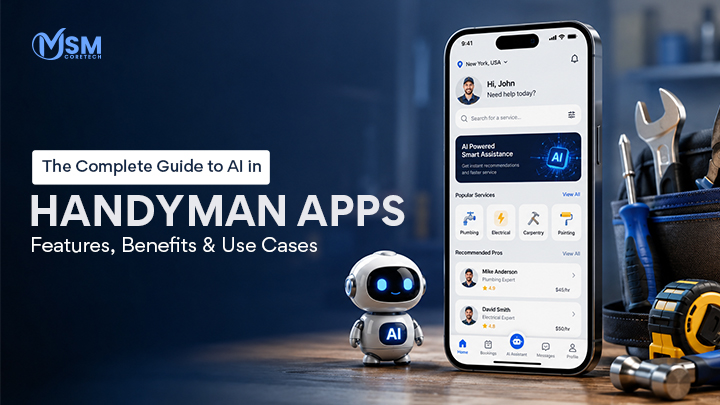
On-demand services have completely changed the way people manage their daily lives, and home repair services are no different. Today, homeowners want to book a plumber, electrician, or carpenter just as easily as they order a cab or food delivery: quickly, reliably, and with only a few taps on their phone. This increasing demand for on-demand handyman services is encouraging platform owners to go beyond basic booking systems and create something much smarter and more useful.
This is exactly where AI in handyman apps makes a real difference. Artificial Intelligence in handyman apps is no longer just a future concept. It is already changing the way service marketplaces connect customers with the right technicians, set fair job prices, and encourage users to return again and again. Recent industry reports show that the global on-demand home services market is expected to grow beyond $1000 billion by the early 2030s, and a major part of this growth is being driven by AI-powered personalization, automation, and smart predictive features.
In this guide, you will understand what an AI-powered handyman app actually is, why AI is becoming more important for this industry, the main features every modern app should include, the technologies used behind these apps, the real development costs, common challenges, and future trends. Whether you are a startup founder or a business owner with an established company, this guide will help you explore how to build a smarter and more profitable handyman platform, and how to choose the right development partner to turn your idea into reality.

What is an AI-Powered Handyman App?
An AI-powered handyman app is a service marketplace platform that uses Artificial Intelligence to make handyman app services easier and better for both customers and service providers. It helps automate how customers book services and how technicians are matched, scheduled, and paid. Instead of depending only on manual settings and fixed rules, the app looks at data, learns from past activities, and makes smarter decisions on its own. In simple words, it is a handyman booking app that can think, predict, and keep getting better with every single job it completes.
How AI Differs From Traditional Handyman Apps
A traditional handyman app works like an online service directory. The customer searches for a service, uses different filters, and chooses a technician on their own. The app does not really understand the type of work, how urgent the service is, or what the customer has preferred before. It only shows results by following fixed rules like location or service category.
An AI-powered app works in a much smarter way. It looks at the service request, the customer’s previous history, the technician’s skills, current traffic conditions, and even the words used in the request, and then gives the most suitable recommendation. It does not simply show different options; it chooses the best one and keeps making that choice better over time. This is the real difference between a basic listing app and a genuine AI-powered handyman app experience.
Also Read: How to Design a Handyman App?
Why AI is Becoming Essential in Handyman Apps?
The handyman services industry is more competitive than ever before, and just having an app is no longer enough to attract and keep customers. This is why AI in handyman apps has now become a necessity instead of just a luxury.
Rising Customer Expectations
Today, customers are used to getting quick results from apps like food delivery and ride-hailing services. They now expect the same fast service and personalized experience from a handyman app. AI helps make this possible by quickly finding the right technician and providing accurate arrival time estimates, instead of making customers wait for someone to confirm the booking manually.
Faster Service Delivery
AI helps reduce the time between when a customer submits a service request and when a technician reaches their location. By automatically checking the type of job, the technician’s location, and their availability, the system quickly assigns the nearest and most suitable technician within seconds instead of taking minutes or even hours.
Workforce Optimization
Many handyman businesses often face a problem where some technicians have no work in one area, while other technicians are too busy in another. AI-based workforce optimization looks at service demand patterns and automatically distributes job assignments more evenly, helping reduce idle time and allowing each technician to complete more jobs every day.
Increasing Competition
Every year, many new handyman apps are launched in the market, and a large number of them choose to work with a handyman app development company that has expertise in building AI-powered solutions. Businesses that do not use AI may fall behind their competitors who provide quicker booking, more accurate pricing, and a better overall customer experience.
Cost Reduction
AI helps businesses reduce their operational costs by automatically handling tasks that earlier needed people to do them manually, such as dispatching jobs, managing schedules, calculating prices, and even answering customer questions through AI chatbots. This helps businesses serve more customers without needing to increase the number of staff at the same rate.
Better Customer Retention
Personalized recommendations, correct pricing, and fast solutions to customer problems all help create a better customer experience. AI can find customers who may be starting to lose interest and automatically send them personalized offers to encourage them to come back, which directly helps improve customer retention. Over time, this proactive approach helps build strong trust and long-term customer loyalty that is very hard to achieve with a fully manual, same-for-everyone approach to customer service.
How AI Works in a Handyman App?
To understand how AI really helps in handyman apps, it is useful to see the actual steps the system follows in the background, from the time a customer opens the app until the job is completed.
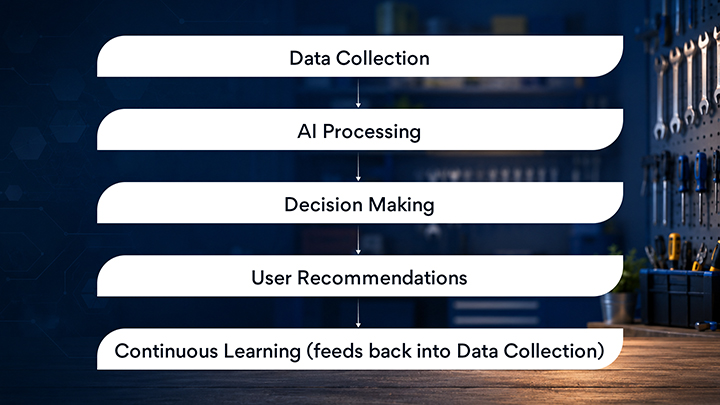
Data Collection
Everything starts with data. The app keeps collecting information like the customer’s location, service history, technician performance, ratings, response time, job photos, and even the language used in chat messages. This collected data becomes the foundation for every AI decision that comes next.
AI Processing
After the data is collected, machine learning models analyze it to find useful patterns. For example, the system may see that plumbing service requests increase on Monday mornings in a specific neighborhood, or that a certain technician regularly gets high customer ratings for electrical work.
Decision Making
Based on the patterns it finds, the AI system makes quick decisions in real time, like which technician should be assigned, what price should be suggested, or how urgent a request needs to be marked. These decisions are made within seconds and are much more consistent than making them manually.
User Recommendations
The app then shows helpful recommendations to both the customer and the technician. The customer may see a recommended service package or an expected cost range, while the technician gets a prioritized list of nearby jobs that best match their skills.
Continuous Learning
Every completed job, cancelled booking, or customer review helps improve the system. This allows the AI model to learn from real user activity, becoming smarter and more accurate as the app continues running over time.
Here is a simple workflow diagram showing how these five stages connect in an AI handyman app:
Top AI Features Every Handyman App Should Have
If you are planning to build or improve a platform, these are the handyman app features that really make a modern and competitive AI-powered handyman app solution.
AI-Based Smart Service Matching
This feature looks at the customer’s request, previous bookings, and personal preferences to automatically connect them with the most suitable service category and technician, making it easy to choose the right professional without any guesswork.
Intelligent Technician Assignment
Instead of showing a long list of available technicians, the AI automatically finds and assigns the best technician by checking their skills, nearby location, current workload, and previous customer ratings, making sure the right person gets the job every time.
AI Appointment Scheduling
Smart scheduling tools check technician schedules, travel time, and estimated job duration to recommend the best available time slots, helping reduce scheduling problems and missed appointments.
Dynamic Pricing
Just like ride-hailing apps, dynamic pricing changes the service cost based on customer demand, how urgent the service is, technician availability, and the time of day, helping businesses earn more while keeping prices fair for customers.
AI Chatbot & Virtual Assistant
A chatbot that uses natural language processing can answer common customer questions, help people book services, and even solve small issues, all without any human help, while staying available 24 hours a day.
Voice Search & Voice Booking
Voice-enabled booking lets customers simply say what they need, like ‘book an electrician for tomorrow morning’, making the app easier to use and more convenient, especially for users who are on the go.
Predictive Maintenance
By looking at past service requests, AI can predict when a customer’s appliance or home system may need maintenance again, and suggest booking a service early before a bigger problem happens.
AI-Powered Image Recognition for Issue Detection
Customers can upload a photo of a leaking pipe or a broken switch, and smart image technology checks the picture to understand the type of problem and how serious it is, helping send the right technician with the right tools for the job.
AI Cost Estimation
Instead of waiting for a technician to manually prepare a quote, AI can quickly provide an estimated price range based on the type of job, required materials, location, and past pricing data, giving customers better transparency right from the beginning.
Route Optimization
AI-powered route planning finds the quickest and most fuel-saving route for technicians traveling from one job to another, helping reduce travel time and making it possible to complete more jobs every day.
AI Fraud Detection
Machine learning models can easily detect suspicious activities, such as fake reviews, duplicate accounts, or unusual payment behavior, helping protect both the business and real customers from fraud.
Personalized Service Recommendations
Based on previous bookings and browsing history, the app can suggest useful extra services, like recommending a plumbing inspection to a customer who recently booked a water heater repair.
Customer Behavior Analytics
AI keeps track of how customers use the app, which services they look at the most, and where they stop using it, giving business owners useful insights to improve the user experience and their marketing strategy.
Automated Review & Sentiment Analysis
Instead of only showing star ratings, AI can read the actual words in customer reviews to understand their feelings and find common problems, helping businesses know which technicians need more coaching and support.
AI-Powered Push Notifications
Smart notifications are sent at the right time with the right message, like reminding customers about seasonal maintenance or informing technicians about a nearby high-paying job, helping increase engagement without sending too many unnecessary notifications.
You do not need to build all of these features right from the beginning. Many successful platforms start with important features like smart matching, flexible pricing, and a simple chatbot, then slowly add more advanced features like image recognition and predictive maintenance as their users increase and more data becomes available. The main thing is choosing a handyman app development company that can create a strong and flexible foundation today while also preparing your app for these advanced AI features in the future.
Also Read: Develop a Handyman App like Angi
Advanced AI Technologies Used in Handyman Apps
Every smart feature mentioned above works because of a group of core technologies behind it. Knowing these will help you have better discussions with your development team.
Machine Learning (ML)
Machine Learning helps the app learn from past data, like booking history and technician performance, so it can keep improving matching accuracy, pricing, and demand predictions over time without needing someone to manually update or reprogram it every time.
Natural Language Processing (NLP)
NLP helps the app understand and respond to the way people speak and write, making chatbots, voice assistants, and even analyzing customer reviews to find useful and meaningful insights.
Computer Vision
Computer Vision helps the app understand images and videos, like recognizing a damaged appliance from a photo or checking a completed job using before-and-after pictures shared by technicians.
Generative AI
Generative AI can automatically create personalized messages, write service descriptions, summarize customer complaints, and even make instant repair guides based on the problem explained by the customer.
Predictive Analytics
This technology uses past and real-time data to predict what may happen in the future, such as finding out which time slots will have the highest demand or which technicians are more likely to get cancellations.
Recommendation Engine
A recommendation engine looks at user preferences and behavior to suggest the right services, technicians, or special offers, just like streaming platforms recommend shows you may enjoy.
Speech Recognition
Speech recognition changes spoken words into text, creating the base for voice search and voice booking features that make the app easier to use without using your hands.
IoT Integration
By connecting with smart home devices and sensors, IoT integration helps the app automatically detect problems, like a smart water sensor sending an alert about a leak before the homeowner even becomes aware of it.
These technologies usually do not work alone. In a real AI handyman app, machine learning, NLP, and computer vision often work together on the same service request. For example, a customer explains a leaking tap in a chat message, uploads a photo, and gets an instant price estimate, all in the same conversation. This combined approach is what makes the platform truly smart instead of being an app that only claims to use AI without actually using it in a real way.
Benefits of AI in Handyman Apps
The real value of Artificial Intelligence in handyman apps becomes much easier to understand when you see how it helps every single person involved in the platform: customers, service providers, and business owners alike.
For Customers
- Faster bookings: customers get matched with a technician within seconds instead of browsing endless listings.
- Personalized recommendations: the app suggests services based on the customer’s own history and preferences.
- Better communication: AI chatbots and smart notifications keep customers informed at every step.
- Accurate pricing: instant cost estimation removes the uncertainty of surprise charges.
- Reduced waiting time: smart scheduling and route optimization mean technicians arrive faster.
Benefits for Service Providers
- Better job allocation: technicians receive jobs that genuinely match their skills and location.
- Higher productivity: optimized routes and schedules mean more completed jobs in a day.
- Improved earnings: less idle time and better job matching directly increase income potential.
- Reduced cancellations: accurate scheduling and expectations lower the chances of last-minute cancellations.
- Efficient scheduling: AI handles calendar conflicts and travel time automatically.
For Business Owners
- Lower operational costs: automation reduces the need for large manual dispatch and support teams.
- Increased customer retention: personalized experiences keep customers coming back to the platform.
- Higher revenue: dynamic pricing and upselling recommendations improve average order value.
- Better analytics: AI dashboards provide clear insights into what is working and what needs improvement.
- Scalable operations: AI systems can handle growing volumes of bookings without a proportional increase in staff.
When all of these benefits are combined, it becomes easy to understand why so many well-established companies and new businesses are investing heavily in AI for handyman apps. The benefits are not limited to just one group. When customers enjoy a faster, smoother, and more reliable experience, technicians naturally earn more and remain loyal to the platform, while business owners see this positive growth reflected directly in both their revenue and their brand reputation. This is why adopting AI is truly a win-win choice instead of being seen as only a simple technology upgrade.
Also Read: Develop a Home Service App like TaskRabbit
Real-World AI Use Cases in Handyman Apps
To help you understand it better, here are real-world examples showing how AI in handyman app platforms is already being used in a successful way.
Smart Technician Matching
When a customer needs an urgent electrical repair, the AI quickly checks nearby technicians by looking at their certified skills, past ratings for similar repair work, and current location, then assigns the best person within seconds instead of making the customer scroll through different profiles.
Instant Cost Estimation
A customer uploads a photo of a broken cabinet hinge, and the app quickly shows an estimated price range by using data from similar repair jobs completed in the past, helping the customer feel confident before they even book the service.
AI Customer Support
A chatbot can answer common questions like rescheduling appointments or checking when a technician will arrive, so human support agents can spend their time handling only difficult or sensitive customer issues.
Predictive Equipment Maintenance
For customers who have previously booked HVAC service, the app can estimate when the next service is due using seasonal patterns and send a timely reminder before the system breaks down in advance alert system.
Smart Route Planning
When a technician has many jobs planned in one day, AI automatically sets the order and route in a way that reduces travel time, helping them fit one or two extra jobs within the same shift.
AI-Powered Review Analysis
Rather than going through hundreds of reviews one by one, business owners receive an auto-created summary that shows common patterns, like technicians often being praised for arriving on time or sometimes being criticized for not cleaning up after the job.
Demand Forecasting
By observing seasonal patterns, such as higher plumbing service requests during winter, the platform can proactively inform technicians to keep more of their availability open during expected high-demand time periods.
Automated Workforce Management
AI checks busy technicians across a city and automatically sends new job requests to less busy technicians, keeping the workforce balanced and efficient overall.
Personalized Promotions
Customers who haven’t booked any service for the past few months automatically get a personalized discount notification, which is created based on their previous service category, to motivate them to come back to the platform.
Fraud Prevention
The system marks unusual activity, like a technician account getting an unusually high number of five-star reviews in a short time, triggering manual review to protect the platform’s credibility and system integrity.
What makes these use cases powerful is that they are not just separate experiments. Leading platforms in the on-demand service industry are already combining many of these use cases, using smart matching along with predictive maintenance and fraud detection to build one smooth and seamless user experience. Businesses that carefully study these real-world examples and apply them in their own market usually see faster returns on their investment in Artificial Intelligence in handyman apps.
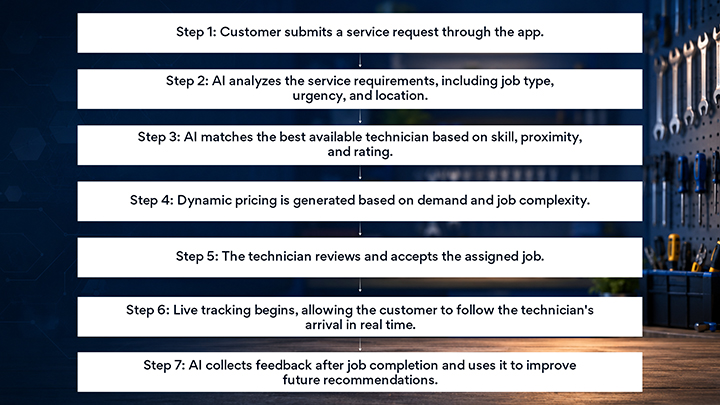
AI Workflow in a Handyman App
Here is a simplified, step-by-step look at how a single booking flows through an AI-powered system from start to finish.
Essential Features of an AI Handyman App
A complete AI-powered handyman platform is built with three connected panels, and each panel is designed for a different type of user. Below is what each of these panels usually includes.
Customer Panel
- Registration/Login
- AI Service Recommendation
- Smart Search
- Voice Search
- Booking Management
- Live Tracking
- Secure Payments
- Ratings & Reviews
- Chat Support
Service Provider Panel
- AI Job Recommendation
- Availability Management
- Route Optimization
- Earnings Dashboard
- Calendar Management
- Job History
- AI Performance Insights
Admin Panel
- Dashboard
- User Management
- Technician Management
- AI Analytics
- Pricing Management
- Promotions
- Reports
- Fraud Monitoring
The admin panel is usually the place where business owners can clearly see the real power of AI. Instead of manually searching through spreadsheets, admins can use live dashboards that display which services are becoming popular, which technicians require help, and where changes in pricing could increase conversions, all of it automatically created by the main AI engine
Tech Stack for AI Handyman App Development
Picking the right set of technologies is very important for building a platform that is fast, dependable, and able to handle AI features at a large scale. Below is a simple breakdown of the most commonly used technologies in each layer of an AI handyman app solution.
Frontend
React Native or Flutter are commonly used to create smooth cross-platform mobile apps for customers as well as technicians from a single codebase.
Backend
Node.js, Python, or Java are commonly used to handle business logic, APIs, and the heavy lifting required to run AI models efficiently.
Database
PostgreSQL or MongoDB are popular choices for storing structured booking data and flexible, fast-changing user activity data.
Cloud Platform
AWS, Google Cloud, or Microsoft Azure provide the scalable infrastructure needed to host AI models, store data, and handle traffic spikes.
AI Frameworks
TensorFlow and PyTorch are the leading frameworks used to build and train the machine learning models that power matching, pricing, and predictions.
Computer Vision APIs
Google Cloud Vision or AWS Rekognition are often integrated to power image-based issue detection features.
Chatbot Frameworks
Dialogflow or Rasa are commonly used to build the natural language chatbots that handle customer support and booking assistance.
Maps & GPS
Google Maps API or Mapbox provide the location tracking and route optimization capabilities essential to the platform.
Payment Gateway
Stripe, PayPal, or Razorpay enable secure, seamless in-app payments for customers across different regions.
Notifications
Firebase Cloud Messaging or OneSignal power the smart, personalized push notifications sent to users and technicians.
Analytics
Google Analytics or Mixpanel help track user behavior and measure the real-world impact of AI-driven features.
AI Integration Challenges and Solutions
Adopting AI in handyman apps comes with real challenges. Here is an honest look at the most common ones, along with practical solutions.
Data Privacy
Handyman apps collect sensitive information such as home addresses and payment details. The solution is to implement strong encryption, follow data protection regulations, and give users clear control over their data.
AI Model Training
AI models need large volumes of quality data to perform well, which can be limited for new platforms. Businesses can start with rule-based logic and gradually introduce machine learning as more data becomes available.
High Development Cost
Building custom AI features can be expensive, especially for startups. Working with an experienced handyman app development company can help prioritize the highest-impact features first and scale gradually.
AI Bias
If historical data reflects unfair patterns, such as favoring certain technicians repeatedly, the AI can unintentionally reinforce that bias. Regular audits and diverse training data help reduce this risk.
Integration Complexity
Connecting AI models with existing systems like payment gateways, maps, and databases can be technically complex. A modular architecture with well-documented APIs makes this integration smoother.
Regulatory Compliance
Different regions have different rules around data usage and AI transparency. Staying updated with local regulations and building compliance checks into the development process avoids costly legal issues later.
Scalability
As the user base grows, AI systems need to handle significantly more data and requests without slowing down. Cloud-based infrastructure with auto-scaling capabilities ensures the platform grows smoothly alongside demand.
It is worth remembering that none of these challenges are reasons to avoid AI altogether. They are simply reasons to plan carefully and work with a development partner who has already solved these problems for other clients. A phased rollout, starting with lower-risk features and expanding gradually, is usually the safest and most cost-effective path forward for most handyman businesses.
Cost to Develop an AI Handyman App
One of the most common questions business owners ask is about the real cost of handyman app development. The honest answer is that it depends on many factors, which we explain below clearly.
Factors Affecting Development Cost
- Features: the more advanced features you include, such as live tracking or voice booking, the higher the development effort and cost.
- AI complexity: basic recommendation logic costs far less than advanced predictive maintenance or computer vision-based issue detection.
- Platform: building for both iOS and Android increases cost compared to launching on a single platform first.
- UI/UX: a highly polished, custom-designed interface takes more design and development time than a template-based approach.
- Third-party APIs: premium mapping, payment, or AI APIs can add ongoing licensing costs on top of development.
- Team location: development rates vary significantly between regions such as North America, Europe, and Asia.
Estimated Cost Table
| App Type | Key Capabilities | Estimated Cost Range |
|---|---|---|
| Basic AI App | Simple booking, basic AI-based matching, standard notifications | $8,000 to $18,000 |
| Mid-Level AI App | Smart matching, dynamic pricing, chatbot, live tracking | $18,000 to $40,000 |
| Advanced AI Marketplace | Predictive maintenance, image recognition, route optimization, fraud detection | $40,000 to $80,000 |
| Enterprise AI Platform | Full AI suite, IoT integration, multi-region scalability, advanced analytics | $80,000 and above |
These numbers are only general industry estimates and can vary a lot depending on your specific requirements, the technology stack you choose, and the development partner you work with. It is also important to think about cost in terms of return on investment instead of only focusing on the upfront price.
A well-made AI handyman app usually pays for itself through higher job completion rates, better technician retention, and stronger customer loyalty, often in many cases within the first one or two years of operation. Businesses that treat AI as a long-term investment rather than a one-time cost usually get much greater value from their platform over time in the long run.
Future Trends of AI in Handyman Apps (2026 & Beyond)
The role of Artificial Intelligence in handyman apps is only going to grow. Here are the trends set to define the next phase of this industry.
Generative AI Booking Assistants
Future apps will use generative AI to create simple conversational booking experiences where users describe problems in normal language, and the assistant manages everything else after that smoothly.
AI Voice Agents
Beyond basic voice search, fully conversational AI voice agents will be able to manage full bookings during a phone call, understanding context and confirming details without any human help.
AR + AI for Remote Assistance
Using AR and AI, technicians can help customers remotely fix simple problems through their phone camera, so they do not need in-person visits for small issues from anywhere easily.
Hyper-Personalization
AI will go beyond simple suggestions to give highly personal experiences, adjusting pricing, service recommendations, and communication style for every customer.
Autonomous Scheduling
Scheduling will become fully autonomous, with AI independently coordinating technician calendars, customer availability, and travel time without any manual adjustment.
Predictive Maintenance
As more smart home devices become common, AI will increasingly predict maintenance needs before a customer even realizes there is a problem, shifting the industry from reactive to proactive service.
IoT Integration
Greater integration with smart home sensors will allow handyman apps to automatically detect issues like water leaks or electrical faults and initiate a service request instantly.
AI Digital Twins
Some platforms are beginning to explore digital twin technology, creating a virtual model of a customer’s home systems to better predict and plan maintenance needs over time.
AI Copilots for Technicians
Technicians will increasingly rely on AI copilots that provide real-time repair guidance, safety checklists, and parts recommendations directly through their mobile device while on the job.
Edge AI
Processing AI computations directly on devices, known as edge AI, will allow for faster image recognition and decision-making even in areas with weak internet connectivity.
Businesses that start preparing for these trends now, even in small ways, will be far better positioned than competitors who wait until these technologies become mainstream. Investing in a flexible AI foundation today makes it much easier to adopt these emerging capabilities as they mature over the next few years.
Why Choose MSM Coretech as Your AI Handyman App Development Company?
Creating a successful AI-powered handyman app platform needs more than just technical skills. It needs a development partner who understands the industry, the technology, and how to combine both into a product that truly works for your business. This is where MSM Coretech stands out as a trusted handyman app development company.
- Custom AI solutions: every business has different needs, and MSM Coretech builds AI features tailored specifically to your service model rather than offering generic, one-size-fits-all solutions.
- Scalable architecture: the platforms are built to grow smoothly from a handful of bookings a day to thousands, without requiring a costly rebuild down the line.
- Security-first development: customer data, payment details, and business information are protected using industry-standard security practices from day one.
- Faster deployment: with a proven development process and reusable components, MSM Coretech helps bring your AI-powered app to market faster than starting from scratch.
- Ongoing support: the relationship does not end at launch, with continued maintenance, updates, and feature enhancements as your business evolves.
- AI model optimization: existing AI models are continuously fine-tuned using real usage data, ensuring matching, pricing, and recommendations keep improving over time.
If you’re ready to build a smarter and more competitive handyman platform, working with an experienced handyman app development company like MSM Coretech can help turn your idea into a fully functional app powered by AI.
From the first discussion about your project to the final launch and ongoing support, the main goal is to create technology that solves real problems for both customers and service professionals, instead of simply using AI as a marketing term. This practical and result-focused approach helps businesses stay ahead and succeed in a market where AI in handyman apps is quickly becoming the new industry standard.
Conclusion
AI in handyman apps is no longer just a nice feature if you want to stay ahead in today’s on-demand service market. From finding the right technician quickly and offering flexible pricing to predicting maintenance needs and allowing voice-based bookings, AI is improving every part of the experience for both customers and service professionals. Businesses that start using these AI-powered features early are getting more bookings, reducing operating costs, and building stronger customer loyalty than those still depending on old-fashioned manual processes.
In this guide, we explained what an AI-powered handyman app is, the technologies used to build it, the essential features it should have, real-world examples of how it is used, the cost of development, the common challenges you may face, and the future of this growing industry. The opportunity to create a truly useful handyman app is greater than ever, but long-term success depends on selecting the right features and working with the right app development partner.
FAQs
AI in handyman apps refers to using technologies like machine learning and predictive analytics to automate technician matching, pricing, and scheduling. It helps the app make smarter decisions instead of relying only on manual filters.
It speeds up bookings by instantly matching the right technician and generating accurate cost estimates. It also personalizes recommendations based on the customer’s past service history.
Key features include smart service matching, dynamic pricing, AI chatbots, and image recognition for issue detection. Route optimization and predictive maintenance are also valuable additions.
Costs typically range from $8,000 for a basic app to $80,000 or more for an enterprise-level AI platform. The final price depends on features, AI complexity, and chosen tech stack.
An experienced handyman app development company understands how to build and train AI models specific to your service model. This reduces development risks and helps launch a scalable, future-ready platform faster.

Related Posts

How to Start an Online Handyman Business? A Complete Guide
Home services have quietly become one of the busiest corners of the on-demand economy. People no longer want to flip...
Read More
Top Music Streaming App Trends To Follow In 2026
Music streaming has changed how people find, share, and listen to their favorite songs. Today, listeners want more than just...
Read More

Top Benefits Of Medicine Delivery Apps In Healthcare 2026
Buying medicine used to mean the same thing everywhere: get in the car, wait in line at the pharmacy counter,...
Read More


 Verified Review




 +44 7427829444
 71-75, Shelton Street, Covent Garden, London, United Kingdom, WC2H 9JQ