

Share this article


How to Develop a Food Delivery App Like Deliveroo: A Complete Guide
The food delivery industry has grown very fast in recent years. People now prefer ordering food online instead of visiting restaurants. Apps like Deliveroo have changed the way we eat by making food delivery quick, easy, and convenient. If you are planning to build an app like Deliveroo, this guide will help you understand everything in very simple language.
Today, many businesses want to develop an app like Deliveroo because it offers huge profit opportunities. From startups to restaurant owners, everyone is entering this space. But creating a successful app like Deliveroo is not just about design—it requires the right features, technology, and strategy.
In this blog, we will explain step by step how to build an app like Deliveroo, what features you need, how much it costs, and how a food delivery app development company can help you. Whether you are a beginner or a business owner, this guide will give you a clear understanding of the entire process.
What is the Deliveroo App?
Deliveroo is a popular food delivery app that connects customers with restaurants and delivery partners. It allows users to order food from their favorite restaurants and get it delivered to their doorstep quickly.
The app works with three main users:
- Customers who order food
- Restaurants that prepare food
- Delivery riders who deliver the food
Deliveroo provides a simple interface where users can browse restaurants, select dishes, make payments, and track their orders in real-time. It also helps restaurants increase their reach and sales without needing their own delivery system.
If you want to build an app like Deliveroo, you need to create a similar system that connects all three parties smoothly.
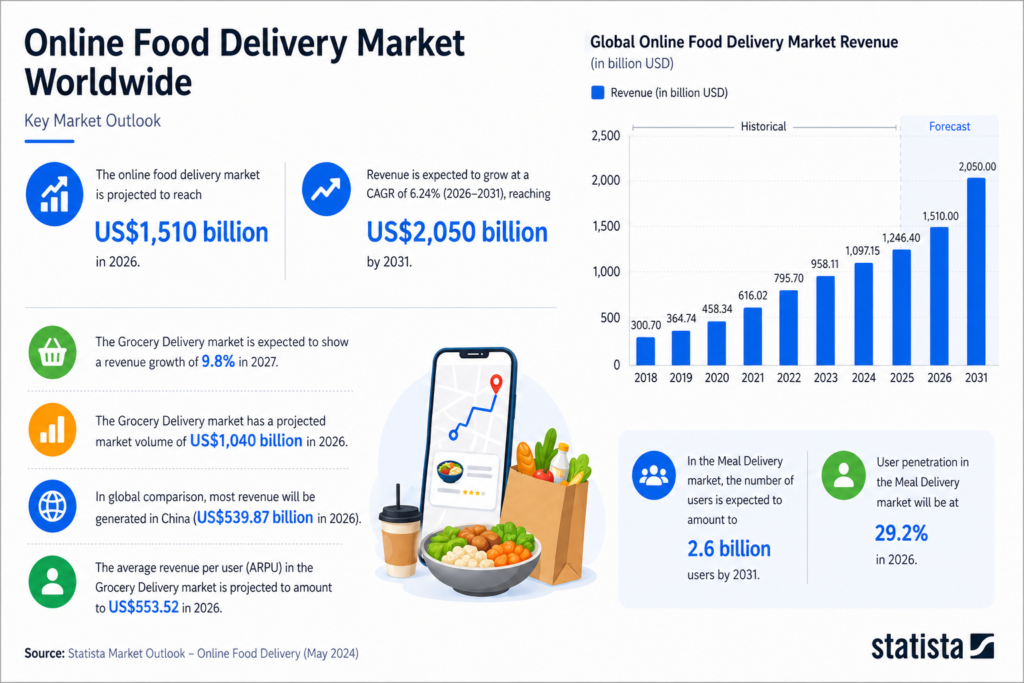
Market Stats of Food Delivery Apps
The global online food delivery market is set for massive growth, with revenues expected to climb steadily over the next few years. Rising user adoption and expanding grocery delivery services are driving this surge across key regions.
- The online food delivery market is projected to reach US$1,510 billion in 2026, growing at a CAGR of 6.24% from 2026 to 2031, and is expected to hit US$2,050 billion by 2031.
- The grocery delivery segment is forecasted to grow by 9.8% in 2027, with a market size of US$1,040 billion in 2026 and an average revenue per user of US$553.52.
- China is expected to lead globally, generating US$539.87 billion in revenue by 2026.
- The meal delivery segment will reach 2.6 billion users by 2031, with user penetration estimated at 29.2% in 2026.
Types of Food Delivery App Like Deliveroo You Can Build
When you plan to build an app like Deliveroo, choosing the right business model is one of the most important decisions. The type of food delivery app you choose will decide how your platform earns money, how operations are handled, and what kind of users you will attract. Below are the main types of food delivery apps, explained in a simple and detailed way.
1. Order-Only Model (Aggregator Model)
In this model, your app acts as a bridge between customers and restaurants. Users can browse restaurants, check menus, and place orders through your app. However, the restaurant is responsible for preparing and delivering the food.
This model is easier and cheaper to start because you don’t need to manage delivery logistics. Your main focus is on creating a smooth user experience and onboarding restaurants.
How you earn:
- Commission from restaurants on each order
- Featured listings or promotions
Best for: Startups with a low budget or businesses that want to test the market before scaling.
2. Order and Delivery Model (Marketplace Model)
This is the most popular model used by apps like Deliveroo, Uber Eats, and DoorDash. In this system, your platform handles everything-order placement, food preparation coordination, and delivery through your own fleet of drivers or delivery partners.
You control the entire process, which helps you maintain quality and provide a better customer experience. However, it requires strong logistics management.
How you earn:
- Delivery fees from customers
- Commission from restaurants
- Surge pricing during peak hours
Best for: Businesses that want full control and are ready to invest in operations and delivery infrastructure.
3. Full-Service Model (Cloud Kitchen / Inventory Model)
In this model, you manage everything, including food preparation. Instead of partnering with restaurants, you operate your own kitchens (also called cloud kitchens or ghost kitchens).
You prepare food under your own brand and deliver it directly to customers using your app. This gives you complete control over quality, pricing, and branding.
How you earn:
- Direct food sales
- Subscription plans
- Combo offers and upselling
Best for: Businesses that want to build their own food brand and maintain full control over operations.
4. Subscription-Based Model
In this model, users pay a monthly or yearly subscription fee to get benefits like free delivery, discounts, or exclusive deals. This model is usually added on top of other models to increase customer retention.
For example, users may pay a small monthly fee to avoid delivery charges.
How you earn:
- Subscription fees
- Increased order frequency
Best for: Apps that already have a stable user base and want to improve customer loyalty.
5. On-Demand Delivery Service Model
This model focuses mainly on fast delivery rather than restaurant listings. Customers can order from nearby restaurants or stores, and delivery partners pick up and deliver the items quickly.
This model is popular for quick commerce (like groceries, snacks, or urgent food delivery).
How you earn:
- Delivery charges
- Distance-based pricing
Best for: Urban areas where users prefer fast delivery within minutes.
6. Hybrid Model
A hybrid model combines two or more of the above models. For example, your app can offer both restaurant partnerships and your own cloud kitchen services. You can also include subscription features along with delivery services.
This model gives flexibility and allows you to expand your business over time.
How you earn:
- Multiple revenue streams (commissions, delivery fees, subscriptions, ads)
Best for: Businesses planning long-term growth and scalability.
How to Choose the Right Model?
Before you develop an app like Deliveroo, ask yourself:
- What is your budget?
- Do you want to manage delivery operations?
- Are you targeting a local area or a large market?
- Do you want quick profits or long-term growth?
If you are just starting, the order-only model is a good choice. If you want to scale like Deliveroo, the order and delivery model is ideal. And if you want full control, the cloud kitchen model is the best option.
Choosing the right type will help you build an app like Deliveroo that matches your business goals and market needs.
Also Read: Develop a Food Delivery App Like Hungerstation
Popular Food Delivery Apps like Deliveroo in the USA
If you want to build an app like Deliveroo, it is very important to understand the top players in the USA market. These apps have already built strong systems, large customer bases, and advanced features. By studying them, you can learn what works well and what you should include when you develop an app like Deliveroo.
Below are some of the most popular food delivery apps in the USA, explained in detail:
1. Uber Eats
Uber Eats is one of the biggest food delivery platforms in the world. It was launched by Uber and uses its strong driver network to deliver food quickly.
Key Features:
- Easy-to-use interface
- Real-time order tracking
- Wide restaurant selection
- Multiple payment options
Why it is successful: Uber Eats benefits from Uber’s existing infrastructure and strong brand value. Developing an app like Uber Eats also offers fast delivery and reliable service.
2. DoorDash
DoorDash is the market leader in the USA food delivery industry. It covers a large number of cities and restaurants.
Key Features:
- DashPass subscription for free delivery
- Scheduled deliveries
- Contactless delivery
- Advanced tracking system
Why it is successful: DoorDash focuses on customer convenience and offers great discounts and subscription plans. Food delivery apps like DoorDash also has a strong delivery network.
3. Grubhub
Grubhub is one of the oldest food delivery apps in the USA. It has a strong presence in urban areas and offers a wide range of restaurant options.
Key Features:
- Pre-order meals
- Loyalty programs
- Detailed restaurant filters
Why it is successful: Grubhub built early trust in the market and still attracts users with rewards and offers. Leverage the benefits of a powerful food delivery app like Grubhub.
4. Postmates
Postmates is known for delivering more than just food. It also delivers groceries, drinks, and other essentials.
Key Features:
- Multi-category delivery
- Fast delivery service
- Live tracking
Why it is successful: Its ability to deliver almost anything makes it different from other apps. Developing an on-demand food delivery app like Postmates supports your food delivery business.
5. Instacart
Instacart mainly focuses on grocery delivery but also offers food delivery services in some areas.
Key Features:
- Scheduled delivery
- Personal shopper system
- Real-time updates
Why it is successful: Instacart is popular for convenience and wide product availability. Food delivery apps like Instacart are made for convenience and speed.
Features of a Food Delivery App Like Deliveroo
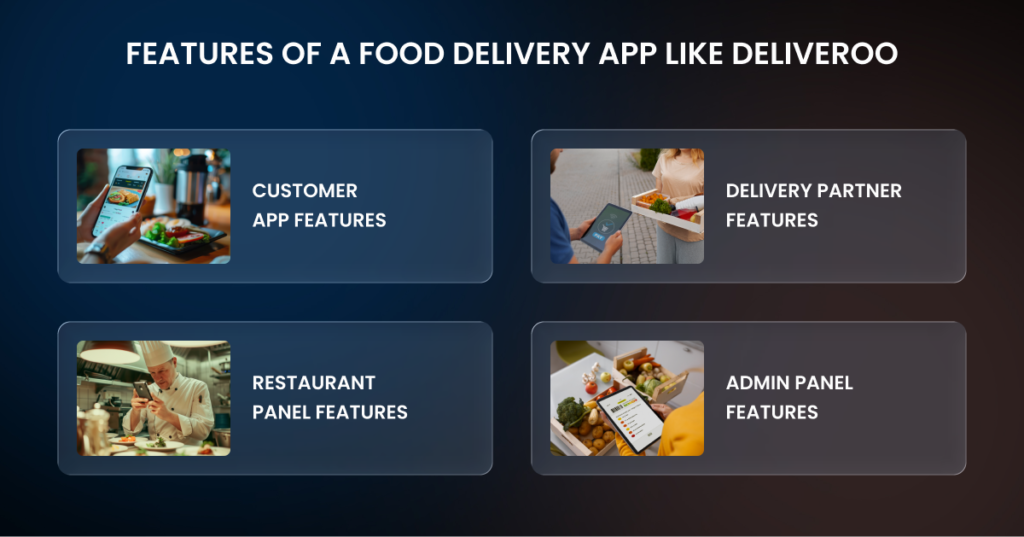
To build an app like Deliveroo, you need to include a complete set of features for all users-customers, restaurants, and delivery partners. These features should be simple to use, fast, and reliable. A good food delivery app development company always focuses on creating a smooth experience for everyone involved.
Let’s understand each feature of a food delivery app in detail.
Customer App Features
The customer app is the most important part of your platform because it directly affects user experience and satisfaction.
1. User Registration and Login
Users should be able to sign up easily using email, phone number, or social media accounts. A quick and simple login process improves user retention.
2. Profile Management
Users can manage their personal details, delivery addresses, and payment methods. This makes ordering faster in the future.
3. Search and Filters
Customers should be able to search for restaurants, cuisines, or dishes. Filters like price range, ratings, and delivery time help users find what they want quickly.
4. Restaurant Listings
Display a list of nearby restaurants with details like ratings, delivery time, and menu highlights. This helps users make better decisions.
5. Menu Browsing
Users can explore detailed menus with images, descriptions, and prices. A clean layout makes the app more attractive.
6. Add to Cart
Customers can select multiple items and add them to their cart before placing an order.
7. Multiple Payment Options
Offer different payment methods like credit/debit cards, UPI, wallets, and cash on delivery. This increases convenience.
8. Order Tracking
Real-time tracking allows users to see the status of their order—from preparation to delivery.
9. Push Notifications
Send updates about order status, offers, and discounts to keep users engaged.
10. Ratings and Reviews
Users can rate restaurants and delivery services. This builds trust and improves service quality.
Restaurant Panel Features
The restaurant panel helps restaurant owners manage their operations efficiently.
1. Restaurant Registration
Restaurants can sign up and list their business on your platform.
2. Menu Management
Restaurants can add, update, or remove food items, prices, and descriptions anytime.
3. Order Management
Restaurants receive orders and can accept or reject them based on availability.
4. Inventory Management
Track ingredient availability to avoid accepting orders for unavailable items.
5. Earnings Dashboard
Restaurants can view daily, weekly, and monthly earnings.
6. Offers and Discounts
Restaurants can create special deals to attract more customers.
Delivery Partner Features
Delivery partners play a key role in ensuring fast and smooth delivery.
1. Easy Registration
Delivery agents can sign up and submit documents for verification.
2. Order Notifications
Delivery partners receive alerts for new delivery requests.
3. Accept/Reject Orders
They can accept or decline delivery requests based on availability.
4. Navigation Support
Integration with maps helps delivery agents find the fastest route.
5. Earnings Tracking
Delivery partners can track their daily and weekly earnings.
6. Delivery Status Update
They can update the status (picked up, on the way, delivered) in real time.
Admin Panel Features
The admin panel is the backbone of your platform. It allows you to control, monitor, and manage the entire system from one place. If you want to build an app like Deliveroo successfully, a powerful admin panel is a must.
Here are the key admin features in detail:
1. Dashboard Overview
The admin gets a complete overview of the platform including total users, orders, revenue, and active deliveries in real time.
2. User Management
Admins can manage all users including customers, restaurants, and delivery partners. They can view profiles, block users, or resolve issues.
3. Restaurant Management
Add, approve, or remove restaurant listings. Admins can also monitor restaurant performance and customer feedback.
4. Delivery Partner Management
Manage delivery agents, verify documents, assign deliveries, and track their performance.
5. Order Management
Track all orders in real time, manage order status, and handle cancellations or refunds.
6. Commission and Payment Management
Set commission rates for restaurants and delivery partners. Admins can also manage payments, payouts, and transaction history.
7. Offers and Promotions Management
Create and manage discount codes, coupons, and promotional campaigns to attract more users.
8. Analytics and Reports
Access detailed reports on sales, user activity, order trends, and business growth. This helps in making better decisions.
9. Content Management System (CMS)
Easily update app content like banners, images, FAQs, and notifications without technical knowledge.
10. Customer Support Management
Handle user complaints, queries, and support tickets directly from the admin panel.
11. Notification Management
Send push notifications, alerts, and updates to users, restaurants, and delivery partners.
12. Security and Access Control
Manage admin roles and permissions to ensure data security and controlled access.
A well-designed admin panel makes it easy to manage and scale your business. When you develop an app like Deliveroo, make sure your admin features are strong and easy to use, as they directly impact your overall operations and growth.
Also Read: Develop an App like Talabat
Advanced Features to Make Your App Like Deliveroo Stand Out
If you want to build an app like Deliveroo that competes with top platforms, basic features are not enough. You need advanced features that improve user experience, increase engagement, and help your business grow faster. These features make your app more smart, efficient, and future-ready.
Here are some powerful advanced features of apps like Deliveroo explained in detail:
1. AI-Based Food Recommendations
Artificial Intelligence (AI) can analyze user behavior, past orders, and preferences to suggest food items and restaurants. This helps users find what they want quickly and increases order value.
2. Real-Time GPS Tracking
Live tracking allows customers to see exactly where their order is. It shows when the food is being prepared, picked up, and delivered. This builds trust and improves transparency.
3. In-App Chat Support
Users should be able to chat with delivery agents or customer support directly within the app. This helps resolve issues quickly without leaving the platform.
4. Voice Search and Smart Search
Adding voice search makes it easier for users to find food without typing. Smart search also suggests results as users type, saving time.
5. Multiple Payment Integration
Integrate different payment options like UPI, wallets, cards, and even Buy Now Pay Later (BNPL). This improves user convenience and increases conversions.
6. Push Notifications with Personalization
Send personalized notifications based on user behavior, such as favorite food offers, discounts, or reminders. This keeps users engaged and encourages repeat orders.
7. Loyalty Programs and Rewards
Reward users with points, cashback, or discounts for frequent orders. This helps increase customer retention and brand loyalty.
8. Schedule Orders
Allow users to schedule their orders in advance. This is useful for busy users who want food delivered at a specific time.
9. Multi-Language and Multi-Currency Support
If you are targeting a global audience, your app should support multiple languages and currencies. This makes your app accessible to more users.
10. Heat Maps and Smart Delivery Allocation
Use heat maps to identify high-demand areas and assign delivery partners efficiently. This reduces delivery time and improves service quality.
11. Contactless Delivery Option
Users can choose contactless delivery for safety and convenience. This feature became very important after the pandemic.
12. Advanced Analytics Dashboard
Provide detailed insights like user behavior, peak order times, and sales trends. This helps in making data-driven decisions.
13. Cloud Kitchen Integration
Allow businesses to run virtual kitchens directly through your platform. This opens new revenue streams.
14. Social Media Integration
Let users share their orders or reviews on social media platforms. This helps in free marketing and brand promotion.
15. Fraud Detection and Security Features
Advanced security systems can detect fake orders, payment fraud, and suspicious activity, keeping your platform safe.
Including these advanced features will help you develop an app like Deliveroo that is modern, competitive, and user-friendly. A skilled food delivery app development company can help you integrate these features effectively and ensure smooth performance.
Also Read: Launch a Food Delivery App
Step-by-Step Guide to Build an App Like Deliveroo
If you want to build an app like Deliveroo successfully, you need a clear and practical food delivery app development process. It’s not just about development-it’s about planning, execution, and continuous improvement. Below are more detailed and realistic processes to build an app like Deliveroo.
Step 1: Start with a Clear Business Idea
Before anything else, define your idea properly.
- What problem are you solving?
- Who are your target users?
- Will you focus on a specific city or multiple locations?
For example, you can target late-night delivery, healthy food, or budget meals. A clear idea helps you stand out when you develop an app like Deliveroo.
Step 2: Analyze Competitors Deeply
Do not just look at competitors- study them carefully.
- What features do they offer?
- What are users complaining about?
- How fast is their delivery?
Read app reviews on the Play Store and App Store. This gives real insights into user expectations and gaps you can fill.
Step 3: Plan Your Revenue Strategy
Before you build the app, decide how you will earn money.
Common revenue models include:
- Commission per order
- Delivery charges
- Subscription plans
- Ads and promotions
A strong revenue plan ensures your app becomes profitable.
Step 4: Build a Feature Roadmap
Instead of adding everything at once, plan features in phases.
First Phase (Basic Launch):
- Login/signup
- Restaurant listing
- Order placement
- Payment system
Second Phase (Growth):
- Live tracking
- Reviews and ratings
- Push notifications
Third Phase (Advanced):
- AI recommendations
- Loyalty programs
- Subscription plans
This approach saves cost and speeds up launch.
Step 5: Design Simple and Clean UI/UX
Your app should be very easy to use.
- Keep navigation simple
- Use clear buttons and categories
- Avoid too many steps in ordering
A confusing design will make users leave your app quickly, even if the features are good.
Step 6: Choose Development Approach
You have two main options:
- Custom Development: Build everything from scratch (more flexible but costly)
- Ready-Made Solutions: Faster and cheaper, but limited customization
If you want long-term growth, custom development is better when you build an app like Deliveroo.
Step 7: Develop Customer, Restaurant & Delivery Apps
Remember, you are not building just one app. You need:
- Customer app
- Restaurant panel/app
- Delivery partner app
- Admin dashboard
All these systems should work together smoothly.
Step 8: Integrate Important Services
Your app needs external services to function properly:
- Payment gateway (Stripe, Razorpay, PayPal)
- Maps and navigation (Google Maps)
- SMS/OTP verification
- Push notifications
These integrations are essential for a real-world working app.
Step 9: Focus on Speed and Performance
Users expect fast apps. If your app is slow, they will uninstall it.
- Optimize loading speed
- Use a strong backend
- Test performance under heavy traffic
Performance is a major factor in app success.
Step 10: Test in Real-Life Conditions
Testing should not be limited to basic checks.
- Test with real users
- Try different devices and networks
- Simulate high-order situations
This helps you identify real problems before launch.
Step 11: Launch with a Smart Strategy
Do not launch everywhere at once.
- Start with one city or area
- Partner with a few restaurants
- Offer discounts to attract users
A small and focused launch helps you manage operations better.
Step 12: Build a Strong Delivery Network
Delivery is the heart of your business.
- Hire reliable delivery partners
- Provide proper training
- Use route optimization tools
Fast and accurate delivery improves customer satisfaction.
Step 13: Invest in Marketing and Branding
Even a great app will fail without marketing.
- Use social media ads
- Offer referral bonuses
- Collaborate with influencers
- Run local campaigns
Marketing helps you gain visibility and downloads.
Step 14: Collect Feedback and Improve
After launch, listen to your users.
- Read reviews
- Collect feedback
- Fix issues quickly
Continuous improvement helps you grow faster than your competitors.
Step 15: Scale Your Business
Once your app is stable, start expanding.
- Add new cities
- Partner with more restaurants
- Introduce new features
Scaling at the right time is key when you develop an app like Deliveroo.
Technology Stack for Building a Scalable Food Delivery App Like Deliveroo
Choosing the right technology stack is very important when you build an app like Deliveroo. The tech stack decides how fast your app runs, how secure it is, and how easily it can grow when more users join.
A strong and modern stack helps you handle real-time orders, live tracking, payments, and high traffic without slowing down. Below is a detailed and easy-to-understand table of the technologies commonly used by a professional food delivery app development company.
Tech Stack Overview
| Layer | Technology Options | Purpose | Why It Matters |
|---|---|---|---|
| Frontend (Mobile App) | React Native, Flutter | Builds the user interface for Android and iOS apps | Helps create fast, smooth, and cross-platform apps with a single codebase |
| Frontend (Web Panel) | React.js, Angular, Vue.js | Used for admin panel and restaurant dashboards | Makes dashboards interactive, fast, and easy to use |
| Backend | Node.js, Django, Laravel | Handles server logic, APIs, and data processing | Ensures fast performance and smooth handling of multiple users |
| Database | MongoDB, MySQL, PostgreSQL | Stores user data, orders, menus, and transactions | Keeps data secure, organized, and easy to access |
| Real-Time Tracking | Firebase, Socket.io | Enables live order tracking and updates | Important for showing real-time delivery status to users |
| Payment Integration | Stripe, PayPal, Razorpay | Processes online payments securely | Supports multiple payment methods and safe transactions |
| Maps & Navigation | Google Maps API, Mapbox | Helps delivery partners find the fastest route | Helps delivery partners find the fastest route |
| Cloud Services | AWS, Google Cloud, Azure | Hosts the app and manages servers | Ensures scalability, uptime, and data security |
| Push Notifications | Firebase Cloud Messaging (FCM), OneSignal | Sends alerts and updates to users | Keeps users engaged with order updates and offers |
| Authentication | OAuth, Firebase Auth | Manages login and user security | Protects user data and enables easy login options |
| Analytics Tools | Google Analytics, Mixpanel | Tracks user behavior and app performance | Helps in making data-driven decisions |
| Security | SSL, JWT, Data Encryption | Protects user data and transactions | Builds trust and prevents fraud or data breaches |
Why This Tech Stack Works
- It supports real-time operations like live tracking and instant updates
- It ensures your app can handle thousands of users at the same time
- It provides strong security for payments and personal data
- It allows easy scaling as your business grows
When you develop an app like Deliveroo, selecting the right technology is not just a technical step-it is a business decision. A reliable food delivery app development company will help you choose the best stack based on your goals, budget, and future plans.
Also Read: Develop a Food Delivery App
Cost to Build an App Like Deliveroo
The cost to build an app like Deliveroo depends on many factors such as features, technology, design, and the development team you choose. There is no fixed price because every app is different. However, understanding the cost structure will help you plan your budget better.
Let’s break it down in a simple and detailed way.
Key Factors That Affect the Cost
1. App Complexity
A basic app with limited features will cost less, while an advanced app with AI, real-time tracking, and analytics will cost more.
2. Number of Features
More features mean more development time, which increases the cost. Adding advanced features like live tracking or AI recommendations will increase your budget.
3. Platform (Android, iOS, or Both)
- Single platform (Android or iOS) is cheaper
- Cross-platform or both platforms cost more but reach a larger audience
4. Design (UI/UX)
Simple designs cost less, while custom and interactive designs require more time and money.
5. Development Team Location
- India/Asia: Lower cost
- Europe/USA: Higher cost
6. Third-Party Integrations
Services like payment gateways, maps, and notifications may have additional costs.
Estimated Cost Breakdown
| App Type | Features Included | Estimated Cost |
|---|---|---|
| Basic App | Login, restaurant listing, cart, payment | $10,000 – $25,000 |
| Medium App | Tracking, reviews, notifications, and the delivery system | $25,000 – $60,000 |
| Advanced App | AI features, analytics, multi-language, high scalability | $60,000 – $120,000+ |
Cost Based on App Modules
When you build an app like Deliveroo, you are actually developing multiple systems:
- Customer App: $8,000 – $25,000
- Restaurant Panel: $5,000 – $15,000
- Delivery App: $8,000 – $20,000
- Admin Panel: $10,000 – $25,000
The total cost depends on how advanced each module is.
Partner with MSM Coretech for Food Delivery App Development
If you are planning to build an app like Deliveroo, choosing the right development partner is one of the most important decisions. MSM Coretech is a trusted food delivery app development company that helps businesses turn their ideas into powerful and scalable applications.
We understand that every business is different. That’s why we offer customized solutions based on your goals, budget, and target market. Whether you are a startup or an established business, our team can help you develop an app like Deliveroo with the right strategy and technology.
Why Choose MSM Coretech?
1. End-to-End Development Services
From idea validation to app launch and maintenance, we handle everything. You don’t need to manage multiple teams.
2. Custom App Development
We build fully customized apps tailored to your business needs instead of using limited ready-made solutions.
3. Experienced Development Team
Our skilled developers, designers, and project managers have experience in building high-quality on-demand apps.
4. Modern Technology Stack
We use the latest technologies to ensure your app is fast, secure, and scalable.
5. User-Friendly Design
We focus on simple and attractive UI/UX design to improve user experience and engagement.
6. Affordable Pricing
We offer cost-effective solutions without compromising on quality.
7. Ongoing Support and Maintenance
After launch, we continue to support your app with updates, bug fixes, and performance improvements.
Our Food Delivery App Development Services
- Android and iOS app development
- Admin dashboard and restaurant panel development
- Delivery partner app development
- Payment gateway integration
- Real-time tracking integration
- App testing and quality assurance
Start Your Project Today
If you want to develop an app like Deliveroo that stands out in the market, MSM Coretech is here to help you at every step. Our team ensures that your app is not only functional but also competitive and future-ready.
Get in touch with MSM Coretech today and take the first step toward building a successful food delivery business.
Conclusion
Building a food delivery app like Deliveroo is a great business idea in today’s digital world. With the increasing demand for online food delivery, now is the perfect time to enter this market. However, success depends on proper planning, the right features, and strong technology.
In this guide, we explained everything you need to know to build an app like Deliveroo, from understanding the concept to development, features, and cost. By following this step-by-step process, you can create a successful food delivery app that meets user needs and stands out in the market.
Working with a reliable food delivery app development company like MSM Coretech can make the process easier and more efficient. With expert support, you can turn your idea into a fully functional and profitable app.
Start your journey today and develop an app like Deliveroo that delivers success along with food.
FAQs
Building an app like Deliveroo usually takes between 3 to 9 months, depending on features and complexity. A basic version can be launched faster with limited features. Advanced apps with AI and real-time systems require more development and testing time.
The cost depends on features, design, and development team location. A basic app may cost around $10,000, while advanced apps can go beyond $100,000. Starting with an MVP is a smart way to reduce initial investment.
Essential features include user login, restaurant listing, menu browsing, order placement, payment integration, and real-time tracking. These features ensure a smooth user experience. Advanced features can be added later for growth.
Yes, starting in a small city is a great strategy to test your idea. It requires less investment and helps you understand user behavior. Once successful, you can expand to larger markets step by step.
A professional company provides technical expertise, faster development, and better quality. They help you avoid common mistakes and ensure scalability. This increases your chances of building a successful app like Deliveroo.

Related Posts
How Much Does It Cost to Build A FinTech App Like Revolut?
Today, many people want to manage their money using just one mobile app. With an app like Revolut, users can...
Read More
How to Build A Veterinary Medicine Online Shopping App?
Pet owners today don’t want to drive across town every time their dog needs a flea tablet, or their cat...
Read More
5 Ways Restaurant Technology Is Transforming the Industry
The restaurant industry is changing fast, and technology is now an important part of this change. Restaurants are using technology...
Read More


 Verified Review




 +44 7427829444
 71-75, Shelton Street, Covent Garden, London, United Kingdom, WC2H 9JQ