

Share this article


How Much Does It Cost to Build a Food Delivery App Like Uber Eats in 2026?
Delivery apps are booming and present an excellent business opportunity for established or new start-up companies. Today’s consumers want faster, safer and more convenient ways to order food from their favorite restaurants. Investing in a food delivery platform is now a strategic way of building a profitable business. Want to know how much it will cost to build a food delivery app like Uber Eats in 2026? The food delivery app development cost can start from $30,000, and it goes up to $300,000. Moreover, it totally depends on its features, tech stack, platform compatibility, and other business requirements.
Today, Uber Eats is one of the leading food delivery apps in the world with millions of customers each month. Uber Eats operates in more than 70 countries and more than 11,000 cities. Uber’s delivery business is growing and thriving. It made more than $14 Billion in revenue in 2025. This is proof that food delivery is no longer just a convenience but a multi-billion-dollar digital business opportunity! Uber Eats’ success has inspired thousands of entrepreneurs, restaurant chains, cloud kitchens, and grocery store brands to develop their own on-demand food delivery apps.
The success of a food delivery app isn’t just about copying the Uber Eats user interface. For example, the customer app, the restaurant app, the delivery partner app, AI-powered recommendations, real-time GPS tracking of food delivery drivers, secure payment gateway integration and backend scalability are all features that will impact the total cost to develop a food delivery app like Uber Eats. Knowing the various cost-driving factors before starting your project will help create a reasonable budget and the greatest return on investment.
In this extensive guide, we’ll cover everything you need to know & learn, including the cost to build a food delivery app like Uber Eats in 2026. We’ll share the development costs per feature, app complexity, development process stages, technology stack, hidden costs, maintenance costs & several proven strategies for reducing your overall investment when developing a competitive food delivery app.
Why Invest in Food Delivery App Development in 2026?
In today’s fast-paced world, the need for food delivery app development is increasing rapidly. Ordering through a mobile application is easy, fast and accessible for users to get food delivered to them compared to the conventional methods of ordering via phone or in-person. Investing in a food delivery app like Uber Eats helps companies reach new customers, generate additional revenues and build customer loyalty.
The future development cost of building a food delivery app like Uber Eats will depend on the development features required and the level of development complexity, according to current trends. However, the fast growth of the industry makes this type of application a worthy investment for businesses.
Online Food Delivery Market Growth
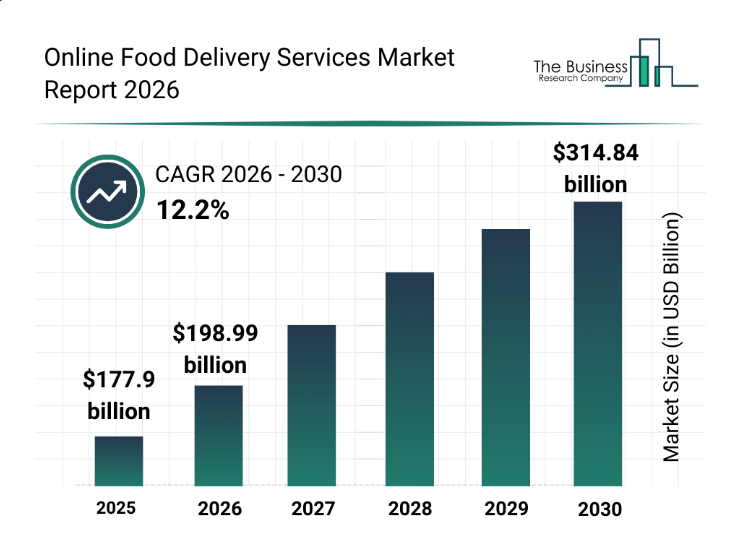
Source: https://www.thebusinessresearchcompany.com/report/online-food-delivery-services-global-market-report
Why Businesses Are Investing?
- Creating Online Food Ordering Habits
- Smart delivery routes and AI-driven recommendations
- Quick commerce (10-30 minutes delivery) is becoming the new normal
- Digital payments and mobile phones push more orders online
- Improved customer retention through reward systems and customized offers.
| Key Market Statistics | Data |
|---|---|
| Global Market (2024) | $288.8 Billion |
| Expected Market (2030) | $505.5 Billion |
| CAGR (2025-2030) | 9.4% |
| Growth Drivers | Ai, Quick Commerce, Cloud Kitchens, Digital Payments. |
What Makes Uber Eats a Successful Food Delivery App?
Uber Eats has become a leader in the food delivery apps. It provides a seamless interface that connects customers, restaurants, and drivers. The advanced technology and an easy-to-use application which makes it an ideal model for anyone who wishes to create a food delivery app like Uber Eats.
Customer Experience
On the customer side, the application is user-friendly with real-time GPS tracking, order tracking capabilities, secure payment processing, AI-driven recommendations, as well as timely push-notifications, which keep customers coming back for more.
Restaurant Management
With a single login through the restaurant dashboard, restaurants can manage menu items, orders, pricing, inventory and cloud kitchens.
Delivery Partner Network
Live route navigation, route optimization, earnings tracking and advanced delivery management systems are available on the delivery partner side of the application to make the deliveries fast and efficient.
AI & Intelligent Automation
Uber Eats uses AI for personalized recommendations, forecasting future demand, and optimizing delivery routes. Uber Eats has a scalable business model that allows restaurant partners and delivery operators to make significant profits along with its commission-based payment model, subscription service model, and lower food delivery app maintenance costs.
How Much Does It Cost to Build an App Like Uber Eats?
The costs of developing a food delivery app like Uber Eats in 2026 typically range from $30k-$300k+. Final project cost will depend on the app design, functions, required competitive analysis, complexity level, and include third-party integration, including AI functionalities. To help reduce startup costs, it may be useful to develop an MVP first.
Cost Summary
| App Type | Estimated Cost | Best For |
|---|---|---|
| MVP App | $30,000 – $60,000 | Startups & Validation |
| Standard App | $60,000 – $150,000 | Growing Businesses |
| Enterprize App | $150,000 – $300,000+ | Large Brands & Multi-City Operations |
Step-by-Step Food Delivery App Development Process with Estimated Cost
Building a successful food delivery app follows a well-defined process from start to finish. The steps are planning and designing before launching your app, and then ongoing maintenance. By working with an experienced food delivery app developer, you can lower your risks, save money and easily create a scalable application. Here’s a brief overview of the different phases in the development of a food delivery app, with average costs and time that each phase usually takes.
1: Define Your Business Model
Research similar businesses and identify gaps in the market. Decide on what kind of revenue model you want to follow.
- Price Range: $2,000 – $5,000
- Time: 1-2 weeks
2: Find Your Target Market
Understand the user’s behavior inside the app. Complete the features to be implemented in the app.
- Price Range: $1,500-$4,000
- Time: 1 week
3: Design A User-Friendly UI/UX
Design a user interface that is easy to use, including wireframes and prototypes
- Price Range: $5,000 –$15,000
- Time: 2-4 weeks
4: Develop The Application
The restaurant management application is an admin application, a back-end, and APIs for other applications to work together. Build the user application for customers and the delivery partner application.
- Price Range: $20,000-$120,000+
- Time: 10-20 weeks
5: Third-Party APIs Integration
Integrate 3rd party APIs for payments, maps, GPS, notifications, SMS, and analytics.
- Price length: 3,000-12,000 $
- Time: 2-3 weeks
6: Try out the application
Run application functionality tests, security tests and performance tests.
- Price Range: $4,000 – $10,000
- Time: 2-4 weeks
7: Start the Application
Launch the app to the marketplace and app stores, and monitor app performance
- Price Range: $2,000 to $8,000.
- Time: 1-2 weeks
8: Continuing Maintenance & Support
Perform maintenance on your application. Correct errors in your application. Strengthen the security of your application. Build new features for your application
- Price Range: 15% – 20% of the cost of the development per year.
- Time: continuous.
Factors That Affect the Cost to Build a Food Delivery App Like Uber Eats
There are many food delivery apps in the market today, and each comes with its own price tag. One app could be launched with a very basic minimum viable product (MVP), while another could aim to build a full-fledged platform with hundreds of features ready to serve thousands of customers from the day of launch.
Your total budget will be greatly influenced by the expenses linked to various decisions you make regarding your food delivery app, from the user interface to the technology used. By being aware of these choices in advance, you will be able to estimate the investment properly and avoid unpleasant surprises during the process of starting work on a food delivery app development project.
App Complexity
The more functionalities/features you add, the higher the cost of development of your app. Developing a simple food ordering and payment app will cost less than developing an app with additional features such as AI recommendations, loyalty programs, live chat, and real-time tracking of food delivery. Start with the basics and build on them as your business grows.
Platform Selection (Android, iOS, Cross-Platform)
Making apps for both Android and iOS takes more time and money to get each app done. However, working with a cross-platform framework like Cordova or React Native allows you to build one app that runs on both platforms, saving time and money during development, and providing users a similar experience on both platforms.
Technology Stack
The technology behind your food delivery app development impacts its performance (speed), security, and future scalability. While it might seem more costly to develop an app initially using current frameworks and a cloud-based infrastructure, the long-term maintenance costs associated with these technologies may decrease.
Development Team Location
The choice of a food delivery app development company can affect the final cost. Rates of development vary greatly depending on geography, so it is worth considering both your budget and the level of expertise and quality of the developer.
Third-Party Integrations
Some features in the food delivery application ecosystem require a number of integrations to third-party software. Including but not limited to payment gateways, Google Maps, SMS confirmation, push notifications and analytics. While these integrations improve the user experience of an application, they also raise the costs of licensing and implementing those applications.
AI Features
AI can offer your users more personalized food recommendations, smart searching, demand forecasting, and route optimization. As you build these advanced features, development costs will increase, but they greatly enhance customer satisfaction with the better user experience and operational efficiency the app offers.
Security & Compliance
A secure app makes it easier to build trust with your customers. Protect your customers’ sensitive information and minimize any risks to your business by implementing security measures such as data encryption, secure payment processing, user authentication, and adherence to applicable privacy laws. Investing in an application that is secure from the start will almost always be cheaper than trying to fix vulnerabilities in your app after it has launched.
Advanced Features That Increase Food Delivery App Development Cost
Today’s customers want more than just the option to order food and get it delivered. They want their experience to be simple, personalized, fast, and smooth. Many companies are now using technology to improve the customer experience and to work more efficiently so they can meet these customer expectations. Even though these types of features are increasing the cost of building a food delivery app, they will help businesses bring in new customers, increase how often customers place orders, and maintain a strong competitive advantage in this fast-changing market.
AI-Based Food Recommendations
Businesses can use AI to analyze customer data, such as preferences and past orders, and suggest meals to their customers. This improves the customer’s experience and satisfaction and, at the same time, allows the business to achieve extra sales.
- Customized meal plans
- Increase average order value per transaction.
- Drive more customer engagement
Voice Search & Ordering
Now, instead of typing anything, users will be able to search restaurants and order food by using voice commands. This means that ordering is faster, easier, and more accessible for every customer.
- Strictly voice-ordered (hands-free) capability
- Accelerate search
- To provide a better user experience by improving accessibility
Predictive Analytics
By examining what customers have ordered and how they might order in the future, businesses can better figure out how many meals to prepare each day. Predictive analytics will also help businesses in making better decisions on inventory and eventually reducing food loss from waste.
- Better estimates of how to forecast demand for future sales
- Better resource use when planning for inventory stock
- Improved forecasting for food loss and waste reduction
Smart Route Optimization
AI and real website traffic to help build the fastest route to deliver goods. This allows for faster deliveries to be done and saves the company money when doing these orders at the same time.
- Speed Up Delivery
- Cut Fuel Costs
- Deliver More Efficiently, Boost Profitability
Loyalty & Rewards
Customer loyalty and reward programs incentivize customers to come back and make repeat purchases by providing rewards such as points for each item that they purchase, cash back on certain purchases and special deals only available through the loyalty program.
- Point System
- Discount Prices
- Continue Doing Business with Us
Cloud Kitchen Integration
Cloud kitchen integration allows you to serve multiple virtual brands from a single shared-location kitchen. This makes it easier to manage all orders, achieve operational efficiencies and faster growth of the food delivery business.
- Central Purchasing
- Improved operational effectiveness
- Scalability ease
Recommended Technology Stack for Food Delivery App Development
Choosing the right technology is the most important thing when it comes to creating a food delivery application. Whether you’re developing an MVP (minimum viable product) or an enterprise solution, a modern tech stack enables you to build a fast, secure, scalable, and maintainable application using the right front-end, back-end, database, cloud service, and API to create a seamless experience for the customer, the restaurant, and the delivery partner.
They can recommend suitable technologies to fulfil your business goals with less future maintenance costs and better application performance as your user base grows, working with an experienced food delivery app development company.
How Long Does It Take to Build a Food Delivery App Like Uber Eats?
The features and functionality you decide to include in your food delivery app will influence the expected time to completion. A basic MVP can usually take as little as three to four months to develop and launch, while a feature-rich solution takes significantly longer due to a much higher degree of complexity in terms of planning, testing, and integrating all of the various components. Plus, you’ll get the speed of an experienced food delivery app developer who specializes in such projects, while still maintaining the highest quality of the software product.
Typical Timeline:
- MVP App: 3–4 Months
- Standard App: 5–7 Months
- Enterprise App: 8–12 Months
It is important to keep in mind that the final timeline will also depend on how much time is spent on developing the UI/UX design of the app, spent on third-party integrations, allocated for testing, and time is spent on implementing post-launch enhancements.
Food Delivery App Development Cost Breakdown
The total cost of developing a food delivery app depends on all the stages required for development (design, post-launch support). The price of each item is essential to know to budget properly and find a food delivery app development company that is right to work with your project.
Development Costs
- UI/UX Design: User Research, Wireframes & Prototyping ($5,000-$15,000)
- Customer App Development: Front-end Development ($10,000 – $40,000)
- Backend Development: Server, Database & APIs ($15,000 – $50,000)
- API Integration: Payments, Maps & Notification Services ($3,000 – $12,000)
- Testing: QA Testing, Security Testing, Bug Fixes ($4,000 – $10,000)
- Deployment: Getting an App on the App Store or Server ($2,000 – $8,000)
- Maintenance: Updating the application, providing security patches and new features annually will run about 15% – 20% of the original cost of development per year.
Hidden Costs of Developing a Food Delivery App
Many businesses focus on the initial development cost of a food delivery app, but there are also ongoing expenses that can affect the overall amount you spend developing your food delivery app. By knowing these hidden costs from the very start of your project, you can make a realistic budget for your food delivery app and make sure that your food delivery app will function smoothly after it is launched.
Many people don’t realise that there can be a lot of hidden costs when developing your mobile food ordering application. Here are just a few of the costs to think about:
- App updates/maintenance
- Your third-party API subscription fees
- Charges for cloud hosting and servers
- Cost to set up your developer account with the App Store and Google Play Store
- Security updates & compliance costs
- Marketing and CAC (Customer Acquisition Cost)
- Technical support/bug fixes
When you’re creating your food delivery app, taking into account these hidden costs will help you successfully create a sustainable food delivery app.
How to Reduce Food Delivery App Development Costs
Cost-cutting doesn’t mean compromising on quality when it comes to food delivery app development. The most important thing is to make smart decisions when you are starting. With meticulous project planning and a collaboration with a trustworthy food delivery app development company, you can create a successful, high-quality application at an affordable price.
Methods for Reducing Your Overall Development Expenses:
- Begin with an MVP: Start with just your core features and gradually add in advanced features that are contingent on customer feedback
- Use a Cross-Platform Development Approach: Build a single app for iOS and Android, saving you time and money.
- Focus on Core Features: Focus on the must-have features like online order, payment processing, and tracking before you bring in any AI or loyalty programs.
- Reliable Third Party APIs: Using reliable third-party services for payments, maps, and communications is a lot more cost-effective than building everything from scratch.
- Build for Future Scalability: As your business grows, the build-out of your product allows for cheap redevelopment.
- Pick The Right Experts: Choosing an experienced food delivery app development company will save you time and money by helping you avoid the most common mistakes in the development process.
MSM Coretech is an experienced technology partner that provides full end-to-end food delivery app development services for startup companies, restaurants, or enterprises. We can help you build your app from strategy and UI/UX design to development and testing, deployment, and post-launch support. We are committed to developing scalable and feature-rich food delivery apps that provide you with the highest return on investment while adhering to high-quality standards
Why Choose MSM Coretech for Food Delivery App Development?
To create a successful food delivery app like Uber Eats, it is important to find a solid technology partner. MSM Coretech provides user-friendly food delivery app development services to meet your needs with regard to business objectives, scalable, secure and rich in features.
MSM Coretech developers have skill sets focused exclusively on developing applications for food delivery businesses, such as customer-focused application development, delivery partner application development, restaurant dashboard development and administrative dashboard creation.
As part of our comprehensive food delivery app development company, we assist clients with everything from UI/UX design and API integrations to deployment and ongoing production support.
MSM Coretech can assist you in launching your MVP (Minimum Viable Product) quicker and with lower total costs than developing a fully customized, on-demand delivery platform. Also, MSM Coretech will help you stay competitive in the food delivery market.
Conclusion
The average cost to develop a food delivery app like Uber Eats in 2026 will depend on a number of variables. Some considerations include the complexity and feature set of a meal delivery service, the technology stack and resources used, the development team, and ongoing support costs.
By knowing how to navigate the app development process and what to expect from start to finish, including what’s needed for an efficient and comprehensive solution, organizations can better plan for their investment.
Working with a reputable, experienced company that specializes in food delivery app software development, such as MSM Coretech, can also shorten your application development cycle, lengthen your time to market and provide you with an application that can be maintained and expanded as your business grows profitably for many years to come.
FAQs
The typical cost can range from $30,000 up to over $300,000, depending on a number of factors like the features of the app, the platform and your business goals.
The MVP creation time is on average about 3-4 months. More complex applications usually take 6-12 months to complete.
The primary functions of food delivery Apps include online ordering, secure payment options, order tracking, notifications and restaurant management.
Cross-platform Development allows to deploy the application to Android & iOS platforms in shorter periods and at lower costs.
Other factors that determine the cost to build a food delivery application are feature growth, overall complexity, technology stack, Plug-Ins application, and the final cost of development by the location of your development team.
Sure. An MVP lets you validate your idea with a lower investment before scaling the business.
Yes. AI can help the user find items better, both through recommendations and by analysing delivery routes and customer engagement. In addition, AI can enhance a developer’s capability to oversee their business operations and processes.
Delivery Apps generally generate revenue from programmatic commission rates, delivery fees, subscription fees, advertising and promoted listings.

Related Posts
Crowdfunding App Development Guide: From Idea to Launch
Raising money for a big idea used to mean walking into a bank, filling out endless paperwork, and hoping for...
Read More
How to Develop a Healthcare Fintech Solution: Features, Process, and Cost
The healthcare industry is rapidly using digital financial solutions to make payments, billing, insurance, and money management simpler for patients...
Read More
Top 10 FinTech Startup Ideas to Build a Successful Finance App
FinTech is one of the most exciting spaces to build a startup in right now. Every year, more people are...
Read More


 Verified Review




 +91 9426029999
 311, 3rd Floor, Space 7, Sector 7, Shipra Path, Mansarovar, Jaipur, Rajasthan 302020