

Share this article


How to Develop a Food Delivery App Like Hungerstation With Cost Breakdown
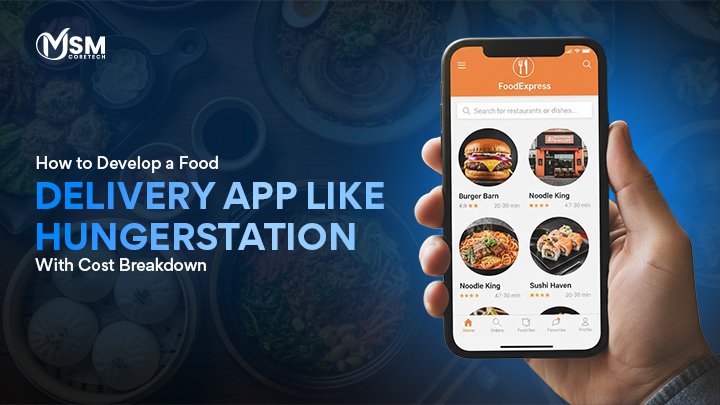
Saudi Arabia’s #1 Food App Processed Over 40 Million Orders. Here’s How You Can Build the Next One.
In 2012, a small startup in Dammam launched a simple website where people could browse restaurant menus and place food orders online. Nobody predicted it would become the dominant food delivery platform across an entire country. That startup was HungerStation, and today it operates in over 102 cities, partners with more than 55,000 restaurants and stores, and has crossed 40 million app downloads.
The Middle East food delivery market is no longer a niche. It is a multi-billion dollar industry growing faster than most other regions in the world. And if you are an entrepreneur, a startup founder, or a business looking to tap into this booming sector, building an app like HungerStation is one of the smartest moves you can make right now.
This guide covers everything you need to know, from what HungerStation actually does, to the exact steps, features, and costs involved in building a similar on demand food delivery app in 2026.
HungerStation Statistics and Facts
Before jumping into development, it helps to understand the scale of opportunity. The numbers around HungerStation and the Saudi food delivery market tell a compelling story.
Key Market Stats (2025 to 2026)
| Metric | Data |
|---|---|
| Saudi Arabia delivery apps market value (2025) | USD 8.33 billion |
| Projected market value by 2031 | USD 19.45 billion |
| Market CAGR (2026 to 2031) | 15.18% |
| HungerStation app downloads | 40+ million |
| Restaurant and store partners | 55,000+ |
| Cities covered in Saudi Arabia | 102+ |
| Global online food delivery market (2025) | USD 173.6 billion |
| Global market projected value by 2030 | USD 618+ billion |
| Food delivery app revenue growth projected for 2026 | 5% year on year |
The Saudi Arabian delivery apps market was valued at USD 8.33 billion in 2025 and is estimated to grow from USD 9.59 billion in 2026 to reach USD 19.45 billion by 2031, at a CAGR of 15.18% during the forecast period.
HungerStation is currently leading the market with the largest market share. It has over 40 million app downloads and has formed partnerships with thousands of restaurants and stores across Saudi Arabia.
In the past five years, Saudi Arabia’s foodtech startups have attracted over $555 million in funding, with food delivery startups snapping up 48% of that total funding ($266 million).
These numbers make one thing very clear: the demand is real, the market is growing, and the timing to build a food delivery app is right.
Also Read: Food Delivery App Trends
What Is a HungerStation App?
HungerStation is not just a food ordering app. It is a full-scale multi-category delivery platform that connects customers, restaurants, grocery stores, pharmacies, and delivery partners through a single mobile application.
HungerStation is Saudi Arabia’s leading multi-category delivery marketplace that allows customers to order meals, groceries, flowers, medicines, and more through a mobile app. The HungerStation business model works by connecting customers with nearby restaurants and stores through a digital platform.
Think of it as the DoorDash or Uber Eats of the Middle East, but built for the local culture, language, and consumer behavior of Saudi Arabia.
How HungerStation Works
The platform operates through three interconnected user groups:
Customers browse restaurants, place orders, make payments, and track deliveries in real time through the consumer app.
Restaurant partners receive orders, manage menus, update availability, and coordinate with delivery partners through a dedicated vendor dashboard.
Delivery drivers accept assignments, navigate to pickup and drop-off locations, and manage earnings through a separate rider app.
HungerStation was founded in 2012 and is based in Riyadh, Saudi Arabia. In July 2023, HungerStation was acquired by Delivery Hero.
The Business Model
HungerStation operates a multi-sided revenue model that capitalizes on every touchpoint in the food delivery ecosystem, from restaurants and customers to delivery drivers and advertisers. Key revenue streams include commission from restaurants, delivery fees from customers, service charges, sponsored listings, and subscriptions.
| Revenue Stream | How It Works |
|---|---|
| Restaurant Commissions | 20% to 30% per order from partner restaurants |
| Delivery Fees | Distance-based or flat fee from customers |
| Service Charges | App maintenance and support fees per transaction |
| Sponsored Listings | Restaurants pay for featured placements |
| Subscription Plans | HungerStation Pro offers free delivery perks |
| Third-Party Logistics | Logistics services for other businesses |
Also Read: App Like Talabat: Development Cost & Complete Guide
How to Build an App Like HungerStation
Building a food delivery app like HungerStation is a structured process. Each stage directly impacts your product quality, user experience, and long-term scalability. Here is a step by step breakdown of how the development works.
Step 1: Market Research and Business Planning
Every successful on demand food delivery app development project begins with research. Before writing a single line of code, you need to understand your target market, identify competitors, and define what will make your app different.
Ask yourself: Which cities or regions will you serve? Who is your primary user, busy professionals, college students, or families? What restaurants are not yet on any platform? These answers shape your entire product strategy.
Step 2: Define Your Business Model
Will you run a marketplace like HungerStation, a single-restaurant delivery app, or a hybrid? Your business model determines your revenue streams, feature set, and the panels you need to build.
Step 3: UI/UX Design
Design is not decoration. For food delivery apps, the design directly affects conversion rates. A clean menu browsing experience, smooth checkout flow, and clear order tracking screen can significantly increase order frequency.
Focus on mobile-first design since the majority of food delivery orders come from smartphones. For markets like Saudi Arabia, Arabic right-to-left (RTL) language support is also a must.
Step 4: Choose Your Tech Stack
Your technology choices determine performance, scalability, and cost.
| Layer | Recommended Technologies |
|---|---|
| Frontend (iOS) | Swift, Objective-C |
| Frontend (Android) | Kotlin, Java |
| Cross-Platform | React Native, Flutter |
| Backend | Node.js, Python (Django/Flask) |
| Database | PostgreSQL, MySQL, Firebase |
| Real-Time Updates | WebSockets, Firebase |
| Maps and Tracking | Google Maps API, Mapbox |
| Cloud Hosting | AWS, Google Cloud, Azure |
| Payment Gateways | Stripe, PayPal, Apple Pay, regional gateways |
Step 5: Develop the Core Modules
A HungerStation-like app requires at minimum three separate applications: the customer app, the restaurant/vendor panel, and the delivery driver app. You also need a backend admin panel to manage everything.
Step 6: Integration and Testing
Before launch, integrate all third-party APIs including payments, GPS, push notifications, and analytics tools. Conduct thorough testing across devices, operating systems, and network conditions.
Step 7: Launch and Post-Launch Support
Launch on both the App Store and Google Play. Ongoing maintenance costs typically run 15% to 20% of your initial development budget per year and cover updates, security patches, and performance improvements.
Also Read: How to Develop a Food Delivery App Like Postmates
Key Features to Include in a HungerStation-Like Food Delivery App
Features are what set successful food delivery apps apart from ordinary ones. Here is a comprehensive breakdown organized by user panel.
Customer App Features
| Feature | Description |
|---|---|
| User Registration and Login | Sign up via email, phone, or social accounts (Google, Facebook) |
| Smart Restaurant Search | Filter by cuisine, rating, price range, and delivery speed |
| Real-Time Order Tracking | Live GPS tracking from kitchen to doorstep |
| Multiple Payment Options | Cards, wallets, cash on delivery, in-app wallet |
| Scheduled Deliveries | Order now, receive later at a preferred time |
| Push Notifications | Order updates, deals, and flash discounts |
| Reviews and Ratings | Feedback on restaurants and delivery partners |
| Promo Codes and Discounts | Apply coupon codes at checkout |
| Multi-Category Ordering | Food, groceries, pharmacy, flowers in one app |
| Multilingual Support | Arabic and English with RTL design support |
| AI-Powered Recommendations | Personalized meal suggestions based on order history |
| Reorder with One Tap | Save favorite meals for quick repeat orders |
Restaurant Panel Features
| Feature | Description |
|---|---|
| Menu Management | Add, edit, or remove items with pricing and images |
| Order Acceptance and Rejection | Confirm or decline incoming orders instantly |
| Delivery Partner Coordination | Assign delivery to available riders |
| Analytics and Sales Reports | Track revenue, peak hours, and popular items |
| Customer Feedback Dashboard | View ratings and respond to reviews |
| Operating Hours Management | Set and update restaurant availability |
Delivery Driver App Features
| Feature | Description |
|---|---|
| Order Acceptance | Accept or decline delivery assignments |
| Navigation and Route Optimization | Integrated GPS for efficient routes |
| Earnings Dashboard | Track daily, weekly, and monthly earnings |
| Online/Offline Toggle | Flexible availability settings |
| In-App Chat | Communicate with customers for delivery updates |
Admin Panel Features
| Feature | Description |
|---|---|
| User and Restaurant Management | Onboard, verify, and monitor all platform users |
| Order Management System | Oversee the complete order lifecycle |
| Commission and Payment Management | Configure commission rates and handle payouts |
| Delivery Zone Configuration | Set serviceable areas and delivery fee structures |
| Reports and Analytics | Platform-wide performance insights |
| Promotional Campaign Management | Create and manage deals and coupon campaigns |
Advanced Features Worth Investing In (2026)
These are features that separate good food delivery apps from great ones:
AI Chatbot for Customer Support reduces dependency on support teams while handling common queries automatically.
Voice Ordering lets users place orders hands-free, a particularly useful feature for accessibility and convenience.
Dark Mode and Accessibility design improvements that improve user retention across broader demographics.
Halal Food Filters critical for markets like Saudi Arabia, UAE, and other Muslim-majority regions.
Cloud Kitchen Integration connects ghost kitchens directly with the platform for faster delivery.
Cost to Develop an App Like HungerStation
This is where most entrepreneurs get stuck. The truth is that the cost to develop a food delivery app depends on several factors, including the complexity of features, the number of platforms you target, the location of your development team, and whether you choose a custom build or a white-label solution.
Development Cost by App Complexity
| App Type | Features Included | Estimated Cost |
|---|---|---|
| MVP (Basic) | Core ordering, basic tracking, one platform | USD 25,000 to USD 50,000 |
| Mid-Level App | Both iOS and Android, admin panel, live tracking | USD 50,000 to USD 100,000 |
| Full-Scale App (HungerStation-Level) | All panels, AI features, multi-category, analytics | USD 100,000 to USD 200,000+ |
Cost Breakdown by Development Component
| Component | Estimated Cost |
|---|---|
| UI/UX Design | USD 5,000 to USD 20,000 |
| Customer App (iOS + Android) | USD 20,000 to USD 60,000 |
| Restaurant Panel | USD 10,000 to USD 25,000 |
| Delivery Driver App | USD 10,000 to USD 20,000 |
| Admin Panel (Web-Based) | USD 10,000 to USD 30,000 |
| Backend Development and APIs | USD 15,000 to USD 40,000 |
| Third-Party Integrations (Maps, Payments) | USD 5,000 to USD 15,000 |
| Testing and QA | USD 5,000 to USD 15,000 |
| Post-Launch Maintenance (Annual) | 15% to 20% of total dev cost |
Cost by Development Team Location
Where your team is based has a significant impact on hourly rates and total cost.
| Region | Average Hourly Rate |
|---|---|
| United States / Canada | USD 100 to USD 200/hour |
| Western Europe | USD 80 to USD 150/hour |
| Eastern Europe | USD 40 to USD 80/hour |
| India / Southeast Asia | USD 20 to USD 50/hour |
Partnering with an experienced food delivery app development company in India or Southeast Asia can significantly reduce your total investment without compromising on quality.
Ways to Reduce Development Cost
Starting with a Minimum Viable Product (MVP) is the smartest approach for most startups. Launch with only the essential features, gather user feedback, and then build advanced functionality in later phases.
Using cross-platform frameworks like React Native or Flutter allows you to build one codebase for both iOS and Android, cutting development time and cost by 30% to 40%.
You can also explore white-label food delivery solutions as a starting point. These are pre-built platforms you can customize and launch faster, typically costing 40% to 60% less than a fully custom build.
For a detailed breakdown of what goes into building a mobile app budget, visit our guide on the Cost to Develop a Mobile App.
Want to Build a HungerStation Clone App? Partner with MSM CoreTech
Building a food delivery app like HungerStation is not just a development project. It is a business strategy that requires deep technical knowledge, a strong understanding of on-demand user behavior, and the ability to scale.
At MSM CoreTech, we specialize in on demand food delivery app development for startups and established businesses. Whether you want to build from scratch, customize a white-label solution, or scale an existing platform, we bring the technical expertise and product thinking needed to get it right.
We have worked with businesses across the food delivery, grocery delivery, and multi-category delivery sectors, and we understand exactly what it takes to build an app that users actually enjoy using.
Why Choose MSM CoreTech
When you are investing in food delivery app development services, you need more than a development vendor. You need a technology partner who understands your business goals and builds accordingly.
Here is what sets us apart:
End-to-End Development from idea validation and design to development, testing, and post-launch support, we handle everything.
Custom and Scalable Architecture your app is built on a foundation that can handle thousands of concurrent users, multiple geographies, and rapid feature expansion.
Cross-Platform Expertise we build native iOS and Android apps as well as cross-platform solutions using React Native and Flutter.
AI and Real-Time Tech Integration from AI-powered recommendations to live GPS order tracking, we integrate the features that make apps like HungerStation stand out.
Transparent Pricing no hidden costs. We provide detailed project estimates before work begins so you always know what you are paying for.
Dedicated Post-Launch Support bugs happen. We have your back with ongoing maintenance and improvement plans.
As a mobile app development company trusted by clients across multiple industries, we combine technical depth with real-world product experience to deliver food delivery platforms that perform.

Conclusion
HungerStation’s journey from a small website in Dammam to a 40 million download platform is a blueprint that any entrepreneur can learn from. The ingredients are not secret: a strong product foundation, the right features for your audience, a reliable tech stack, and the willingness to keep improving based on user needs.
The global food delivery market is growing rapidly. The Saudi Arabia market alone is on track to nearly double by 2031. The question is not whether food delivery apps will continue to grow. The question is whether your app will be part of that growth.
If you are ready to build a food delivery app like HungerStation, MSM CoreTech is ready to help you do it right. Reach out today and let us turn your idea into a platform that people actually use, every day.
FAQs
Cost depends on complexity. A basic MVP starts at USD 25,000 to USD 50,000. A mid-level app with iOS, Android, and an admin panel runs USD 50,000 to USD 100,000. A full-scale platform with AI features and advanced analytics can exceed USD 200,000. Partnering with a development team in India or Southeast Asia can cut costs significantly without sacrificing quality.
The Saudi Arabia food delivery market is projected to hit USD 19.45 billion by 2031 at a 15% CAGR. The population is young, mobile-first, and digitally active. Rising urbanization, a large expatriate base, and expanding demand beyond major cities make it one of the most attractive markets for a new food delivery platform right now.
A basic MVP takes 3 to 5 months. A mid-level app with both platforms, a restaurant panel, and a driver app takes 6 to 9 months. A full-featured enterprise platform can take 9 to 14 months. Using cross-platform frameworks or a white-label base can shorten that timeline considerably.
Yes. Start with an MVP on one platform, use Flutter or React Native for cross-platform development, or go with a white-label solution, which typically costs 40 to 60 percent less than a custom build. Validate first, then scale.
You need a customer app with registration, restaurant search, real-time GPS tracking, and multiple payment options. Add a restaurant vendor panel, a driver app, and an admin panel. Advanced features like AI recommendations, scheduled deliveries, push notifications, and multi-language support will set you apart.

Related Posts
10 Key Applications of AI in the Food Industry (2026)
Walk into any restaurant kitchen, grocery warehouse, or food delivery control room today, and you will find something quietly running...
Read More
How To Develop An App Like YouTube Music: A Complete Guide
Music is now a part of our everyday life. People listen to songs while getting ready in the morning, working,...
Read More
Must-Have Features in Fintech Apps & Digital Financial Platforms
Think about how often you use your phone to pay bills, send money, shop online, or check your bank balance....
Read More


 Verified Review



 +44 7427829444
 71-75, Shelton Street, Covent Garden, London, United Kingdom, WC2H 9JQ