

Share this article


How to Develop a Taxi App Like Hala Taxi: Features, Cost & Full Development Guide
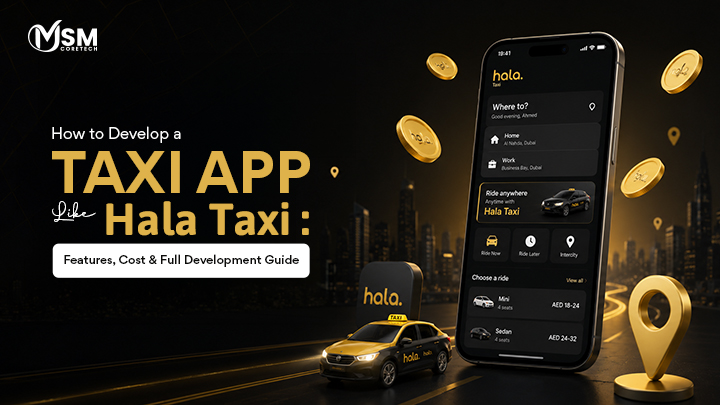
Ride hailing has quietly become one of the biggest habits in modern city life. People no longer stand at street corners waving for a cab. They open an app, tap a button, and a ride shows up in minutes. Platforms like Hala Taxi have made this experience simple, affordable, and available in cities across the Middle East, and that success has caught the attention of entrepreneurs everywhere.
The global ride hailing market is expected to reach close to $184.49 billion in 2026 and continues to grow at a strong double-digit pace. That kind of growth is exactly why so many founders now want to develop a taxi app like Hala and bring the same convenience to their own city or region.
In this guide, we will walk through everything in plain, simple language. You will explore what Hala Taxi actually does, which features your app needs, what it costs to build, and how the entire development process works from the first sketch to the final launch.
Also Read: Build a Taxi Booking App Like Uber
What Is Hala Taxi?
Hala Taxi is a ride-hailing app that connects passengers with nearby drivers through a smartphone, similar in spirit to Uber or Careem but built around local partnerships and pricing that fits the region it serves. It launched as a joint venture between a major ride-hailing brand and a national taxi corporation, which is one of the reasons it grew so quickly. Instead of building a driver network from zero, it plugged into an existing fleet of licensed taxis and added a modern booking layer on top.
That single decision is worth paying attention to if you are studying the Hala model. The app itself is not just a booking screen; it is a bridge between old-style taxi operations and new-style digital convenience. Riders get the app experience they expect, such as upfront fares, live tracking and cashless payment, while the underlying vehicles and drivers are already regulated, insured and known to local authorities.
How Hala Taxi works
The flow is simple enough that a first-time user does not need any instructions. A passenger opens the app, enters a pickup point and a destination, and the app shows the fare before the ride is even booked. Once confirmed, the request goes out to nearby available drivers, and the closest one accepts the trip. The rider can then watch the car approach in real time on the map, see the driver’s name, photo, vehicle number and rating, and pay through a card or wallet saved in the app once the ride ends.
On the driver’s side, the app acts as a constant stream of ride requests. Drivers log in, mark themselves as available, and start receiving trip offers based on their location. They get turn-by-turn navigation to the pickup point and then to the destination, along with a clear breakdown of the fare and any incentives for that trip.
Key services Hala Taxi offers
Beyond the basic point-to-point ride, Hala Taxi platforms usually offer a few variations that widen their appeal. These include scheduled rides that can be booked in advance for airport runs or early meetings, different vehicle categories such as economy, comfort and larger vehicles for groups, and corporate accounts that let companies book and pay for employee travel in one place. Some versions also support ride sharing, where two passengers heading in a similar direction split a trip and the fare, and multilingual support so the same app works for tourists, expats, and residents alike.
It is also worth noting how much of Hala Taxi’s success comes down to consistency rather than flashy technology. Riders know exactly what to expect every single time they open the app: the same clean booking flow, the same transparent pricing, and drivers who already meet a certain licensing standard because they come from an established taxi network. That predictability is often underestimated by new entrants who focus only on features and forget that trust is built through repetition. When you sit down to plan your own platform, it helps to study this balance carefully, because copying the feature list alone will not automatically produce the same rider confidence.
How Hala Taxi compares to other ride hailing apps
It is natural to compare Hala Taxi with global names like Uber or Careem, and on the surface the booking experience does look similar. The real difference sits underneath, in how the driver network is sourced and regulated. Where a purely aggregator-driven app onboards independent drivers one by one, Hala Taxi’s roots in an established taxi corporation mean a large share of its fleet was already licensed, insured, and inspected before the app even launched. This gives it an advantage in markets where regulators are cautious about unregulated ride hailing, and it is a pattern worth studying closely if your own target city has similarly strict taxi licensing rules. Understanding this distinction early on can save months of regulatory back-and-forth once your own app is ready to launch.
Also Read: Taxi Booking App Development Cost
Why Businesses Want to Create a Taxi App Like Hala?
It is easy to see why so many transport companies, taxi unions, and independent entrepreneurs now want to create a taxi app like Hala instead of continuing to rely on phone calls and street hailing. The traditional model has clear limits. A dispatcher can only handle so many calls at once, drivers waste time driving around looking for passengers, and customers have no way to know how long they will wait or what the fare will be until the ride is already over.
An app removes almost all of that uncertainty. Riders see the fare upfront, track their driver in real time, and pay without using cash. Drivers spend less time idle because the app matches them with nearby requests automatically, which means more trips per shift and better earnings. For the business itself, every trip becomes a data point, so owners can see peak hours, popular routes, driver performance, and customer complaints in one dashboard instead of guessing.
Then there is the financial side. Ride hailing apps open up new pricing models such as surge pricing during high-demand hours, subscription passes for frequent riders, and corporate billing accounts, all of which increase revenue without adding a single extra vehicle to the fleet. This is exactly why taxi companies, logistics firms, and even fresh startups are choosing to build their own version rather than depending only on aggregators or third-party platforms that take a cut of every fare.
Types of Taxi App Business Models to Choose From
Before any coding starts, it helps to decide what kind of taxi business the app will actually run. This decision shapes almost every feature that comes later, so it is worth spending real time on it rather than rushing ahead. Skipping this step is one of the most common mistakes founders make, since it is tempting to jump straight into wireframes and screens before the underlying business logic has even been settled. A rushed decision here often means expensive rework later, once real drivers and riders are already using the platform and the business model needs to change underneath them.
Aggregator model
This is the Uber and Hala style model, where the app owner does not own the vehicles. Instead, independent drivers or partner taxi fleets sign up on the platform, and the company earns a commission on every completed ride. This model scales fast because there is no need to buy or maintain a fleet, but it requires strong driver onboarding, verification, and support systems to keep quality consistent.
Fleet-owned model
Here the company owns the vehicles and directly employs the drivers. This gives full control over service quality, branding and pricing, and it works well for companies that already run a taxi fleet and simply want to modernize how customers book rides. The tradeoff is higher upfront investment in vehicles, maintenance, and driver salaries.
Hybrid model
Many successful platforms, including Hala Taxi itself, blend both approaches. A core fleet of company-affiliated or partner taxis forms the reliable backbone, while independent drivers can join during high-demand periods to fill gaps. This gives flexibility without losing the consistency that comes from a managed fleet.
Franchise or white-label model
Some businesses prefer to license an existing taxi app framework and relaunch it under their own brand in a new city or country. This shortens development time significantly since the core booking, tracking, and payment logic already exists, and the work shifts toward customization, local compliance, and marketing instead of building everything from scratch.
A taxi platform is really three connected products working as one system: a rider app, a driver app, and an admin panel that ties everything together. Skipping detail on any one of these three weakens the whole platform, so let’s go through each piece properly.
Also Read: Ride-Hailing Apps in Dubai
Must-Have Features for a Taxi App Like Hala
A taxi platform is really three connected products working as one system: a rider app, a driver app, and an admin panel that ties everything together. Skipping detail on any one of these three weakens the whole platform, so let’s go through each piece properly.
Rider App Features
Simple sign-up and profile
Riders should be able to register in under a minute using a phone number, email, or social login. Once inside, they can save home and work addresses, add multiple payment methods, and manage personal details without digging through menus.
Ride booking with live map
This is the heart of the app. Riders drop a pin or type an address for pickup and drop-off, and the app instantly shows nearby available cars along with an estimated fare and arrival time. Clear map visuals build trust because the rider can see exactly what is happening before committing to the trip.
Upfront fare estimates
Before confirming a ride, riders should see the total expected fare, not just a price range. This single feature is one of the biggest reasons people prefer apps over street taxis, since there is no argument or surprise at the end of the trip.
Multiple ride categories
Offering economy, comfort, premium and XL options inside the same booking screen lets one platform serve many types of customers, from a student on a budget to a family that needs extra seats.
Real-time tracking
Once a driver accepts the ride, the rider watches the car move on the map in real time and gets an accurate countdown to arrival. This same tracking should be shareable with a friend or family member for safety.
In-app payments and wallet
Cards, digital wallets, and cash should all be supported, with a saved wallet balance for quick, cashless checkout. Automatic receipts after every trip keep things transparent, especially for business travelers who need to claim expenses.
Ratings and reviews
After each trip, riders rate the driver and can leave short feedback. This keeps service quality high and gives the admin team early warning if a particular driver needs coaching or removal.
Safety tools
An SOS or emergency button, trip sharing with contacts, and driver verification badges all reassure riders, particularly those traveling alone or at night.
Promotions and referral codes
Discount codes, first-ride offers, and referral bonuses are simple growth tools that cost little to build but drive real word-of-mouth signups.
Driver App Features
Driver registration and document upload
Drivers should be able to upload their license, vehicle registration, insurance, and identification directly from their phone, with the admin team reviewing and approving each application before the driver goes live.
Availability toggle
A simple online and offline switch lets drivers control exactly when they want to receive ride requests, which respects their flexibility and working hours.
Ride requests with accept or decline
When a nearby ride comes in, the driver sees the pickup location, estimated fare and distance, then has a short window to accept or pass on the trip.
Turn-by-turn navigation
Integrated maps guide the driver to the pickup point and then to the destination, ideally with live traffic updates so routes adjust automatically if there is congestion ahead.
Earnings dashboard
Drivers need a clear, honest view of what they are earning, broken down by trip, day, and week, along with any bonuses or incentive payouts they have qualified for.
In-app communication
A masked calling or chat feature lets drivers and riders coordinate pickup details without either party seeing the other’s real phone number, which protects privacy on both sides.
Trip history and support access
Drivers should be able to review past trips, download statements, and reach support quickly if a payment looks wrong or a rider dispute needs resolving.
Admin Panel Features
Live dispatch dashboard
The admin team needs a real-time view of every active ride, every online driver, and every pending request on one screen, so problems can be spotted and solved before they escalate.
Driver and rider management
This includes approving new driver applications, verifying documents, suspending accounts that break rules, and handling rider complaints or refund requests from a single control panel.
Fare and zone management
Admins should be able to set base fares, per-kilometer rates, surge pricing rules, and service zones without needing a developer every time a price needs adjusting.
Analytics and reporting
Detailed reports on daily rides, revenue, driver performance, popular routes, and customer retention help the business make informed decisions instead of guessing what is working.
Payment and commission settings
The admin panel should let the business configure driver commission percentages, process payouts, and reconcile payment gateway transactions accurately every single day.
Promotions and notifications control
Marketing teams need the ability to launch discount campaigns, push notifications, and in-app banners directly, without waiting on a development cycle for every small promotion.
Customer support ticketing
A built-in ticketing system lets support staff track every rider and driver complaint from the moment it is raised to the moment it is resolved, with clear ownership so nothing falls through the cracks as ticket volume grows alongside the user base.
Also Read: Cost to Develop an App like Letgo
Advanced Features That Make an App Stand Out
Once the core rider, driver, and admin experience is solid, a few advanced features can push the platform from functional to genuinely competitive.
AI-based demand prediction
Machine learning models can study historical ride data to predict where demand will spike, such as near a stadium after an event or a business district at 6 PM, and nudge idle drivers toward those zones before requests even come in.
Dynamic surge pricing
Instead of a flat fixed rate, fares can adjust automatically based on real-time demand and driver supply, which keeps enough drivers available even during rush hour or bad weather.
Voice-enabled booking
Voice commands let users book a ride hands-free, which is especially useful for visually impaired riders or anyone who prefers speaking over typing.
In-app chat support with chatbots
A basic AI chatbot can resolve common questions instantly, such as fare disputes or lost item reports, and escalate to a human agent only when the issue is genuinely complex.
Multi-language and multi-currency support
For apps operating across borders or in tourist-heavy cities, automatic language detection and local currency display remove friction for international users.
Integration with public transport or micro-mobility
Some platforms now let riders combine a taxi ride with a bike or scooter rental in the same app, turning the product into a broader mobility hub rather than a single-service tool.
Predictive driver-rider matching
Rather than simply assigning the nearest available driver, smarter matching algorithms also consider driver ratings, vehicle type preferences, and even a rider’s experience with a particular driver, resulting in fewer cancellations and a more consistent trip quality over time.
Fraud and anomaly detection
As a platform grows, so does the risk of fake accounts, GPS spoofing, or promo code abuse. Automated systems that flag unusual patterns, such as a driver accepting and canceling trips repeatedly or a single device claiming multiple new-user discounts, protect revenue without requiring the admin team to manually review every account.
Also Read: Cost to Build a Music Streaming App Like Shazam
Monetization Models for Your Taxi App
Features and design matter, but none of it means much if the app cannot generate steady revenue. Fortunately, taxi apps have several proven ways to make money, and most successful platforms combine more than one at the same time.
Commission on every ride
This is the most common model. The platform takes a percentage, often somewhere between 15 and 25 percent, from every fare paid by the rider before paying the rest out to the driver. It scales naturally with ride volume, so revenue grows automatically as the platform gets busier.
Surge or dynamic pricing
During high-demand periods such as rush hour, bad weather, or major events, fares increase automatically to balance supply and demand. This not only increases revenue during peak times but also encourages more drivers to come online exactly when they are needed most.
Subscription plans for riders
Frequent riders can pay a flat monthly or weekly fee in exchange for discounted fares, priority pickups, or waived booking fees. This creates predictable recurring revenue and increases loyalty, since subscribers are less likely to switch to a competing app once they have already paid for a plan.
Driver subscription or membership fees
Instead of, or alongside, commission, some platforms charge drivers a flat weekly fee for unlimited access to ride requests. This model is popular in markets where drivers prefer predictable costs over a percentage cut of every trip.
In-app advertising
Once a platform has a large enough active user base, local businesses will pay to advertise inside the app, whether through banner placements, sponsored pickup locations near malls and airports, or promotional push notifications.
Corporate and B2B accounts
Offering dedicated business accounts with monthly invoicing, employee travel policies, and detailed expense reports opens up a steady stream of higher-value bookings from companies rather than relying only on individual riders.

Also Read: AI in Handyman Apps
Tech Stack You Need to Build a Taxi App Like Hala
The right technology choices depend on budget, timeline, and how much scale the app needs to handle, but here is a practical starting point that most taxi booking app development company teams rely on today. None of these are exotic or experimental choices, and that is intentional. A ride hailing app lives or dies on reliability, not novelty, so proven, well-supported technologies are almost always a safer bet than chasing the newest framework simply because it is trending.
- Frontend (rider and driver apps): React Native or Flutter for cross-platform development, or native Swift and Kotlin for a fully polished single-platform experience
- Backend: Node.js, Python (Django) or Java (Spring Boot) to handle ride matching, user data and business logic
- Database: PostgreSQL or MongoDB for storing user, driver and trip data reliably at scale
- Real-time tracking: Google Maps Platform or Mapbox combined with WebSockets for live location updates
- Payments: Stripe, Razorpay or a region-specific gateway depending on where the app will launch
- Push notifications: Firebase Cloud Messaging for instant alerts to riders and drivers
- Cloud hosting: AWS, Google Cloud or Azure for scalable, secure infrastructure that can grow with demand
None of these choices are set in stone. A good taxi booking app development company will recommend the exact combination based on your target city, expected ride volume, and long-term growth plans rather than applying the same stack to every client.
Also Read: Cost To Develop A Hotel Booking App Like Marriott Bonvoy
Step-by-Step Development Process
Step 1: Market research and planning
Before any design work begins, the team studies the target city, local competitors, pricing norms, and regulatory requirements for taxi operations. This stage also defines the business model, whether aggregator, fleet-owned, or hybrid, and locks down the feature list for the first launch.
Step 2: UI/UX design
Designers map out every screen a rider and driver will see, from sign-up to trip completion, focusing on speed and clarity since users open ride hailing apps under time pressure and expect instant results.
Step 3: Backend and API development
This is where the ride matching engine, driver allocation logic, payment processing, and notification systems are built. It is the most technically demanding phase because it has to handle many simultaneous requests without delay.
Step 4: Frontend development
The rider app, driver app, and admin panel are built and connected to the backend, with careful attention to map performance, since a laggy map ruins the entire experience no matter how good the backend is.
Step 5: Integrations
Payment gateways, SMS and push notification services, maps and navigation APIs, and any third-party verification tools for driver documents are all wired into the platform during this stage.
Step 6: Testing and quality assurance
The app is tested across devices, network conditions, and edge cases, such as a ride request during a driver’s app crash or a payment failure mid-trip, to make sure nothing breaks when it matters most.
Step 7: Launch and post-launch support
After launch, the real work of monitoring performance, fixing bugs that only show up with real users, and rolling out updates based on rider and driver feedback begins. Most successful platforms treat this as a continuous cycle rather than a one-time event.
Put together, these seven steps usually take anywhere from three to six months for a well-planned first version, depending on how many features are included in the initial launch and how quickly feedback loops move between the client and the development team. Rushing this timeline rarely pays off, since a taxi app carries real money and real safety expectations, and small oversights at this stage tend to turn into expensive fixes after thousands of riders are already depending on the app daily.
Also Read: Cost to Build a Music Streaming App Like Pandor
Cost to Develop a Taxi App Like Hala Taxi
This is usually the first question every founder asks, and the honest answer is that cost depends heavily on feature complexity, platform choice, team location, and design quality. That said, here is a realistic breakdown based on a mid-range cost of developing an app with all the core features covered earlier in this guide.
| Development Stage | Estimated Cost (USD) | Estimated Timeline |
|---|---|---|
| Research, planning, and UI/UX design | $2,000 – $6,000 | 2 – 3 weeks |
| Rider app development | $8,000 – $18,000 | 4 – 8 weeks |
| Driver app development | $7,000 – $15,000 | 4 – 7 weeks |
| Admin panel and dispatch dashboard | $6,000 – $12,000 | 3 – 6 weeks |
| Payment gateway and API integrations | $2,000 – $6,000 | 1 – 3 weeks |
| Testing, QA and bug fixing | $2,000 – $5,000 | 2 – 4 weeks |
| Deployment and post-launch support | $1,500 – $4,000 | Ongoing |
Based on this breakdown, a complete build to develop a taxi app like Hala Taxi with core rider, driver, and admin functionality typically falls between $28,000 and $66,000 for a solid, launch-ready product. Adding advanced features such as AI demand prediction, voice booking, or multi-city support can push the number higher, while a leaner MVP with only essential booking and tracking features can be delivered closer to the lower end of that range.
A few factors move this number more than anything else. The number of platforms you launch on, meaning iOS only versus both iOS and Android, has a direct effect on cost and timeline. The complexity of your admin dashboard and reporting needs also matters, since a simple dispatch view costs far less than a full analytics suite with custom reports. Finally, the region where your development team is based plays a real role, since rates vary significantly between different parts of the world for the same quality of work.
Common Challenges and How to Solve Them
Driver supply and demand balance
New platforms often struggle to have enough drivers online exactly when riders need them. Solving this usually means running driver incentive programs during the early months and using demand prediction tools to guide drivers toward busy zones before requests pile up.
Building rider trust from zero
A brand new app has no reputation to lean on. Clear driver verification, visible safety features, and honest upfront pricing help new platforms earn trust faster than marketing alone ever could.
Handling payment failures gracefully
Payment issues mid-trip can quickly frustrate both riders and drivers. A reliable payment gateway paired with a fallback cash option and clear in-app messaging prevents small technical hiccups from becoming lost customers.
Scaling the backend as ride volume grows
An app that works fine with a hundred daily rides can slow down badly at ten thousand. Choosing cloud infrastructure that scales automatically, and load testing before major city launches, avoids painful outages during growth spurts.
Meeting local transport regulations
Taxi and ride hailing rules differ from city to city and country to country. Working with a development partner that understands these compliance requirements from day one saves significant rework later.
Keeping driver churn low
Drivers will leave for a competing platform if earnings feel unpredictable or unfair. Transparent commission structures, fast payouts, and a genuine feedback channel for driver concerns go a long way toward keeping a driver base loyal instead of constantly rebuilding it.
Managing customer support at scale
As ride volume grows, so does the number of disputes, lost items, and fare complaints. Setting up tiered support, where a chatbot resolves simple issues and human agents handle escalations, keeps response times reasonable even as the platform expands into new cities.
None of these challenges are unique to any one company, and every successful ride hailing platform in the world has worked through some version of them. What separates the ones that survive from the ones that fade out is usually not the challenge itself, but how quickly the team notices a problem and how honestly they respond to it, whether that means adjusting incentives, retraining support staff, or simply being transparent with riders when something goes wrong.
Also Read: Cost to Develop a Doctor Booking App Like Practo
Why MSM Coretech Is the Right Taxi Booking App Development Company?
Choosing the right technology partner matters just as much as the idea itself. MSM Coretech has built a strong reputation as a taxi booking app development company that understands both the technical and business sides of ride hailing platforms, not just the code behind them.
The team at MSM Coretech starts every project with real research into the target market rather than reusing a generic template, which means the app you launch actually fits how riders and drivers in your city behave. From wireframes to a fully tested rider app, driver app, and admin panel, MSM Coretech handles the entire journey under one roof, so there is no confusion between separate design, development, and support teams.
What genuinely sets MSM Coretech apart is the attention given to the details that make ride hailing apps succeed or fail in the real world, such as accurate live tracking, dependable payment processing, and an admin dashboard that actually gives business owners useful, readable insights instead of raw data dumps.
Another reason clients keep coming back to MSM Coretech is the way post-launch support is handled. Ride hailing apps are never really finished on launch day; they need constant small updates as driver feedback comes in, as new cities are added, and as payment or navigation providers update their own systems. MSM Coretech treats this ongoing relationship as part of the deal rather than a separate paid extra, which means business owners always have a team that already understands their app instead of starting from scratch with a new vendor every time something needs fixing.

Also Read: Develop a Doctor Appointment Booking App Like Zocdoc
Conclusion
Building a taxi app like Hala Taxi is no longer just an ambitious idea; it is a realistic business opportunity backed by a market that keeps growing year after year. The key is treating the project the right way from day one, meaning clear planning, a well-chosen business model, a genuinely useful set of features for both riders and drivers, and a technology partner who understands the ride hailing space deeply.
As we have covered in this guide, the cost and timeline are very manageable when the scope is planned properly, and most of the risk in these projects comes from skipping research or choosing the wrong development partner rather than from the technology itself. With the right approach, a taxi app can become a dependable, growing business rather than just another app in a crowded store.
If you are ready to move forward, working with an experienced team like MSM Coretech gives you a real head start, since you are not just buying development hours; you are buying the accumulated knowledge of what actually works in this industry. The opportunity is there, the demand is proven, and the path to building something successful is more achievable today than it has ever been.
FAQs
A solid, launch-ready build with core rider, driver, and admin features typically costs between $28,000 and $66,000. Advanced AI features or multi-city support can push this higher.
Most well-planned builds take three to six months from research to launch, depending on feature scope and how fast feedback loops move.
At minimum, you need live tracking, upfront fare estimates, multiple payment options, driver-rider ratings, and a strong admin dispatch panel.
It depends on whether you already own vehicles. Aggregator models scale faster with lower upfront cost, while fleet-owned models give more control over service quality.
Yes, most founders launch a leaner MVP first and add features like demand prediction or voice booking once real usage data shows what riders actually want.
MSM Coretech handles design, development, and long-term post-launch support under one roof, with real market research behind every build rather than a generic template.

Related Posts

10 Key Applications of AI in the Food Industry (2026)
Walk into any restaurant kitchen, grocery warehouse, or food delivery control room today, and you will find something quietly running...
Read More

How To Develop An App Like YouTube Music: A Complete Guide
Music is now a part of our everyday life. People listen to songs while getting ready in the morning, working,...
Read More

Must-Have Features in Fintech Apps & Digital Financial Platforms
Think about how often you use your phone to pay bills, send money, shop online, or check your bank balance....
Read More


 Verified Review




 +44 7427829444
 71-75, Shelton Street, Covent Garden, London, United Kingdom, WC2H 9JQ