

Share this article


How to Build a Taxi Booking App Like Uber: A Complete Guide?
The way people book rides has changed completely. No one stands on a street corner waving down a cab anymore. Today, a ride is three taps away on a smartphone. This shift has turned taxi booking apps into one of the most profitable digital products in the world, and the numbers back it up.
According to Mordor Intelligence, the global taxi market was valued at USD 254.36 billion in 2026 and is projected to reach USD 366.91 billion by 2031, growing at a CAGR of 7.62%.
If you are an entrepreneur, a fleet owner, or a startup founder looking to develop an app like Uber, right now is a strong time to act. The market is growing, the technology is accessible, and riders in every city are looking for better, faster, and safer cab booking experiences.
We have helped businesses across India and globally build scalable taxi booking apps that deliver real results. This guide walks you through everything you need to know. from understanding the core architecture to choosing the right tech stack, defining must-have features, and estimating development costs.
What Is a Taxi Booking App and How Does It Work?
A taxi booking app is more than just a mobile application. It is a complete ecosystem that connects three separate parties: the passenger who needs a ride, the driver who provides one, and the admin or business owner who manages the platform.
When a passenger opens the app, they enter a pickup point and a destination. The system instantly reads their GPS location, calculates fare estimates, and broadcasts the request to nearby available drivers. The closest or best-matched driver accepts the ride, and the passenger tracks the driver in real time on a live map. Payment is collected automatically once the trip ends. The admin panel records every transaction, monitors driver activity, and keeps the operation running smoothly behind the scenes.
This three-sided architecture is what powers apps like Uber, Ola, and Lyft. The execution of each component determines whether the platform succeeds or stalls.

Why Build a Taxi App in 2026?
The opportunity is real for several reasons:
- The global taxi app market is on track to exceed USD 468 billion by 2033, growing at a steady 7% CAGR.
- Smartphone penetration has crossed 80% in leading urban markets, making app-based bookings the default choice for most commuters.
- Platforms like Uber are pushing into robotaxi territory, which means the underlying technology for regular taxi apps has matured and is more affordable to deploy.
- Local and regional markets still have white space. Global giants do not serve every city, every language, or every transport category well. Niche apps for bike taxis, auto-rickshaws, women-only rides, and corporate shuttles are growing fast.
- Electric vehicle integration, in-app wallets, and surge pricing are now standard, and riders expect these features as a baseline.
Also Read: Taxi Booking App Development Cost
Core Components of a Taxi Booking App
Before jumping into features, understand the three core applications that make up the full system.
1. The Passenger App
This is what riders download and use on a daily basis. It needs to be fast to load, simple to navigate, and reliable in every network condition. The experience here directly determines whether a user books again or deletes the app after the first ride.
2. The Driver App
Drivers spend hours inside this app every day. It has to be lightweight, battery-efficient, and clear enough to use while managing traffic. Poor driver app experiences directly lead to high driver churn, which kills the platform’s supply side.
3. The Admin Panel
This is the business’s control center. It manages everything from driver verification and pricing rules to commission settings, dispute resolution, and business analytics. A well-built admin panel is what turns a working app into a scalable business.
Must-Have Features for a Taxi Booking App Like Uber
A taxi booking app like Uber should have real-time GPS tracking, easy ride booking, and secure payment options. It must also include driver ratings, ride history, and notifications for a smooth user experience. Features like in-app chat, navigation, and driver support help ensure efficient and reliable service.
Passenger App Features
- User registration and profile management with phone or email verification
- Real-time GPS tracking of the assigned driver on a live map
- Fare estimator before ride confirmation, so users know the cost upfront
- Multiple payment options, including cards, UPI, wallets, and cash
- In-app chat and call functionality with the driver
- Ride scheduling for future bookings
- Driver rating and feedback system after every trip
- Trip history with downloadable invoices
- SOS emergency button and ride sharing with trusted contacts
Driver App Features
- Driver onboarding with document upload and verification flow
- Ride request alerts with accept/decline options and passenger details
- Turn-by-turn GPS navigation integrated within the app
- Earnings dashboard showing daily, weekly, and monthly income
- Availability toggle to go online or offline instantly
- Trip history and passenger ratings
Admin Panel Features
- Centralized dashboard for monitoring all active rides in real time
- Driver and passenger management, including banning and verification controls
- Surge pricing configuration by zone and time
- Commission management and payout scheduling
- Promo codes and referral campaign management
- Business analytics reports on rides, revenue, cancellations, and driver performance
Also Read: AI in Dating Apps
Recommended Tech Stack to Build a Taxi App in 2026
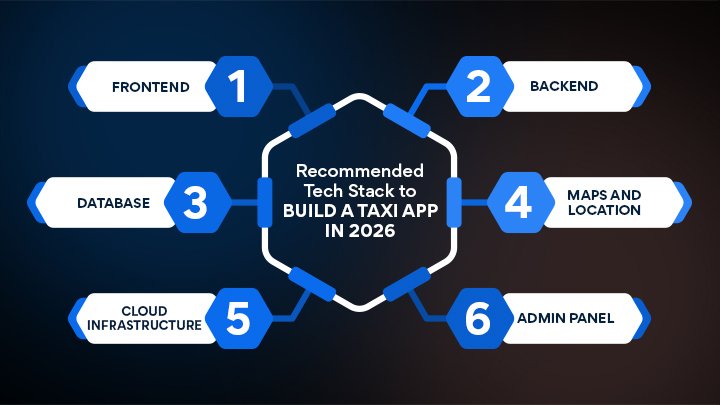
Choosing the right technology is one of the most consequential decisions in taxi app development. The stack you pick determines how well the app scales, how fast it loads, and how much it costs to maintain. Here is what the industry recommends in 2026.
Frontend (Mobile Apps)
React Native or Flutter for cross-platform iOS and Android development from a single codebase. This cuts development time significantly without compromising performance. Swift and Kotlin are used where native background location handling requires more control.
Backend
Node.js or NestJS with TypeScript for APIs, ride matching logic, authentication, and pricing calculations. Python and Go are strong alternatives for high-concurrency real-time systems.
Database
PostgreSQL with PostGIS for location-based queries. Redis handles caching, real-time driver availability state, and fast trip status updates.
Maps and Location
Google Maps Platform for geocoding, route calculation, and place search. OpenStreetMap is a cost-effective alternative for early-stage startups.
Cloud Infrastructure
AWS, Google Cloud, or Microsoft Azure with auto-scaling containers to handle peak booking hours without downtime. Firebase Cloud Messaging handles push notifications across both platforms.
Admin Panel
Next.js or React with TypeScript, connected to the same backend for dispatch visibility, pricing control, and reporting.
Also Read: eCommerce Mobile App Development
Step-by-Step Process to Develop a Taxi Booking App
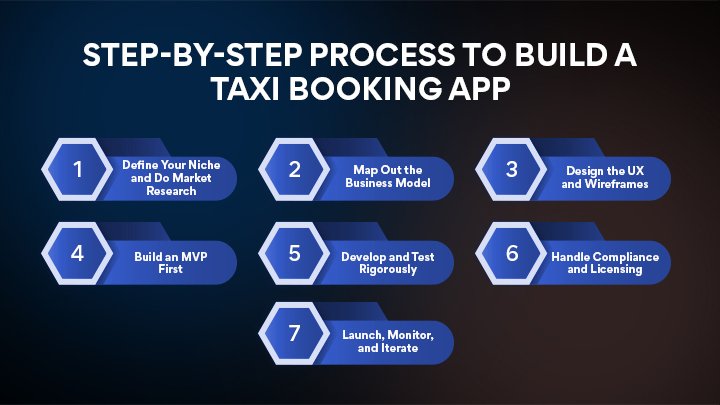
Building a taxi booking app requires a structured approach that balances business goals, user experience, and technical scalability. Below is a practical step-by-step app development process used by successful ride-hailing platforms to build reliable and scalable solutions.
Step 1: Define Your Niche and Do Market Research
Do not start with code. Start with questions. Who is your target rider? What city or region are you serving? Are you building for corporate employees, students, airport travelers, or everyday commuters? What gap does your platform fill that Uber, Ola, or local apps do not? Answering these questions determines every feature decision and every rupee spent later.
Step 2: Map Out the Business Model
Your revenue model shapes how the platform is built. The most common approaches are commission per ride (typically 10 to 30 percent of the fare), driver subscription plans, surge pricing during peak hours, in-app advertising, and corporate accounts. partnerships. You can also layer in wallet cashback programs to drive repeat usage. Pick a model before development starts so the payment logic and admin reporting are built the first time correctly.
Step 3: Design the UX and Wireframes
Good design is not decoration. For a taxi app, it is a safety feature. Users booking a ride at midnight in an unfamiliar area cannot afford a confusing interface. Keep booking under three taps. Make the map the center of the passenger screen. Put the earnings summary front and center on the driver’s home screen. Prototype with Figma, test with real users, and revise before a single line of code is written.
Step 4: Build an MVP First
A Minimum Viable Product (MVP) lets you launch fast, gather real user feedback, and avoid building features nobody wants. Your MVP needs user and driver registration, ride booking and matching, GPS tracking, fare calculation, and basic payment processing. Everything else, including scheduled rides, multi-vehicle types, and loyalty programs, can come in later versions after you know what users actually need.
Step 5: Develop and Test Rigorously
Development happens in parallel streams: the passenger app, the driver app, the backend API, and the admin panel. Use an agile sprint structure so you ship working components every two weeks and catch bugs early. Testing must cover real-world scenarios like poor GPS signal, payment failures, driver cancellations mid-trip, and surge pricing edge cases. Load testing is non-negotiable before launch.
Step 6: Handle Compliance and Licensing
Depending on your target market, you may need to comply with local transport regulations, driver licensing rules, data privacy laws such as India’s Digital Personal Data Protection Act or GDPR for European users, and payment compliance standards like PCI DSS. Skipping this step is one of the most common and costliest mistakes a taxi app startup can make.
Step 7: Launch, Monitor, and Iterate
Go live on the Google Play Store and Apple App Store. Set up crash reporting tools like Sentry and monitoring tools like CloudWatch from day one. Watch how users actually move through the app, not how you expected them to. Your first week of real usage will teach you more than months of internal testing. Plan to push a meaningful update within 30 days of launch based on that data.
How Much Does It Cost to Build a Taxi Booking App in 2026?
Cost depends on scope, team location, and the complexity of features. When estimating the cost to develop a mobile app for taxi booking, here is a clear breakdown:
| Category | Details |
|---|---|
| MVP Build (Core Features) | $8,000 to $30,000 |
| Full-Featured App | $30,000 to $120,000 |
| Annual Maintenance | 15% to 20% of initial cost per year |
| Development Timeline (MVP) | 2 to 3 months |
| Development Timeline (Full App) | 4 to 8 months |
Monetization Strategies for Your Taxi App
- Commission model: Take a percentage of every fare, the same way Uber and Ola operate.
- Subscription plans for drivers: Charge a weekly or monthly fee instead of per-ride commissions to attract high-volume drivers.
- Surge pricing: Increase fares automatically during high-demand periods and earn more per ride without adding supply.
- Corporate accounts: Offer business travel management tools to companies with employee transportation needs.
- In-app advertising: Partner with local businesses to display location-relevant promotions to riders during their trip.
Also Read: Develop a Fantasy Cricket App like Dream11
Common Mistakes to Avoid When Building a Taxi App
- Skipping the MVP: Building every feature upfront before validating product-market fit wastes money and time.
- Ignoring driver experience: An app that works perfectly for riders but frustrates drivers will lose its supply side and fail quickly.
- Weak GPS matching logic: Inaccurate pickup pins and route errors are the top reason users uninstall taxi apps after their first bad experience.
- No payment failure handling: Transactions fail. If your app has no graceful recovery for failed charges, cancellations, or disputed fares, it will generate complaints you cannot resolve.
- Ignoring compliance early: Trying to retrofit regulatory requirements into a live app is far more expensive than building them in from the start.

Why MSM Coretech Innovations Is Your Best Partner for Taxi App Development
Building a taxi booking app requires more than coding skills. It demands an understanding of how urban mobility works, where users drop off in the booking funnel, how driver supply affects customer retention, and how to build systems that hold up under real-world demand.
At MSM Coretech Innovations, we bring all of that together. Our taxi booking app development company has built on-demand applications across ride-hailing, logistics, and fleet management. We use proven tech stacks, deliver against agreed timelines, and stay with you through post-launch maintenance. Our development team do not just ship an app. We help you build a business.
Conclusion
The global taxi app market is not slowing down. The opportunity to build a competitive product remains strong, especially for startups targeting specific cities, niche vehicle categories, or unique user segments that larger platforms often overlook.
Building a taxi booking app like Uber is a serious technical and operational challenge. But with the right partner, a clear business model, the correct tech stack, and a real commitment to the user experience on both the rider and driver sides, it is entirely achievable.
MSM Coretech Innovations is a leading taxi booking app development company that offers the experience, the team, and the process to take your idea from concept to a live, scalable product.
FAQs
A basic MVP with core ride booking, GPS tracking, and payment processing can be built and launched in 2 to 3 months. A full-featured platform with advanced matching algorithms, multi-vehicle support, and a complete admin panel typically takes 4 to 8 months, depending on team size and complexity.
Development costs in India are significantly lower than in the US or UK. An MVP-level taxi app can cost between $8,000 and $20,000 when built with an Indian development partner. A full-featured, production-ready platform with both iOS and Android apps, a web admin panel, and a scalable backend typically ranges from $25,000 to $70,000. Annual maintenance adds roughly 15 to 20 percent of the initial cost.
Yes. White-label taxi app solutions give you a pre-built framework that you can customize with your branding, pricing logic, and service area. This approach reduces development time and cost substantially and is a strong choice for startups that want to test the market quickly. The trade-off is that customization has limits, and scaling to a large user base may require rebuilding parts of the system later. An experienced development partner can help you decide which approach fits your business goals.
In 2026, the baseline expectation for any competitive taxi app includes real-time GPS tracking, fare estimation before booking confirmation, multiple payment options including digital wallets, in-app driver-passenger communication, ride scheduling, a driver earnings dashboard, an SOS emergency button, and an admin panel with live fleet visibility. AI-powered driver matching and surge pricing are no longer optional for apps targeting urban markets.

Related Posts

10 Key Applications of AI in the Food Industry (2026)
Walk into any restaurant kitchen, grocery warehouse, or food delivery control room today, and you will find something quietly running...
Read More

How To Develop An App Like YouTube Music: A Complete Guide
Music is now a part of our everyday life. People listen to songs while getting ready in the morning, working,...
Read More

Must-Have Features in Fintech Apps & Digital Financial Platforms
Think about how often you use your phone to pay bills, send money, shop online, or check your bank balance....
Read More


 Verified Review




 +44 7427829444
 71-75, Shelton Street, Covent Garden, London, United Kingdom, WC2H 9JQ