

Share this article


How To Develop Logistic App Like Amazon Flex: A Courier Delivery App
Courier delivery apps are changing how people get their parcels. Now deliveries are fast, flexible and can be done on demand. A popular example is Amazon Flex, where drivers use their own vehicles to deliver packages and earn flexible income.
A useful fact is that the “last-mile” delivery can take more than half of the total shipping cost. Because of this, companies invest in smart courier apps to make deliveries faster and more efficient.
Courier delivery apps are changing the logistics industry by making parcel delivery faster, more flexible, and on-demand. Amazon Flex is a popular example where drivers use their own vehicles to earn money by delivering packages. A simple fact is that last-mile delivery can take more than 50% of total shipping costs. In this article, you will learn how to build an app like Amazon Flex, including its features, technology, cost, and business model for success.
The courier delivery app market is growing very fast because of the rise of eCommerce and the gig economy. Around the world, the global last-mile delivery market size was estimated at USD 167.36 billion in 2025 and is projected to reach USD 348.85 billion by 2033, growing at a CAGR of 9.8% from 2026 to 2033. The market for last-mile delivery is experiencing rapid expansion, fueled by the exponential growth of e-commerce and digital retail ecosystems. Apps like Amazon Flex, Uber Eats, and DoorDash show that people like flexible delivery jobs and fast delivery services. As online shopping and same-day delivery needs increase, there are big opportunities in this field. This makes courier delivery apps a very strong and profitable business idea today.
Read Also: Cost To Build a Logistics App Like Uber Freight
What Is Amazon Flex?
Amazon Flex is a delivery service by Amazon where people can earn money by delivering packages using their own vehicles. It is a gig-based platform, which means drivers work whenever they want, selecting flexible delivery time blocks that fit their free time.
Drivers pick up parcels from Amazon warehouses and deliver them directly to customers. The app provides GPS tracking and route optimization features to help drivers find the fastest and most efficient delivery routes. Many businesses looking to build similar platforms often partner with a Logistics App Development Company to create advanced delivery solutions with real-time tracking and route management capabilities.
This system helps people earn income easily and also helps Amazon deliver packages quickly and efficiently to customers. It is widely used for fast and reliable last-mile delivery around the world.

Key Features of an App Like Amazon Flex
To build a courier delivery app like Amazon Flex, you need some important features. These features help ensure smooth operations, easier delivery management, and a better user experience. Below are the main features explained in very simple words.
Driver Registration and Verification: Drivers should be able to sign up easily by adding their personal details, vehicle information, and required documents. A proper checking system makes sure only safe and eligible drivers are approved. This helps make the service more reliable.
Delivery Job Scheduling System: This feature lets drivers choose available delivery time slots (called “blocks”). It helps drivers manage their working hours freely and also helps companies assign deliveries based on demand.
Real-Time Tracking and GPS Integration: GPS tracking allows customers and admins to see deliveries in real time. This makes the process more transparent and helps improve delivery accuracy and customer satisfaction.
Route Optimization: The app should suggest the fastest and best routes for delivery. This saves time, reduces fuel use, and helps drivers complete more deliveries easily.
In-App Navigation Support: Built-in maps guide drivers step by step during deliveries. This reduces confusion and helps them reach the correct address without delay.
Payment Management System: This feature manages driver earnings, delivery payments, and payment history. It ensures safe and on-time payments, which builds trust in the platform.
Ratings and Reviews System: Customers and companies can rate drivers based on their service. This helps maintain good performance and improves overall quality.
Together, these features make a strong, easy-to-use, and scalable courier delivery app like Amazon Flex.
Read Also: 9+ Best Project Management Software Development Companies in the USA
Business Model of Amazon Flex-Like Apps
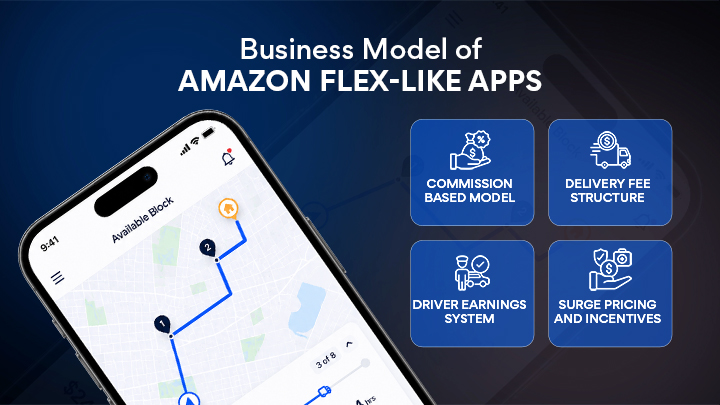
An Amazon Flex-like courier delivery app needs a good business model to be successful. These apps help drivers earn money through flexible work and provide fast delivery services to customers. At the same time, they generate revenue for the business.
Commission-Based Model
The platform earns money by charging a commission on every completed delivery. When a customer places an order and a driver delivers it, the platform keeps a small percentage of the payment. This creates a regular source of income for the business.
Delivery Fee Structure
Customers pay a delivery fee for sending or receiving packages. The delivery cost depends on things like package size, delivery distance, location, and delivery speed. Regular deliveries usually cost less, while same-day or express deliveries cost more. This pricing system helps the platform earn more revenue while staying competitive.
Driver Earnings System
Drivers are paid for every delivery they complete. Their earnings can depend on the distance traveled, delivery time, number of packages, and service quality. The app should clearly show drivers their deliveries, earnings, bonuses, and payment history so they can easily track their income.
Surge Pricing and Incentives
During busy hours, holidays, or times of high demand, delivery charges may increase through surge pricing. This encourages more drivers to accept delivery requests. The platform can also offer bonuses and rewards to motivate drivers to complete more deliveries and maintain good performance.
By using commissions, delivery fees, driver payment management, and surge pricing, businesses can build a profitable and scalable courier delivery app like Amazon Flex.
Read Also: 9+ Best AI App Development Companies in the USA
Technology Stack Needed to Build an App Like Amazon Flex
Quick Summary Table
| Component | Technologies | Purpose |
|---|---|---|
| Frontend | React Native, Flutter, Swift, Kotlin | Build responsive Android and iOS apps |
| Backend | Node.js, Django, Laravel | Manage business logic and app operations |
| Database | MongoDB, PostgreSQL | Store user, delivery, and payment data |
| Cloud Services | AWS, Google Cloud | Hosting, storage, scalability, and security |
| Maps API | Google Maps API | GPS tracking and route optimization |
| Payment API | Stripe, PayPal | Secure payment processing |
| Notification API | Firebase Cloud Messaging, OneSignal | Real-time alerts and updates |
| Security Tools | JWT, OAuth, SSL | User authentication and data protection |
A good technology stack is very important for creating a courier delivery app like Amazon Flex. It helps the app run smoothly, stay secure, and handle more users as the business grows.
Frontend Technologies
The frontend is the part of the app that users see and use. Technologies like React Native and Flutter help developers build Android and iOS apps using a single codebase. Swift is used for iOS app development, while Kotlin is used for Android app development.
Backend Technologies
The backend works behind the scenes and manages important tasks such as user accounts, deliveries, and payments. Popular backend technologies like Node.js, Django, and Laravel help make the app fast, secure, and scalable.
Database Options
A database stores important information, including user details, delivery data, and payment records. MongoDB and PostgreSQL are commonly used because they are reliable and manage data efficiently.
Cloud Services
Cloud platforms such as AWS and Google Cloud provide hosting, storage, and infrastructure support. They help the app handle increasing numbers of users and keep services available without interruptions.
APIs for Maps, Payments, and Notifications
Third-party APIs add useful features to the app. Map APIs provide GPS tracking and route planning, payment APIs allow secure online payments, and notification APIs send real-time updates to drivers and customers.
Choosing the right technology stack helps build a courier delivery app that is secure, scalable, and performs well.
Read Also: 9+ Best Logistics App Development Companies in USA
Steps to Develop a Courier Delivery App
Developing a courier delivery app like Amazon Flex requires a well-planned app development process. Each step plays an important role in building an app that is easy to use, secure, and reliable.
1. Market Research and Planning
The first step is to understand the courier delivery market. Research your target customers, competitors, and current market trends. Identify what customers need and what services competitors offer. After that, set your business goals, decide the app features, choose a revenue model, and create a clear development plan.
2. UI/UX Design for Drivers and Admins
Design a simple and user-friendly interface for drivers, customers, and administrators. The app should be easy to navigate so users can quickly accept delivery requests, track orders, manage payments, and handle daily tasks without confusion.
3. App Development (Frontend + Backend)
This is the stage where the actual app is built. Developers create the frontend that users interact with and the backend that manages all app operations. Important features such as user registration, delivery scheduling, GPS tracking, route optimization, push notifications, and secure payment integration are added during this phase.
4. Testing and Quality Assurance
Before launching the app, it must be tested carefully. Testing helps find and fix bugs, performance issues, and security problems. This ensures the app works properly on different devices and operating systems and provides a smooth user experience.
5. Deployment and Launch
Once testing is completed, the app is deployed on cloud servers and published on app stores such as Google Play Store and Apple App Store. Proper monitoring and technical support are important during the launch process to ensure everything runs smoothly.
6. Post-Launch Maintenance and Updates
The work does not end after the app is launched. Regular maintenance is needed to monitor performance, fix issues, and release updates. Adding new features, improving security, and enhancing the user experience help the app stay competitive and grow over time.
By following these steps, businesses can develop a secure, efficient, and scalable courier delivery app that meets the needs of drivers, customers, and administrators.
Read Also: How On-Demand App Development Can Drive Business Growth and Success
Challenges in Developing Delivery Apps
Building a courier delivery app like Amazon Flex can be a good business opportunity. However, it also comes with some challenges. Businesses need to solve these problems to provide smooth delivery services and a good user experience.
Managing Real-Time Deliveries
One of the biggest challenges is managing deliveries in real time. The app should be able to track drivers, show where packages are, and update delivery status immediately. If the information is not updated on time, deliveries may get delayed and customers may become unhappy. GPS tracking and smart route planning help make deliveries faster and more efficient.
Making Sure Drivers Are Trustworthy
A delivery app depends a lot on its drivers. Businesses need to check driver identities, driving licenses, and background details before allowing them to work. Customer ratings and reviews can also help track driver performance. Good and reliable drivers help build customer trust and make sure deliveries are completed on time.
Handling Busy Delivery Times
Delivery orders often increase during holidays, weekends, and special sale events. Managing many orders at the same time can be difficult. Businesses need a system that can handle more users and orders without slowing down. Smart order assignment and rewards for drivers can help manage high demand and ensure faster deliveries.
Keeping User Data Safe
Delivery apps collect important information such as customer details, payment information, delivery addresses, and live location data. Keeping this information safe is very important. Developers should use data encryption, secure payment methods, multi-factor authentication, and regular security updates to protect users from cyberattacks and data leaks.
These challenges can be handled with proper planning, the right technology, and regular monitoring. By improving delivery management, hiring reliable drivers, managing busy periods, and protecting user data, businesses can build a secure, efficient, and scalable delivery app that provides a smooth experience for both customers and drivers.
Read Also: 9+ Best CRM Software Development Companies in the USA
Cost of Developing an App Like Amazon Flex
The cost of building an app like Amazon Flex depends on many factors, such as the features you want, the technology used, the development team, and the overall complexity of the project. Knowing these costs can help businesses plan their budget more effectively.
Factors That Affect Development Cost
Many things can impact the total cost of app development. These include the number of features, the complexity of the app design, whether the app is built for Android, iOS, or both, third-party integrations, and security requirements. Advanced features like real-time GPS tracking, route optimization, payment processing, and cloud-based systems can increase the overall development cost.
Estimated Development Cost
A basic courier delivery app with only essential features may cost between $20,000 and $40,000. A medium-level app that includes features like real-time tracking, payment integration, and driver management can cost between $40,000 and $80,000. A fully advanced app similar to Amazon Flex, with AI-powered route planning, detailed analytics, and a scalable cloud infrastructure, may cost anywhere from $80,000 to $150,000 or more, depending on the project requirements.
Ongoing Maintenance Costs
Building the app is only the first step. Regular maintenance is needed to keep the app secure, stable, and running smoothly. Maintenance costs include server hosting, cloud services, bug fixing, security updates, new feature additions, API subscriptions, and technical support. Most businesses spend around 15% to 20% of the original development cost each year on maintenance.
With proper planning and the right feature set, businesses can manage costs effectively while creating a reliable and scalable courier delivery app that meets the needs of both customers and drivers.
Read Also: 9+ Best Social Networking App Development Companies in USA
Quick Cost Table
| Cost Component | Estimated Cost |
|---|---|
| UI/UX Design | $3,000 – $10,000 |
| Frontend Development | $10,000 – $30,000 |
| Backend Development | $10,000 – $35,000 |
| GPS & Maps Integration | $2,000 – $8,000 |
| Payment Gateway Integration | $1,000 – $5,000 |
| Testing & QA | $3,000 – $10,000 |
| Cloud Infrastructure Setup | $2,000 – $10,000 |
| Basic App | $20,000 – $30,000 |
| Advanced App | $40,000 – $80,000+ |
| Annual Maintenance | 15%–20% of development cost |
Monetization Strategies
A good monetization strategy is important for the long-term success of a courier delivery app like Amazon Flex. It helps the business earn money from different sources and grow steadily while providing good service to customers and drivers.
Commission from Deliveries
One of the most common ways to earn money is by charging a commission on every completed delivery. When a customer places an order and a driver delivers it successfully, the platform takes a small percentage of the delivery fee. As the number of deliveries increases, the platform’s earnings also grow.
Subscription Plans for Businesses
The app can offer subscription plans to businesses that use delivery services regularly. Restaurants, retailers, and eCommerce companies can pay a monthly or yearly fee to get benefits such as lower delivery charges, priority support, detailed reports, and tools to manage multiple deliveries. This provides a steady and predictable source of income for the platform.
Premium Delivery Services
Customers who want faster or more convenient delivery can pay extra for premium services. These services may include same-day delivery, express shipping, scheduled delivery times, or priority package handling. Premium options improve customer satisfaction and generate additional revenue for the business.
By using delivery commissions, business subscriptions, and premium delivery services together, courier delivery apps can create a strong and sustainable business model. Having multiple sources of income reduces dependence on a single revenue stream and supports long-term growth. As more customers and businesses use the platform, these monetization methods can increase profits while maintaining a high-quality delivery experience.
Read Also: 9+ Best E-commerce App Development Companies in the USA
Quick Summary Table
| Monetization Strategy | How It Works | Revenue Benefit |
|---|---|---|
| Commission from Deliveries | Charge a percentage on each completed delivery | Consistent transaction-based income |
| Subscription Plans | Monthly or yearly plans for businesses | Recurring revenue stream |
| Premium Delivery Options | Charge extra for faster or priority deliveries | Higher profit per order |
| Enterprise Services | Advanced tools for large businesses | Additional B2B revenue |
| In-App Promotions | Featured listings and promotions | Advertising revenue |
Future Trends in Courier Delivery Apps
The courier delivery industry is changing very fast. New technologies are helping companies deliver packages faster, save money, and provide better service to customers. Businesses that want to build apps like Amazon Flex should follow these new trends to stay ahead in the market.
AI-Based Route Optimization
Artificial Intelligence (AI) helps drivers find the best and quickest routes. It can check traffic, weather, roadblocks, and delivery locations in real time. This helps drivers reach customers faster, use less fuel, and complete more deliveries.
Drone and Autonomous Delivery
Drones and self-driving vehicles are becoming popular in the delivery industry. They can deliver packages quickly, especially in busy cities or remote areas. These technologies are still growing, but they can help businesses reduce costs and improve delivery speed in the future.
Expansion of Hyperlocal Logistics
Today, customers want faster deliveries, such as same-day or instant delivery. To meet this demand, businesses are building hyperlocal delivery networks. These networks use local warehouses, small fulfillment centers, and nearby drivers to deliver products quickly and easily.
Sustainable Delivery Solutions
Many delivery companies are now using eco-friendly delivery methods. They use electric vehicles, bicycle delivery services, better route planning, and paperless systems. These steps help reduce pollution and support a cleaner environment.
The future of courier delivery apps will depend on technology, automation, and sustainability. By using AI tools, testing drones and self-driving deliveries, expanding local delivery services, and adopting eco-friendly practices, businesses can create modern delivery apps that offer faster, smarter, and more environmentally friendly services.
Conclusion
Developing an app like Amazon Flex needs proper planning, the right technology, and a strong business strategy. In this guide, we discussed the important parts of courier delivery app development, including key features, business models, development process, technology requirements, monetization methods, development costs, challenges, and future trends.
One of the most important things for a successful courier delivery app is building a scalable system. As more customers, drivers, and delivery requests join the platform, the app should continue to work smoothly without slowing down. Using trusted cloud services, secure databases, and a strong backend system helps the app grow and perform well over time.
Businesses should also focus on providing a smooth and easy user experience. Features like real-time package tracking, route optimization, secure payment options, and effective driver management help improve customer satisfaction and make delivery operations more efficient.
The logistics industry is changing quickly, and technologies such as artificial intelligence (AI), autonomous delivery systems, hyperlocal delivery services, and eco-friendly delivery solutions will play a major role in the future. Businesses that adopt these technologies can stay ahead of their competitors.
By combining the right technology, efficient delivery operations, and a scalable business model, companies can successfully build an app like Amazon Flex and create a reliable platform that benefits customers, drivers, and delivery partners.
FAQs
The cost typically ranges from $8,000 to $15,000+, depending on the app’s features, complexity, technology stack, and development team location.
Key features include driver registration, delivery scheduling, real-time GPS tracking, route optimization, in-app navigation, payment management, and ratings and reviews.
These apps generate revenue through delivery commissions, subscription plans for businesses, premium delivery services, and other value-added offerings.
Popular technologies include React Native or Flutter for frontend development, Node.js or Django for backend development, MongoDB or PostgreSQL for databases, and AWS or Google Cloud for hosting.
Common challenges include managing real-time logistics, ensuring driver reliability, handling peak delivery demand, and maintaining strong data security and privacy standards.

Related Posts
Top 10 Digital Payment Apps for Secure Online Transactions in 2026
Cash is quietly fading into the background, and 2026 is the year digital payment apps have taken over almost every...
Read More
FinTech App Design Guide for Beginners: Best Practices & Tips
FinTech app design is the process of shaping how a financial app looks, feels, and behaves for the person using...
Read More

How to Build a Doctor Booking App: Complete Development Guide
Healthcare is becoming more digital every year, and doctor booking apps are making it easier for people to get medical...
Read More