

Share this article


How to Build a Mobile Banking App: Cost, Architecture, and Development Guide
Imagine being able to check your bank balance, pay bills, transfer money, or apply for a loan anytime using your smartphone. You can do all this in just a few taps. That is why mobile banking apps have become an important part of our daily lives. Today, people want banking services that are quick, safe, and available anytime and from anywhere.
The demand for mobile banking is growing rapidly as people prefer fast, secure, and easy digital banking services. According to Statista, the digital payments market is expected to reach USD$28.32 trillion in transaction value by 2026, showing the increasing adoption of digital financial services worldwide. As more people use smartphones and online payment methods, the need for secure mobile banking apps continues to rise.
To meet the growing demand for digital banking, banks, fintech startups, and financial institutions are investing in mobile banking app development. These apps make banking easier and more convenient for customers. They also help businesses reduce operating costs, provide safe and secure transactions, offer personalized financial services, and build stronger relationships with customers.
In this guide, you will learn everything you need to know about building a mobile banking app. We will explain the complete development process, important features, app architecture, technology stack, estimated development cost, security requirements, and the latest industry trends. By the end of this guide, you will clearly understand how to create a secure, scalable, and easy-to-use mobile banking app that meets both business goals and customer needs.

What Is a Mobile Banking App?
A mobile banking app is a smartphone application that allows users to access banking services anytime and anywhere. It helps customers manage their bank accounts without visiting a physical branch. Users can check account balances, view transaction history, transfer money, pay bills, manage cards, and access other financial services directly from their mobile devices.
A mobile banking app works by connecting users with the bank’s secure digital systems. When a user logs in, the app verifies their identity through passwords, OTPs, or biometric authentication. After successful verification, the app communicates with the bank’s servers to provide real-time information and complete transactions safely. Strong security features like encryption and fraud monitoring help protect customer data.
There are different types of mobile banking apps, and each one is designed to meet different user needs. Retail banking apps are made for individual customers to manage their everyday banking tasks, such as making payments, transferring money, checking savings, and managing accounts.
Digital-only banking apps (Neobanks) work completely online without physical bank branches. They provide quick, simple, and convenient digital banking services.
Corporate banking apps are designed for businesses to manage company accounts, handle employee payments, and complete large financial transactions easily. Credit union banking apps help credit union members access banking services like account management, loans, and money transfers.
Each type of mobile banking app focuses on providing a secure, easy-to-use, and convenient banking experience for its users.
Read Also: Agentic AI in Banking
Benefits of Mobile Banking App Development
Mobile banking apps have completely changed how people handle their money. Today, customers want banking services that are fast, easy, and secure, and they want to use them anytime and from anywhere. For banks and financial companies, building a mobile banking app helps increase customer satisfaction, lower operational costs, and create more chances for business growth. Partnering with an experienced banking app development company also helps businesses build secure, scalable, and feature-rich banking solutions that meet customer expectations. Let’s understand the main benefits of mobile banking app development.
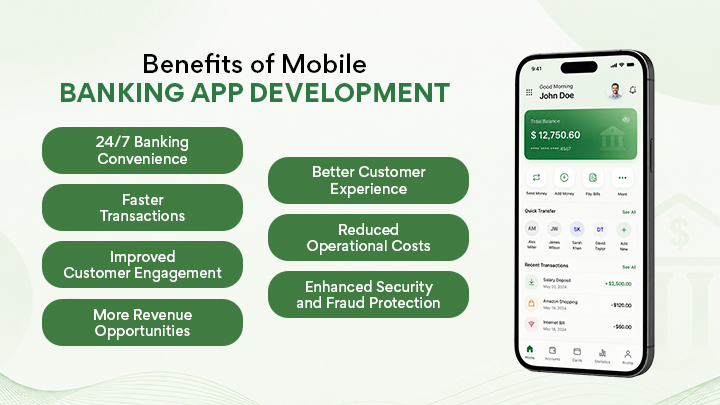
24/7 Banking Convenience
One of the biggest benefits of a mobile banking app is that customers can use banking services anytime they want. They no longer need to visit a bank branch or stand in long lines for simple banking tasks. Users can easily check their account balance, transfer money, pay bills, manage cards, and check transaction history from their smartphones. This 24/7 access makes banking faster, easier, and more convenient for customers.
Better Customer Experience
A well-designed mobile banking app gives customers a simple and smooth banking experience. Users can complete their banking tasks in just a few clicks, which saves their time and effort. Features like personalized dashboards, quick payments, financial advice, and customer support make it easier for users to manage their money. A better user experience also helps banks create stronger relationships with their customers.
Faster Transactions
Mobile banking apps make financial transactions quicker and easier. Customers can instantly send and receive money, pay bills, recharge services, and make online payments without visiting a bank or using traditional banking methods. Secure payment gateways and banking API integrations help process transactions faster while providing a smooth and reliable experience.
Reduced Operational Costs
Mobile banking apps help banks lower their daily operating costs. By offering banking services online, banks can reduce their need for physical branches, paperwork, and manual work. Features like online customer support, digital bank statements, and self-service options save employees’ time and reduce their workload. This allows banks to spend more time improving their services and providing a better customer experience.
Improved Customer Engagement
Mobile banking apps help banks stay better connected with their customers. Features like push notifications, personalized offers, spending insights, and financial advice encourage customers to use the app regularly. Banks can understand customer needs and provide services based on their preferences. This helps increase customer satisfaction, build loyalty, and create a stronger relationship between customers and the bank.
Enhanced Security and Fraud Protection
Security is one of the most important parts of mobile banking app development. Today’s banking apps use advanced security features like fingerprint or face authentication, multi-factor authentication, data encryption, and AI-powered fraud detection. These technologies help keep customer information safe and quickly detect any unusual or suspicious activities. This creates a more secure and trusted banking experience for users.
More Revenue Opportunities
A mobile banking app can help businesses create new ways to earn revenue. Banks can provide premium services, personalized financial solutions, investment options, loans, insurance services, and special partner offers through the app. By offering more digital services, banks can increase customer engagement and generate additional income opportunities.
Overall, mobile banking app development helps banks provide faster, safer, and more convenient services to customers. With the right features, modern technology, and strong security measures, a banking app can improve customer satisfaction and help financial businesses grow in today’s digital world.
Read Also: Cost To Build A Fintech App
Key Features of a Mobile Banking App
A successful mobile banking app should offer useful features for both customers and bank administrators. These features make banking easier, improve security, and help banks manage their services more efficiently.
Customer Features
Customer features are created to make banking easy, safe, and convenient for users. Customers should be able to sign up and log in securely using a password, fingerprint, Face ID, or multi-factor authentication. The app should show account balances and transaction history in real time, so users can easily keep track of their money. It should also allow users to transfer money, pay bills, make QR code payments, and deposit checks using their mobile phones for faster and easier transactions.
The app should also include debit and credit card management features. Users should be able to block or unblock their cards, set spending limits, and request a new card if needed. Push notifications can keep customers updated about payments, account activity, and important security alerts. Other helpful features include expense tracking, budget planning, loan management, an ATM and branch locator, and 24/7 customer support through live chat, making banking simpler and more convenient.
Admin Features
The admin panel helps banks manage the mobile banking app and handle daily operations smoothly. It allows administrators to manage users, verify customer accounts, and approve or reject account requests. They can also monitor transactions to track payments and quickly identify any suspicious activity. Fraud detection tools help prevent unauthorized transactions and keep customer accounts secure.
The admin dashboard also provides reports and analytics to track app performance and understand customer activity. It includes content management, customer support management, role-based access control, and compliance management to help the bank follow industry rules and regulations. All of these features work together to make the banking app secure, reliable, and easy to manage while providing customers with a safe and better digital banking experience.
Read Also: Top FinTech Trends: Transforming the Future of Financial Services
Advanced Features for Modern Mobile Banking Apps
Modern mobile banking apps do much more than let users check their account balance or transfer money. They use smart technology to make banking faster, safer, and more convenient. Adding advanced features also helps banks improve customer satisfaction and stay ahead of competitors.
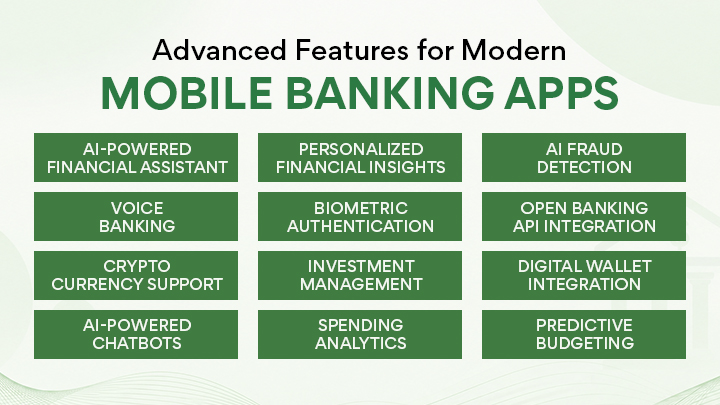
AI-powered Financial Assistant
An AI-powered financial assistant helps users manage their money more easily. It can answer banking questions, remind users about bill payments, suggest ways to save money, and provide helpful financial tips. This gives customers quick support without visiting a bank branch.
Personalized Financial Insights
This feature looks at how users earn and spend their money. It gives simple suggestions to help them manage their finances better. It shows where they spend the most, suggests ways to save money, and helps create better saving plans. This makes it easier for users to control their money and make smarter financial decisions.
AI Fraud Detection
AI keeps an eye on transactions all the time and quickly finds anything unusual. If it notices a suspicious payment or login attempt, the app immediately alerts the user or temporarily blocks the transaction. This helps keep user accounts safe from fraud and unauthorized access.
Voice Banking
Voice banking lets users do simple banking tasks using voice commands. They can check their account balance, see recent transactions, or transfer money without typing. This makes banking faster, easier, and more convenient.
Biometric Authentication
Biometric authentication uses a fingerprint or face scan to confirm a user’s identity. It allows users to log in quickly and securely without entering a password. It also helps prevent unauthorized access to their accounts.
Open Banking API Integration
Open Banking APIs help the banking app connect safely with trusted third-party financial services. This lets users see all their bank accounts in one place, use budgeting tools, and enjoy a more connected and convenient banking experience.
Cryptocurrency Support
Some modern banking apps let users buy, sell, store, and track cryptocurrencies. This gives customers more investment options and allows them to manage both traditional money and digital assets in one app.
Investment Management
Investment management features help users keep track of their stocks, mutual funds, and other investments. They can check how their portfolio is performing, stay updated with market changes, and make better financial decisions directly through the banking app.
Digital Wallet Integration
A banking app can connect with popular digital wallets, making payments quick and secure. Users can pay online, shop in stores, and complete transactions without using physical debit or credit cards.
AI-Powered Chatbots
AI chatbots give instant customer support anytime. They answer common questions, help users use banking services, solve account-related issues, and reduce waiting time for customer support.
Spending Analytics
Spending analytics automatically sort expenses into categories like food, travel, shopping, and bills. This helps users clearly see where their money is going and find ways to save more.
Predictive Budgeting
Predictive budgeting uses AI to estimate future income and expenses based on past spending and earning habits. It helps users plan their monthly budget, avoid overspending, and reach their financial goals more easily.
Read Also: Top 7 Fintech Web Design Companies in Australia
Mobile Banking App Development Process
Building a mobile banking app needs careful planning, secure development, and regular updates. Every step is important because banking apps store personal customer information and manage financial transactions. A proper app development process helps create an app that is safe, easy to use, and ready to grow in the future.
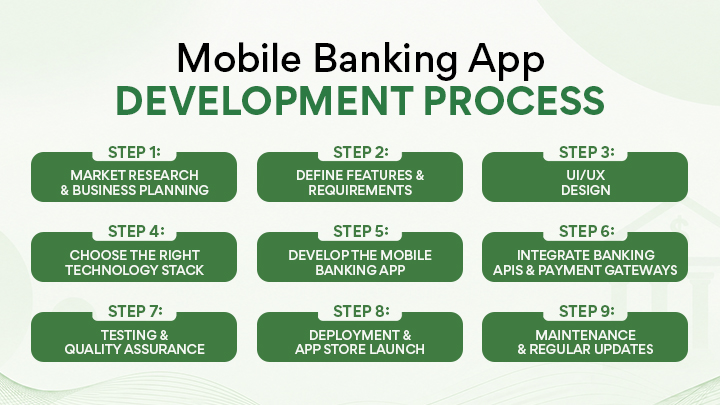
Step 1: Market Research & Business Planning
The first step is to understand the market and your target customers. Research your competitors, learn what customers need, and find out what problems your app will solve. You should also decide your business goals, target audience, revenue model, and the main features of the app. Having a clear plan from the beginning helps reduce unnecessary costs and keeps the development process focused.
Step 2: Define Features & Requirements
After planning your app, make a list of all the features you want to include. Decide which features are most important for the first version of the app and which ones can be added later. Some common features are user registration, secure login, account balance, money transfers, bill payments, transaction history, card management, notifications, and customer support. Having clear and detailed requirements makes the development process easier and helps avoid confusion.
Step 3: UI/UX Design
A banking app should be simple, easy, and comfortable to use. Before development starts, designers create wireframes and interactive prototypes to plan how the app will look and work. The design should be clean, the buttons should be easy to find, and important information should be clearly visible. A user-friendly design helps customers complete their banking tasks quickly and makes them feel confident and secure while using the app.
Step 4: Choose the Right Technology Stack
Choosing the right technology is very important for building a good mobile banking app. Developers select the best programming languages, frameworks, databases, cloud services, and security tools based on the app’s needs. The right technology helps the app run smoothly, keeps user data safe, supports many users at the same time, and makes future updates easier.
Step 5: Develop the Mobile Banking App
After the design and technology are finalized, developers start building the app. They create the frontend, which is the part users see and use, and the backend, which manages user accounts, transactions, and customer information. By following good coding practices, developers build a mobile banking app that is fast, secure, stable, and reliable.
Step 6: Integrate Banking APIs & Payment Gateways
The app needs to connect with banking systems and other trusted services. APIs help add features like account verification, online payments, money transfers, digital wallets, KYC verification, and transaction tracking. These connections make sure users can complete their financial tasks safely, quickly, and without any delays.
Step 7: Testing & Quality Assurance
Before the app is launched, it is carefully tested. Developers check all the features, fix any bugs, improve the app’s performance, and make sure security is strong. They also test how easy the app is to use so customers do not face any confusion. Proper testing helps reduce errors and provides a smooth and better user experience.
Step 8: Deployment & App Store Launch
After the app is fully tested, it is published on the Google Play Store and Apple App Store. The developers complete all the app store requirements and create a good app listing. After the app goes live, they keep a close watch on its performance and collect user feedback. This feedback helps them understand what can be improved in future updates.
Read Also: 9+ Best FinTech App Development Companies in the USA
Step 9: Maintenance & Regular Updates
Launching the app is just the first step. Regular maintenance keeps the app safe, stable, and working well on new devices and operating systems. Developers regularly fix bugs, improve the app’s speed and performance, add new features, and strengthen security. These updates help keep users happy and ensure the mobile banking app stays useful and competitive over time.

Mobile Banking App Architecture
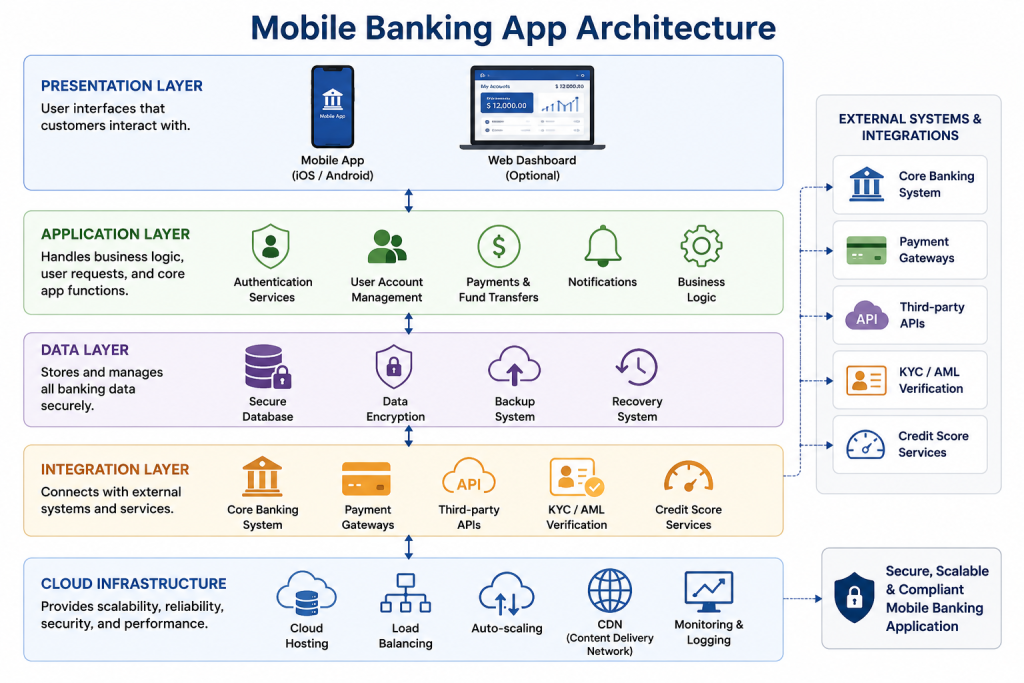
A strong architecture is the foundation of every successful mobile banking app. It helps the app run smoothly, keeps customer data secure, and supports thousands or even millions of users at the same time. A well-designed architecture also makes it easier to add new features, improve performance, and meet banking regulations. Below are the main layers of a modern mobile banking app architecture.
Presentation Layer
The presentation layer is the part of the mobile banking app that customers use every day. It includes the iOS and Android apps, where users can check their account balance, transfer money, pay bills, and manage their finances.
The app should have a simple, clean, and easy-to-use design. This helps users complete their banking tasks quickly and without any confusion.
Some banks also offer a web dashboard. Although it is not required, it gives customers another way to access their accounts from a computer. A web dashboard is helpful for people who prefer using a larger screen to manage their finances.
Application Layer
The application layer is the part that makes the mobile banking app work. It connects the user interface with the backend system and makes sure every feature works properly.
This layer checks the user’s identity through passwords, PINs, or biometric login, such as a fingerprint or face scan. It also manages user accounts, processes payments and money transfers, sends notifications about transactions and account activity, and handles the app’s main business functions. Every action the user performs is processed in this layer before the correct information is shown on the screen.
Data Layer
The data layer stores and manages all the important banking information. It keeps customer details, account balances, and transaction records safe and well organized in secure databases.
To keep this information protected, the data is encrypted. This means that only authorized people can read it. The data layer also has backup and recovery systems that regularly save important information. If there is a system problem or failure, the data can be restored quickly, allowing the bank to continue its services without major interruptions.
Integration Layer
A modern banking app needs to connect with different external systems to work smoothly. The integration layer handles these connections.
It connects the app with the core banking system, where customer accounts and financial records are stored. It also connects with payment gateways to process online payments, third-party APIs to provide additional services, KYC and AML verification systems to verify customer identities and reduce fraud, and credit score services that help users apply for loans and other credit-related products.
Cloud Infrastructure
Cloud infrastructure gives the app the power it needs to run smoothly and handle many users at the same time. Cloud hosting stores the app and its data on secure cloud servers, making it safe and easy to access.
Load balancing shares user traffic across different servers, so the app does not slow down or crash during busy times. Auto-scaling automatically adds or reduces server resources based on the number of users, helping the app perform well at all times.
A Content Delivery Network (CDN) delivers images and other content faster, giving users a better experience. Monitoring and logging tools continuously check the app’s performance, detect technical problems, and help developers fix them before they affect users.
Together, these cloud services make the mobile banking app reliable, secure, and able to grow as more users start using it.
Read Also: How Fintech Apps Make Money: 15 Proven Revenue Models
Best Technology Stack for Mobile Banking App Development
Choosing the right technology stack is very important when building a mobile banking app. A good technology stack helps the app work smoothly, keeps customer data safe, supports fast transactions, and makes it easier to add new features in the future. Below are the main technologies used to build a modern mobile banking app.
Frontend
The frontend is the part of the app that customers use every day. It should be simple, fast, and easy to use.
Flutter and React Native are popular choices because they let developers build both Android and iOS apps using one codebase. This saves both development time and cost.
If a business wants to build separate apps for each platform, Swift is the best choice for iOS, and Kotlin is the best choice for Android. Both technologies provide excellent performance and give users a smooth and reliable app experience.
Backend
The backend manages all the important work behind the mobile banking app. It processes transactions, manages user accounts, and stores customer information safely and securely.
Node.js is a good choice because it can handle many users at the same time while providing fast performance. Java (Spring Boot) is widely used by banks because it is secure, reliable, and can easily support growing business needs. .NET is another trusted platform for building large and secure banking applications. Python with Django or FastAPI is a great option for adding AI-powered features and automating banking and financial services.
Database
A banking app needs a safe and reliable database to store customer details and transaction records. PostgreSQL and MySQL are popular choices because they offer strong security and good performance. MongoDB is useful for storing flexible types of data. Redis helps the app run faster by keeping frequently used data in memory, making transactions and account updates quicker.
Cloud
Cloud platforms help keep a banking app running smoothly all the time. AWS, Microsoft Azure, and Google Cloud provide secure hosting, automatic scaling, data backups, and disaster recovery. These cloud services allow the app to handle thousands of users at the same time without slowing down or affecting performance.
APIs
APIs help connect the mobile banking app with other financial services. Plaid allows users to securely connect their bank accounts to the app. Stripe, Razorpay, and PayPal make online payments fast, easy, and secure. Open Banking APIs let banks safely share financial data with trusted third-party apps. This helps users get more personalized banking and financial services.
Security
Security is one of the most important parts of a mobile banking app. OAuth 2.0 securely verifies users when they log in. JWT safely manages user sessions after login. SSL/TLS encrypts data while it is being sent, protecting it from unauthorized access. AES-256 encryption keeps sensitive customer information safe while it is stored in the system. Biometric authentication, such as fingerprint and face recognition, adds an extra layer of security and also makes logging in faster and more convenient. A strong security system helps protect customer data, builds trust, and ensures the app follows banking and financial regulations.
Read Also: Car Rental App Development Trends to Watch
Mobile Banking App Development Cost
The cost of developing a mobile banking app depends on the features, design, security, third-party integrations, and how complex the app is. A simple banking app with basic features costs less and can be developed in less time. However, an advanced banking app with AI features, biometric login, investment tools, and real-time analytics takes more time to build and requires a higher budget.
Before starting development, businesses should decide their goals, understand their target users, and choose the features they need. This helps avoid extra app development costs and keeps the project within the planned budget.
It is also a smart idea to start with a Minimum Viable Product (MVP). An MVP includes only the most important features, so you can launch the app quickly, get feedback from users, and add more features in future updates.
Below is a general estimate of the cost of developing a mobile banking app based on its complexity.
| App Type | Estimated Cost | Timeline |
|---|---|---|
| Basic Banking App | $10,000–$15,000 | 3–5 Months |
| Medium Banking App | $15,000–$25,000 | 5–8 Months |
| Advanced Banking App | $25,000–$75,000+ | 8–14 Months |
Basic Banking App
A basic banking app is a good choice for startups, small banks, or businesses that want to launch their first digital banking app. It usually includes important features like user registration, secure login, account balance, transaction history, money transfers, and basic notifications. Building this type of app usually takes 3 to 5 months, and the development cost is around $10,000 to $15,000.
Medium Banking App
A medium-level banking app includes all the basic banking features along with more advanced functions to improve the user experience. It may offer bill payments, QR code payments, card management, budgeting tools, push notifications, and customer support. Developing this type of app usually takes 5 to 8 months, and the estimated development cost ranges from $15,000 to $25,000.
Advanced Banking App
An advanced banking app is built for banks and large financial companies that need advanced features and strong security. It can include AI-based financial insights, biometric login (fingerprint or face ID), fraud detection, investment management, digital wallets, and Open Banking API integration.
These apps need a strong system, high-level security, and complete testing to make sure everything works safely and smoothly. Building an advanced banking app usually takes 8 to 14 months, and the development cost starts at $25,000 and can go beyond $75,000, depending on the app’s features and project requirements.
By selecting the right features and planning the project properly, you can build a secure, scalable, and cost-effective mobile banking app that meets your business needs and provides a great experience for your customers.
Read Also: Cost to Develop a Restaurant App Like Resy
Common Challenges in Mobile Banking App Development
Building a mobile banking app is not just about adding useful features. It also needs strong security, smooth performance, and compliance with banking rules and regulations. Banks and fintech companies face many technical and business challenges while developing a banking app. They must solve these challenges to provide users with a safe, secure, and easy banking experience. Below are some of the most common challenges in mobile banking app development.
Data Security Risks
A mobile banking app stores important and sensitive information, such as personal details, bank account numbers, passwords, and transaction history. Because of this, banking apps are a common target for hackers. To protect customer data, developers must use strong data encryption, secure login and authentication methods, regular security testing, and secure APIs. These security measures help keep user information safe and prevent unauthorized access.
Regulatory Compliance
Every country has its own rules for mobile banking apps. These rules help keep customer information safe, prevent fraud, and make online transactions secure. While developing the app, businesses must follow important regulations like KYC (Know Your Customer), AML (Anti-Money Laundering), PCI DSS, and data privacy laws. Following these rules requires proper planning and regular updates to keep the app compliant.
Fraud Prevention
As more people use digital banking, online fraud is also increasing. A mobile banking app should have smart security features that can detect suspicious activities in real time. Features like multi-factor authentication, biometric login, device verification, and AI-powered fraud detection help reduce security risks and protect users from unauthorized access.
Legacy Banking System Integration
Many banks still use old banking systems that were not built for modern mobile apps. Connecting a new banking app with these old systems can be difficult and take a lot of time. Developers use secure APIs and the right integration methods to make sure the old systems and the new app work together safely and smoothly.
Performance Optimization
People expect a banking app to open quickly and complete transactions without any delays. If the app is slow or crashes often, users may become unhappy and stop using it. Developers improve the app’s code, make servers faster, reduce response times, and test the app on different network conditions to ensure it runs smoothly, quickly, and reliably.
Scalability
As more people start using the app, it should still work quickly and smoothly. A scalable app can handle more users, transactions, and new features without slowing down or crashing. Using cloud services, load balancing, and a well-managed database helps the app grow as the business grows.
User Trust
Trust is very important in mobile banking. People will use the app only if they feel their money and personal information are safe. Strong security, clear privacy policies, secure login, easy-to-understand transaction history, instant notifications, and helpful customer support help build customer trust and confidence.
Cross-Platform Compatibility
People use different devices, such as Android phones, iPhones, tablets, and smartwatches. A banking app should work smoothly on all of them and provide the same user experience. Cross-platform development, responsive design, and proper testing help make sure the app performs well on every supported device.
Read Also: AI in Restaurant Industry: A Complete Guide
Why Choose MSM CoreTech for Mobile Banking App Development Company?
Choosing the right development partner is one of the most important steps when building a mobile banking app. As a trusted mobile app development company builds secure, scalable, and user-friendly mobile banking solutions for banks, fintech startups, and financial institutions. We help businesses deliver smooth digital banking experiences while meeting modern customer expectations.
Our team develops banking apps with advanced security features, including data encryption, biometric authentication, multi-factor authentication, and secure payment integration to protect customer information and financial transactions. Every app is built on a scalable architecture, making it easy to handle growing user numbers, new features, and future business expansion.
We use modern technologies such as Flutter, React Native, Node.js, Java, AWS, and secure cloud platforms to build high-performance banking applications for both Android and iOS. Our developers also integrate essential banking services, including payment gateways, digital wallets, KYC verification, and Open Banking APIs, to provide a complete digital banking solution.
From business analysis and UI/UX design to development, testing, deployment, and post-launch support, MSM CoreTech offers end-to-end mobile banking app development services. We focus on quality, security, transparent communication, and on-time delivery, helping businesses launch reliable, future-ready banking apps that improve customer satisfaction, increase user engagement, and support long-term business growth.
Conclusion
Building a mobile banking app is more than creating a digital platform for money transfers. It requires careful planning, strong security, and a scalable architecture that can support business growth and increasing customer demand. A well-built app provides a smooth user experience, protects sensitive financial data, and delivers reliable performance across different devices.
Choosing the right architecture, modern technology stack, and advanced security features is essential for long-term success. Technologies like cloud computing, secure APIs, encryption, multi-factor authentication, and biometric login help keep customer information safe while ensuring the app remains fast, stable, and easy to upgrade as new banking features are introduced.
It is also important to understand the overall development cost before starting the project. The final cost depends on the app’s features, design, security requirements, integrations, and the size of the development team. Planning your budget early helps avoid unexpected expenses and keeps the project on track.
Working with an experienced Mobile Banking App Development Company gives you access to the right technical expertise, industry knowledge, and ongoing support. The right development partner can help you build a secure, scalable, and future-ready mobile banking app that delivers excellent customer experiences and supports long-term business growth.
FAQs
The cost of developing a mobile banking app depends on its features, complexity, security requirements, and third-party integrations. A basic app may cost between $10,000 and $15,000, while an advanced banking app with AI features and biometric authentication can cost $75,000 or more.
A mobile banking app should include secure login, account management, money transfers, bill payments, transaction history, card management, push notifications, customer support, and biometric authentication. Advanced apps may also include AI-powered financial insights, fraud detection, and digital wallet integration.
The development timeline depends on the app’s complexity. A basic banking app usually takes 3–5 months, a medium-complexity app takes 5–8 months, and an advanced banking app with custom features can take 8–14 months to develop.
Popular technologies include Flutter and React Native for cross-platform development, Swift and Kotlin for native apps, Node.js, Java (Spring Boot), and .NET for the backend, PostgreSQL or MySQL for databases, and cloud platforms like AWS, Microsoft Azure, and Google Cloud.
Security is essential because banking apps handle sensitive financial data. Features such as data encryption, multi-factor authentication, biometric login, secure APIs, and AI-powered fraud detection help protect user information, prevent unauthorized access, and ensure compliance with banking regulations.
A mobile banking app provides customers with 24/7 access to banking services, improves customer engagement, speeds up transactions, reduces operational costs, enhances security, and creates new revenue opportunities. It also helps banks and financial institutions deliver a better digital banking experience and stay competitive.

Related Posts

10 Key Applications of AI in the Food Industry (2026)
Walk into any restaurant kitchen, grocery warehouse, or food delivery control room today, and you will find something quietly running...
Read More

How To Develop An App Like YouTube Music: A Complete Guide
Music is now a part of our everyday life. People listen to songs while getting ready in the morning, working,...
Read More
Must-Have Features in Fintech Apps & Digital Financial Platforms
Think about how often you use your phone to pay bills, send money, shop online, or check your bank balance....
Read More


 Verified Review




 +44 7427829444
 71-75, Shelton Street, Covent Garden, London, United Kingdom, WC2H 9JQ