

Share this article


Top Benefits Of Medicine Delivery Apps In Healthcare 2026
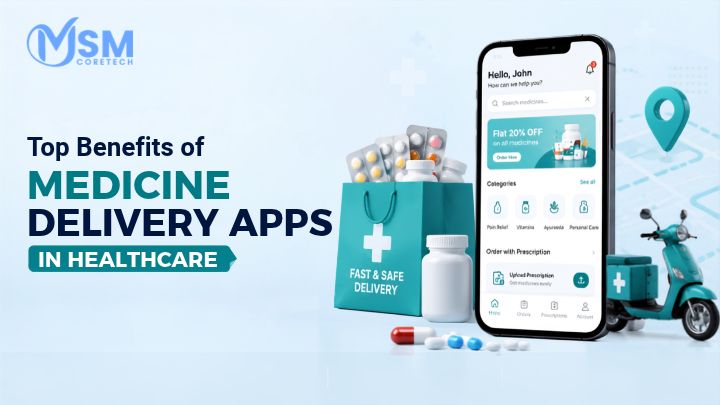
Buying medicine used to mean the same thing everywhere: get in the car, wait in line at the pharmacy counter, and hope they have what you need in stock. That routine is fading fast. In 2026, more people are opening an app on their phone, searching for a medicine, uploading a prescription, and having it delivered to their door within hours. Medicine delivery apps have quietly become one of the most useful tools in everyday healthcare, connecting patients, pharmacies, doctors, and delivery partners on a single platform.
This shift isn’t just about convenience. Digital healthcare has become a genuine priority for governments, hospitals, and patients alike, and medicine ordering is one of the easiest entry points into that digital world. For patients, it means faster access to medicines, fewer wasted trips, and better control over prescriptions and refills. For pharmacies and healthcare businesses, it means new customers, better inventory control, and data that helps them run smarter operations.
In this article, we’ll walk through the real benefits of medicine delivery apps in healthcare today, who gains from them, and what’s driving their growth heading into 2026 and beyond.
Also Read: Build a Health Insurance App
What Is a Medicine Delivery App?
Before getting into the benefits, it helps to understand what a medicine delivery app actually is and how it fits into the bigger healthcare picture.
A medicine delivery app is a mobile or web platform that lets people search for medicines, upload prescriptions, place orders, and get them delivered directly to their home or another chosen location. Instead of walking into a pharmacy, the entire process- search, order, payment, and delivery happens digitally.
How Online Medicine Ordering Works
At a basic level, most medicine delivery apps follow the same simple flow:
Prescription/Medicine Search → Order → Verification → Payment → Pharmacy Processing → Delivery
A patient opens the app, searches for a medicine or uploads a prescription, and places an order. The app, or a pharmacist behind the scenes, verifies the prescription where required; the patient pays through the app; the pharmacy prepares and packs the order; and a delivery partner brings it to the patient’s doorstep. Each step is tracked, so nobody is left wondering what’s happening with their order.
Who’s Involved: The Key Stakeholders
A medicine delivery app isn’t a one-sided tool. It brings together several groups, each playing a specific role:
- Patients/Customers: The people searching for, ordering, and receiving medicines.
- Pharmacies: The businesses that stock, verify, and prepare medicine orders for dispatch.
- Doctors: The medical professionals who issue prescriptions and, in many apps, can be consulted digitally.
- Delivery Partners: The people who physically pick up orders from the pharmacy and deliver them to patients.
- Administrators: The team behind the platform managing users, pharmacies, orders, and overall operations.
Traditional Pharmacy vs. App-Based Delivery
Traditional pharmacy visits require a patient to physically travel to a store, often during limited business hours, and wait for their turn at the counter. If the medicine isn’t in stock, they have to search elsewhere. With app-based delivery, patients can check availability instantly, compare pharmacies, upload their prescription digitally, and place an order from wherever they are, day or night. The core purpose is the same: getting the right medicine to the right person, but the process is faster, more transparent, and far less dependent on physical proximity to a pharmacy.
How Medicine Delivery Apps Are Transforming Healthcare in 2026
Medicine delivery apps aren’t a passing trend; they’re becoming a core part of how healthcare is delivered. A few shifts explain why.
A Digital-First Healthcare Experience
More patients now expect to manage their health the same way they manage everything else: from a phone screen. Booking a doctor’s appointment, checking lab results, and ordering medicine are increasingly happening on the same set of digital touchpoints, and medicine delivery apps are a natural extension of that expectation.
Growing Demand for Home-Based Healthcare
Home healthcare, from remote monitoring to medicine delivery, has grown steadily as patients look for care options that don’t require a trip outside. This is especially true for people managing chronic conditions who need regular medication without repeated pharmacy visits.
Faster Access to Medicines
Instead of waiting for pharmacy hours or driving to multiple stores to find a specific medicine, patients can check availability and place an order within minutes. This matters most for patients who need medicines urgently or who live in areas with limited pharmacy access.
Remote Prescription Management
Doctors and patients can now handle prescriptions digitally, issuing, uploading, verifying, and reordering, without needing an in-person visit for every renewal. This is particularly valuable for long-term medication plans.
Personalized Healthcare Experiences
Apps increasingly tailor the experience to each patient, showing relevant medicines, reminding them about refills, and surfacing health products based on past orders. This personalization makes healthcare feel less generic and more responsive to individual needs.
AI-Powered Recommendations and Automation
Artificial intelligence is playing a growing role behind the scenes, powering smarter search, demand forecasting, and automated reminders. Used correctly, AI supports the experience without replacing the judgment of doctors and pharmacists.
Real-Time Order and Delivery Tracking
Patients no longer have to wonder where their order is. Real-time tracking, from confirmation to dispatch to doorstep, has become a standard expectation, not a bonus feature.
Also Read: Build A Veterinary Medicine Online Shopping App
Top Benefits of Medicine Delivery Apps in Healthcare
This is where medicine delivery apps really prove their worth. The benefits of medicine delivery apps touch nearly every part of the healthcare experience, for patients who want convenience and reliability, and for pharmacies and healthcare businesses that want to grow and run more efficiently. Let’s go through them one by one.
1. 24/7 Access to Medicines
One of the simplest but most valuable benefits is round-the-clock access. Physical pharmacies operate on fixed hours, which means patients who need medicine late at night, early morning, or on a holiday are often out of luck. Medicine delivery apps remove that limitation. Patients can browse catalogs, check availability, and place orders at any hour, regardless of whether a physical pharmacy nearby is open.
For people managing ongoing conditions, or for a sudden need like a fever in the middle of the night, this always-on access can make a real difference. Availability of delivery itself still depends on the pharmacy’s operating hours and local logistics, but the ability to search, order, and queue a request at any time is a genuine shift from how medicine buying used to work.
2. Greater Convenience for Patients
Convenience is the benefit most patients notice first. Medicine delivery apps bring medicines to a patient’s doorstep, so there’s no need to travel, find parking, or stand in a queue. Reordering a medicine a patient has purchased before takes just a few taps instead of repeating the entire in-store process. Prescriptions can be uploaded digitally instead of being carried around on paper, reducing the risk of losing them.
Multiple payment options cards, UPI, wallets, or cash on delivery- mean patients aren’t limited in how they pay. Put together, these small conveniences add up to a genuinely easier way to manage medicine needs, especially for people juggling work, family, or health issues that make travel difficult.
3. Faster Medicine Delivery
Speed matters when someone needs medicine, and delivery apps are built around getting orders out quickly. Many platforms offer same-day delivery, and some offer express delivery options for urgent needs. Automated order processing, where the app routes an order to the nearest available pharmacy and delivery partner without manual back-and-forth, helps cut down the time between placing an order and receiving it.
Real-time tracking lets patients see exactly where their order stands, which reduces the uncertainty that often comes with waiting. That said, delivery speed depends on factors like location, pharmacy stock, and local logistics, so it’s worth being realistic: not every order can be promised within a fixed time window everywhere, but the overall trend is clearly toward faster fulfillment than traditional pharmacy visits.
4. Better Accessibility for Elderly and Mobility-Limited Patients
For elderly patients or anyone with limited mobility, a trip to the pharmacy can be a real obstacle, physically demanding, time-consuming, or simply not possible without help. Medicine delivery apps remove that barrier by bringing the medicine to them instead.
Family members can also place orders on behalf of a parent or relative, manage their prescriptions, and track deliveries remotely, which is especially useful when caregivers live far away. This benefit goes beyond convenience; for many elderly or mobility-limited patients, it directly affects whether they’re able to stay consistent with their medication at all.
5. Easy Prescription Management
Handling prescriptions used to mean keeping paper slips safe, remembering to bring them to the pharmacy, and re-explaining the same details every time a refill was needed. Medicine delivery apps simplify this considerably. Patients can upload a prescription photo directly in the app, and the pharmacy or a licensed pharmacist verifies it before the order is processed.
Digital records mean prescriptions don’t get lost, and reordering based on a previous prescription is often just a matter of selecting “reorder.” It’s important to be clear here: prescription medicines are still dispensed strictly according to applicable laws and require proper pharmacist or doctor verification. The app makes the process smoother, but it doesn’t bypass the checks that keep prescription medicine dispensing safe and legal.
6. Improved Medication Adherence
Sticking to a medication schedule is harder than it sounds, especially for long-term treatments. Medicine delivery apps help by sending refill reminders, tracking medication schedules, and offering recurring or auto-refill orders so patients don’t run out unexpectedly. Notifications nudge patients when it’s time to reorder or take a dose.
These features are best understood as support tools rather than guarantees; they make it easier for a motivated patient to stay on track, but adherence still ultimately depends on the patient and their care plan. Even so, removing the friction of manually remembering and reordering medicines is a meaningful help for people managing chronic conditions.
7. Personalized Medicine Shopping Experience
As patients use an app over time, it can start tailoring the experience to them, surfacing medicines they order regularly, suggesting relevant health products, and making search faster based on past behavior. AI-assisted search can help patients find what they’re looking for more quickly, even with vague or misspelled queries.
It’s worth being clear about the boundaries here: this kind of personalization is about shopping convenience, not medical decision-making. AI should never independently diagnose a condition or decide what medicine a patient should take; that responsibility stays with licensed doctors and pharmacists. Used within those limits, personalization simply makes routine medicine shopping quicker and less repetitive.
8. Real-Time Order Tracking
Not knowing when a delivery will arrive is one of the most frustrating parts of any online order, and medicine delivery apps address this directly. Patients can track their order through every stage: confirmation, pharmacy processing, dispatch, assignment to a delivery partner, and estimated arrival.
This transparency is especially reassuring for medicine orders, where patients may be anxious about running out of a needed dose. Real-time tracking also reduces the number of “where is my order” support queries pharmacies and platforms have to handle, which is a quieter but real operational benefit too.
9. Multiple Payment Options
Flexibility in how patients pay removes another point of friction. Most medicine delivery apps support credit and debit cards, UPI, and digital wallets, alongside cash on delivery where it’s legally and operationally appropriate for that market. Some platforms also integrate with insurance providers or corporate health benefit plans, letting eligible patients pay through those channels directly.
Giving patients more than one way to pay isn’t just a nicety; it widens who can actually use the app, including patients who prefer not to enter card details online or who don’t have easy access to digital payment methods.
10. Better Pharmacy Inventory Management
This is where the benefits start shifting toward the business side. For pharmacies, a delivery app isn’t just a sales channel; it’s also an inventory management tool. Real-time inventory visibility means pharmacy staff always know what’s in stock. Low-stock alerts flag items that need reordering before they run out completely, and automated inventory updates keep stock counts accurate as orders come in, without manual recounting.
Demand forecasting, often powered by past order data, helps pharmacies anticipate which medicines they’ll need more of and when. Together, these features reduce stockouts and make day-to-day order management noticeably less chaotic than manual, paper-based tracking.
11. Wider Customer Reach for Pharmacies
A physical pharmacy’s customer base is naturally limited to people who live or work nearby. A medicine delivery app changes that by letting a pharmacy serve patients across a much wider delivery radius, subject to local delivery and pharmacy regulations. This means a well-run local pharmacy can compete for customers it would never have reached through walk-in traffic alone, opening up real growth potential without needing to open new physical locations.
12. Reduced Operational Workload
Running a pharmacy involves a lot of repetitive administrative work, taking orders, sending notifications, generating bills, updating inventory, communicating with customers, and coordinating deliveries. Medicine delivery apps automate much of this. Orders flow directly into a pharmacy’s system instead of being manually recorded.
Notifications go out automatically at each stage. Billing is generated without manual calculation. Inventory updates itself as orders are placed and fulfilled. Delivery coordination happens through the platform instead of phone calls back and forth. The result is a pharmacy team that spends less time on repetitive tasks and more time on the parts of the job that actually need a human, like verifying prescriptions or handling customer questions.
13. Data-Driven Healthcare Insights
Every order placed through a medicine delivery app generates data, and when that data is aggregated, anonymized, and handled in a properly governed, privacy-compliant way, it becomes genuinely useful. Pharmacies and healthcare businesses can understand which products are in highest demand, how ordering patterns shift by season or region, what inventory levels they should maintain, and what customers generally prefer.
This kind of insight supports smarter purchasing and planning decisions. It’s important to be clear that this benefit applies to aggregated, de-identified data used for business planning, not to freely using sensitive individual patient data, which remains protected by healthcare privacy laws and should never be treated as a casual business resource.
14. Better Customer Experience and Retention
All of the benefits above eventually add up to one outcome that matters most for a healthcare business: whether patients keep coming back. Faster service, a personalized experience, easy access to order history, refill reminders, and loyalty programs all give patients reasons to stick with one platform instead of shopping around every time.
Responsive customer support, for questions about an order, a delayed delivery, or a prescription issue, reinforces trust. For pharmacies and healthcare businesses, retained customers are far more valuable than one-time buyers, which makes customer experience one of the most important long-term benefits a well-built medicine delivery app can offer.
Also Read: Ultimate Guide to Medicine Delivery App Development
Key Benefits for Different Healthcare Stakeholders
Different players in the medicine delivery ecosystem gain different things from the same platform. Here’s a quick, scannable summary:
| Stakeholder | Major Benefits |
|---|---|
| Patients | Convenience, accessibility, real-time tracking |
| Pharmacies | More orders, inventory control, wider reach |
| Doctors | Easier prescription workflows |
| Delivery Partners | Structured, organized delivery management |
| Healthcare Businesses | Automation, analytics, customer retention |
Essential Features of a Medicine Delivery App
Understanding the benefits is one thing; knowing what actually makes those benefits possible is another. Here’s a look at the features behind a well-built medicine delivery app, organized by who uses them.
Patient App
- User registration/login: Quick sign-up so patients can start ordering right away.
- Medicine search: Fast search across the pharmacy’s full catalog.
- Categories and filters: Easy browsing by medicine type, brand, or health need.
- Prescription upload: A simple way to submit prescriptions for verification.
- Medicine details: Clear information on dosage, usage, and alternatives.
- Shopping cart: Standard cart functionality for adding multiple items.
- Checkout: A smooth, few-step checkout process.
- Multiple payment options: Cards, UPI, wallets, and cash on delivery where applicable.
- Order tracking: Real-time visibility into order status.
- Reorder medicine: One-tap reordering based on past purchases.
- Refill reminders: Notifications when it’s time to reorder a recurring medicine.
- Notifications: Updates on order status, offers, and account activity.
- Ratings/reviews: Feedback on pharmacies and delivery experience.
- Customer support: In-app help for order or prescription issues.
Pharmacy Panel
- Medicine/catalog management: Adding, updating, and organizing the medicine catalog.
- Inventory management: Real-time stock tracking and updates.
- Prescription verification workflow: A structured process for pharmacists to review and approve prescriptions.
- Order management: Viewing, accepting, and processing incoming orders.
- Pricing management: Setting and updating prices and discounts.
- Sales reports: Data on order volume, revenue, and trends.
- Customer management: Viewing customer order history and details.
- Notifications: Alerts for new orders, low stock, and platform updates.
Delivery Partner App
- Delivery request management: Accepting and managing assigned delivery tasks.
- Route/navigation integration: Built-in maps and directions to the delivery location.
- Order status updates: Marking orders as picked up, in transit, or delivered.
- Customer contact: A way to reach the customer if needed during delivery.
- Delivery confirmation: Proof of delivery, such as a signature or photo.
- Earnings/history: A record of completed deliveries and payouts.
Admin Panel
- User management: Overseeing patient and delivery partner accounts.
- Pharmacy management: Onboarding and managing pharmacy partners.
- Delivery management: Monitoring delivery operations across the platform.
- Order management: A platform-wide view of all orders.
- Payment management: Tracking transactions, refunds, and settlements.
- Prescription oversight/workflows: Monitoring how prescriptions are verified and processed.
- Analytics and reports: Platform-wide performance data.
- Offers/promotions: Managing discounts and campaigns.
- Content management: Updating app content, banners, and information pages.
How AI Is Enhancing Medicine Delivery Apps in 2026
Artificial intelligence has moved from being a buzzword to being a practical part of how medicine delivery apps operate. Here’s where it’s actually being used:
- AI-powered medicine search: Understanding search queries better, including typos or vague descriptions, to return relevant results faster.
- Intelligent product recommendations: Suggesting relevant medicines or health products based on order history and browsing behavior.
- Demand forecasting: Predicting which medicines will be needed in higher volumes, helping pharmacies plan.
- Inventory prediction: Flagging likely stockouts before they happen, based on historical ordering patterns.
- Personalized reminders: Timing refill and medication reminders based on a patient’s actual usage patterns.
- Customer-support chatbots: Handling common questions, order status, return policies, and delivery timing without waiting for a human agent.
- Delivery route optimization: Calculating faster, more efficient delivery routes for delivery partners.
- Fraud/anomaly detection: Flagging unusual order patterns or suspicious account activity.
- Automated document/prescription processing: Speeding up prescription intake and organization where legally appropriate, before a licensed pharmacist reviews and verifies it.
It’s worth repeating something important here: AI in a medicine delivery app is there to assist, not to replace medical judgment. It can help surface information, speed up administrative steps, and personalize the shopping experience, but it should never independently diagnose a patient’s condition or decide what medicine they should be prescribed. That responsibility stays firmly with licensed doctors and pharmacists, and any well-built medicine delivery app is designed with that line clearly in place.
Also Read: Cost to Develop a Medicine Delivery App Like 1mg
Medicine Delivery App Business Models
Anyone thinking about building a medicine delivery app, or investing in one, needs to understand the different ways these platforms can be structured. Here are the main models in use today:
B2C Model
A single pharmacy sells and delivers directly to customers through its own app. This model gives the pharmacy full control over pricing, inventory, and customer relationships, but its reach is limited to that pharmacy’s own catalog and capacity.
Marketplace Model
Multiple pharmacies operate on one shared platform, and customers can choose between them based on price, availability, or delivery time. This model tends to offer patients more choice and better medicine availability, since an order can be filled by whichever partner pharmacy has stock.
Pharmacy-Owned Model
A single pharmacy chain builds and operates the app across all of its branches. This is common for larger pharmacy chains that want a unified digital presence without opening their platform to competitors.
Subscription Model
Patients subscribe to receive recurring medicines or refill services automatically, often at a discounted rate. This model works especially well for chronic-condition patients who need the same medicines on a predictable schedule.
B2B Model
A pharmacy or healthcare supplier sells to other healthcare businesses, clinics, hospitals, or other pharmacies, rather than directly to individual patients. This model focuses on bulk orders and business-to-business logistics rather than consumer-facing features.
Hybrid Model
Many successful platforms combine elements of the models above, a marketplace with subscription options, or a pharmacy-owned app that also offers B2B supply. A hybrid approach lets a business capture multiple revenue streams and serve different customer types from a single platform.
How Medicine Delivery Apps Generate Revenue
A medicine delivery app can bring in revenue through several channels, and most successful platforms combine more than one:
- Delivery fees: A charge per order for the delivery service itself.
- Commission from pharmacy orders: A percentage taken from each order processed through partner pharmacies.
- Subscription plans: Recurring revenue from patients who sign up for regular refill or membership plans.
- Premium delivery: Extra charges for faster or scheduled delivery options.
- Featured product listings: Pharmacies or brands paying to have their products shown more prominently.
- Pharmacy onboarding fees where applicable: A fee charged to pharmacies joining the platform, depending on the business model.
- Healthcare product sales: Direct sales of health and wellness products beyond core medicines.
- B2B partnerships: Revenue from supplying to clinics, hospitals, or other healthcare businesses.
Not every monetization model fits every market. Healthcare advertising rules, pharmacy regulations, and what patients are used to paying for vary significantly from one region to another, so a model that works well in one country may need real adjustment elsewhere. Anyone building a platform should treat this list as a starting menu of options, not a one-size-fits-all formula.
Step-by-Step Process to Develop a Medicine Delivery App
Building a medicine delivery app is a structured process, not something to rush through. Here’s a realistic step-by-step flow:
Step 1: Define the business model
Decide whether the platform will be B2C, marketplace, pharmacy-owned, subscription-based, B2B, or a hybrid, since this shapes almost every decision that follows.
Step 2: Identify target users
Get clear on who the app is really for, everyday consumers, chronic-condition patients, elderly users, or a business-to-business audience.
Step 3: Research regulations
Study the pharmacy, prescription, and data-privacy laws that apply in the target market before designing a single feature.
Step 4: Define app features
Map out exactly what the patient app, pharmacy panel, delivery app, and admin panel each need to do.
Step 5: Create UI/UX design
Design wireframes and interfaces that are simple to navigate, especially for less tech-savvy users like elderly patients.
Step 6: Select technology stack
Choose the frameworks, databases, and cloud infrastructure the platform will be built on.
Step 7: Develop backend and APIs
Build the core logic, order processing, inventory sync, prescription verification workflows, and the APIs that connect everything.
Step 8: Develop mobile/web interfaces
Build out the actual patient, pharmacy, delivery partner, and admin interfaces.
Step 9: Integrate payments, maps, notifications, etc.
Connect third-party services like payment gateways, mapping/navigation tools, and push notification systems.
Step 10: Implement security and compliance controls
Add encryption, access controls, and the safeguards needed to protect patient data and meet healthcare regulations.
Step 11: Test the application
Run functional, security, and usability testing across every part of the platform before launch.
Step 12: Launch
Release the app to the public, along with the pharmacy and delivery partner onboarding needed to make it functional from day one.
Step 13: Monitor, maintain, and scale
Track performance, fix issues as they come up, and expand features or coverage as the user base grows.
Following this kind of structured process is one reason working with an experienced medicine delivery app development company makes such a difference; it helps avoid costly missteps around compliance, scalability, and user experience that are hard to fix after launch.
Also Read: Develop a Healthcare Fintech Solution
Technologies Emerging in the Healthcare Industry
Medicine delivery apps don’t exist in isolation; they’re part of a broader wave of healthcare technology. A few developments worth knowing about:
- Telemedicine platforms: Letting patients consult doctors remotely, often feeding directly into prescription and medicine ordering.
- Electronic health records (EHR) integration: Connecting medicine orders with a patient’s broader medical history for more informed care.
- Wearable health devices: Feeding real-time health data that can inform medication reminders and health tracking.
- Cloud-based healthcare infrastructure: Supporting the scale and reliability that healthcare platforms need.
- IoT-enabled logistics: Monitoring conditions like temperature during transport for medicines that need controlled storage.
These technologies increasingly overlap with medicine delivery apps, which is part of why the space is evolving so quickly.
Future of Medicine Delivery Apps
Looking beyond 2026, several trends are likely to shape where medicine delivery apps go next:
- AI-powered personalization: Deeper personalization in recommendations, reminders, and search as AI models improve.
- Predictive inventory: More accurate forecasting that helps pharmacies avoid both stockouts and overstocking.
- Voice-based medicine search: Letting patients search or reorder medicines using voice commands, especially useful for elderly or visually impaired users.
- Automated refill systems: Smarter auto-refill logic that adjusts based on actual usage rather than a fixed schedule.
- Smart healthcare reminders: Reminders that factor in a patient’s broader health data, not just a medicine schedule.
- Hyperlocal delivery: Faster fulfillment through delivery networks built around smaller, localized zones.
- Wearable/device integrations: Tighter connections between wearables and medicine ordering, especially for chronic-condition management.
- Telemedicine integration: A more seamless link between a doctor’s consultation and the resulting prescription and medicine order.
- Digital health records: Broader adoption of connected health records that make prescription history available across providers.
- IoT-enabled temperature monitoring: Better tracking of storage conditions for temperature-sensitive medicines throughout delivery.
- Autonomous delivery technologies: Early use of drones or autonomous vehicles for delivery, where practical and legally permitted.
None of these trends are guaranteed to unfold at the same pace everywhere; regulation, infrastructure, and patient trust all play a role. But the overall direction is clear: medicine delivery apps are only going to become more capable and more central to how people access healthcare.
Also Read: How to Build a Doctor Booking App
Final Takeaway
Medicine delivery apps have moved from being a convenient extra to becoming a genuine part of how healthcare works. For patients, they mean faster access to medicines, easier prescription management, and a shopping experience that fits around their life instead of a pharmacy’s opening hours. For pharmacies and healthcare businesses, they bring wider customer reach, better inventory control, reduced operational workload, and data-driven insights that support smarter decisions.
None of this works without getting the fundamentals right. Security and compliance have to be built in from the start, not added later. AI and automation should support the experience, not replace the medical judgment of doctors and pharmacists. And the platform itself needs to be built to scale as demand grows, which industry data suggests it will keep doing well into the coming years.
For businesses looking to build or grow in this space, the difference between an app that works and one that doesn’t often comes down to who builds it. Partnering with an experienced medicine delivery app development company can make the difference between a platform that just launches and one that actually scales, stays compliant, and earns patient trust over time.
FAQs
They offer 24/7 access to medicines, faster delivery, easier prescription management, and better medication adherence for patients, while giving pharmacies wider reach, better inventory control, and reduced operational workload.
Patients search for medicines or upload a prescription, place an order, and pay through the app. The pharmacy verifies and prepares the order, and a delivery partner brings it to the patient’s doorstep with real-time tracking along the way.
Reputable medicine delivery apps follow prescription verification rules, data privacy laws, and secure payment processing. Safety ultimately depends on the specific platform and pharmacy partners involved, so it’s worth checking that a platform is properly licensed.
Patients upload a photo or scan of their prescription, and a licensed pharmacist reviews and verifies it before the order is processed, ensuring that prescription medicines are dispensed in accordance with applicable laws.
Yes, AI can power smarter search, personalized recommendations, demand forecasting, and chatbot support. It should assist the process, not independently diagnose patients or prescribe medicines.
Same-day and express delivery are common in many areas, but availability depends on the pharmacy’s location, stock, and local delivery infrastructure, so it isn’t guaranteed universally.

Related Posts
A Complete Guide to Developing an AI-Powered Financial Wellness App
Managing money can sometimes feel difficult, especially when expenses keep going up and financial goals become harder to achieve. An...
Read More
How to Build a Health Insurance App: Features, Cost & Development Guide
More and more people are managing their health cover from their phones instead of standing in queues or calling a...
Read More
E-wallet App Development: Types, Features & Development Process
Imagine paying a bill, sending money to a friend, or shopping online without using cash or a card. This easy...
Read More


 Verified Review




 +44 7427829444
 71-75, Shelton Street, Covent Garden, London, United Kingdom, WC2H 9JQ