

Share this article


How to Build a Health Insurance App: Features, Cost & Development Guide
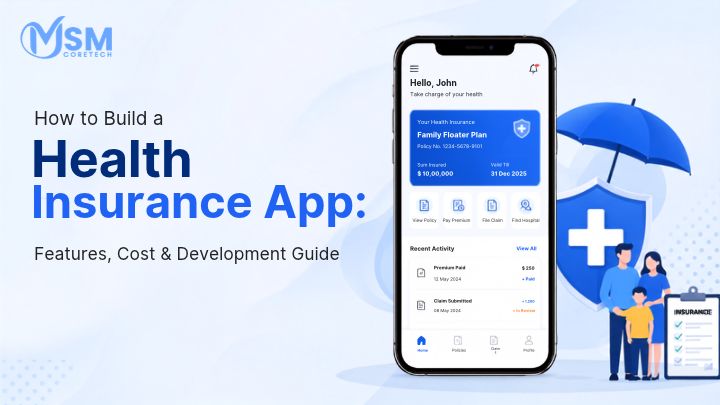
More and more people are managing their health cover from their phones instead of standing in queues or calling a helpline. Buying a policy, filing a claim, paying a premium, or finding a nearby hospital used to take days of paperwork. Now it can happen in a few taps. This shift is exactly why so many insurers, hospitals, and startups are investing in health insurance app development right now.
The numbers back this up. The global health insurance market is expected to touch USD 2.89 trillion in 2026, and the insurance mobile apps market alone is projected to reach USD 499.43 million in 2026, growing at a steady pace as more insurers move their services online.
A good health insurance app brings policy management, insurance purchases, claims processing, premium payments, doctor and hospital discovery, customer support, and health tracking into one place. In this guide, we will walk through what these apps actually do, the features they need, the technology behind them, how much they cost to build, and how a mobile app development company like MSM Coretech can help you bring one to life.
Also Read: How to Develop a Healthcare Fintech Solution?
What Is a Health Insurance App?
A health insurance app is a digital platform that connects four groups of people: policyholders, insurance companies, healthcare providers, and administrators. Instead of each of these groups working through separate phone calls, paper forms, and emails, the app brings them onto one shared system. A customer can buy a plan, pay a premium, visit a hospital, and file a claim, while the insurer and the hospital both see the same information in real time.
Here is a simple way to picture how the pieces fit together:
User → Insurance Plan → Premium Payment → Healthcare Service → Claim → Verification → Settlement
A user picks a plan that fits their needs, pays the premium through the app, visits a doctor or hospital under that plan, submits a claim for the treatment, the insurer verifies the claim against the policy terms, and finally settles the payment either to the user or directly to the hospital. Every health insurance app is built around some version of this cycle, even if the screens and steps look a little different from one app to another.
Not every health insurance app does the same job, though. Broadly, you will come across five types:
Health insurance marketplace apps
These let users browse and buy plans from multiple insurers in one place, similar to how a travel app lets you compare flights from different airlines.
Insurance provider apps
Built by a single insurance company for its own customers, focused on managing that insurer’s own policies, claims, and payments.
Health management + insurance apps
These combine insurance features with wellness tracking, doctor consultations, and health records, so the app becomes a daily-use health companion, not just a claims tool.
Employer health insurance apps
Used by companies to manage group health plans for their staff, usually with HR and payroll integrations.
Insurance aggregator platforms
Similar to marketplace apps, but they focus heavily on comparison, quotes, and lead generation for insurers rather than owning the policy relationship themselves.
Also Read: Healthcare IT Market Size, Statistics, and Trends
Why Invest in Health Insurance App Development?
It is easy to list features and call it a day, but the real question every business owner asks is simpler: what do we actually get out of this? Health insurance app development pays off in different ways depending on who you ask. Let’s break it down by who benefits and how.
For Customers
For the everyday policyholder, an app removes almost every friction point that used to make health insurance frustrating.
- Faster policy access: Customers can view their coverage details, download policy documents, and check what is covered without calling anyone.
- Digital claims: Instead of mailing forms and waiting weeks, users upload documents from their phone and track the claim status live.
- Easy premium payments: One-tap payments through UPI, cards, or wallets, plus auto-pay so nobody misses a due date.
- Policy comparison: Users can compare coverage, premiums, and exclusions side by side before choosing a plan.
- Cashless healthcare access: Network hospital discovery and digital e-cards mean users can walk into a hospital without carrying physical paperwork.
For Insurance Companies
On the insurer’s side, the benefits are less about convenience and more about running a leaner, faster business.
- Lower operational costs: Digital workflows cut down on the staff hours needed for manual data entry, printing, and phone support.
- Faster claim processing: Automated verification and digital documents mean claims that used to take weeks can be settled in days.
- Better customer retention: A smooth digital experience keeps policyholders happy, and happy customers renew instead of switching insurers.
- Reduced paperwork: Fewer physical forms mean fewer errors, less storage, and less back-and-forth between departments.
- Improved data visibility: Insurers get real-time dashboards showing claim trends, customer behavior, and risk patterns.
For Businesses
If you are building the app as a business itself, whether as an aggregator, a marketplace, or a corporate insurance platform, the upside looks a bit different again.
- New revenue channels: Commissions, subscriptions, and partner tie-ups open up income streams beyond a single insurer’s premiums.
- Automated workflows: Less manual coordination between insurers, hospitals, and customers means the business can scale without scaling headcount at the same rate.
- Personalized insurance products: Data collected through the app helps design plans that actually match what different customer segments need.
- Better customer engagement: Push notifications, wellness tracking, and health tips keep users opening the app instead of forgetting about their policy until renewal time.
There’s also a bigger shift happening underneath all of this: AI and automation are quietly changing what people expect from insurance. Chatbots now handle basic policy questions instantly. Machine learning models flag suspicious claims before a human even looks at them. Predictive models help insurers price risk more accurately instead of relying on broad, generic categories. None of this replaces human judgment entirely, but it does mean the apps being built today need to be designed with AI in mind from day one, not bolted on as an afterthought.
Key Types of Health Insurance Apps
We touched on the different categories earlier, but this is worth its own section because choosing the wrong type early on can mean rebuilding half your app later. Before you write a single line of code, it helps to know exactly which of these five you are building.
Insurance Provider App
This is built by a company that sells and manages its own insurance products. Think of it as a direct extension of the insurer’s business, focused entirely on that company’s own plans, claims, and customers. It gives insurers full control over branding, pricing, and customer relationships, but it only serves people who already chose that insurer.
Insurance Aggregator App
An aggregator app lets users compare policies from multiple providers side by side. Instead of owning the insurance relationship, the aggregator makes money by connecting customers to insurers, often through referral commissions or lead generation fees. Sites and apps that let you compare car or health insurance quotes from ten companies at once fall into this category.
Health Insurance Marketplace
A marketplace goes a step further than an aggregator. It doesn’t just compare plans, it lets users actually buy and manage policies from multiple insurers within the same app. This means deeper integrations with each insurer’s backend systems, but it also means the marketplace can own more of the customer relationship over time.
Corporate Health Insurance App
This type is designed specifically for employees, HR teams, and corporate insurance administrators. It handles group policies, employee enrollment, dependent coverage, and claims for an entire workforce. HR teams get dashboards to manage enrollment periods and monitor claim trends across departments, while employees get a simplified view of just their own coverage.
Health + Insurance Super App
This is the most ambitious option. A super app combines insurance with telemedicine, wellness tracking, pharmacy delivery, doctor appointments, and claims, all inside one platform. It takes longer and costs more to build, but it also keeps users coming back far more often, since they are not just opening the app once a year to renew a policy. If you are researching health insurance app development with long-term growth in mind, this is often where the market is heading.
Also Read: Cost to Develop a Doctor Booking App Like HealthTap
Essential Features of a Health Insurance App
This is the heart of any health insurance app, and rather than dumping every feature into one giant list, it makes more sense to organize them by who is actually using them. Let’s start with the customer-facing app, since that is what most users will interact with every day.
Customer/User App Features
User Registration & Login
The first thing any user does is create an account, so this needs to be quick and secure without feeling like a chore.
- Email/phone authentication
- OTP verification
- Social login
- Biometric authentication
User Profile
A complete profile is what lets the app personalize plans and speed up claims later on.
- Personal information
- Family members
- Medical information
- Nominee details
- Document management
Insurance Plan Search & Comparison
This is often the very first thing a new user does, so it needs to be simple to browse and easy to compare.
- Premium comparison
- Coverage limits
- Deductibles
- Network hospitals
- Policy benefits
- Exclusions
Policy Management
Once a user has a policy, they need an easy way to check on it without calling customer support.
- View active policies
- Policy renewal
- Coverage details
- Policy documents
- Expiry reminders
Premium Payment
Payments should feel as easy as any other digital purchase, with multiple options depending on the user’s region.
- Credit/debit cards
- UPI
- Net banking
- Digital wallets
- Auto-pay
Claims Management
Claims are usually where users get frustrated with traditional insurance, so this feature set matters more than almost any other.
- Submit claim
- Upload documents
- Claim tracking
- Claim status notifications
- Claim history
Hospital & Doctor Search
When someone is unwell, the last thing they want is to guess which hospital accepts their insurance, so this needs to be fast and location-aware.
- Network hospitals
- Doctors
- Location-based search
- Specialties
- Cashless hospitals
E-Card
A digital insurance card that users can pull up instantly at a hospital counter, no wallet-digging required.
Notifications
Timely alerts keep users informed without them needing to open the app and check manually.
- Premium reminders
- Policy expiry
- Claim updates
- Payment confirmations
- Health alerts
Customer Support
Even the best-designed app will have users with questions, so support channels need to be built in from the start.
- Live chat
- Chatbot
- Call support
- FAQs
- Ticket management
Advanced Features to Make the App Competitive
The features above cover the basics that every health insurance app needs. But if you want your app to stand out from the dozens of similar apps already on the market, you need to go further. This is where AI, automation, and smarter integrations come in.
AI-Powered Insurance Recommendations
Instead of showing every user the same list of plans, AI can recommend policies based on factors that actually matter to that person:
- Age
- Family size
- Coverage requirements
- Lifestyle
- Budget
- Existing policies
AI Claims Assistance
Filing a claim is confusing for most people, and AI can quietly guide them through it. It can help users:
- Understand claim requirements
- Identify missing documents
- Track claim progress
- Answer claim-related questions
Fraud Detection
Insurance fraud costs the industry billions every year, and AI and machine learning models can flag unusual claim patterns, duplicate submissions, or inflated bills before a human reviewer even sees them, cutting down losses without slowing down legitimate claims.
Personalized Health Insights
By connecting to wearable devices and health platforms, the app can turn everyday activity data, like steps, sleep, and heart rate, into personalized insights and even wellness rewards tied to the insurance plan.
Predictive Risk Analysis
Using historical claims data alongside information the user provides, predictive models help insurers assess risk more accurately and design offerings that reflect an individual’s actual health profile rather than broad averages.
OCR-Based Document Processing
Optical character recognition can automatically read and extract information from documents that would otherwise need manual data entry:
- Medical bills
- Prescriptions
- ID documents
- Hospital invoices
- Insurance documents
Voice Assistant
A voice assistant lets users get quick answers without typing or navigating menus, simply by asking things like:
- “What is my current coverage?”
- “What documents do I need for my claim?”
Telemedicine Integration
Bringing doctors directly into the app turns it from a policy-management tool into a genuine health companion:
- Video consultations
- Audio calls
- Online appointments
- Digital prescriptions
One important note here: it is worth clearly separating what AI is assisting with from what still needs a human decision. AI can flag a claim as suspicious or suggest a plan, but denying a claim, approving a payout, or making a final underwriting call should still go through proper regulatory and human review. Blurring that line is one of the fastest ways to run into compliance trouble.
Also Read: Healthcare App Development Companies in the USA
Features for Insurance Providers
So far we have focused on what the end customer sees. But if insurers are going to actually run their business through this app, they need an entirely separate set of tools built for their side of the operation.
- Policy creation and management: Tools to design new insurance products, set terms, and update existing policies without needing a developer every time.
- Customer management: A full view of every policyholder, their history, and their active plans in one dashboard.
- Premium management: Tracking collections, overdue payments, and renewal cycles across the entire customer base.
- Claim management: A structured workflow to review, verify, approve, or reject claims with a clear audit trail.
- Risk assessment: Tools to evaluate the risk profile of applicants before issuing a policy.
- Underwriting workflows: Structured processes for reviewing applications and deciding coverage terms and pricing.
- Document verification: Checking submitted IDs, medical records, and claim documents for authenticity.
- Payment management: Handling premium collection, refunds, and claim settlements in one place.
- Provider management: Managing relationships and contracts with network hospitals and doctors.
- Customer communication: Sending renewal reminders, claim updates, and policy notices at scale.
- Reports and analytics: Dashboards showing claim ratios, customer retention, and business performance over time.
Admin Panel Features
Behind every good health insurance app sits a backend dashboard that keeps the whole system running. This is where the operations team, not the end customer, spends their day.
- User management: Adding, editing, or deactivating customer and staff accounts.
- Insurance provider management: Onboarding new insurers onto the platform, especially important for marketplace and aggregator apps.
- Policy management: Creating and updating the policies available across the platform.
- Claims management: A central view of every claim in the system, at any stage.
- Payment tracking: Monitoring every transaction moving through the platform.
- Hospital management: Adding and updating the network hospital list.
- Doctor management: Maintaining the directory of doctors, specialties, and availability.
- Content management: Updating FAQs, policy wording, and in-app content without a developer.
- Reports: Exportable data for business, compliance, and finance teams.
- Analytics: Usage trends, claim patterns, and customer behavior at a glance.
- Notifications: Managing what alerts go out to users and when.
- Role-based access control: Making sure each staff member only sees and edits what their role allows.
A strong addition here is a real-time analytics dashboard, one that updates live as claims come in, payments are processed, and users sign up, instead of relying on end-of-day reports. For a growing insurance business, that kind of visibility can be the difference between catching a problem early and finding out about it a week later.
Health Insurance App User Flow
Understanding the features is one thing, but seeing how a real user actually moves through the app is what makes the whole picture click. Here is the typical end-to-end journey:
Sign Up → Complete Profile → Compare Plans → Select Plan → Make Payment → Receive Policy → Find Hospital → Submit Claim → Track Claim → Settlement
That is the big-picture journey, but in reality, users move through a few distinct smaller flows depending on what they are trying to do at any given moment.
Policy Purchase
A new user browses available plans, compares premiums and coverage, selects one that fits their needs, completes payment, and receives their digital policy and e-card almost instantly.
Policy Renewal
An existing user gets a reminder before their policy expires, reviews their current coverage, makes any changes if needed, and renews with a single payment, often through auto-pay if they set it up.
Cashless Treatment
The user finds a network hospital through the app, shows their digital e-card at admission, the hospital verifies coverage directly with the insurer, and the bill is settled between the hospital and insurer without the patient paying out of pocket.
Reimbursement Claim
If the treatment happened outside the network, the user pays upfront, then submits the claim through the app with bills and documents attached; the insurer verifies everything and reimburses the user directly to their bank account.
Also Read: Cost to Develop a Mobile Healthcare App
Health Insurance App Development Process
This is where planning turns into an actual roadmap. Building an app of health insurance is not something you rush into feature-first; it works best when you move through a clear, deliberate sequence from business planning all the way through to post-launch support.
Step 1: Define the Business Model
Before anything else, decide exactly what kind of platform you are developing: an insurance provider app, an aggregator, a marketplace, or a corporate insurance platform. Once that’s settled, define your target audience, target market, insurance products, revenue model, and overall business objectives. This decision shapes almost everything that follows, from the integrations you need to the compliance rules that apply to you.
Step 2: Conduct Market & Competitor Research
Spend real time studying existing insurance apps, competitor features, customer reviews, pricing models, UX patterns, and gaps in the market. Look closely at what competitors do well and, just as importantly, where their users consistently run into problems. That second part is often where your biggest opportunity to stand out actually lives.
Step 3: Define App Requirements
Prepare a detailed requirements document covering user roles, features, user journeys, admin requirements, API requirements, security requirements, and compliance requirements. This is also the stage where you separate MVP features from advanced features, so development doesn’t drift into building everything at once before you’ve validated what users actually need.
Step 4: Design the UI/UX
Create user flows, wireframes, interactive prototypes, visual designs, and a design system the whole team can build against consistently. A few UX principles matter more here than almost anywhere else: simple onboarding, easy plan comparison, transparent policy information, a simple claims process, clear navigation, accessible design, and a mobile-first experience throughout.
Step 5: Select the Technology Stack
Choose technologies based on your target platforms, scalability needs, security requirements, integration requirements, and budget. The recommended stack we cover in the dedicated technology section later in this guide is a solid starting point for most teams.
Step 6: Develop the Backend
Build the core infrastructure that everything else depends on: authentication, user management, policy management, claims, payments, notifications, APIs, the database, and the admin panel. It’s worth using a scalable architecture from the start, so additional insurance providers and users can be added later without a costly rebuild.
Step 7: Develop the Mobile Application
Build the customer-facing application for both Android and iOS. For most teams, cross-platform development using Flutter or React Native makes sense here, since it lets you build once and ship to both platforms, which saves real time and budget without a major compromise on performance or user experience.
Step 8: Integrate Third-Party APIs
Integrate the services your app depends on: insurance APIs, payment gateways, hospital APIs, doctor and appointment APIs, maps, identity verification, OCR, SMS and email services, telemedicine, and health or wearable APIs. These integrations often take longer than expected, so it helps to start lining up access and documentation for each one early rather than leaving them until the end.
Step 9: Implement Security & Compliance
Before launch, implement encryption, secure authentication, MFA, access controls, audit logs, secure API communication, data privacy controls, consent management, and thorough security testing. Compliance itself should be evaluated based on the country you’re operating in, your business model, the type of data you process, and every entity involved in that data flow, not treated as a single one-size-fits-all checkbox.
Step 10: Testing & Quality Assurance
Testing at this stage needs to cover several angles at once, not just whether buttons work.
- Functional testing: Checking whether every feature works correctly, end-to-end.
- Security testing: Identifying vulnerabilities and data-security risks before attackers do.
- API testing: Verifying that communication between systems behaves correctly under normal and edge-case conditions.
- Performance testing: Testing how the app holds up under high traffic and heavy claim volumes.
- Usability testing: Making sure real users can easily navigate the app and complete important tasks without confusion.
- Compatibility testing: Testing across different devices, screen sizes, operating systems, and browsers.
Step 11: Deployment
With testing complete, prepare the production environment, cloud infrastructure, App Store and Google Play deployment, database configuration, monitoring, and backup systems. A well-prepared deployment stage means fewer surprises in the first critical days after launch, when traffic and real user behavior finally put the app to the test.
Step 12: Post-Launch Maintenance
Launch is really just the start of the next phase. After going live, the work shifts to monitoring performance, fixing bugs, releasing updates, improving security, adding new features, updating APIs as partners change theirs, monitoring analytics, improving UX based on real usage data, and scaling infrastructure as the user base grows. Apps that stay competitive treat this as an ongoing commitment, not a one-time finish line.
Also Read: Build A Veterinary Medicine Online Shopping App
Technology Stack for Health Insurance App Development
Here is a quick reference table pulling together the technology choices we’ve mentioned throughout this guide, useful if you are briefing a healthcare app development company or comparing proposals from different teams.
| Component | Recommended Technologies |
|---|---|
| iOS/Android | Flutter, React Native, Swift, Kotlin |
| Frontend | React.js / Next.js |
| Backend | Node.js, Django, Laravel |
| Database | PostgreSQL, MySQL, MongoDB |
| Cloud | AWS, Azure, Google Cloud |
| AI/ML | Python, TensorFlow, PyTorch |
| APIs | REST, GraphQL |
| Payments | Stripe, Razorpay, PayPal |
| Notifications | Firebase |
| Analytics | GA4, Mixpanel |
| Security | OAuth 2.0, MFA, encryption |
How Much Does It Cost to Build a Health Insurance App?
This is usually the first question anyone asks, and it’s fair, since health insurance app development cost varies a lot depending on scope. There is no single fixed number here, but a rough cost breakdown by app type gives you a realistic starting point for planning your budget.
| App Type | Estimated Cost |
|---|---|
| Basic MVP | $30,000 – $60,000 |
| Medium Complexity | $60,000 – $120,000 |
| Advanced Platform | $120,000 – $250,000+ |
| Enterprise Insurance Ecosystem | $250,000+ |
Keep in mind these are ballpark estimates, not fixed quotes. Your actual health insurance app development cost will depend on the exact features you choose, the platforms you target, and the partner you work with. The only way to get an accurate number is a detailed scoping conversation with a development team.
Factors Affecting Health Insurance App Development Cost
A lot of variables feed into that final number, and it helps to understand each one before you start budgeting.
- Number of platforms: Building for iOS, Android, and web all at once costs more than launching on one platform first.
- UI/UX complexity: Highly custom, animated interfaces take longer to design and build than a clean, standard layout.
- Number of features: Every additional feature, from claims tracking to wellness rewards, adds development time.
- Third-party integrations: Each API connection, whether it’s payments, maps, or hospital systems, adds its own setup and testing effort.
- AI/ML implementation: Features like fraud detection or personalized recommendations require specialized data science work.
- Insurance APIs: Connecting to multiple insurers’ systems, especially for aggregator or marketplace apps, adds real complexity.
- Compliance requirements: Meeting HIPAA, GDPR, or regional data protection laws takes dedicated legal and technical effort.
- Security architecture: Encryption, MFA, and audit logging all need to be built and tested properly, not bolted on at the end.
- Admin dashboard: A full-featured backend for insurers and administrators is a substantial project in its own right.
- Development team location: Rates vary significantly between regions, which affects the overall project cost.
- Testing requirements: Thorough QA, especially for payment and claims flows, takes real time to do properly.
- Post-launch maintenance: Ongoing updates, bug fixes, and server costs continue well after the initial launch.
A useful way to think about the total cost is with a simple formula:
Development Cost = Features + Design + Development + Integrations + Security/Compliance + Testing + Deployment + Maintenance
Development Timeline
Timelines follow a similar pattern to cost, they scale with scope. Here is a realistic breakdown of how the stages typically play out:
| Development Stage | Approx. Duration |
|---|---|
| Research & Planning | 1–3 weeks |
| UI/UX Design | 2–4 weeks |
| MVP Development | 8–14 weeks |
| API Integrations | 2–6 weeks |
| Testing | 2–4 weeks |
| Deployment | 1–2 weeks |
These stages often overlap in practice; design work continues into early development, and integrations get tested alongside the rest of the app rather than strictly after it. Timelines can also stretch depending on how many insurance and healthcare partners you need to onboard, and how demanding your regulatory requirements are.
Health Insurance App Monetization Models
If you are building this as a standalone business rather than an internal tool for an existing insurer, you’ll want a clear plan for how the app actually makes money. There are several proven models to choose from, and many successful platforms combine more than one.
Commission Model
Earn a commission from insurers every time a user buys a policy through your platform. This is the most common model for aggregators and marketplaces, since it aligns your revenue directly with successful policy sales.
Subscription Model
Charge users a recurring fee for premium features, like advanced health tracking, priority claims support, or exclusive wellness content, on top of the core free experience.
Lead Generation
Generate qualified insurance leads and sell or pass them on to insurance providers, who pay for access to users actively looking for coverage.
B2B Licensing
License your platform itself to insurers or employers who want the technology without building it from scratch, turning your app into a white-label product for other businesses.
API-as-a-Service
If you’ve built strong insurance infrastructure, you can offer it as an API to other businesses, letting them plug your claims processing, plan comparison, or verification tools into their own products.
Partner Revenue
Generate additional income through partnerships with healthcare, pharmacy, wellness, or telemedicine providers who want access to your user base.
How AI Is Transforming Health Insurance Apps
We’ve mentioned AI a few times already, but it deserves its own dedicated look, because this is genuinely where the industry is heading over the next few years.
- AI customer support: Chatbots that resolve common questions instantly, freeing up human agents for complex cases.
- Personalized plan recommendations: Matching users to plans based on their actual profile instead of generic categories.
- Automated document processing: Reading bills, prescriptions, and forms without manual data entry.
- Fraud detection: Spotting suspicious patterns across thousands of claims far faster than a human reviewer could.
- Claims assistance: Guiding users through what documents they need and where their claim currently stands.
- Predictive analytics: Forecasting claim volumes and customer behavior to help insurers plan.
- Risk assessment support: Helping underwriters price policies more accurately using richer data.
- Voice-based insurance assistance: Letting users ask questions naturally instead of digging through menus.
- Personalized wellness recommendations: Using health and activity data to suggest habits that could lower risk and improve outcomes.
None of this works well without guardrails, though. As AI takes on more of the day-to-day work, human oversight, explainability, bias monitoring, and privacy protections need to scale right alongside it. A recommendation engine that quietly discriminates against certain user groups, or a fraud model nobody can explain the reasoning behind, creates real regulatory and reputational risk. The apps that get this right treat AI as a powerful assistant to human decision-makers, not a replacement for them.
Also Read: Medicine Delivery App Development
Common Challenges in Health Insurance App Development
Every team building in this space runs into a familiar set of obstacles. Knowing them ahead of time makes it much easier to plan around them.
Complex Insurance Workflows
Challenge: Insurance logic around eligibility, exclusions, and pricing is genuinely complicated and varies by product.
Solution: Work closely with insurance domain experts during planning, not just developers, so the logic is right before it’s built.
Regulatory Compliance
Challenge: Laws around health data and insurance vary widely by region and change over time.
Solution: Build compliance into the architecture from day one and involve legal counsel familiar with each target market.
Data Privacy
Challenge: The app handles some of the most sensitive personal data that exists.
Solution: Apply encryption, strict access controls, and clear consent flows as non-negotiable baseline requirements.
Multiple API Integrations
Challenge: Connecting to insurers, hospitals, and payment systems means dealing with many different, sometimes inconsistent, external systems.
Solution: Design an API-first architecture with strong error handling so one partner’s downtime doesn’t break the whole app.
Claims Verification
Challenge: Verifying that a claim is legitimate and matches policy terms is time-consuming when done manually.
Solution: Combine OCR, automated rule-checking, and AI-assisted review to speed up the first pass, with humans reviewing edge cases.
Fraud Prevention
Challenge: Fraudulent claims cost insurers heavily and are often hard to spot individually.
Solution: Use machine learning models trained on historical claims data to flag unusual patterns for review.
Legacy System Integration
Challenge: Many insurers and hospitals still run on older systems that weren’t built for modern APIs.
Solution: Use middleware and integration layers that can bridge old and new systems without a full system overhaul.
User Trust
Challenge: People are naturally cautious about sharing health and financial data digitally.
Solution: Be transparent about data use, invest visibly in security, and make the app genuinely useful so trust builds over time.
Data Accuracy
Challenge: Incorrect or outdated data, like an old hospital network list, damages user trust quickly.
Solution: Set up regular data audits and give administrators easy tools to keep information current.
Scalability
Challenge: An app that works fine for a thousand users can struggle at a hundred thousand.
Solution: Design the backend architecture with growth in mind from the start, rather than retrofitting scalability later.
Common Mistakes to Avoid
Alongside the challenges above, there are a handful of avoidable mistakes that come up again and again in health insurance app projects.
- Building too many features in the first version
- Ignoring compliance until launch
- Using weak authentication
- Poor claims UX
- Hiding policy exclusions
- Depending on unreliable APIs
- Ignoring accessibility
- Skipping security testing
- Not planning scalability
- Treating AI as a replacement for human oversight
MVP vs Advanced Health Insurance App
When you’re deciding what to build first, it helps to see the two ends of the spectrum laid out side by side.
| MVP | Advanced Version |
|---|---|
| Registration | AI recommendations |
| User profile | AI claims assistance |
| Plan browsing | Fraud detection |
| Plan comparison | OCR |
| Policy management | Telemedicine |
| Premium payment | Wearable integration |
| Claims submission | Predictive analytics |
| Claim tracking | Voice assistant |
| Notifications | Advanced analytics |
| Admin dashboard | Multi-insurer ecosystem |
Starting with the MVP column and expanding into the advanced column as you learn what your users actually need is almost always the smarter path, both financially and strategically.
Why Choose MSM Coretech as Your Health Insurance App Development Company
Building a health insurance app is not a project you hand to just any team. It sits at the intersection of healthcare, finance, compliance, and cutting-edge technology, and getting any one of those pieces wrong can be costly. Here’s a practical checklist of what to look for in a partner, and where MSM Coretech fits in.
- Healthcare/insurance development experience: A team that already understands insurance workflows and healthcare data doesn’t need to learn the domain on your dime.
- API integration expertise: Smooth connections to payment gateways, insurance systems, and healthcare platforms.
- Security capabilities: Encryption, MFA, and secure architecture built in from the start, not added later.
- Compliance knowledge: Familiarity with HIPAA, GDPR, and regional data protection requirements across different markets.
- AI/ML experience: The ability to build genuinely useful recommendation engines, fraud detection, and claims assistance, not just marketing buzzwords.
- UI/UX portfolio: Proof of designing interfaces that make complex insurance information easy to understand.
- Testing methodology: Rigorous QA processes, especially around payments and claims, where mistakes are costly.
- Cloud expertise: Experience building on AWS, Azure, or Google Cloud for reliable, scalable performance.
- Post-launch support: Ongoing maintenance, updates, and monitoring after the app goes live.
- Transparent pricing: Clear, honest estimates instead of vague quotes that balloon later.
As a mobile app development company with hands-on experience across fintech, healthcare, and insurance-style platforms, MSM Coretech brings all of this together under one roof. Whether you’re building an insurer’s own app, a comparison marketplace, or a full health-and-insurance super app, our team works with you from the first planning conversation through to post-launch support.
Also Read: Develop a Medicine Delivery App Like 1mg
Conclusion
Health insurance app development brings together a lot of moving parts, but they all fit into a logical order. Start by defining your business model, whether that’s an insurer’s own app, an aggregator, a marketplace, or a corporate platform. Build out the features your users actually need, from plan comparison and claims tracking to AI-powered recommendations. Choose a technology stack that can scale, and connect it to the right insurance, payment, and healthcare APIs.
None of that matters, though, without strong security and the right compliance approach for your target market, since this app will be handling some of the most sensitive data a person has. Budget realistically using the health insurance app development cost ranges we covered, plan for a timeline that allows proper testing, and design the whole system with scalability in mind from day one.
Get all of these pieces right, and you end up with an app that customers trust, insurers rely on, and your business can grow on for years. If you’re ready to turn this plan into a working product, MSM Coretech is a healthcare app development company built to help you do exactly that, from your first wireframe to your post-launch support.
FAQs
It typically ranges from $30,000 for a basic MVP to $250,000 or more for an advanced, enterprise-grade platform, depending on features and integrations.
A typical MVP takes around 3 to 4 months, while advanced platforms with AI and multiple integrations can take 6 months or longer.
Registration, policy management, plan comparison, premium payments, claims management, hospital/doctor search, notifications, and customer support are the core essentials.
Yes, AI can power plan recommendations, claims assistance, fraud detection, and personalized health insights, though human oversight should remain part of key decisions.
Users submit documents through the app, the system verifies them against policy terms, often with AI assistance; and the insurer approves and settles the claim digitally.

Related Posts
E-wallet App Development: Types, Features & Development Process
Imagine paying a bill, sending money to a friend, or shopping online without using cash or a card. This easy...
Read More
How Much Does It Cost to Build A FinTech App Like Revolut?
Today, many people want to manage their money using just one mobile app. With an app like Revolut, users can...
Read More
How to Build A Veterinary Medicine Online Shopping App?
Pet owners today don’t want to drive across town every time their dog needs a flea tablet, or their cat...
Read More


 Verified Review




 +44 7427829444
 71-75, Shelton Street, Covent Garden, London, United Kingdom, WC2H 9JQ