

Share this article


A Complete Guide to Developing an AI-Powered Financial Wellness App
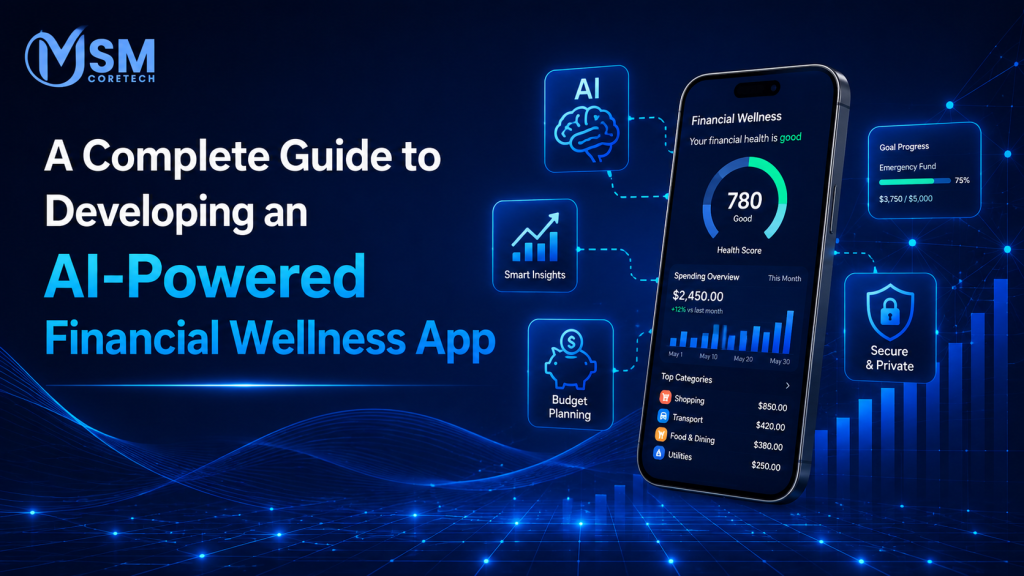
Managing money can sometimes feel difficult, especially when expenses keep going up and financial goals become harder to achieve. An AI-powered financial wellness app can make money management easier by turning daily financial data into simple and helpful advice. Instead of checking and managing everything manually, users can get support with budgeting, saving, spending, and financial planning in one place.
Financial wellness apps are becoming more useful as people want simple ways to manage their money and improve their financial health. According to Bank of America’s 2025 study, 72% of Gen Z adults took steps to improve their financial health, such as saving money and paying off debt. Another Bank of America study found that 66% of workers experience financial stress. This shows that there is a growing need for easy-to-use tools that can help people manage their money better.
An AI-powered financial wellness app uses smart technology to understand a user’s income, spending, savings, and money goals. It can track spending habits, help create a practical budget, remind users about bills, and share useful saving tips. An AI assistant can also answer common money questions in a simple and easy-to-understand way.
For businesses, these apps can open new ways to earn money through subscriptions, premium features, financial partnerships, and personalized services. For users, the main benefits are convenience, better understanding of their finances, smarter money decisions, and a clearer way to reach their financial goals.
What Is Financial Wellness App Development?
Financial wellness app development means creating a mobile or web app that helps people manage their money in an easy and organized way. These apps keep important money-related tasks in one place, so users can easily see where their money goes and make better financial choices.
A financial wellness app can help users track their income and expenses, create budgets, set saving goals, manage bills, check spending habits, and get useful money tips. When AI is added, the app can become even more helpful. It can understand a user’s spending habits and give personal suggestions, such as how to reduce unnecessary spending or how much money to save each month.
The main goal is not only to show financial information but also to help users feel more confident about managing their money. With a simple design, strong security, smart AI features, and reliable financial integrations, businesses can work with a fintech app development company to create an app that makes everyday money management easier and more useful.
Also Read: Cost to Build A FinTech App Like Revolut
Why Build an AI-Powered Financial Wellness App?
Managing money can sometimes feel difficult. People have to handle bills, daily spending, savings goals, and unexpected expenses. An AI-powered financial wellness app can make this easier by bringing useful money tools and simple guidance into one place.
Growing Demand for Digital Financial Management
Today, more people use mobile apps to check their spending, create budgets, pay bills, and track their savings. A financial wellness app gives users a simple and quick way to manage their money. It can help them keep track of their finances without using spreadsheets or dealing with complicated tools.
Personalized Financial Guidance
Everyone has different income, expenses, and money goals. AI can understand a user’s spending habits and give advice based on their needs. For example, it can suggest how much money to save or where they can cut down on spending.
Better Budgeting and Saving Habits
The app can track expenses automatically and sort them into different categories. It can help users make simple and realistic budgets. The app can also send friendly reminders and useful saving tips to help users build better money habits.
Real-Time Financial Insights
AI can turn financial data into simple and easy-to-understand information. Users can quickly see where they are spending their money, find unusual spending, and check how close they are to reaching their financial goals.
Opportunities for Fintech Businesses
For businesses, AI financial wellness apps can open new ways to make money. They can earn through subscriptions, premium features, financial partnerships, and personalized services. With a good idea and the right features, an AI financial wellness app can become a useful and scalable fintech product.
How Does an AI-Powered Financial Wellness App Work?
An AI-powered financial wellness app works like a smart money helper. It helps users understand how they spend their money, build good financial habits, and reach their money goals. It makes managing money simple and less stressful.
User Registration and Financial Profile Setup
First, users create an account and add some basic financial information, such as their income, monthly expenses, savings goals, and spending habits. The app uses this information to understand the user’s financial situation and provide more useful guidance.
Connecting Bank Accounts and Financial Data
Users can safely connect their bank accounts, cards, and other financial services to the app. The app collects important transaction details, such as payments, deposits, and regular bills. This helps users view all their financial information in one place.
AI Analyzes Spending and Income Patterns
The AI looks at the user’s financial activity to find useful patterns. For example, it can show where the user spends the most money, identify regular expenses, and notice changes in monthly income. Working with an experienced ai development company can help businesses add these smart features to their apps easily and effectively
Personalized Recommendations
Using the collected data, the app can give users simple and useful suggestions. It may suggest a suitable budget, show where they can save money, or provide tips to help them reach their financial goals faster.
Continuous Tracking and Improvement
The app keeps track of the user’s financial activity and updates its suggestions when their spending habits change. Over time, users get more useful and relevant insights, helping them make smarter money decisions every day.
Also Read: Top 10 FinTech APIs for Every Startup
Step-by-Step Process to Build an AI Financial Wellness App
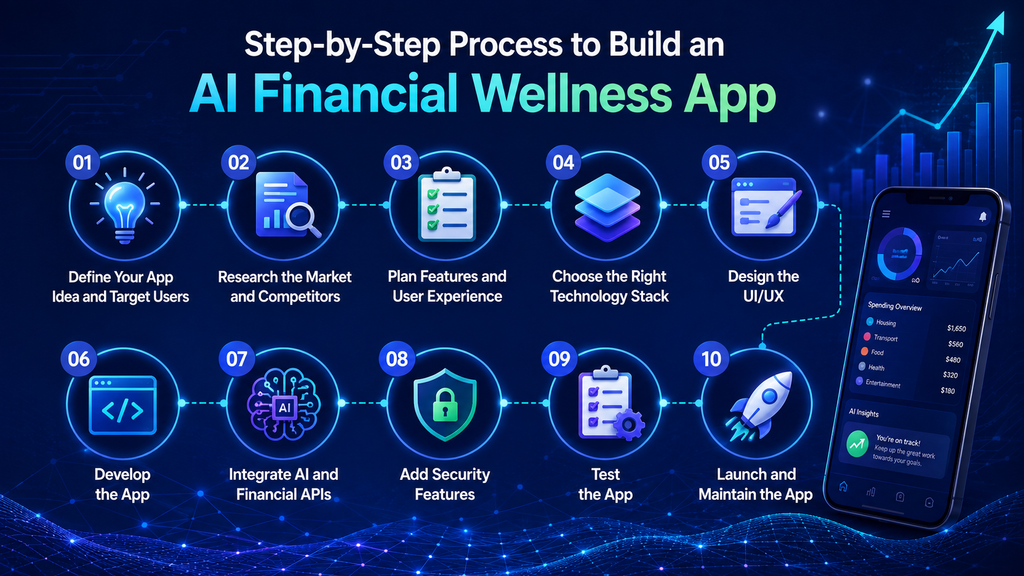
Building an AI-powered financial wellness app is more than just adding a few smart features. First, you need to understand what your users need, plan the right features, choose the right technology, and keep security as a top priority. A simple and clear app development process can help you create an app that is useful, easy to use, and ready to grow.
Step 1: Define Your App Idea and Target Users
First, decide what your app will help people do. Your app may help users track their expenses, make budgets, save money, manage bills, or reach their financial goals.
Next, decide who will use your app. For example, you can build it for students, young professionals, families, or small business owners.
Knowing your target users will help you understand their needs and choose the right features for your app.
Step 2: Research the Market and Competitors
Before you start development, research other financial wellness apps. Check their features, prices, design, user reviews, and common problems. This will help you understand what users like and what they do not like. You can use this information to find a simple way to make your app different, better, and more useful.
Step 3: Plan Features and User Experience
Make a list of features based on what your users need. Some important features can include expense tracking, budgeting, savings goals, financial reports, bill reminders, AI suggestions, and an AI financial assistant. Keep the first version simple and easy to use. A well-planned MVP can help you test your app idea before adding more advanced features.
Step 4: Choose the Right Technology Stack
Choose technology that can support your app as it grows. Flutter or React Native can help you build apps for different platforms. Node.js or Python can be used for the backend. PostgreSQL, MySQL, or MongoDB can store and manage financial data. If you want to add AI features, Python and machine learning tools can help understand user behavior and make useful predictions.
Step 5: Design the UI/UX
A financial app should be simple and easy to use. Users should be able to quickly check their spending, savings, and financial goals without feeling confused by too many numbers. Use clean screens, simple menus, easy-to-understand charts, and clear reports. The app should also work smoothly on different screen sizes.
Step 6: Develop the App
Now, the development team can start building the app. Developers create the app design, backend, database, APIs, and main features. It is better to build the most important features first and then improve the app step by step. Getting regular feedback during development can help find and fix problems early.
Step 7: Integrate AI and Financial APIs
AI can make the app more useful by understanding how users spend their money. It can give personal tips based on their spending habits. For example, it can alert users when they are spending more than usual or suggest ways to reach their savings goals. Financial APIs can connect the app with bank accounts, payment services, and other financial data sources.
Step 8: Add Security Features
Financial apps deal with private and sensitive user information, so security is very important. Use data encryption, secure login, multi-factor authentication, token-based security, and safe API connections. Follow the required financial and data privacy rules to protect user information and build trust.
Step 9: Test the App
Before launching the app, test all important features carefully. Check the login, payments, bank connections, AI recommendations, notifications, reports, and data security. Test the app on different devices and under different network conditions. Testing with real users can also help find small problems that developers may miss.
Step 10: Launch and Maintain the App
After testing is complete, launch the app on the platforms you need. However, the work does not end after launch. Keep checking the app’s performance, collect user feedback, fix bugs, update security, and improve the AI models over time. Adding useful features based on what users need can help your financial wellness app stay useful, fresh, and competitive.
Also Read: Top 10 FinTech Startup Ideas
Technology Stack for an AI-Powered Financial Wellness App
Choosing the right technology is an important step when building a reliable financial wellness app. The right tools help your app manage user data, AI features, bank connections, and daily transactions without problems. Here is a simple look at the main technologies you can use.
| Technology Area | Common Technologies | Main Use |
|---|---|---|
| Frontend | Flutter, React Native, Swift, Kotlin | Builds the app users see and use |
| Backend | Node.js, Python, Java | Handles app logic and server requests |
| Database | PostgreSQL, MySQL, MongoDB | Stores user and financial data |
| AI/ML | TensorFlow, PyTorch, Python | Powers smart insights and predictions |
| Cloud | AWS, Google Cloud, Microsoft Azure | Provides secure hosting and storage |
| APIs | Banking, payment, credit score, financial APIs | Connects the app with financial services |
Frontend: Flutter, React Native, Swift, Kotlin
The frontend is the part of the app that users see and use every day. Flutter and React Native are good choices for building apps for both Android and iOS without writing the same code twice. Swift is mainly used for iOS apps, while Kotlin is a popular choice for Android apps. The best option depends on your budget, app needs, and target users.
Backend: Node.js, Python, Java
The backend works in the background and handles important app tasks. It manages user accounts, transactions, notifications, financial calculations, and requests from the app. Node.js is a good choice for fast and real-time apps. Python works well when the app needs AI and data processing. Java is also a strong option for large and secure financial systems.
Database: PostgreSQL, MySQL, MongoDB
A financial wellness app stores a lot of data, such as user profiles, spending records, financial goals, and reports. PostgreSQL and MySQL are good choices for managing organized financial data. MongoDB is useful when the app needs to store flexible types of data.
AI/ML: TensorFlow, PyTorch, Python
AI can make a financial wellness app smarter and more useful. TensorFlow, PyTorch, and Python can be used for spending analysis, smart recommendations, financial predictions, and AI-powered assistants.
Cloud: AWS, Google Cloud, Microsoft Azure
Cloud platforms provide the space needed to run and grow your app. AWS, Google Cloud, and Microsoft Azure can help with data storage, databases, security, backups, and handling more users as your app grows.
APIs
Banking, payment, credit score, and financial data APIs help your app connect with other financial services. These connections make it easier to get transaction details, process payments, and show updated financial information.
A well-balanced technology stack can help you build an app that is fast, secure, smart, and ready to grow.
How Much Does It Cost to Build an AI-Powered Financial Wellness App?
The app development cost of an AI-powered financial wellness app depends on its features, design, AI capabilities, security needs, and the number of platforms you want to support. A simple app with basic money-tracking features will cost less. However, a more advanced app with AI predictions, bank connections, and detailed financial analytics will need more time, effort, and development work.
| App Type | Estimated Cost | Development Time |
|---|---|---|
| Basic Financial Wellness App | $15,000-$30,000 | 3–4 months |
| Medium-Level AI Financial App | $30,000-$40,000 | 5–7 months |
| Advanced AI Financial Platform | $40,000-$75,000+ | 8–12+ months |
Basic Financial Wellness App
A basic financial wellness app is a good option for startups that want to launch their app quickly. It can include features like user registration, expense tracking, simple budgeting, savings goals, notifications, and basic financial reports. AI features can be simple, such as spending insights and rule-based suggestions.
The development cost can range from $15,000 to $30,000. The final cost depends on factors like the app design, platform, integrations, and development team.
Medium-Level AI Financial App
A medium-level AI financial app offers smarter tools to help users manage their money better. It can include AI-based spending analysis, personalized budget tips, financial goal tracking, bank account integration, an AI chatbot, and spending alerts.
This type of app can cost around $30,000 to $40,000. The cost may increase if you add advanced AI models, third-party APIs, or stronger security features.
Advanced AI-Powered Financial Platform
An advanced financial wellness platform is built for businesses that need a powerful and scalable solution. It can offer features like AI-based financial advice, future financial predictions, smart saving suggestions, fraud detection, investment insights, real-time data analysis, multiple bank connections, and personalized recommendations.
The development cost can start from around $40,000 and may go above $75,000, depending on the features, complexity, and overall project requirements.
Also Read: What Is FinTech? A Complete Guide
Factors Affecting Development Cost
Several things can affect the total cost of developing an app:
- Features: Adding more features means more development time, which can increase the cost.
- AI complexity: Advanced AI features need more development, testing, and time.
- Platform: Building the app for both iOS and Android can cost more than developing for one platform.
- API integrations: Connecting banking, payment, credit score, and other APIs adds extra development work.
- Security: Financial apps need strong security, encryption, user authentication, and data protection.
- UI/UX design: A custom and well-designed app can require more time and increase the budget.
- Maintenance: Regular updates, bug fixes, cloud services, and AI improvements create ongoing costs.
Starting with an MVP (Minimum Viable Product) can be a smart way to manage your initial investment. After users start using the app, you can use their feedback to add more AI features and improve the app.
Key Features of an AI-Powered Financial Wellness App
An AI-powered financial wellness app should do more than just show account balances. It should help users understand their money, create better money habits, save for their goals, and make smarter financial choices. AI can make the app more useful by learning about users’ spending habits and giving them helpful tips at the right time. Here are some important features to include when building a modern financial wellness app.
1. User Registration and Profile
The app should make signing up quick and easy. Users can create an account using their email, phone number, or social media account. After signing up, they can create a simple financial profile by adding details like their income, regular expenses, savings goals, and financial preferences.
This information helps the AI understand each user better. Instead of giving everyone the same financial advice, the app can provide useful suggestions based on each person’s needs, spending habits, and financial goals.
2. Budget and Expense Tracking
Budget tracking is a very important feature of a financial wellness app. Users should be able to set a monthly budget and easily track how they spend their money.
The app can automatically sort expenses into simple categories like food, shopping, travel, bills, and entertainment. Easy charts and summaries can show users if they are staying within their budget.
The app can also send alerts when users are close to their spending limit. This helps them control small expenses before they turn into bigger problems.
3. AI-Powered Financial Insights
AI can turn your basic financial data into simple and useful information. The app can look at your income, expenses, savings, and spending habits to show you what is happening with your money.
For example, the app may tell you that you are spending more on food than you did in previous months. It can also show areas where your spending has increased more than usual.
These insights should be explained in simple words, so users can easily understand their finances without needing any financial knowledge.
4. Personalized Budget Recommendations
Everyone has different financial needs, so the same budget may not work for everyone. AI can look at a user’s income, expenses, and financial goals to suggest a budget that fits their needs.
For example, if a user wants to save money for a vacation, the app can suggest how much they can save each month after covering their regular expenses.
Users should always have the option to change or reject these suggestions. AI should help users make better financial decisions, not make important decisions for them.
5. Smart Saving Suggestions
Saving money can be hard when users do not know where to begin. An AI-powered app can make saving easier by giving small and useful suggestions.
The app can find areas where users may be able to spend less and suggest simple ways to save money. It can also suggest a regular savings amount based on the user’s goals and available money.
For example, if a user spends less than planned in one category, the app can suggest putting some of that extra money toward a savings goal.
6. AI Financial Assistant
An AI financial assistant gives users an easy way to ask money-related questions inside the app. For example, users can ask, “How much did I spend this month?” or “How can I reduce my shopping expenses?”
The assistant can use the user’s financial information to give helpful answers in simple, everyday language.
It can also help users find useful features in the app, such as budgets, savings goals, and spending reports. However, it should clearly explain its limits and should not give uncertain information as professional financial advice.
Also Read: FinTech App Design Guide for Beginners
7. Bill and Payment Reminders
Missing a bill can cause late fees and extra stress. A financial wellness app can help users stay on top of their payments by reminding them about upcoming bills.
Users can add regular bills such as rent, electricity, internet, subscriptions, loan payments, and insurance. The app can send reminders before each payment is due.
AI can make these reminders even smarter by learning the user’s payment habits and pointing out bills that may need attention soon.
8. Credit Score Monitoring
Credit information can help users understand their financial health. If the app works with trusted credit-data providers, it can show credit score updates and important changes.
The app can also explain the simple factors that may affect a credit score, such as making payments on time, credit usage, and unpaid balances.
Instead of using difficult financial words, the app should explain credit information in a simple and easy-to-understand way. This helps users understand their credit habits and make better financial decisions.
9. Notifications and Alerts
Smart notifications help users stay updated without sending too many alerts. The app can notify users about budget limits, upcoming bills, unusual transactions, savings milestones, and important account changes.
AI can make these notifications more helpful by showing users the information that is most important to them.
Users should also be able to control their notification settings. They can choose which alerts they want to receive and how often they want to get them.
AI Technologies Used in Financial Wellness Apps
AI is making financial wellness apps smarter and more helpful. These apps do more than just show users their income and expenses. They can understand spending habits, predict future financial needs, and provide simple suggestions. Here are some important AI technologies used in financial wellness apps.
Machine Learning for Spending Analysis
Machine learning helps the app understand how users spend their money. It looks at transactions and puts them into categories such as food, shopping, travel, bills, and entertainment.
As users continue to use the app, the system learns more about their spending habits. It can also identify when users are spending more than usual in a particular area. This helps users better understand their daily spending and manage their money more easily.
Natural Language Processing for AI Assistants
Natural Language Processing (NLP) helps users talk to the app in simple, everyday language. For example, a user can ask, “How much did I spend on food this month?” or “Can I save $500 in three months?” The AI assistant can understand these questions and give quick answers. This makes managing personal money easier and more natural.
Predictive Analytics for Financial Forecasting
Predictive analytics uses past financial data to predict what may happen in the future. For example, the app can check a user’s past spending and income to estimate upcoming expenses. It can also alert users if they may run out of money before their next payday. These early warnings help users plan their money better and avoid financial problems later.
Recommendation Systems for Personalized Advice
Everyone has a different financial situation, so the same advice may not work for everyone. AI recommendation systems can look at a user’s income, expenses, financial goals, and spending habits. Based on this information, the app can give more useful and personal suggestions. For example, it may suggest spending less in a specific category, saving more money, or setting a monthly budget that is easy to follow.
Fraud and Unusual-Activity Detection
AI can also help protect users and their money. It can check transactions and find unusual activity, such as a large payment, a transaction from an unknown location, or a sudden change in spending habits. If the AI finds something that looks suspicious, the app can quickly send an alert. This allows users to check the transaction and take action if needed.
AI-Powered Financial Goal Predictions
AI can help users set realistic money goals and understand how long it may take to reach them. Whether they want to save for a vacation, build an emergency fund, buy a car, or purchase a home, the app can look at their income and spending habits. Based on this information, it can suggest how much they should save regularly and show their progress over time.
With these AI technologies, a financial wellness app can do more than just track money. It can work like a smart financial companion that helps users understand their finances, make better money decisions, and build healthy financial habits.
Also Read: Cost to Develop a Fintech App Like Wise
Monetization Models
An AI-powered financial wellness app can earn money in different ways. The right option depends on your users, app features, and business goals.
| Monetization Model | How It Works |
|---|---|
| Freemium | Free basic tools with paid premium features |
| Subscription | Users pay monthly or yearly |
| Partner Commissions | Earn money when users sign up for partner services |
| Product Referrals | Earn fees by referring financial products |
| Employer Plans | Businesses pay for employee access |
- Freemium Model: Keep basic features like expense tracking, budgeting, and simple financial tips free. Users can pay for advanced AI insights, detailed reports, and premium tools.
- Monthly or Yearly Subscriptions: Users can pay every month or year to use features such as personalized financial plans, AI coaching, investment insights, or credit monitoring. Yearly plans can also help keep users for a longer time.
- Partner Commissions: Work with banks, insurance companies, investment platforms, and other financial service providers. When users sign up for a partner service through your app, you can earn a commission.
- Financial Product Referrals: Suggest financial products based on what users need. For example, you can recommend a savings account, credit card, or insurance plan and earn a referral fee.
- Business or Employer Plans: Companies can offer the app to their employees as a financial wellness benefit. Businesses can pay a monthly or yearly fee based on the number of employees using the app.
Challenges in Building an AI Financial Wellness App
| Challenge | Simple Solution |
|---|---|
| Financial data security | Encryption and MFA |
| AI accuracy | Quality data and regular testing |
| API integration | Reliable API architecture |
| Regulations | Follow local financial rules |
| User trust | Clear privacy and AI explanations |
| App performance | Cloud scaling and monitoring |
Building an AI-powered financial wellness app can be a good business idea, but it also has some challenges. Since the app deals with users’ personal money information, keeping this data safe is very important. Strong encryption, secure login, multi-factor authentication, and safe API connections can help protect user data.
Another challenge is making sure the AI gives accurate advice. The app may suggest budgets, saving plans, or changes in spending habits. If the advice is wrong, it could affect a user’s financial decisions. To avoid this, AI models should use trusted data and be tested regularly.
Connecting different financial APIs can be challenging. Banking, payment, credit score, and transaction APIs may all use different rules and formats. A well-planned backend can help connect these APIs smoothly.
The app must also follow financial regulations and privacy rules. These rules can be different in each country, so businesses should work with legal and compliance experts to make sure the app follows the right requirements.
Building user trust is also very important. The app should clearly explain how user data is collected and used. Avoid using confusing financial terms and keep the information simple. The app should also work reliably, with fast loading, stable servers, and regular updates.
Also Read: How Much Does It Cost To Build A Fintech App
Future Trends in AI Financial Wellness Apps
AI is making financial wellness apps smarter, easier, and more helpful. In the future, these apps will do more than just track expenses. They will work like a helpful money partner that understands users’ spending habits and financial goals.
AI-powered financial coaching will become more common. Users will get simple, real-time help with budgeting, saving money, controlling spending, and reaching their goals. They will not need to understand difficult financial terms.
Predictive money management will help users understand what could happen with their money next. AI can study income and spending habits and warn users about possible cash shortages or extra spending.
Voice-based financial assistants will make money management even easier. Users can ask simple questions like, “How much did I spend this month?” and get quick answers.
Hyper-personalized recommendations will provide advice based on each user’s income, spending habits, goals, and lifestyle. This means users will get tips that fit their own needs.
Automated savings will help users save money with less effort. The app can move a suitable amount into savings based on the user’s financial situation.
AI-powered fraud detection will also become stronger. AI can find unusual transactions and quickly warn users about possible fraud or security risks.
Finally, open banking integration will let users securely connect different financial accounts. This will give them a clearer view of all their money in one place.
Why MSM CoreTech Is the Right Partner for Your AI-Powered Financial Wellness App Development
Building an AI-powered financial wellness app needs more than just good coding. You also need knowledge of finance, AI, security, and what users want from a money management app. MSM CoreTech is a trusted mobile app development company that helps businesses turn their ideas into simple, useful, and reliable financial apps.
Our team can build features like AI financial assistants, smart budgeting, expense tracking, saving tips, financial goals, spending insights, and personalized recommendations. We make these features simple and easy to use, so users can better understand and manage their money without feeling confused.
Security is an important part of financial app development. We use secure login methods, data encryption, protected APIs, and other security measures to help keep sensitive financial information safe.
We know that every business has different needs. Whether you want to start with a simple MVP or build a feature-rich financial wellness platform, we can help you choose the right technology, features, and development plan.
From UI/UX design and AI integration to testing, launch, and ongoing support, MSM Coretech can manage the complete development process. Our goal is to build a financial wellness app that is easy to use, works smoothly, and can grow with your business.
Conclusion
Building an AI-powered financial wellness app can help users manage their money in a simpler and smarter way. From expense tracking and budgeting to saving goals, financial insights, AI assistants, and fraud detection, these apps can make everyday money management easier. AI can also provide personalized suggestions based on each user’s spending habits and financial goals.
However, creating a successful financial wellness app requires careful planning, strong security, reliable financial integrations, and a user-friendly design. Starting with an MVP can be a practical way to test the idea, understand user needs, and add advanced features over time.
With the right technology, AI features, and development approach, businesses can build a secure and scalable financial wellness platform. MSM CoreTech can help turn your idea into a simple, useful, and growth-ready app, from UI/UX design and AI integration to testing, launch, and ongoing support.
FAQs
An AI-powered financial wellness app helps users manage their money by tracking income and expenses, creating budgets, setting savings goals, monitoring bills, and providing personalized financial insights using AI.
Key features include expense and budget tracking, AI-powered financial insights, personalized budget recommendations, smart saving suggestions, an AI financial assistant, bill reminders, credit score monitoring, notifications, and fraud detection.
AI can analyze spending and income patterns, provide personalized recommendations, predict future financial needs, identify unusual transactions, and help users create realistic savings and budgeting plans.
According to the blog, a basic financial wellness app can cost around $15,000-$30,000, a medium-level AI financial app around $30,000-$40,000, and an advanced AI financial platform around $40,000-$75,000+. The actual cost depends on features, AI complexity, platforms, integrations, security, and UI/UX requirements.
The development process includes defining the app idea and target users, researching competitors, planning features, choosing the technology stack, designing the UI/UX, developing the app, integrating AI and financial APIs, adding security, testing, and finally launching and maintaining the app.

Related Posts

Top Benefits Of Medicine Delivery Apps In Healthcare 2026
Buying medicine used to mean the same thing everywhere: get in the car, wait in line at the pharmacy counter,...
Read More

How to Build a Health Insurance App: Features, Cost & Development Guide
More and more people are managing their health cover from their phones instead of standing in queues or calling a...
Read More

E-wallet App Development: Types, Features & Development Process
Imagine paying a bill, sending money to a friend, or shopping online without using cash or a card. This easy...
Read More


 Verified Review




 +44 7427829444
 71-75, Shelton Street, Covent Garden, London, United Kingdom, WC2H 9JQ