

Share this article


How Technology Is Shaping Modern Dating Applications
The way people find romantic partners has changed in ways that felt impossible to imagine just a decade ago. What once relied on chance encounters, mutual friends, or personal ads has shifted almost entirely to the palm. In 2026, dating applications are no longer passive directories of profiles. They are intelligent, adaptive platforms powered by real-time data, machine learning, and behavioral science, driving the growing demand for Dating app development services.
The numbers tell a clear story. According to a 2026 report by Our Culture Mag, Hinge’s AI-powered recommendation engine drove a 15% increase in matches and contact exchanges after its late 2025 launch, a result that Match Group CFO Steve Bailey described as “huge” for real revenue and user impact.
That single statistic captures something much larger happening across the entire industry. Technology is no longer being used to add features on top of dating apps. It is being used to rebuild the very foundation of how two people are brought together online. This shift has significantly increased interest in Dating app development services, as businesses aim to create smarter, more personalized platforms. This blog breaks down exactly how that transformation is unfolding in 2026 and what it means for users, developers, and anyone trying to understand the future of human connection.
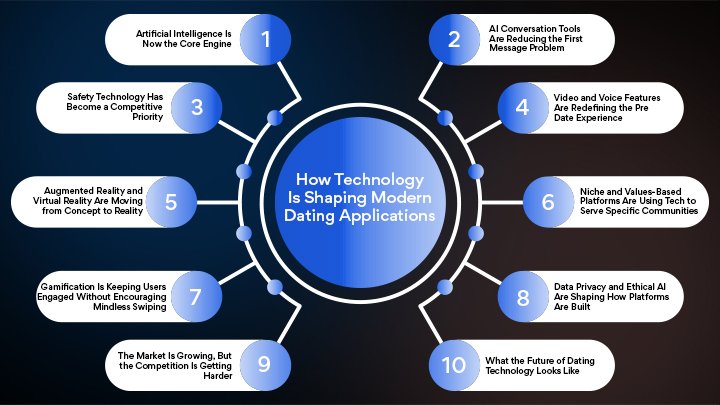
1. Artificial Intelligence Is Now the Core Engine
Artificial intelligence has moved from being a buzzword in app store descriptions to the actual infrastructure running modern dating platforms. The most significant shift in 2026 is that platforms are using AI not just to filter profiles but to understand relationship compatibility at a behavioral level.
Hinge tracks how users interact with each other over time, including which conversations fizzle and which ones lead to real dates, and feeds all of that back into the matching model. The result is an algorithm that gets more accurate the longer someone uses the platform. Tinder, under Match Group, committed $60 million toward a product overhaul that includes a feature called Chemistry, which pairs users based on behavioral signals rather than surface-level profile data.
Bumble has gone even further. Rather than adding AI tools onto its existing app, the company is rebuilding its entire platform from the ground up as a cloud-native, AI-first system scheduled to launch around mid-2026. This signals something important: older app architectures were not built for the kind of machine learning these companies now consider essential.
For users, the practical experience of AI-driven matching is a visible reduction in irrelevant profiles and a noticeable increase in conversations that actually go somewhere. For developers, building these systems requires rethinking how dating apps are structured at the database and recommendation-engine level.
Also Read: AI In Dating Apps: Impact, Use Cases, and More
2. AI Conversation Tools Are Reducing the First-Message Problem
One of the most overlooked friction points in online dating has always been the opening message. A match notification arrives, and many users stare at it with no idea what to say. Platforms are now using AI to solve this directly.
Hinge introduced a feature called Convo Starters that generates personalized opening lines based on what a potential match has written in their profile. The company’s research found that 72% of users are more likely to respond when a message is included alongside a match notification. Rather than leaving users to figure it out alone, the app gives them a drafted line they can send as written or edit before sending.
Grindr is testing an AI tool internally referred to as a digital wingman. Currently in beta with around 10,000 users, the tool can draft responses, help identify promising matches, and suggest how to move a conversation forward. Unlike many AI assistants, it is designed to handle frank discussions about intimacy while staying within appropriate educational limits.
These tools reflect a practical recognition that the emotional barrier to starting conversations is one of the biggest reasons matches go nowhere. Reducing that barrier through technology has a measurable effect on engagement, as the data from Hinge’s rollout confirms.
Also Read: Top 10 Dating Apps in the USA
3. Safety Technology Has Become a Competitive Priority
Trust has always been a limiting factor in online dating. Fake profiles, catfishing, and bad actors have consistently driven users away from platforms that cannot adequately protect them. In 2026, safety features will no longer be optional additions. They are central to whether a platform can retain users at all.
Tinder launched a verification feature called FaceCheck that requires users to take a real-time selfie and compares it against their profile photos using facial recognition. The company reported that this feature produced a measurable reduction in interactions with accounts flagged as potentially harmful. For users who have previously encountered deceptive profiles, this kind of verification removes a significant source of anxiety.
Beyond identity verification, platforms are deploying automated content moderation that reviews messages and images before users even receive them. This moves the safety layer upstream, so potentially harmful content is screened before it creates a negative experience rather than after a complaint is filed.
Pew Research data shows that 60% of dating app users support background checks as a platform feature. When that demand exists at that scale, investing in safety technology is not just an ethical choice. It is a business decision that directly affects subscriber retention.

Get a Free Quote: Hire Dating App Developer
4. Video and Voice Features Are Redefining the Pre-Date Experience
Text-based conversation has clear limits as a way to assess whether two people will actually get along in person. Video and voice features have entered dating apps in a meaningful way, and their adoption has accelerated significantly since the pandemic normalized remote interaction.
Modern dating platforms now offer short intro videos on profiles, in-app live streaming, and the ability to conduct full video dates without ever sharing a personal phone number. By 2024, 40% of dating app users had already tried video dates, and that number has grown as the feature became more polished and widely available across major platforms.
Voice features are also gaining traction. Several platforms now allow voice notes and voice-based profile introductions. Researchers note that hearing someone’s voice provides far more information about personality and emotional tone than reading a typed message ever could. Some platforms have even begun exploring AI-powered voice analysis to factor communication style into compatibility assessments.
The practical benefit for users is significant. A five-minute video call before agreeing to meet in person filters out a large percentage of mismatches that would otherwise result in wasted time and uncomfortable situations. Platforms that have implemented video well are seeing better match-to-date conversion rates than those relying on text alone.
Also Read: Top Tech Stack for Dating App Development
5. Augmented Reality and Virtual Reality Are Moving from Concept to Reality
Augmented reality (AR) and virtual reality (VR) are no longer theoretical features on a product roadmap. In 2026, some dating platforms are running immersive virtual environments where users can go on simulated coffee dates, attend virtual concerts together, or walk through shared digital spaces before deciding whether to meet in person.
The appeal is straightforward. Shared experiences tend to create connections faster than profile browsing. When two people do something together, even in a virtual setting, they have material to talk about and a reference point for what they might enjoy doing in person. This shifts the dating app experience from reviewing a stranger’s curated self-presentation to actually spending time with them in a low-stakes context.
AR features also show up in more immediate and practical ways. Profile filters that use AR to add context, gamified interactions that respond to facial expressions, and location-aware AR overlays that let users see potential matches nearby are all active in various apps. These features tend to attract younger users who already live inside AR-adjacent experiences on platforms like Snapchat and Instagram.
6. Niche and Values-Based Platforms Are Using Tech to Serve Specific Communities
The mass-market dating app model assumes that a large pool of users is inherently better than a smaller one. But user behavior is telling a different story. People are increasingly drawn to platforms built around shared values, lifestyles, or identities, and technology has made it economically viable to build and sustain those communities.
Niche dating apps now exist for fitness enthusiasts, professionals in specific industries, users who prioritize shared religious beliefs, people with particular dietary choices, and dozens of other categories. What technology enables in these platforms is precision. Because the user base shares baseline characteristics, the matching algorithm has a more meaningful set of variables to work with from the start.
An interesting data point from 2026: one in three people now use dating apps for professional or career-related networking, according to a Resume Builder survey of over 2,000 users. Platforms like Bumble and Tinder are seeing a secondary use case emerge where people treat matches as professional contacts. This was not a designed feature. It is user behavior being identified through data and gradually being accommodated through updated profile and filtering options.
Also Read: Dating App Revenue and Usage Statistics
7. Gamification Is Keeping Users Engaged Without Encouraging Mindless Swiping
One of the core criticisms of first-generation dating apps was that swipe mechanics created addictive, game-like behavior that had nothing to do with finding a real partner. Users spent more time swiping than connecting. Platforms are now redesigning gamification to serve connection rather than undermine it.
In 2026, gamification in dating apps looks quite different from the binary left-right swipe. Compatibility quizzes prompt users to reveal preferences in a low-pressure format. Daily challenges encourage users to respond to specific prompts or share a new piece of information about themselves. Reward systems acknowledge consistent users with visibility boosts or exclusive features rather than just pushing them to swipe more.
Tinder’s Double Date feature is a useful example of technology-enabled social interaction, redesigning the way matches work. The feature lets two users match as a pair with another pair, turning what was a solo browsing experience into a shared social activity. Tinder’s data shows that 85% of Double Date users are under 30, and women are nearly three times more likely to engage in the feature than in traditional one-on-one matching.
8. Data Privacy and Ethical AI Are Shaping How Platforms Are Built
The more sophisticated dating apps become at collecting and analyzing personal data, the more important privacy and ethical design become. Users in 2026 are more aware of what they give up when they use these platforms, and that awareness is affecting which apps they trust.
Platforms are responding by offering clearer controls over what data is used in matching, providing transparency about how AI recommendations are generated, and allowing users to opt out of certain forms of data collection. Some apps now let users see an explanation of why a particular match was suggested, which reduces the sense that an invisible algorithm is making decisions on their behalf.
The tension here is real. Better AI requires more data. But users who feel surveilled or manipulated disengage. The platforms that will win long-term are those that can collect enough information to deliver genuinely useful results while giving users enough control and transparency that they remain comfortable with the arrangement.
Also Read: Top 10 Features to Include in Your Dating App Development
9. The Market Is Growing, But the Competition Is Getting Harder
The global dating application market was valued at $11.61 billion in 2025 and is projected to reach $12.52 billion in 2026. Long-term forecasts are even more striking, with Straits Research projecting the market to hit $19.33 billion by 2033. That growth is largely being driven by the integration of AI and more sophisticated user experience design.
But growth at the market level does not mean every player is growing. Tinder’s paying subscribers fell 8% year over year in Q4 2025. Bumble lost 16% of its paying users over the same period. These are major brands with hundreds of millions in annual revenue, and both are declining in their most important business metric.
Meanwhile, Hinge grew revenue by 38% year over year to reach $550 million in 2024, and it is on track to hit $1 billion by 2027. The difference is not luck. Hinge invested earlier and more seriously in behavioral matching, profile depth, and AI-driven recommendation than its competitors. The market is rewarding that investment directly.
For anyone building in this space, the message from the numbers is consistent. Technology investment that improves real user outcomes drives growth. Technology investment that optimizes for engagement metrics without improving those outcomes does not.
10. What the Future of Dating Technology Looks Like
Looking at where the industry is going in the next three to five years, several directions are becoming clear. AI will continue to move from a supporting role to the central architecture of every major platform. Matching will become less about who you say you want and more about behavioral pattern recognition that identifies who you are actually compatible with.
For businesses planning to enter this growing market, partnering with a reliable dating app development company in USA can help implement these advanced technologies and create a future-ready platform.
Hybrid experiences will grow. The line between online and in-person dating will continue to blur. Apps will increasingly facilitate real-world events, group activities, and structured dates rather than simply providing a list of profiles to browse. Tinder’s Double Date is an early version of this direction. Expect far more sophisticated social coordination features to follow.
AI coaching will become a standard feature. As Hinge’s CEO noted before stepping down, the future involves apps functioning more like personalized matchmaking services than social platforms. That means guiding users on how to present themselves, what to say, and how to build toward a real relationship, not just manage a list of matches.
Safety verification will expand. As facial recognition, document verification, and behavioral analysis become cheaper and more accurate, identity verification will shift from an optional premium feature to a baseline expectation on serious relationship-focused platforms.

Also Read: How Much Does Dating App Development Cost in the USA?
Conclusion
Dating applications in 2026 are a direct reflection of how far technology has come in understanding human behavior. AI-powered matching, real-time safety screening, video and voice integration, AR-based interactions, and values-based filtering have collectively moved these platforms far beyond anything that resembled a simple profile directory.
The platforms that are winning are the ones that have chosen to use technology in the service of real connection rather than in service of screen time. That distinction is simple to state and genuinely difficult to execute, but the data from 2025 and 2026 makes it clear that users can tell the difference and are rewarding the platforms that get it right.
At MSM Coretech Innovations, we build technology that solves real problems. Understanding how modern applications are designed around user behavior, data intelligence, and experience quality is central to everything we do. If you are building in the digital product space and want to think through what these trends mean for your platform, we would be glad to talk.
FAQ
AI improves dating matches by analyzing real user behavior—like profile interactions, conversations, and outcomes—instead of just stated preferences. It continuously learns from this data to refine recommendations over time. As a result, users get fewer but more relevant and meaningful matches instead of endless scrolling.
Dating apps are now safer with features like facial verification, AI content filtering, and behavior tracking to detect scams or harassment. Many platforms use identity checks to improve trust. However, users should still stay cautious, meet in public, and report suspicious activity.
Dating apps have become safer with AI-powered features like facial verification, content filtering, and behavior analysis to detect scams and harmful activity. These technologies significantly reduce risks and improve user trust. However, they are not foolproof, so users should still exercise caution, meet in public places, and report anything suspicious.
When building a dating app in 2026, the focus should be on improving real user outcomes rather than just increasing engagement. Strong data privacy and safety features must be built in from the beginning, as users are more aware of how their data is used. Additionally, investing in accurate matching systems and making foundational improvements when needed can lead to better long-term success.

Related Posts

How to Start an Online Handyman Business? A Complete Guide
Home services have quietly become one of the busiest corners of the on-demand economy. People no longer want to flip...
Read More
Top Music Streaming App Trends To Follow In 2026
Music streaming has changed how people find, share, and listen to their favorite songs. Today, listeners want more than just...
Read More

Top Benefits Of Medicine Delivery Apps In Healthcare 2026
Buying medicine used to mean the same thing everywhere: get in the car, wait in line at the pharmacy counter,...
Read More


 Verified Review




 +44 7427829444
 71-75, Shelton Street, Covent Garden, London, United Kingdom, WC2H 9JQ