

Share this article


Top 7 Home Services App Development Companies in 2026
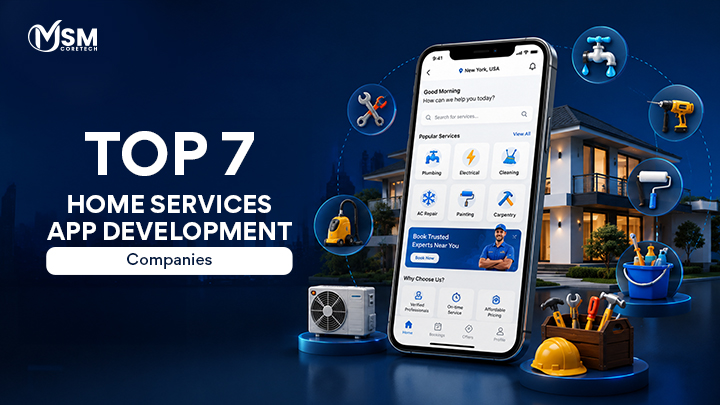
If you’ve ever booked a plumber, an electrician, or a house cleaner from your phone, you already know why home service apps are everywhere right now. What used to mean flipping through a phone book or asking a neighbor for a recommendation is now a two-minute job done from the couch. And this shift is not small. The global home services market is expected to grow from $424.86 billion in 2025 to $463.93 billion in 2026, growing at a strong 9.2% rate, according to Research and Markets. In the US alone, the home service market is worth close to $842.04 billion in 2026, based on data from Mordor Intelligence.
Numbers like these explain why so many entrepreneurs, startups, and even long-running service businesses are racing to build their own apps right now, not five years from now. But here is the truth: building a good home service app is not a one-person job, and it is definitely not something you want to hand off to just any generic development shop. You need a team that understands both the technology and the industry it is building for. That is exactly where home service app development companies come in. In this article, we will walk through 7 of the best ones to know in 2026, what makes each one stand out, and why putting your money into this space actually makes sense right now.

Also Read: Develop a Profitable Home Service App
How These Companies Compare
Here is a quick side-by-side look at all 7 home service app development companies covered above, so you can compare them at a glance before digging deeper into any one of them.
| Company | Best Known For | Ideal For | Approx. Team Size |
|---|---|---|---|
| Appinventiv | Scalable, feature-rich platforms with AI integration | Large, ambitious marketplace apps | 1200+ |
| MSM Coretech | Full-stack builds (app, web, software) tailored to specific service models | Startups and businesses wanting one team for everything | 100+ |
| Yalantis | Engineering-first architecture for high-volume marketplaces | Apps expecting rapid scale and complex logistics | 400+ |
| Intellectsoft | IoT and smart home integration | Apps connecting to smart home devices | 300+ |
| Fueled | Design-led development and product strategy | Founders prioritizing UX and market positioning | 150+ |
| Simform | Dedicated teams and cloud infrastructure | Long-term partnerships and staged growth | 1000+ |
| Hyperlink InfoSystem | Budget-friendly, fast, feature-complete builds | Startups testing an MVP before scaling | 600+ |
Why Invest in Home Service App Development?
Before we go further down the list, it is worth pausing on a simple question: why is everyone suddenly building home service apps? The answer comes down to a mix of changing habits and real business opportunity. Here’s a simple breakdown of the reasons:
Convenience
Dual-income households make up a large share of homes worldwide, and nobody has time to call around for quotes or wait at home all day for a technician. An app that lets someone book, compare prices, and track arrival time solves a real daily problem.
Steady market growth
As the numbers in the introduction show, this is not a short-term spike. It is being driven by aging housing stock that needs regular repairs, rising smart home adoption, and more households renovating instead of moving because of higher mortgage rates.
New revenue streams
Subscription plans for recurring services like lawn care or pest control create predictable monthly income. In-app advertising, premium listings, and commission-based booking fees add extra layers of income on top.
Better data
Every booking, cancellation, and review tells you something about customer behavior, peak demand times, and which services are most profitable, letting business owners make informed decisions instead of guessing.
Stronger customer loyalty
Push notifications for maintenance reminders, loyalty rewards, and smooth rebooking keep customers coming back instead of shopping around for a new provider every time.
Put simply, the businesses that get in early with a well-built app are the ones positioning themselves to capture a larger share of a market that is not slowing down anytime soon. The technology cost upfront is small compared to the recurring revenue, customer loyalty, and operational efficiency it can unlock over the following years.
Also Read: Cost to Develop a Home Service App like TaskRabbit
Top 7 Home Services App Development Companies
1. Appinventiv
Appinventiv is one of the names that keeps coming up whenever people talk about on-demand app development, and home service apps are very much part of that conversation. The company has built a reputation for handling complex, feature-heavy apps for clients across industries like healthcare, logistics, fintech, and yes, home services. What makes them a solid pick is their focus on scalability. A home service app rarely stays small for long. It starts with bookings and payments, but soon you want live tracking, in-app chat, subscription plans, and maybe even AI-based service matching. Appinventiv builds with that growth in mind from day one, so you are not stuck rebuilding your app from scratch a year later.
Here’s what makes them stand out:
- Scalable architecture: built to handle growth from a few hundred users to millions without a rebuild
- Native and cross-platform development: flexibility depending on your budget and timeline
- Strong UI/UX focus: booking flows simple enough to finish in under a minute
- Real-time backend systems: live technician tracking, status alerts, instant updates
- AI and machine learning: smart scheduling, nearest-provider matching, predictive suggestions
- Best suited for: funded startups or established businesses ready for a full-scale platform, since pricing sits on the higher end
If you are looking for a company that can handle a big, ambitious home service platform and has the engineering depth to back it up, Appinventiv is worth a serious look. Just keep in mind that their pricing sits on the higher end compared to smaller agencies, which makes sense given the scale of projects they typically take on. This makes them a better fit for a funded startup or an established business ready to build a full-scale platform, rather than someone testing an early idea on a shoestring budget.
2. MSM Coretech
MSM Coretech is a trusted home service app development company that has quietly become one of the go-to names for businesses building home service platforms. What sets MSM Coretech apart is that they do not treat every app the same way. A cleaning service app has different needs than a handyman marketplace, and a handyman marketplace is different again from an all-in-one home maintenance platform. MSM Coretech spends real time understanding the specific service model before writing a single line of code, which saves clients from the common trap of ending up with a generic app that does not actually fit their business.
Here’s what makes them stand out:
- Full-stack development: mobile app, web platform, and backend software all from one team, so there’s no juggling separate vendors
- Tailored builds: the app is shaped around the actual service model instead of a generic template
- Admin and management tools: dashboards, payment systems, and provider management built in from the start
- Two-sided attention: job scheduling, earnings tracking, in-app navigation, and rating systems built with the same care for providers as for customers
- Flexible pricing: enterprise-level quality without an enterprise-level budget
- Startup and enterprise experience: works with both first-time founders and established businesses digitizing their operations
- Responsive post-launch support: a team that stays involved after the app goes live
MSM Coretech has a track record of working with startups as well as established home service businesses that are digitizing their operations for the first time. Their flexible pricing and full-stack approach make them a practical choice for founders who want enterprise-level quality without an enterprise-level budget, which is exactly why they keep showing up on shortlists for home service app development.
3. Yalantis
Yalantis has built a strong name in the on-demand and marketplace app space, and home services is one of their core areas of focus. What stands out about Yalantis is their engineering-first approach. Rather than jumping straight into design, they spend significant time on system architecture, especially for apps that need to handle high volumes of simultaneous bookings, real-time provider matching, and payment processing without hiccups.
Here’s what makes them stand out:
- Engineering-first approach: heavy focus on system architecture before design begins
- Marketplace experience: background in building two-sided platforms similar in structure to ride-hailing apps
- Logistics and route optimization: useful if your app involves multiple providers covering different zones
- Clean, minimal design: fewer steps needed to complete a booking
- Future-ready builds: designed with later integrations in mind, like IoT-enabled smart home devices
- Transparent communication: clear project management throughout development
- Worth knowing: timelines can run a little longer because of the emphasis on upfront planning, but it tends to pay off with fewer post-launch issues
For businesses that want a technically robust, scalable platform and are willing to invest in solid groundwork before launch, Yalantis is a strong contender. Their timelines can run a bit longer than some competitors, but for a founder who has been burned before by a rushed, buggy launch, that upfront patience usually pays off later.
4. Intellectsoft
Intellectsoft has carved out a niche for itself by combining software engineering with a genuine understanding of emerging technology, and that combination shows up clearly in their home service app projects. They are particularly known for integrating IoT and smart home technology into service apps, which is a growing demand area as more homes adopt connected devices like smart thermostats, security systems, and appliances that occasionally need professional installation or repair.
Here’s what makes them stand out:
- IoT and smart home integration: a real strength as more homes adopt connected devices
- Full-lifecycle discovery process: maps the entire service journey before development starts, reducing gaps at launch
- Strong admin panels and analytics: dashboards for monitoring provider performance, revenue, and disputes
- Security-first development: data protection built in from the start, important given how much sensitive information home service apps handle
- Subscription-friendly builds: apps that support recurring maintenance plans, not just one-off bookings
- Best suited for: businesses that want a partner comfortable working at the intersection of software and connected hardware
Their development process usually starts with a discovery phase that maps out the entire service journey, from how a customer discovers the app to how a technician closes out a job and gets paid. That attention to the full lifecycle means fewer gaps once the app goes live, which is exactly the kind of thoroughness a smart home-focused platform needs.
5. Fueled
Fueled has built its reputation primarily on design-led development, and that reputation holds up well in the home services space where user experience can make or break adoption. Their team places heavy emphasis on how an app feels to use, not just how it functions, which translates directly into higher completion rates for bookings and fewer abandoned carts at the payment stage.
Here’s what makes them stand out:
- Design-led development: strong focus on how the app feels to use, not just how it works
- Strategic product input: helps shape positioning and differentiation, not just the build itself
- Polished onboarding and loyalty features: interfaces that feel more like consumer lifestyle apps than plain booking tools
- Native and cross-platform builds: flexibility on tech stack depending on project needs
- Third-party integrations: payment gateways, mapping APIs, and identity verification tools for provider background checks
- Post-launch growth support: app store optimization and analytics setup included
- Best suited for: founders who see design quality and market positioning as top priorities
Fueled tends to work closely with founders during the early strategy phase, helping shape not just the app but the overall product direction, including how to stand out from established players already in the market. This kind of strategic input is valuable for newer companies entering a crowded space, since a technically solid app still needs a clear reason for people to choose it over the competition.
6. Simform
Simform rounds out this list with a reputation built on flexible engagement models and strong technical execution, particularly for companies that want a long-term development partner rather than a one-time project vendor. They work extensively with dedicated development teams, meaning a client gets a consistent group of developers who understand the product deeply over months or years.
Here’s what makes them stand out:
- Dedicated development teams: consistent developers over time instead of a rotating cast per phase
- Operational tooling: dispatch systems, provider onboarding flows, and reporting dashboards, not just the customer-facing app
- Cloud infrastructure expertise: built to handle more users, more data, and tighter uptime as the app scales
- Staged, pragmatic approach: a stable core product first, advanced features like AI recommendations layered in later
- Strong QA and testing: lowers the risk of bugs slipping into a live app processing real payments
- Best suited for: businesses that want a steady, dependable long-term partner with room to scale
Simform’s approach tends to be pragmatic rather than flashy. They focus on building a stable, well-tested product first, then layering on advanced features like AI-based recommendations once the core platform is proven. This staged approach is a smart move for businesses that want to launch quickly and validate demand before investing heavily in extra bells and whistles.
7. Hyperlink InfoSystem
Closing out the list is Hyperlink InfoSystem, a company known for handling a high volume of app development projects across many industries, including a substantial number in home services. Their scale actually works in their favor here, since it means they have likely already solved many of the common technical challenges that come up when building a booking and service marketplace app.
Here’s what makes them stand out:
- High project volume: likely already solved common home service app challenges like cancellations, refunds, and scheduling conflicts
- Budget-friendly packages: functional, well-built apps without a massive upfront investment
- Complete feature sets: service browsing, booking and scheduling, in-app payments, push notifications, rating systems, and an admin panel
- Native and hybrid options: choice between top performance or faster, more cost-effective builds
- Responsive communication: frequently mentioned as a strength by past clients
- Best suited for: businesses testing a home service concept in one city before expanding further
For businesses that are earlier in their journey, perhaps testing a home service concept in one city before expanding, Hyperlink InfoSystem offers a practical path to getting a working app in front of real users without overcommitting resources upfront.
Also Read: Cost to Develop a Home Service App like Thumbtack
Common Features to Look For in a Home Service App
Before comparing companies side by side, it helps to know what a solid home service app should actually include. Whichever company you go with, make sure these basics are covered:
- Easy service browsing and search: customers should be able to find the right service category in a couple of taps, without digging through menus
- Real-time booking and scheduling: instant confirmation, available time slots, and the option to reschedule without calling anyone
- Live provider tracking: similar to a food delivery app, showing exactly when the technician is on the way
- Secure in-app payments: card, wallet, and sometimes cash-on-completion options, all processed safely
- Ratings and reviews: for both customers rating providers and, in many models, providers rating customers
- Push notifications: reminders for upcoming bookings, maintenance schedules, and promotional offers
- Provider verification and background checks: a non-negotiable feature for trust, since providers are entering people’s homes
- Admin dashboard: for the business owner to manage bookings, payouts, disputes, and overall performance from one place
- In-app chat or calling: so customers and providers can communicate directly about job details without sharing personal numbers
A good development partner will not just tick these boxes; they will help you think through which extra features actually make sense for your specific service model, instead of just copying whatever a competitor already has.
Also Read: AI in Handyman Apps
How to Choose the Right Development Partner?
Looking at a list like this is helpful, but it still leaves the real question unanswered: how do you actually pick one? A few things are worth checking before you sign any contract.
- Check their portfolio: look specifically for home service experience, not just general app development work. A company might be excellent at building fitness apps or fintech products, but home service apps have their own quirks, two-sided marketplaces, location tracking, provider verification, dispute handling, that only show up once a team has built a few of these apps. Ask to see real examples and, if possible, talk to a past client.
- Ask about post-launch support: an app is never really “done” at launch. Bugs show up, features need tweaking based on real user behavior, and you will almost certainly want to add things you did not think of at first, like a loyalty program or a subscription tier. A development partner who disappears after handover leaves you stuck when something breaks.
- Think investment, not expense: the cheapest option is rarely the smartest choice for the core product your business will run on. Paying slightly more for a team that builds it right the first time is usually cheaper than patching a poorly built app later on.
- Watch how they communicate: if getting clear answers feels like pulling teeth during the sales process, that is a preview of what working together will feel like once the project is underway.
- Look for genuine interest: the best home service app development company is one that combines technical skill with real curiosity about your specific business model, not one that hands you the same pitch it gives every other client.

Also Read: Top 10 Handyman Apps
Conclusion
Home service apps are not a passing trend. They are becoming the standard way people book plumbers, cleaners, electricians, and just about every other household service, and the market numbers back that up clearly. If you are thinking about building one, the company you choose to build it with matters just as much as the idea itself. Each name on this list brings something different to the table, whether that is Appinventiv’s scalability, MSM Coretech’s full-stack, tailored approach, Yalantis’s engineering depth, Intellectsoft’s smart home expertise, Fueled’s design focus, Simform’s long-term partnership model, or Hyperlink InfoSystem’s budget-friendly speed.
The right pick really depends on your budget, your timeline, and how big you plan to grow. What matters most is picking a team that understands home services as an industry, not just app development as a generic skill. Take the time to talk to a few of these companies, ask about their past home service projects, and see who genuinely gets what you are trying to build. Get that part right, and the technology side of your home service business will be in solid hands heading into 2026 and beyond.
FAQs
If you’re working with a tighter budget, Hyperlink InfoSystem or MSM Coretech are solid picks. Both offer flexible pricing without cutting corners on essential features, which makes them a good fit for founders testing an idea before scaling up.
Costs vary a lot depending on features, platforms, and the company you choose, ranging anywhere from a lean MVP build to a full-scale, AI-powered platform. It’s best to get a custom quote after sharing your specific requirements with a shortlisted company.
A basic version with core booking features can take a few months, while a more advanced app with live tracking, payments, and admin tools takes longer. Companies with a staged approach, like Simform, often help you launch a working version faster and add features afterward.
Native apps generally offer better performance and a smoother experience but usually cost more. Cross-platform apps are quicker and cheaper to build, which makes them a practical option if you want to launch and test demand before investing further.
At a minimum, you need service browsing, real-time booking, secure payments, provider tracking, and an admin dashboard. Ratings, reviews, and push notifications aren’t strictly required but make a big difference in customer trust and repeat bookings.

Related Posts

10 Key Applications of AI in the Food Industry (2026)
Walk into any restaurant kitchen, grocery warehouse, or food delivery control room today, and you will find something quietly running...
Read More
How To Develop An App Like YouTube Music: A Complete Guide
Music is now a part of our everyday life. People listen to songs while getting ready in the morning, working,...
Read More
Must-Have Features in Fintech Apps & Digital Financial Platforms
Think about how often you use your phone to pay bills, send money, shop online, or check your bank balance....
Read More


 Verified Review




 +44 7427829444
 71-75, Shelton Street, Covent Garden, London, United Kingdom, WC2H 9JQ