

Share this article


How to Start an On-Demand Home Services Business and Develop an App?
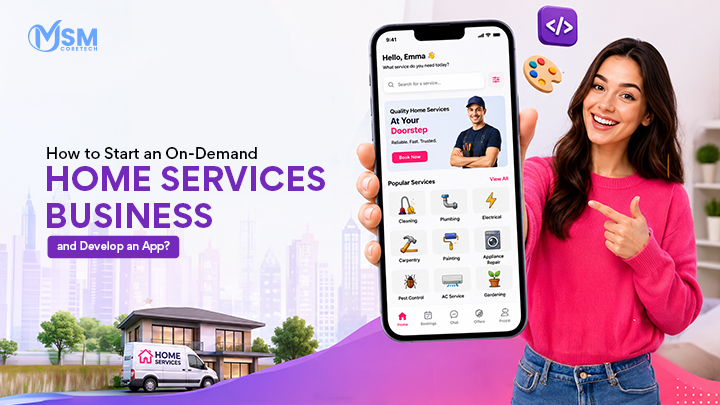
Your kitchen tap starts leaking on a Sunday evening, or your air conditioner gives up right before summer hits its peak. A few years ago, you would have flipped through a local directory or asked a neighbour for a “good guy” who fixes these things. Today, you just open an app, tap a few buttons, and a verified professional shows up at your doorstep within the hour. This shift from word-of-mouth referrals to instant, app-based booking is exactly why the home services industry has turned into one of the most exciting spaces for entrepreneurs right now.
People are busier than ever, households have less free time, and everyone wants convenience without compromising on quality or trust. That’s the gap on-demand platforms fill. If you have been thinking about how to start an on-demand home services business, or you already run a local services company and want to take it online, this guide walks you through everything in plain, simple language. We will cover the business side first, and then get into how to develop a home service app that actually works for your customers, your service providers, and your bottom line.
Also Read: Steps to Develop a Profitable Home Service App
What Is an On-Demand Home Services Business?
An on-demand home services business is a company that connects customers who need household work done with skilled professionals who can do that work, usually through a mobile app or website. Think plumbing, electrical repairs, home cleaning, appliance servicing, pest control, painting, carpentry, salon and spa services at home, moving and packing, gardening, and even handyman jobs for small fixes around the house. The word “on-demand” simply means the customer doesn’t have to wait days for a callback or visit a shop. They open the app, describe what they need, pick a time slot (or ask for immediate service), and the platform matches them with an available, verified provider nearby.
There are usually three sides to this kind of business. First, the customer, who wants a quick, reliable, and fairly priced solution. Second, the service provider, who could be an individual professional or a small team registered on your platform and looking for steady work. Third, you, the platform owner, who builds the trust layer between the two sides: verification, scheduling, payments, reviews, and support. You are not necessarily doing the plumbing or the cleaning yourself. You are building and running the system that makes it easy, safe, and fast for the other two sides to work together.
This model has already proven itself with platforms like Urban Company, TaskRabbit, Thumbtack, Handy, and Angi, each of which took a traditionally offline, unorganised sector and gave it structure through technology. The good news for new entrepreneurs is that the home services space is still fairly fragmented in most cities and countries. There is no single platform that has captured the entire market, which means there is real room for a well-run, locally focused, or niche-focused business to succeed.
Also Read: AI in Handyman Apps
Why the On-Demand Home Services Industry Is Booming
Before you put in the time and money to start an on-demand home services business, it helps to know the numbers behind the opportunity. According to The Business Research Company, the global online on-demand home services market was valued at around $5.92 billion in 2025 and is expected to reach $6.79 billion in 2026, growing at a compound annual growth rate of roughly 14.8 percent, with projections putting it near $11.78 billion by 2030. Separately, Technavio’s home services market research points to the broader home services category expanding by more than a trillion dollars in value between 2026 and 2030, at a steady annual growth rate above 11 percent.
What’s driving all this? A few very human reasons. People are working longer hours and simply have less time to fix things themselves or hunt for a reliable technician. Urban households, especially dual-income families, are outsourcing more of their domestic tasks than any previous generation. Smartphone usage keeps climbing, even in smaller towns, so more people are comfortable booking services from an app instead of calling around. And after the pandemic, customers became far more used to digital-first, low-contact ways of getting things done at home, a habit that has stuck.
How to Start an On-Demand Home Services Business: Step by Step
Starting a business in this space isn’t just about hiring a app developer and launching an app. The strongest platforms are built on solid groundwork first. Here is a practical, step-by-step approach to help you start an on-demand home services business the right way.
1. Pick Your Niche and Service Categories
You don’t have to offer every single home service on day one. In fact, most successful platforms start narrow and expand later. Decide whether you want to be a broad marketplace covering cleaning, repairs, and beauty services, or a focused platform around one category, such as only appliance repair, or only home cleaning. A narrower focus is usually easier to manage in the beginning because you can build deeper expertise, better vetting processes, and a stronger reputation in that one area before branching out.
2. Study Your Local Market and Competition
Spend real time understanding who else is already operating in your target city or region, what they charge, what customers complain about in their reviews, and where the gaps are. Talk to a few local service professionals directly and ask what frustrates them about existing platforms, things like unfair commission cuts, delayed payouts, or unclear job details. Talk to potential customers too. This research will shape your pricing, your onboarding process, and the features you eventually build into your app.
3. Decide on Your Business and Revenue Model
There are a few common ways on-demand home service businesses make money, and you can mix more than one. A commission model takes a percentage of every booking from the service provider’s earnings. A subscription model charges customers a monthly or yearly fee for unlimited or discounted bookings. A lead-generation model charges providers a small fee simply to receive a customer’s contact details, similar to how Thumbtack operates. There’s also advertising and featured listing revenue, where providers pay extra to appear higher in search results. We will go deeper into these later in this guide, but deciding early helps you plan your pricing and your app’s payment logic correctly.
4. Recruit and Vet Your Service Providers
Your platform is only as good as the professionals on it. Before you even launch, start building a base of verified service providers in your city. Set up a clear vetting process: identity verification, background checks where applicable, proof of skill or certification, and even a short trial period or training session so providers understand your quality standards. Providers who feel supported and fairly paid are far more likely to stay loyal to your platform instead of jumping to a competitor, so treat this recruitment phase as seriously as you treat customer acquisition.
5. Register Your Business and Handle the Legal Basics
Depending on your country and city, you may need specific licenses to operate a services marketplace, especially if you are handling payments, insurance, or categories like electrical and plumbing work that have safety regulations attached. Register your company, set up a business bank account, draft clear terms of service and provider agreements, and look into liability insurance that protects you if something goes wrong during a service visit. This step is easy to postpone, but skipping it can create serious problems once you start scaling.
6. Plan Your Go-to-Market and Launch Strategy
Decide which city or neighbourhood you will launch in first. Most successful on-demand platforms deliberately start hyperlocal, focusing all their marketing and provider onboarding energy on one small area until bookings are consistent, and only then expanding to the next city. Plan a launch offer, perhaps discounted first bookings or zero commission for early providers, to create initial momentum on both sides of the marketplace at once. A platform with plenty of customers but no providers, or plenty of providers but no customers, will struggle either way, so your launch plan needs to build both sides together.
7. Build, Test, and Launch Your App
This is where your technology comes in, and it’s detailed enough that it deserves its own sections below. In short, once your business plan, provider base, and go-to-market strategy are ready, you need a reliable technology partner to actually develop a home service app that brings all of this together for your customers and providers.
Also Read: Handyman App Features
Why You Need an App for Your Home Services Business
You might wonder whether a website, a phone number, or even a WhatsApp-based booking system is enough to get started. For a very small, single-city operation, it might work temporarily. But an app is what allows your business to actually scale and compete. Here’s why it matters so much.
An app gives customers instant access to book a service anytime, without waiting for someone to answer a call or reply to a message. It builds trust through visible provider profiles, ratings, past reviews, and real-time tracking of the professional heading to their home, similar to what people are used to with ride-hailing apps. It also removes a lot of manual, error-prone work from your side: manual scheduling, manual payment collection, and manual matching of customers to available providers can all be automated once you have the right app.
For your service providers, an app means they get job notifications instantly, can accept or decline based on their availability, track their earnings, and get paid without chasing anyone for cash. For you as the business owner, the app becomes a data engine. You can see which services are booked most often, which areas have high demand but few providers, which providers get the best reviews, and where customers are dropping off before completing a booking. None of this visibility is possible with a purely manual, phone-call-based operation. In short, if you’re serious about this business, you need to develop a home service app, not just as a nice-to-have, but as the actual backbone of how your business runs.
Also Read: Cost to Develop a Home Service App like Thumbtack
How to Develop a Home Service App: Step-by-Step Process
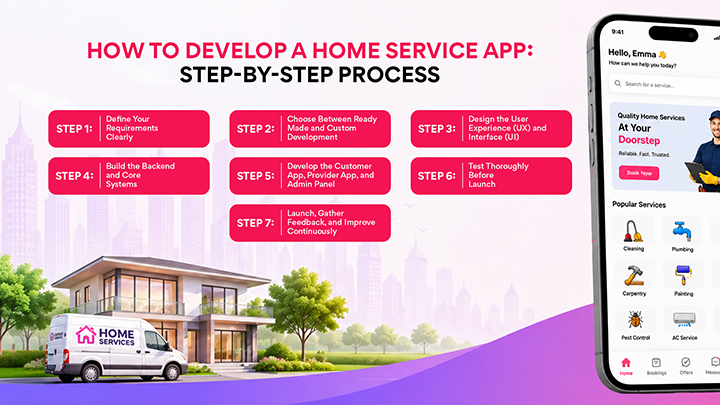
Once your business plan is in place, the next question is how to actually develop a home service app that works smoothly for everyone involved. Here’s a realistic, step-by-step of the app process.
Step 1: Define Your Requirements Clearly
Before any coding starts, write down exactly what your app needs to do. Who are your users (customers, service providers, and admins)? What services will be listed? Will customers book instantly or schedule for later? Will you support multiple cities from day one or just one? Will payments happen inside the app or in cash after the service? The clearer you are here, the smoother the rest of the development process will be, and the less expensive rework you’ll need later.
Step 2: Choose Between Ready-Made and Custom Development
You generally have two paths. One is a ready-made, white-label solution, an existing app framework that gets customised with your branding and basic settings. This is faster and cheaper, and works well if your business model closely matches standard on-demand marketplaces. The other path is custom development, where the app is built from scratch around your exact workflows, unique features, and long-term scaling plans. Custom development takes more time and a bigger budget, but it gives you full ownership, more flexibility, and no dependency on someone else’s software licence. Most businesses that plan to grow seriously, or that have a specific twist on the standard model, are better off working with a dedicated home service app development company that builds a custom solution.
Step 3: Design the User Experience (UX) and Interface (UI)
A home services app needs to feel effortless, especially because your users range from tech-savvy young professionals to older customers who might not be as comfortable with apps. Good design means a simple booking flow (ideally three to four taps from opening the app to confirming a booking), clear service categories with recognisable icons, upfront and honest pricing, and a clean provider profile page that builds confidence. On the provider side, the app needs a clear job dashboard, easy accept and reject actions, and a simple way to check earnings. Spend real time on wireframes and prototypes before writing a single line of code, since fixing design mistakes after development is far more expensive.
Step 4: Build the Backend and Core Systems
The backend is the engine running behind the scenes: user accounts, provider matching logic, booking management, payment processing, notifications, and the admin panel that lets you manage the whole platform. This is also where you set up your database, your APIs for maps and location tracking, your payment gateway integration, and your security layer to protect customer and payment data. This part of development is invisible to users but is what makes everything else actually work reliably at scale.
Step 5: Develop the Customer App, Provider App, and Admin Panel
Most home service platforms are actually built as three connected products: an app for customers to browse and book services, a separate app (or dashboard) for service providers to manage jobs and earnings, and a web-based admin panel for you and your team to oversee bookings, resolve disputes, manage payouts, and track overall business performance. Building these as three coordinated pieces, rather than cramming everything into one interface, keeps the experience clean for each type of user.
Step 6: Test Thoroughly Before Launch
Testing isn’t just about checking whether buttons work. You need to test the entire booking journey end to end, including edge cases like a provider cancelling last minute, a payment failing midway, poor network conditions, and multiple customers booking the same time slot. Test on different phone models and operating system versions, since your customers won’t all be using the latest devices. A rushed testing phase is one of the most common reasons on-demand apps get poor reviews right after launch, so don’t skip it.
Step 7: Launch, Gather Feedback, and Improve Continuously
Once live, treat your first few months as an active learning period. Watch how real customers and providers actually use the app, not just how you assumed they would. Collect feedback through in-app prompts, support tickets, and direct conversations with your early providers. Use this to prioritise your next set of updates. On-demand apps are never really “finished”; the best ones keep evolving based on real usage data and changing customer expectations.

Also Read: Top 10 Handyman Apps
Must-Have Features in a Home Service App
The features you build directly shape how smoothly your business runs day to day. Here’s a breakdown of what each side of your platform typically needs.
Features for Customers
- Easy sign-up and login through phone number, email, or social accounts
- Browsable service categories with clear descriptions and transparent pricing
- Instant booking as well as scheduled booking for a future date and time
- Real-time tracking of the assigned service provider, similar to a ride-hailing app
- In-app chat or call masking to communicate with the provider without sharing personal numbers
- Multiple payment options, including cards, digital wallets, and cash on completion
- Ratings, reviews, and the ability to rebook a preferred provider
- Booking history and digital invoices for every completed service
- Push notifications for booking confirmations, provider arrival, and offers
Features for Service Providers
- Simple onboarding with document upload for verification
- A live job dashboard showing new requests, accepted jobs, and job history
- Availability and schedule management so providers control their own working hours
- Navigation support to reach the customer’s location
- Earnings dashboard with clear breakdowns of commission, payouts, and pending balances
- In-app support for raising issues or disputes about a specific job
Features for the Admin Panel
- A central dashboard to monitor live bookings, revenue, and platform activity
- Provider verification and approval workflows
- Service and category management, including pricing rules by city or region
- Dispute resolution tools and customer support ticketing
- Payout management for service providers
- Analytics and reporting on bookings, cancellations, popular services, and demand by area
Also Read: Top AI Trends
Advanced Features Worth Considering
Once your core app is stable, a few advanced additions can set you apart from competitors. AI-powered service recommendations can suggest the right professional based on a customer’s past bookings and preferences. Automated, AI-driven price estimation can give customers an upfront quote based on job description and photos before a provider even visits. Subscription plans can offer discounted recurring services, like monthly home cleaning. And loyalty or referral programs can turn happy customers into a genuine acquisition channel, reducing how much you spend on advertising over time.
Technology Stack for Home Service App Development
The right technology choices affect your app’s performance, cost, and how easily it can scale later. While your development partner will make the final calls based on your specific requirements, here’s a general idea of what typically goes into a home service app.
Frontend (What Users See)
For mobile apps, common choices include native development with Swift for iOS and Kotlin for Android, or cross-platform frameworks like Flutter or React Native, which let you build one codebase that runs on both platforms, saving time and cost. Cross-platform development is especially popular for early-stage on-demand businesses because it gets you to market faster without doubling your development effort.
Backend (What Runs Behind the Scenes)
Backend development is often built with Node.js, Python (with frameworks like Django), or Java, paired with databases like PostgreSQL or MongoDB to store user, booking, and provider data securely. Cloud hosting through providers like AWS, Google Cloud, or Microsoft Azure gives you the flexibility to scale server capacity up or down as your booking volume grows.
Essential Integrations
A functioning home service app also needs a location and mapping API (Google Maps is the most common choice) for provider tracking and navigation, a payment gateway suited to your target market (such as Stripe, Razorpay, or PayPal, depending on your region), SMS and push notification services for real-time alerts, and cloud storage for provider documents and service photos. Getting these integrations right the first time saves a lot of rework down the line.
Cost to Develop a Home Service App
| App Tier | Key Features | Estimated Cost |
|---|---|---|
| Basic (MVP) | Core booking, payments, basic provider management | $8,000 – $20,000 |
| Mid-Range | Real-time tracking, in-app chat, multiple payment options, polished admin panel | $20,000 – $45,000 |
| Advanced/Custom | AI-based recommendations, multi-city support, advanced analytics, native customer + provider apps | $45,000 |
This is usually the first question every founder asks, and the honest answer is: it depends. The cost to develop an app of home service varies based on the complexity of features, the number of apps you need (customer app, provider app, admin panel), the platforms you target (iOS, Android, or both), the design quality, and which region or agency you hire.
As a rough guide, a basic version with core booking, payment, and provider management features usually costs somewhere in the range of $8,000 to $20,000.
A mid-range app with real-time tracking, in-app chat, multiple payment options, and a polished admin panel typically falls between $20,000 and $45,000. A fully custom, feature-rich platform with AI-based recommendations, multi-city support, advanced analytics, and both provider and customer apps built natively can go anywhere from $45,000 upward, sometimes well beyond that for larger, multi-country platforms.
A few factors that push the cost up include supporting multiple languages and currencies from launch, building native apps separately for iOS and Android instead of using a cross-platform framework, adding AI-powered matching or pricing, and requiring heavy customisation of the admin panel for complex business rules.
Also Read: Cost to Develop an App like Letgo
Revenue Models for On-Demand Home Service Apps
Once your app is live, you need a clear, sustainable way to make money from it. Most platforms use one or a combination of the following models.
Commission-Based Model
This is the most widely used approach. Every time a provider completes a booking through your app, you take a percentage cut, typically somewhere between 10 and 30 percent, depending on the service category and local market norms. It’s simple to understand and directly ties your revenue to actual platform activity, which keeps your incentives aligned with growing bookings.
Subscription Model
Here, customers pay a recurring fee (monthly or yearly) for benefits like discounted service rates, priority booking, or a set number of free services included in their plan. This model works particularly well for recurring needs like home cleaning or lawn care, and it gives your business predictable, recurring revenue instead of relying only on one-off transactions.
Lead-Generation Model
Instead of taking a cut from every completed job, you charge service providers a small fee just to access a customer’s request and contact details. This shifts more of the completion risk to the provider but can work well in categories where jobs are large and infrequent, like home renovation, where a single lead can be worth a lot to a provider.
Advertising and Featured Listings
Providers can pay extra to appear higher in search results or get a “featured” badge on their profile, similar to sponsored listings on e-commerce platforms. This works best once you already have a decent volume of providers competing for visibility, so it’s usually introduced after your platform has some traction rather than on day one.
Many successful platforms actually combine two of these models, for example commission plus subscription, to build a more resilient revenue base that doesn’t depend entirely on booking volume alone.
Common Challenges and How to Overcome Them
No on-demand business grows without hitting a few roadblocks. Knowing these in advance helps you plan around them instead of being caught off guard.
Maintaining Service Quality
Once you’re not the one doing the actual work, quality control becomes an ongoing effort. Build a strong vetting process at onboarding, keep a visible ratings and review system, and set up a process to quickly address, or remove consistently poor-performing providers before they damage your platform’s reputation.
Provider Retention
Providers who feel like just another number, with delayed payouts or unclear commission structures, will leave for a competing platform. Transparent, timely payments and genuinely listening to provider feedback go a long way toward keeping your best professionals loyal.
Trust and Safety
Since providers are entering customers’ homes, safety concerns are real and valid. Background verification, in-app emergency support, secure payments that don’t require cash handling if customers prefer, and clear accountability if something goes wrong are all necessary, not optional, parts of building a trustworthy platform.
Managing Cash Flow and Commission Disputes
Disputes over commission cuts or delayed payments are common complaints against on-demand platforms. Automating payout schedules and making commission structures fully transparent inside the provider app, rather than buried in fine print, prevents a lot of avoidable friction and support tickets.
Also Read: Cost to Build a Music Streaming App Like Shazam
Marketing Strategies to Grow Your On-Demand Home Services Business
Building a great app is only half the job. Without a steady flow of customers and providers, even the best-designed platform will sit quiet. Here are a few marketing approaches that consistently work for on-demand home services businesses in their first year.
Hyperlocal Digital Marketing
Since your service is inherently local, general national advertising rarely gives good returns early on. Instead, run geo-targeted ads on Google and social media focused on the specific neighbourhoods or cities you’re live in. Local SEO also matters a lot here, so make sure your business shows up when someone nearby searches for things like “home cleaning near me” or “plumber today.”
Referral and Loyalty Programs
Word-of-mouth is still one of the strongest drivers in this industry, simply because people trust recommendations from friends and family more than ads. Offer a small discount or wallet credit to both the referrer and the new customer, and consider a similar incentive for providers who refer other skilled professionals to join your platform.
Partnerships with Local Businesses
Real estate agencies, property management companies, and even hardware or furniture stores often deal with customers who need home services regularly. Setting up simple referral partnerships with these businesses can bring in a steady stream of new customers without heavy ad spend.
Content and Trust-Building
Publishing simple, helpful content, like maintenance tips, seasonal home-care checklists, or pricing guides, builds credibility and improves your visibility in search results over time. Pair this with genuine customer testimonials and before-and-after photos from completed jobs to reinforce trust with new visitors who haven’t booked with you yet.
App Store Optimisation
Since your app is the main entry point for customers, invest time in your app store listing too, clear screenshots, an honest description, and encouraging happy customers to leave a rating right after a good service experience. A strong app store rating directly affects how many new users are willing to download and try your platform.
Also Read: Cost To Develop A Hotel Booking App Like Hostelworld
Why Choose MSM Coretech for Home Service App Development?
When it comes to building an on-demand home services app, the development partner you choose can make or break your launch. Here’s why MSM Coretech stands out as the right choice.
Proven Experience
MSM Coretech has hands-on experience building on-demand and marketplace-style platforms across categories like home services, appointment booking, and local service discovery. That means the team already understands the three-sided dynamic of customers, providers, and admins, so you’re not starting from scratch explaining how your business model works.
End-to-End Development
From the first wireframe to post-launch support, MSM Coretech handles the entire journey: requirement gathering, UI/UX design, backend development, third-party integrations (maps, payments, notifications), testing, and deployment. You get one team accountable for the whole product, instead of juggling multiple vendors.
Custom-Built, Not Cookie-Cutter
Rather than pushing a generic template, MSM Coretech builds around your specific business rules, whether that’s a unique commission structure, a niche service category, or a particular provider vetting flow. This keeps your app aligned with how your business actually operates, not how a generic marketplace operates.
Scalable Technology Choices
The team makes smart calls on tech stack, cross-platform frameworks like Flutter or React Native for faster, budget-friendly launches, or native development when performance and scale demand it, so your app can grow smoothly from one city to many without a costly rebuild.
Transparent Process and Pricing
No hidden surprises. MSM Coretech lays out timelines, costs, and a phased, MVP-first roadmap upfront, so you can launch lean, validate demand, and add advanced features once you know what your users actually want.
Ongoing Support After Launch
An on-demand app is never really “done.” MSM Coretech continues supporting clients post-launch with updates, bug fixes, and feature additions as the business scales, so you’re not left on your own once the app goes live.
If you’re ready to turn your home services business idea into a working app, MSM Coretech’s team can guide you through every step, from planning to launch and beyond.

Also Read: Cost to Develop a Doctor Booking App Like Practo
Conclusion
Starting an on-demand home services business is genuinely one of the more accessible ways to build a scalable company right now, especially with the market growing at the pace it is. But success here comes from doing both halves of the work properly: building a solid business foundation with the right niche, providers, and revenue model, and pairing it with a well-built app that makes booking, managing, and completing services feel effortless for everyone involved.
Don’t feel pressure to build every advanced feature on day one. Start focused, launch in one area, learn from real users, and grow from there. And when you’re ready to actually develop a home service app, take the time to choose a development partner who has built this kind of platform before and understands the business behind the screens, not just the code. With the right planning and the right technology partner, there’s genuine room to build something that solves a real, everyday problem for thousands of households while building a sustainable, growing business for yourself.
FAQs
Costs typically range from $8,000 for a basic MVP to $45,000 or more for a fully custom, feature-rich platform, depending on complexity.
A basic app usually takes 2 to 3 months, while a fully custom platform with advanced features can take 4 to 6 months or longer.
Yes, most successful platforms build separate experiences for customers and providers, plus an admin panel, since each group needs very different features.
Yes, as long as you partner with a reliable development company that can guide you through the technical decisions while you focus on operations and growth.
Most platforms start with a commission-based model and later add subscriptions or featured listings once they have consistent booking volume.
Balancing supply and demand early on, having enough providers ready before customers start booking, is usually the toughest early hurdle to solve.

Related Posts

10 Key Applications of AI in the Food Industry (2026)
Walk into any restaurant kitchen, grocery warehouse, or food delivery control room today, and you will find something quietly running...
Read More
How To Develop An App Like YouTube Music: A Complete Guide
Music is now a part of our everyday life. People listen to songs while getting ready in the morning, working,...
Read More
Must-Have Features in Fintech Apps & Digital Financial Platforms
Think about how often you use your phone to pay bills, send money, shop online, or check your bank balance....
Read More


 Verified Review




 +44 7427829444
 71-75, Shelton Street, Covent Garden, London, United Kingdom, WC2H 9JQ