

Share this article


Top 15 Best Cash Advance Apps for Instant Money in 2026
Nobody plans for a flat tire three days before payday or a medical bill that shows up out of nowhere. That is exactly why cash advance apps have become so popular over the last few years. Instead of waiting in line at a payday loan store or feeling embarrassed asking a friend for money, people are now opening an app on their phone and getting money moved into their bank account within minutes.
The demand for instant cash advance apps has grown fast, and it makes sense why. Rising living costs, unpredictable pay schedules, and gig work have left a lot of people needing quick access to their own earned money before payday actually arrives. Cash advance apps step in during these financial emergencies and offer a faster, cheaper, and less stressful alternative to traditional short-term borrowing.
In this guide, we will walk through what cash advance apps are, how they work, and what makes a good one stand out. You will also find a detailed breakdown of the top 15 best cash advance apps for instant money in 2026, a comparison table, safety tips, and answers to the questions people ask most often before downloading one of these apps.
Also Read: Crowdfunding App Development Guide
What Are Cash Advance Apps?
Cash advance apps are mobile applications that let you borrow a small amount of money against wages you have already earned but have not been paid yet, or against a short-term line of credit tied to your bank account. Think of it as getting an early peek at your own paycheck, minus a small fee or an optional tip, instead of taking out a full loan with interest that piles up over months.
Most of these apps are built for everyday people who just need a little breathing room between paychecks. They are not designed for long-term borrowing. They are designed for that one week where the bills land before the paycheck does.
Difference Between Cash Advance Apps and Payday Loans
This is where a lot of confusion happens, so it is worth clearing up early. Payday loans are short-term loans offered by lenders, usually at a storefront or through an online lender, and they come with steep interest rates and fees that can trap people in a cycle of repeat borrowing. Cash advance apps, on the other hand, usually charge either a flat subscription fee, a small instant-transfer fee, or accept an optional tip, and none of that gets treated like traditional loan interest.
Cash advance apps also tend to have smaller advance amounts, shorter repayment windows tied directly to your paycheck, and none of the aggressive collection tactics associated with payday lenders. That said, they are not entirely risk-free either, and we will cover that honestly later in this guide.
How Do Cash Advance Apps Work?
Sign-Up Process
Getting started with most cash advance apps takes just a few minutes. You download the app, create an account with your email and phone number, and answer a few basic questions about your income and employment. Some apps ask you to connect your payroll provider directly, while others simply ask for your bank login through a secure third-party service like Plaid.
Bank Account Verification
Once you sign up, the app needs to verify that you actually have a bank account and that it belongs to you. This step usually happens through read-only access to your transaction history, which the app uses to confirm your identity and understand your typical income and spending patterns. No cash advance app should ever ask for your online banking password directly outside of a secure, encrypted connection tool.
Eligibility Requirements
Eligibility varies from app to app, but most look at a few common things. These include having a steady stream of direct deposits, maintaining a minimum account balance, avoiding frequent overdrafts, and having an active bank account for at least a month or two. Unlike traditional lenders, almost none of these apps pull your credit score to decide whether you qualify.
Receiving Instant Funds
Once approved, you request the amount you need, up to your available limit. Many apps let you choose between a free standard transfer that takes one to three business days, or a paid instant transfer that lands in your account within minutes, sometimes even seconds. This flexibility is part of what makes cash advance apps so appealing during real emergencies.
Repayment Process
Repayment is usually automatic. The app withdraws the amount you borrowed from your linked bank account on your next payday or on a date you agree to when you take the advance. Some apps allow you to adjust the repayment date slightly if you know your paycheck is delayed, which helps you avoid an overdraft. Missing a repayment usually does not hurt your credit score, but it can lock you out of future advances until the balance is settled.
Also Read: Top 10 FinTech Startup Ideas
Benefits of Using Cash Advance Apps
Fast Access to Money
The biggest draw of cash advance apps is speed. When your car will not start or your rent is due tomorrow, waiting a week for a personal loan approval simply is not an option. Most cash advance apps can get money into your account within minutes of approval, which is a massive advantage over traditional lending timelines.
No Traditional Credit Check
Because these apps are advancing money you have already earned rather than issuing new debt, most of them skip the hard credit check entirely. This makes cash advance apps accessible to people with poor credit, thin credit files, or no credit history at all, something that would normally disqualify them from a bank loan or credit card.
Lower Fees Than Payday Loans
This is one of the strongest arguments in favor of cash advance apps. Where a payday loan can carry an APR close to 400 percent, according to the consumer financial protection Bureau, most cash advance apps charge a flat fee of a few dollars for instant transfers or a small monthly subscription, which works out to a fraction of the cost over time.
Easy Mobile Experience
These apps are built mobile-first, with clean interfaces that make requesting an advance, tracking repayment, and monitoring your balance simple even for people who are not particularly tech-savvy. Many also throw in budgeting tools, spending trackers, and savings features at no extra cost.
Flexible Repayment Options
Unlike a rigid loan schedule, many cash advance apps let you choose your repayment date, request smaller amounts more frequently, or pay back early without any penalty. This flexibility helps borrowers stay in control instead of feeling trapped by a fixed repayment plan.
Also Read: Agentic AI in Financial Services
Things to Consider Before Choosing a Cash Advance App
Advance Limits
Every app sets a cap on how much you can borrow, and that cap usually starts small and grows as you build a track record with the app. If you regularly need larger advances, check the maximum limit before you commit, because some apps top out at just $100 to $250 for new users.
Subscription or Service Fees
Some apps are completely free to use as long as you are fine waiting a few days for your money. Others charge a monthly subscription fee regardless of whether you use the advanced feature that month. Read the fee structure carefully so you are not paying for a service you barely use.
Transfer Speed
If you need money right now, check whether instant transfer is available and how much it costs. Standard transfers are usually free but can take one to three business days, which defeats the purpose if you are facing an emergency today.
Repayment Terms
Look closely at when the app expects repayment and how flexible that date can be. Some apps automatically debit your account the moment your paycheck lands, which can cause problems if your paycheck is smaller than expected that period.
Credit Check Policy
Most cash advance apps skip hard credit checks, but a few do a soft pull that will not affect your score. Confirm this before signing up if you are trying to avoid any credit inquiry at all.
Customer Reviews
App store ratings and independent reviews tell you a lot about how a company handles customer service, especially when something goes wrong with a transfer or repayment. A high download count does not always mean a smooth experience, so dig into recent reviews rather than just the overall star rating.
Security and Privacy
Because these apps connect directly to your bank account, security has to be a top priority. Look for apps that use bank-level encryption, do not sell your data to third parties, and are transparent about how your financial information is used.
Availability by Country or State
Not every cash advance app operates in every state or country, and some features, like instant transfer, may not be available everywhere. Always double-check availability in your specific location before you get your hopes up about a particular app.
Also Read: What Is FinTech?
Top 15 Best Cash Advance Apps for Instant Money
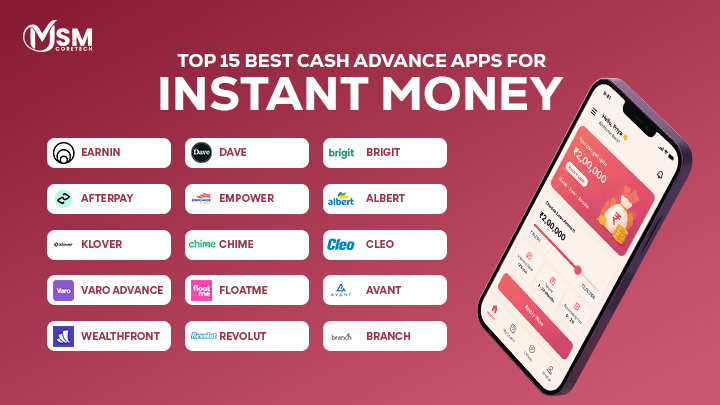
Below is a detailed look at the best cash advance apps available in 2026. Each one has its own strengths, so the right choice really depends on your income type, how much you typically need to borrow, and how quickly you need the money.
1. EarnIn
EarnIn is one of the most well-known names in the earned wage access space. It lets hourly and salaried workers access money they have already earned before their official payday, based on hours tracked through work location or timesheet entry.
Key Features: Earned wage tracking through GPS or timesheets, a Balance Shield feature that automatically transfers small amounts to avoid overdrafts, and a rewards-style tipping model instead of mandatory fees.
Cash Advance Limit: Up to $150 per day and up to $750 per pay period, depending on your earnings and account history.
Processing Time: Instant transfer is available for a small optional fee; standard transfer typically takes one to two business days.
Fees & Pricing: No mandatory fees. EarnIn operates on an optional tipping model, plus a small fee for instant transfers if you choose that option.
Pros: No mandatory fees, works well for hourly workers, Balance Shield helps prevent overdrafts.
Cons: Requires consistent income tracking, tipping culture can feel like a hidden cost, lower limits for new users.
Best For: Hourly employees who want a flexible, tip-based cash advance option.
2. Dave
Dave is a budgeting-first banking app that also offers small cash advances, sometimes called ExtraCash, aimed at helping users avoid bank overdraft fees.
Key Features: Budgeting tools that predict upcoming bills, a Dave spending account with no overdraft fees, and side hustle job listings inside the app.
Cash Advance Limit: Up to $500, with new users typically starting much lower until they build history.
Processing Time: Instant transfer available for a fee; free transfer usually arrives within one to three business days.
Fees & Pricing: A small monthly membership fee, plus an optional fee for instant transfers.
Pros: Strong budgeting features, helpful for avoiding overdraft fees, beginner-friendly interface.
Cons: Monthly membership fee applies even in months you do not borrow; advance limits grow slowly.
Best For: People who want budgeting tools bundled together with occasional cash advances.
3. Brigit
Brigit focuses heavily on financial health, combining budgeting insights with an automatic cash advance feature designed to kick in right before you would otherwise overdraft.
Key Features: Automatic overdraft protection, credit-building tools, and a financial health score that tracks your progress over time.
Cash Advance Limit: Up to $250 for most users.
Processing Time: Instant transfer available on paid plans; standard transfer can take one to three business days.
Fees & Pricing: Flat monthly subscription fee that also includes budgeting and credit-building tools.
Pros: Bundled credit-building feature, automatic protection against overdrafts, clear flat-fee pricing.
Cons: Lower maximum advance compared to some competitors, subscription fee is required to access most features.
Best For: Users who want an all-in-one subscription covering advances, budgeting, and credit building.
4. AfterPay
AfterPay is technically a buy now, pay later app rather than a pure cash advance app, but it is often grouped into this category because it lets shoppers split purchases into smaller payments without traditional interest.
Key Features: Split payments into four interest-free installments, integration with thousands of online and in-store retailers, and reminders to help you stay on track with payments.
Cash Advance Limit: Depends on the purchase amount and your repayment history with the app rather than a fixed cash limit.
Processing Time: Approval happens instantly at checkout.
Fees & Pricing: No interest if payments are made on time; late fees apply if a scheduled installment is missed.
Pros: No interest when paid on time, widely accepted at retailers, simple installment structure.
Cons: Not a true cash advance, since funds are not deposited into your bank account, and late fees can add up quickly.
Best For: Shoppers who want to spread out purchases rather than get direct cash into their bank account.
5. Empower
Empower combines a cash advance feature with automated savings tools and a debit card, making it a solid pick for people who want their advance app to also help them build better financial habits.
Key Features: Automated savings that round up purchases, a cash advance feature tied to your Empower account, and spending insights across linked accounts.
Cash Advance Limit: Up to $300 for most eligible users.
Processing Time: Instant transfer available for a fee; free transfers take a few business days.
Fees & Pricing: Monthly subscription fee that unlocks the advance feature along with savings and tracking tools.
Pros: Useful savings automation, clean and simple app design, transparent flat fee.
Cons: Advance amounts are modest, subscription fee applies whether or not you use the advance.
Best For: People who want savings automation bundled with occasional cash advances.
6. Albert
Albert positions itself as a full financial assistant, offering cash advances alongside investing, savings, and access to human financial experts for personalized guidance.
Key Features: Cash advances up to a few hundred dollars, automated investing and savings, and genius-style advice from real financial experts.
Cash Advance Limit: Up to $250, with some users reporting higher limits over time.
Processing Time: Instant transfer available for a fee; standard transfer typically takes a few business days.
Fees & Pricing: Optional subscription for full access to advisory features; advance fees depend on transfer speed chosen.
Pros: Access to real financial guidance, well-rounded feature set beyond just advances, useful for long-term financial planning.
Cons: Some of the best features sit behind the paid tier; advance limits are on the lower side.
Best For: Users who want financial coaching in addition to occasional cash advances.
7. Klover
Klover offers cash advances funded partly through an advertising and rewards model, which means users can sometimes earn points toward their advance just by using the app and engaging with content.
Key Features: Points system that can boost your advance eligibility, quick approval process, and a simple dashboard for tracking your balance.
Cash Advance Limit: Up to $200 for most users, with higher limits for long-term active users.
Processing Time: Instant transfer available for a fee; standard transfer usually takes one to two business days.
Fees & Pricing: Free to use with optional tips; instant transfer carries a small fee.
Pros: Rewards-based model can reduce your effective cost, no mandatory subscription required, quick sign-up.
Cons: Lower advance limits compared to some competitors, points system can feel gimmicky to some users.
Best For: Users comfortable with an ad-supported model in exchange for lower fees.
8. Chime
Chime is primarily a mobile banking platform, but its SpotMe feature functions much like a cash advance by covering small overdrafts on debit card purchases without a fee.
Key Features: Fee-free overdraft coverage through SpotMe, early direct deposit, and a straightforward mobile banking experience with no monthly fees.
Cash Advance Limit: Up to $200 through SpotMe, based on account history and deposit activity.
Processing Time: Coverage is applied instantly at the point of purchase.
Fees & Pricing: No fees for SpotMe coverage; Chime accepts optional tips for the service.
Pros: Genuinely fee-free overdraft protection, early paycheck access, no hidden monthly charges.
Cons: SpotMe is limited to debit card purchases rather than direct cash withdrawals; eligibility requires consistent deposits.
Best For: People who mainly need small overdraft protection rather than large cash advances.
9. Cleo
Cleo blends budgeting with personality, using an AI-powered chat assistant to help users track spending while also offering a cash advance feature for members who need quick funds.
Key Features: Conversational AI budgeting assistant, spending roasts and insights delivered in a fun tone, and a cash advance option for eligible users.
Cash Advance Limit: Up to $250 for qualifying members.
Processing Time: Instant transfer available for a fee; free transfer can take a few business days.
Fees & Pricing: Subscription required for advance access, with an additional fee for instant transfers.
Pros: Engaging and unique user experience, useful spending insights, decent advance limits for a budgeting app.
Cons: Some users find the tone gimmicky; a subscription is required to unlock the advance feature.
Best For: Younger users who want a more entertaining approach to budgeting alongside cash advances.
10. Varo Advance
Varo Advance is offered through Varo Bank, a fully licensed digital bank, giving users a cash advance option tied directly to their checking account activity and deposit history.
Key Features: Advances tied directly to Varo Bank checking accounts, no separate app required since it is built into the banking app, and gradually increasing limits with responsible use.
Cash Advance Limit: Ranges from $20 up to $500 depending on account tenure and deposit history.
Processing Time: Funds are typically available instantly within the Varo account once approved.
Fees & Pricing: Flat fees ranging based on the amount borrowed, disclosed clearly before you accept the advance.
Pros: Backed by a licensed bank, transparent flat-fee structure, limits grow over time with good usage.
Cons: Requires opening a Varo Bank account; new users start with very small limits.
Best For: People comfortable switching their primary banking to access a bank-backed advance product.
11. FloatMe
FloatMe is built specifically to help users avoid overdraft fees by offering small, fast cash advances called Floats, along with tools that flag upcoming low-balance situations.
Key Features: Low-balance alerts before you overdraft, small quick advances called Floats, and a straightforward flat membership fee.
Cash Advance Limit: Up to $50 for most users, making it one of the smaller advance amounts on this list.
Processing Time: Instant transfer available for a small fee; standard transfer can take a day or two.
Fees & Pricing: Flat monthly membership fee, with an additional fee for instant delivery.
Pros: Very affordable membership pricing, useful low-balance alerts, simple and fast approval.
Cons: Low maximum advance amount compared to other apps, not ideal for larger emergencies.
Best For: People who just need a small buffer of $20 to $50 to avoid an overdraft fee.
12. Avant
Avant is better known as a personal loan platform than a pure cash advance app, offering slightly larger installment loans for borrowers with less-than-perfect credit who need more than a typical app-based advance.
Key Features: Larger loan amounts than typical cash advance apps, fixed monthly installment payments, and a straightforward online application process.
Cash Advance Limit: Loan amounts typically range from a couple thousand dollars up to tens of thousands, far higher than app-based advances.
Processing Time: Approval can happen within a day, with funds arriving shortly after.
Fees & Pricing: Interest rates apply since this is a true installment loan product, along with a possible administration fee.
Pros: Suitable for larger financial needs, fixed and predictable monthly payments, accepts a wider credit range.
Cons: Involves a credit check and interest charges, not designed for same-day micro emergencies.
Best For: Borrowers who need a larger amount than a typical cash advance app can offer.
13. Wealthfront
Wealthfront is primarily a robo-advisor and cash management platform rather than a cash advance app, but its high-yield cash account and line of credit feature give users a way to borrow against invested assets when they need liquidity.
Key Features: A portfolio line of credit for eligible investment account holders, high-yield cash account options, and automated investing tools.
Cash Advance Limit: Typically a percentage of your invested portfolio value, which can be substantial for larger accounts.
Processing Time: Funds from a portfolio line of credit are usually available within a day or two of approval.
Fees & Pricing: Interest is charged on the borrowed amount, generally lower than credit card rates for qualifying users.
Pros: Useful for investors who want liquidity without selling assets, competitive interest rates for a credit line, no traditional application hassle.
Cons: Only available to users with an existing qualifying investment balance, not suitable for people without investments.
Best For: Investors who want to borrow against their portfolio rather than take a standard cash advance.
14. Revolut
Revolut is a global digital banking app offering multi-currency accounts, budgeting tools, and short-term credit or advance-style features in select markets, making it a strong option for international users.
Key Features: Multi-currency account support, budgeting and spending analytics, and short-term credit features available in select regions.
Cash Advance Limit: Varies significantly by country and account tier, generally scaling with account history.
Processing Time: Instant transfers within the Revolut network; transfers to external banks can take longer depending on the method.
Fees & Pricing: Fees vary by plan tier and region, with premium tiers unlocking additional credit features.
Pros: Excellent for international users and travelers, strong budgeting tools, multiple account tiers to fit different needs.
Cons: Advance and credit features are not uniformly available everywhere; fee structure can be confusing across regions.
Best For: International users and frequent travelers who want banking and advance features in one app.
15. Branch
Branch is built primarily for hourly and shift-based workers, offering earned wage access along with a fee-free digital banking account designed around unpredictable work schedules.
Key Features: Earned wage access tied to shift schedules, a fee-free Branch Wallet account, and employer integration for faster approval.
Cash Advance Limit: Varies based on hours worked and employer partnership, often up to a few hundred dollars.
Processing Time: Instant transfer typically available at no cost for Branch Wallet account holders.
Fees & Pricing: Free for employer-partnered users; fees may apply for direct-to-consumer transfers depending on the option chosen.
Pros: Genuinely free for many employer-partnered users, built specifically for shift workers, fast approval tied to actual hours worked.
Cons: Best features require your employer to partner with Branch, less useful for salaried or self-employed users.
Best For: Shift-based and hourly workers whose employer already partners with Branch.
Comparison Table
| App | Advance Amount | Instant Transfer | Monthly Fee | Credit Check | Best For |
|---|---|---|---|---|---|
| EarnIn | Up to $750 | Yes, fee applies | No mandatory fee | No | Hourly workers |
| Dave | Up to $500 | Yes, fee applies | Small flat fee | No | Budgeting + advances |
| Brigit | Up to $250 | Yes, on paid plan | Flat subscription | No | Overdraft protection |
| AfterPay | Purchase-based | Instant at checkout | No monthly fee | No | Splitting purchases |
| Empower | Up to $300 | Yes, fee applies | Flat subscription | No | Savings automation |
| Albert | Up to $250 | Yes, fee applies | Optional subscription | No | Financial coaching |
| Klover | Up to $200 | Yes, fee applies | No mandatory fee | No | Rewards-based advances |
| Chime | Up to $200 | Instant coverage | No monthly fee | No | Overdraft coverage |
| Cleo | Up to $250 | Yes, fee applies | Subscription required | No | AI budgeting + advances |
| Varo Advance | $20 to $500 | Instant in-app | Flat per-advance fee | No | Bank-backed advances |
| FloatMe | Up to $50 | Yes, fee applies | Flat membership fee | No | Small overdraft buffers |
| Avant | Larger loan amounts | Within a day | Interest-based | Yes | Larger loan needs |
| Wealthfront | Portfolio-based | Within a day or two | Interest-based | No | Investors needing liquidity |
| Revolut | Varies by region | Instant in-network | Varies by plan | No | International users |
| Branch | Up to a few hundred | Instant, often free | Free for partnered users | No | Shift and hourly workers |

Also Read: 10 Mobile Banking Trends
Cash Advance Apps vs Payday Loans
Interest Rates
Payday loans are notorious for their sky-high cost. A typical two-week payday loan carries an annual percentage rate of nearly 400 percent, according to the Consumer Financial Protection Bureau. Cash advance apps, on the other hand, generally do not charge interest at all. Instead, they rely on flat fees, small subscription charges, or optional tips, which usually work out to a far smaller cost when converted into an equivalent APR.
Fees
Payday lenders often charge between $10 and $30 for every $100 borrowed, and those fees stack up quickly if the loan is rolled over. Cash advance apps typically charge a flat fee of a few dollars for instant transfer, or a small monthly membership that covers unlimited advances within your limit. The cost difference over time is significant, especially for repeat borrowers.
Repayment Period
Payday loans are usually due in a single lump sum within two to four weeks, which can be a shock to a budget that is already stretched thin. Cash advance apps automatically pull repayment on your next payday, and many allow you to adjust the date slightly if your paycheck is delayed, giving you more breathing room than a rigid payday loan deadline.
Credit Impact
Neither option typically reports to the major credit bureaus in a way that helps build credit, but payday loans can hurt your credit indirectly if they go to collections after a missed payment. Cash advance apps generally do not report missed repayments to credit bureaus either, though they may restrict your future access to advances until your balance is settled.
Overall Affordability
When you look at the numbers side by side, cash advance apps are almost always the more affordable option for short-term borrowing. Research from the National Consumer Law Center shows that even fee-based cash advance products carry APRs far lower than traditional payday loans in most comparison scenarios.
Which Option Is Safer
Cash advance apps are generally considered the safer choice for short-term liquidity needs. They avoid the debt trap cycle commonly associated with payday lending, come with clearer fee disclosures, and rarely involve aggressive collection practices. That said, safety still depends on choosing a reputable app and using it responsibly rather than relying on it every single pay period.
Also Read: Top 10 Digital Payment Apps
How to Choose the Best Cash Advance App?
Compare Fees
Start by lining up the fee structures of a few apps side by side. Some charge nothing if you are willing to wait a couple of days, while others charge a flat monthly fee no matter what. Pick the structure that matches how often you actually plan to use the app.
Check Borrowing Limits
If you regularly need more than $100 or $200, make sure the app you choose actually supports that limit, since many apps start new users off with very small advances that grow slowly over time.
Read User Reviews
Spend a few minutes reading recent app store reviews, especially ones from the last few months, since app policies and customer service quality can change over time. Look specifically for complaints about repayment issues or unexpected fees.
Review Repayment Policies
Understand exactly when and how repayment happens, including whether the app allows you to reschedule if your paycheck is delayed. This one detail can make the difference between a smooth experience and an unexpected overdraft.
Verify Bank Compatibility
Not every app supports every bank, especially smaller credit unions. Double-check that your bank is supported before you spend time filling out a full application.
Look for Budgeting Features
Many of the best cash advance apps also include budgeting tools, spending trackers, or savings features. These extras can help you rely less on advances over time, which is ultimately the healthier long-term goal.
Also Read: FinTech App Design Guide
Safety Tips Before Using Cash Advance Apps
Borrow Only What You Need
It can be tempting to take out the maximum amount available, but borrowing more than necessary just creates a bigger repayment hit on your next paycheck. Stick to the actual amount your emergency requires.
Read All Terms Carefully
Take a few minutes to actually read through the fee structure, repayment terms, and any fine print before accepting an advance. A little upfront reading saves a lot of confusion later.
Avoid Multiple Advances
Taking advances from several apps at once can quickly spiral out of control, since each one will try to pull repayment from the same paycheck. Stick to one app at a time whenever possible.
Protect Your Banking Information
Only connect your bank account through secure, well-known verification tools, and never share your banking password directly with an app or a third party outside of an official secure connection.
Repay On Time
Staying on top of repayment keeps your account in good standing and helps your borrowing limit grow over time. Falling behind can lock you out of future advances right when you might need them most.
Use Only Trusted Apps
Stick to well-reviewed, established apps rather than obscure ones you have never heard of. A quick search for the app’s reputation and regulatory standing goes a long way toward protecting your money.
Are Cash Advance Apps Safe?
Security Measures
Reputable cash advance apps use secure, encrypted connections to link with your bank account, often through trusted third-party services rather than storing your banking credentials directly. Look for apps that clearly explain how they protect your login information.
Data Encryption
Bank-level data encryption should be standard across any legitimate cash advance app, protecting your financial information both while it is being transmitted and while it is stored on the company’s servers.
Regulatory Compliance
While the regulatory landscape for earned wage access and cash advance products is still evolving, the Consumer Financial Protection Bureau has been actively studying and shaping rules around this industry, which pushes reputable providers toward clearer disclosures and fairer practices.
Privacy Policies
Before signing up, take a moment to check the app’s privacy policy for how your financial data is used, whether it is sold to third parties, and how you can request your data be deleted if you ever stop using the service.
Who Should Use Cash Advance Apps?
Salaried Employees
Salaried workers with steady, predictable paychecks can use cash advance apps as an occasional buffer for unexpected expenses that pop up before payday.
Freelancers
Freelancers with irregular income can benefit from apps that analyze bank deposit patterns rather than requiring a traditional employer relationship, giving them access to short-term liquidity between client payments.
Gig Workers
Gig workers, including rideshare and delivery drivers, often deal with day-to-day income swings, making earned wage access apps a natural fit for smoothing out cash flow between busy and slow periods.
Students
Students juggling part-time work and tuition costs sometimes turn to smaller cash advance apps to cover a textbook or an unexpected fee without resorting to a high-interest credit card.
People Facing Temporary Cash Shortages
Really, the core audience for these apps is anyone facing a short, temporary cash shortage rather than an ongoing financial hole. Used this way, cash advance apps do exactly what they are designed for.
Common Mistakes to Avoid
- Borrowing More Than Necessary: It is easy to request the maximum available amount just because it is there, but every dollar borrowed has to come out of your next paycheck, so only take what you genuinely need.
- Ignoring Repayment Dates: Losing track of when an advance will be repaid can lead to an unexpected account shortfall, especially if you have other automatic payments scheduled around the same time.
- Choosing Apps With Hidden Fees: Some apps bury extra charges in fine print, so always read the fee schedule fully before connecting your bank account, not just the advertised headline fee.
- Depending On Advances Regularly: Using a cash advance app every single pay period is usually a sign of a deeper budgeting issue rather than a one-time emergency, and it is worth stepping back to look at the bigger financial picture if that becomes a pattern.
- Not Comparing Multiple Apps: Settling for the first app you find without comparing fees, limits, and reviews means you might miss out on a better fit for your specific financial situation.
Also Read: Cost to Develop a Fintech App Like Wise
Future of Cash Advance Apps in 2026
AI-Powered Financial Assistance
Cash advance apps are increasingly building AI-driven assistants into their platforms, helping users understand spending patterns, predict upcoming shortfalls, and get personalized nudges before a financial gap even happens.
Smarter Eligibility Checks
Instead of relying purely on basic deposit history, newer eligibility models are pulling in a wider range of signals, from employment verification to spending consistency, to make fairer and faster approval decisions.
Faster Same-Minute Transfers
Instant transfer speeds keep improving, with more apps now able to move money into a linked account within seconds rather than minutes, closing the gap even further between request and access.
Open Banking Integration
As open banking standards mature, cash advance apps are able to pull richer, more accurate financial data directly from users’ banks with explicit permission, leading to better-tailored advance limits and fewer surprises.
Personalized Financial Insights
Beyond just advancing money, more apps are positioning themselves as full financial wellness platforms, combining advances with personalized budgeting insights, savings nudges, and credit-building tools all in one place.
How to Choose MSM Coretech for Cash Advance App Development?
If you are a business looking to build your own earned wage access or cash advance platform, choosing the right development partner matters just as much as choosing the right app as a consumer. MSM Coretech is a fintech app development company with hands-on experience building secure, compliant, and scalable financial applications from the ground up.
MSM Coretech understands the unique challenges of this space, including bank-level data security, real-time payment processing, fraud prevention, and the evolving regulatory environment around earned wage access and short-term credit products. The team works closely with clients to design an intuitive user experience while making sure the backend architecture can handle instant transfers, automated repayment logic, and integrations with banking and payroll systems.
Whether you are building a brand-new cash advance app from scratch or looking to add advanced features to an existing fintech platform, partnering with an experienced fintech app development company like MSM Coretech means you get a team that knows how to balance speed, security, and compliance without cutting corners. From initial concept and UI/UX design through development, testing, and post-launch support, MSM Coretech positions itself as a reliable partner for turning a cash advance app idea into a fully functioning, market-ready product.
Also Read: Crypto Wallet App Development Guide
Conclusion
Cash advance apps have genuinely changed the way people handle short-term money gaps, offering a faster and far cheaper alternative to traditional payday loans. From EarnIn and Dave to Brigit, Chime, and Branch, the best cash advance apps on this list each bring something a little different to the table, whether that is rock-bottom fees, bundled budgeting tools, or a design built specifically for shift workers.
Before you download any app, take the time to compare fees, borrowing limits, and repayment terms so you end up with the option that actually fits your paycheck schedule and spending habits. What works well for a salaried employee might not be the best fit for a freelancer or a gig worker, so it really is worth a few extra minutes of comparison shopping.
Above all, remember that cash advance apps are meant to bridge a short, temporary gap rather than become a regular habit. Used responsibly, borrowing only what you need and repaying on time, they can be a genuinely helpful safety net. Used carelessly, even the cheapest app can start to feel like a treadmill. Choose wisely, read the fine print, and let these tools work for you rather than the other way around.
FAQs
Among the apps covered here, EarnIn offers one of the highest limits, up to $750 per pay period for eligible users with steady income history.
Yes, most cash advance apps, including EarnIn, Dave, Brigit, and Chime, do not run a traditional hard credit check to determine eligibility.
Generally yes, since cash advance apps charge flat fees or optional tips instead of interest rates that can approach 400 percent APR like typical payday loans.
Many apps offer instant transfers for a small fee, while free standard transfers usually take 1 to 3 business days.
Most do not charge traditional interest. Instead, they rely on flat fees, optional tips, or monthly subscriptions, which usually cost far less than interest-based borrowing.
Yes, many apps analyze bank deposit history rather than requiring a traditional employer relationship, making them accessible to freelancers and gig workers.

Related Posts

What Is FinTech? A Complete Guide to Financial Technology in 2026
Financial technology, or FinTech, is the concept of using software and digital tools to make financial tasks easier. Instead of...
Read More

Healthcare IT Market Size, Statistics, and Trends: A Complete Guide
Healthcare is no longer only about hospitals and clinics. Technology is now playing an important role in how people get...
Read More

Top 10 Handyman Apps in 2026
Life gets busy, and sometimes you don’t get the time to fix a leaking faucet or repair a cabinet door...
Read More


 Verified Review




 +91 9426029999
 311, 3rd Floor, Space 7, Sector 7, Shipra Path, Mansarovar, Jaipur, Rajasthan 302020