

Share this article


What Is FinTech? A Complete Guide to Financial Technology in 2026
Financial technology, or FinTech, is the concept of using software and digital tools to make financial tasks easier. Instead of visiting a bank branch to send money, check a balance, or apply for a loan, you now do all of it from an app on your phone. That shift, from paper forms and long queues to a few taps on a screen, is what financial technology is really about, and it has quietly become one of the biggest forces reshaping how people and businesses handle money today.
The fintech industry is growing at a pace that traditional banking never saw. Fortune Business Insights values the global fintech market at $460.76 billion in 2026, on its way to $1,760.18 billion by 2034 at a CAGR of 18.2%.
Fortune Business Insights values the global fintech market at $460.76 billion in 2026, growing to $1,760.18 billion by 2034 at a 16.2% CAGR, while DemandSage reports that over 75% of global customers already use at least one payment or money transfer fintech service.
This guide breaks down everything you need to know about FinTech in plain, simple language: what it means, how it actually works behind the scenes, the different types of fintech solutions in use today, the technology powering them, the trends shaping 2026, and what it takes to build your own fintech app. Whether you’re a business owner exploring fintech app development company options, a student learning the basics, or someone simply curious about how your banking app works, you’ll find clear answers here.

What Is FinTech?
FinTech is short for “financial technology.” At its core, it means any technology that is used to deliver, support, or improve financial services. That includes the app you use to check your bank balance, the software that processes your card payment at a coffee shop, the tool that lets you buy a share of stock with your spare change, and the system that approves or rejects a loan application in seconds instead of weeks.
It combines two worlds that used to operate separately: finance, which includes banking, payments, lending, and investing, and technology, which includes mobile apps, cloud computing, artificial intelligence, and secure data systems. When you put these two together, you get faster, cheaper, and more convenient ways to manage money.
You are almost certainly using FinTech already, even if you never thought of it that way. Here are some everyday examples:
- Google Pay: lets you tap your phone to pay at a store or send money to a friend instantly
- PayPal: one of the earliest and most widely used online payment platforms for shopping and freelance payments
- PhonePe: a hugely popular mobile payment app in India for bill payments, recharges, and person-to-person transfers
- Revolut: a digital banking app offering multi-currency accounts, budgeting tools, and card payments in one place
- Stripe: a payment processing platform that lets online businesses accept payments from customers worldwide
- Robinhood: an investment app that made buying stocks as easy as tapping a button, with no traditional broker required
Each of these apps replaces a slow, paper-based, or in-person process with something quick and digital. That is the whole idea of financial technology in one sentence: making money move faster, smarter, and more simply.
Also Read: 10 Mobile Banking Trends
The Evolution of FinTech
FinTech did not appear overnight. It grew in stages, with each new wave of technology unlocking a new way for people to manage their money. Understanding this journey helps explain why today’s apps look and work the way they do.
Traditional Banking Era
For most of the 20th century, banking meant physical branches, passbooks, paper cheques, and face-to-face service. Every transaction, from depositing money to applying for a loan, required a visit to a bank and often a long wait. Record-keeping was manual, and moving money across borders could take days or even weeks.
Internet Banking
In the late 1990s and early 2000s, banks began offering websites where customers could check balances, view statements, and transfer money without visiting a branch. This was the first real step toward digital finance, though it was still limited to a desktop computer and a fairly basic set of features.
Mobile Banking
As smartphones became common, banks launched dedicated mobile apps. Suddenly, customers could check balances, pay bills, and transfer funds from anywhere, at any time. This era made banking genuinely portable for the first time.
Digital Wallets
Digital wallets like Google Pay, Apple Pay, and Paytm introduced a new way to pay: tapping a phone instead of swiping a card or handing over cash. Wallets also began storing loyalty cards, tickets, and even identification documents, making the phone a true replacement for a physical wallet.
Blockchain Revolution
Blockchain technology introduced a way to record transactions on a shared, tamper-resistant ledger without needing a bank in the middle. This gave rise to cryptocurrencies like Bitcoin and Ethereum, and later to broader use cases such as secure cross-border payments and smart contracts.
AI-Powered Finance
Artificial intelligence brought smarter fraud detection, personalized spending insights, robo-advisors that manage investments automatically, and chatbots that answer customer questions instantly. AI turned fintech apps from simple digital tools into intelligent financial assistants.
Embedded Finance
Embedded finance is the practice of adding financial services directly inside non-financial apps. Think of a ride-hailing app that lets drivers get paid instantly, or an online store that offers installment payments at checkout without redirecting you to a separate banking website.
Open Banking
Open banking allows customers to securely share their financial data between banks and third-party apps, using standardized APIs. This is what lets a budgeting app pull in your transactions from multiple banks automatically, instead of you having to enter them manually.
Also Read: Top 10 Digital Payment Apps
Future of FinTech
Looking ahead, FinTech is moving toward hyper-personalized banking, central bank digital currencies, voice-activated payments, and even deeper integration of AI into everyday financial decisions. The line between “a bank” and “an app” will likely keep blurring.
Timeline graphic suggestion: a horizontal timeline graphic works well here, with eight labeled milestones running left to right Traditional Banking, Internet Banking, Mobile Banking, Digital Wallets, Blockchain Revolution, AI-Powered Finance, Embedded Finance, and Open Banking each with a small icon (a bank building, a desktop, a phone, a wallet, a chain link, a robot/brain, a puzzle piece, and an API symbol) and a one-line caption, ending with an arrow pointing toward “The Future of FinTech.”
How Does FinTech Work?
Behind every simple tap-to-pay moment, there is a surprisingly detailed journey happening in the background, all completed in a second or two. Here is the complete workflow, step by step, in the order it usually happens:

Customer
The process always starts with a person, someone opening an app to send money, pay a bill, or buy something online. The customer enters an amount, selects a recipient or a product, and confirms the action.
Mobile/Web App
This is the interface the customer actually sees and taps on. A well-designed fintech app captures the request cleanly, checks that the details look correct, and passes the request along securely without the user needing to know anything about what happens next.
API
Short for Application Programming Interface, an API is the messenger that carries the request from the app to the systems that can actually process it. APIs connect the fintech app to banks, card networks, and other financial institutions, translating the request into a language every system understands.
Cloud Infrastructure
The request is processed on cloud servers rather than on a single physical computer. Cloud infrastructure gives fintech companies the ability to handle millions of transactions at once, scale up during busy periods, and keep services running even if one server fails.
Payment Gateway
The payment gateway is the digital checkpoint that securely captures payment details, encrypts them, and forwards them for authorization. It acts like a digital cashier, making sure the payment information is handled safely at every step.
Banking System
The request then reaches the actual banking network, where the customer’s bank checks that there is enough balance or credit available and approves or declines the transaction.
AI Fraud Detection
Before the money actually moves, AI-based fraud detection systems scan the transaction in real time, comparing it against the customer’s normal spending patterns, location, and device to flag anything unusual. Suspicious transactions can be paused or blocked automatically.
Transaction Completion
Once everything checks out, the transaction is completed, the balance updates, and both the customer and the recipient (or merchant) receive confirmation, usually within seconds.
What makes this workflow impressive is the speed. A process that involves multiple systems talking to each other, security checks, and fraud screening usually finishes in under three seconds, which is exactly why fintech apps feel so instant to the people using them.
Also Read: FinTech App Design
Types of FinTech Solutions
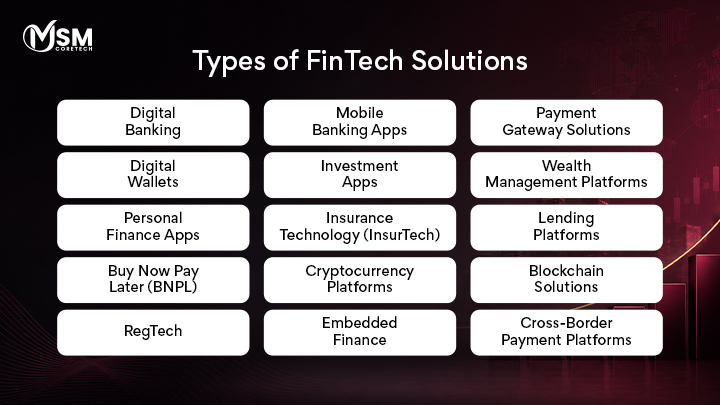
FinTech is not a single product; it is an entire category made up of many different types of solutions, each solving a different financial need. Here is a breakdown of the major categories:
Digital Banking
Digital-only banks, sometimes called neobanks, operate without physical branches. They offer current accounts, savings accounts, and card services entirely through an app, usually with lower fees and faster onboarding than traditional banks.
Mobile Banking Apps
These are apps offered by traditional or digital banks that let customers check balances, transfer funds, pay bills, and manage cards from their phones, bringing full banking functionality to a pocket-sized device.
Payment Gateway Solutions
Payment gateways allow businesses to accept card and digital payments on websites and apps. They handle encryption, authorization, and settlement, so a business does not need to build its own payment processing system from scratch.
Digital Wallets
Digital wallets store card details, loyalty cards, and sometimes tickets or IDs, letting users pay with a tap of their phone instead of carrying physical cards or cash.
Investment Apps
Apps like Robinhood let everyday users buy and sell stocks, ETFs, and other assets directly from their phones, often with no or very low commission fees, making investing accessible to people who previously felt shut out of the stock market.
Wealth Management Platforms
These platforms, often powered by robo-advisors, build and manage investment portfolios automatically based on a person’s goals and risk tolerance, offering a lower-cost alternative to traditional financial advisors.
Personal Finance Apps
Budgeting and expense-tracking apps pull in transactions from various accounts and cards, categorize spending, and help users understand exactly where their money is going each month.
Insurance Technology (InsurTech)
InsurTech companies use technology to simplify buying insurance, filing claims, and assessing risk, often using data and AI to offer more personalized and faster insurance experiences than traditional insurers.
Lending Platforms
Digital lending platforms let individuals and businesses apply for loans online, with automated systems checking credit history and approving or declining applications far faster than a traditional bank loan officer could.
Buy Now Pay Later (BNPL)
BNPL services let shoppers split a purchase into smaller installments at checkout, often with no interest if paid on time, and have become extremely popular in e-commerce.
Cryptocurrency Platforms
These platforms let users buy, sell, store, and trade digital currencies like Bitcoin and Ethereum, often alongside educational tools to help newcomers understand how crypto works.
Blockchain Solutions
Beyond cryptocurrency, blockchain is also used for secure record-keeping, smart contracts, and cross-border settlement systems that do not depend on a single central authority.
RegTech
Regulatory technology, or RegTech, helps financial companies automatically monitor transactions, detect suspicious activity, and stay compliant with ever-changing financial regulations, reducing the manual work involved in compliance.
Embedded Finance
As mentioned earlier, embedded finance places financial services like payments, lending, or insurance directly inside non-financial apps, such as an online marketplace offering instant checkout financing.
Cross-Border Payment Platforms
These platforms, such as Wise, let people and businesses send money internationally at a fraction of the cost and time that traditional wire transfers used to take.
Also Read: Cost to Develop a Fintech App Like Wise
Top Features of Modern FinTech Applications
Whether it’s a banking app, a wallet, or an investment platform, most successful fintech apps share a common set of features that keep users engaged and secure. Here’s a look at what makes up a modern, well-built fintech app:
- User Registration: A quick and simple sign-up process, usually requiring just an email or phone number to get started
- eKYC Verification: Electronic Know Your Customer verification uses ID documents and facial recognition to confirm a user’s identity in minutes instead of days
- Multi-factor Authentication: An extra layer of security that requires more than just a password, such as a one-time code sent to your phone
- Biometric Login: Fingerprint or face recognition login that lets users access their account quickly without typing a password every time
- AI Chatbots: Automated assistants that answer common customer questions instantly, any time of day
- Instant Payments: The ability to send and receive money in real time, without waiting for standard bank processing times
- QR Payments: Scan-to-pay functionality that has become especially popular for in-person retail and small business payments
- Bill Payments: A single place to pay utility bills, subscriptions, and other recurring payments
- Card Management: The ability to freeze, unfreeze, set limits on, or request replacement of a debit or credit card, right from the app
- Investment Dashboard: A clear view of a user’s portfolio performance, holdings, and market trends in one screen
- Real-time Notifications: Instant alerts for transactions, low balances, or suspicious activity
- Transaction History: A searchable record of past payments and transfers, usually with filters by date, amount, or category
- Rewards & Cashback: loyalty programs that give users points, discounts, or cashback for using the app regularly
- Customer Support: In-app chat, phone, or email support for when users need help beyond what a chatbot can offer
- AI Personal Finance Assistant: A smart assistant that offers tailored suggestions, such as reminding a user about an upcoming bill or suggesting a better savings strategy based on their habits.

Also Read: Crypto Wallet App Development Guide
Key Technologies Behind FinTech
None of the features above would be possible without a set of core technologies working together behind the scenes. Here’s what actually powers modern financial technology:
Artificial Intelligence
AI helps fintech apps understand user behavior, detect anomalies, personalize recommendations, and automate customer support, making apps feel smarter the more they’re used.
Machine Learning
A subset of AI, machine learning allows systems to improve their accuracy over time by learning from data, which is especially useful for things like credit scoring and fraud detection, where patterns constantly evolve.
Blockchain
Blockchain provides a secure, shared record of transactions that doesn’t rely on one central authority, making it valuable for cryptocurrency, cross-border payments, and transparent record-keeping.
Cloud Computing
Cloud computing gives fintech companies the flexibility to scale up during busy periods (like a holiday shopping rush) and scale down during quiet ones, without needing to own physical servers.
Big Data Analytics
Fintech companies process enormous volumes of transaction data every day. Big data analytics turns that raw information into useful insights, like spotting spending trends or predicting which customers might need a loan.
Internet of Things
IoT devices, such as smart point-of-sale terminals and connected wearables, are increasingly used to initiate or confirm payments, extending fintech beyond just phones and computers.
Open Banking APIs
These APIs let different financial institutions and apps securely share customer data (with the customer’s permission), enabling features like connecting multiple bank accounts inside a single budgeting app.
Cybersecurity
Given how sensitive financial data is, strong cybersecurity, including encryption, secure coding practices, and constant monitoring, is at the core of every trustworthy fintech product.
Biometric Authentication
Fingerprint scans, facial recognition, and voice recognition all make logging into a fintech app faster while also making it harder for someone else to gain unauthorized access.
Robotic Process Automation
RPA automates repetitive back-office tasks, like reconciling transactions or generating compliance reports, freeing up human staff for more complex work.
Generative AI
The newest addition to the fintech toolkit, generative AI is being used to draft personalized financial advice, summarize complex statements in plain language, and power more natural, conversational chatbots.
Also Read: How to Build Your Own Payment Gateway?
Benefits of FinTech
Customer Solutions
- Faster transactions: payments and transfers that once took days now happen in seconds
- Better accessibility: financial services are now available to people in remote areas or without access to a traditional bank branch
- Lower fees: digital-first companies often have lower overhead, which translates to lower fees for customers
- Convenience: managing money from anywhere, at any time, without visiting a physical location
- Better financial management: budgeting tools and spending insights help people make smarter decisions with their money
For Businesses
- Increased revenue: accepting more payment methods and reaching more customers online
- Better customer experience: smoother checkouts and faster service build customer loyalty
- Automation: reduces manual work in areas like invoicing, reconciliation, and compliance reporting
- Improved security: modern fraud detection and encryption protect both the business and its customers
- Global scalability: fintech infrastructure makes it easier to serve customers in new countries without building banking relationships from scratch
For Banks
- Digital transformation: partnering with or building fintech solutions helps traditional banks modernize their services
- Cost reduction: automating processes reduces the need for manual paperwork and physical branch infrastructure
- Fraud prevention: AI-powered monitoring helps banks catch suspicious activity earlier
- Customer retention: offering modern, app-based services helps banks keep customers who might otherwise switch to a digital-only competitor
Real-World Examples of FinTech
Some of the world’s most recognizable companies are built entirely on financial technology. Here’s what makes a few of the biggest names stand out:
- PayPal: One of the pioneers of online payments, known for making it simple and safe to pay for goods and send money across borders
- Stripe: A favorite among developers and online businesses for its easy-to-integrate payment processing tools
- Wise: Built its reputation on transparent, low-cost international money transfers, showing customers the real exchange rate upfront
- Revolut: Combines banking, currency exchange, budgeting, and even crypto trading in a single super app
- Robinhood: Known for commission-free stock trading that opened up investing to a much younger, mobile-first audience
- Chime: A US-based digital bank popular for having no monthly fees and early access to paychecks
- Klarna: A leading name in buy now, pay later, letting shoppers split purchases into manageable installments
- Square: Helps small businesses accept card payments using simple, affordable hardware and software
- Adyen: A payments platform trusted by large global enterprises for handling complex, high-volume transactions across markets
- Coinbase: One of the most widely used platforms for buying, selling, and storing cryptocurrency
Also Read: How to Build a Mobile Banking App?
Latest FinTech Trends in 2026
The fintech industry never stands still, and 2026 is shaping up to be one of its busiest years yet. Here are the trends defining the space right now:
- AI-Powered Banking: Banks and fintech apps are using AI not just for support, but for personalized recommendations, smarter budgeting nudges, and proactive fraud alerts
- Embedded Finance: More non-financial apps, from ride-hailing to e-commerce, are adding payments, lending, and insurance directly into their platforms
- Banking-as-a-Service (BaaS): Lets non-bank companies offer banking products by plugging into a licensed bank’s infrastructure through APIs
- Open Banking: Continues to expand, giving customers more control over sharing their financial data securely across apps
- Voice Payments: Voice assistants are increasingly able to confirm and complete payments through simple spoken commands
- Contactless Payments: Tap-to-pay continues to grow as the default way to pay in stores worldwide
- Digital Identity Verification: Faster, more secure ways to prove who you are online, reducing fraud during account sign-ups
- Green FinTech: Tools that help individuals and businesses track and reduce their carbon footprint through their spending habits
- CBDCs: Central bank digital currencies are being piloted by governments as a digital form of national currency
- Hyper-Personalisation: Apps are using data to tailor everything from product offers to interest rates to each user
- AI Fraud Detection: Increasingly sophisticated AI models are catching fraud patterns that older rule-based systems used to miss
- Stablecoins: Cryptocurrencies pegged to stable assets like the US dollar are gaining traction for payments and settlements
- Tokenisation: Converting real-world assets, like property or stocks, into digital tokens that can be traded more easily
- Predictive Analytics: Using historical data to forecast customer needs, such as predicting when someone might need a loan or is at risk of financial difficulty
Challenges Facing the FinTech Industry
For all its growth, the fintech industry still faces real obstacles that companies must navigate carefully:
- Cybersecurity threats: As more money moves digitally, fintech platforms become bigger targets for hackers and cybercriminals
- Data privacy: Handling sensitive financial and personal data responsibly is both a legal requirement and a matter of customer trust
- Regulatory compliance: Fintech companies must keep up with financial regulations that vary by country and change frequently
- Customer trust: Convincing people to trust a digital-only company with their money takes time, especially compared to established banks
- Legacy banking systems: Many traditional banks still run on decades-old technology, making it harder to integrate new fintech solutions
- High development costs: Building a secure, compliant, and feature-rich fintech app requires significant investment
- Competition: The fintech space is crowded, with new startups and established players all competing for the same customers
- Cross-border regulations: Expanding into new countries means navigating a completely different set of financial rules and licensing requirements
Also Read: Top FinTech Trends
How to Build a FinTech Application
Building an app of FinTech is more involved than building a typical mobile app, mainly because of the security and compliance requirements involved. Here’s the process broken down into ten clear steps:
- Market Research: Understand your target audience, study competitors, and identify a genuine gap or unmet need in the market
- Choose Your FinTech Niche: Decide whether you’re building a payment app, a digital wallet, a lending platform, an investment tool, or something else entirely
- Define Features: List out the core features your app needs at launch, separating must-haves from nice-to-haves
- UI/UX Design: Design an interface that’s simple, intuitive, and builds trust, since users need to feel confident handling money through your app
- Select the Technology Stack: Choose the programming languages, frameworks, and cloud infrastructure that will power your app securely and at scale
- Develop the MVP: Build a minimum viable product with the core features first, so you can test the concept before investing in every feature
- Integrate APIs: Connect your app to banking systems, payment gateways, KYC providers, and any other third-party services it depends on
- Ensure Security & Compliance: Implement encryption, authentication, and the regulatory measures required in the markets you plan to operate in
- Testing: Thoroughly test for bugs, security vulnerabilities, and usability issues before releasing the app to real users
- Launch & Maintenance: Release the app, monitor performance closely, and keep improving it based on user feedback and evolving regulations
FinTech Compliance and Security Standards
Because fintech apps handle real money and sensitive personal data, they need to meet a strict set of compliance and security standards. Here are the most important ones to know:
- PCI DSS: Payment Card Industry Data Security Standard, a set of requirements for securely handling card payment data
- GDPR: General Data Protection Regulation, the EU’s rules for how personal data must be collected, stored, and used
- PSD2: Payment Services Directive 2, a European regulation that enables open banking and requires stronger customer authentication
- AML: Anti-Money Laundering rules that require fintech companies to monitor for and report suspicious financial activity
- KYC: Know Your Customer, the process of verifying a user’s identity before allowing them to use financial services
- ISO 27001: An international standard for managing information security within an organization
- SOC 2: An auditing standard that confirms a company handles customer data securely and responsibly
- Data Encryption: Converting data into unreadable code that can only be accessed with the correct key, protecting information both in transit and at rest
- Tokenisation: Replacing sensitive data, like card numbers, with a unique token that has no value if intercepted
- Multi-factor Authentication: Requiring more than one method to verify a user’s identity, adding an extra layer of protection against unauthorized access
Cost to Develop a FinTech App in 2026
One of the most common questions business owners ask is simply: how much does it cost to build a fintech app? The honest answer is that it depends heavily on the type of app, the features it includes, and the level of security and compliance required. Here’s a general breakdown to help set expectations:
| App Type | Estimated Cost | Timeline |
|---|---|---|
| Digital Wallet | $15,000 – £40,000 | 3 – 5 Months |
| Payment App | $20,000 – £60,000 | 4 – 6 Months |
| Mobile Banking App | $40,000 – £120,000 | 6 – 10 Months |
| Investment App | $35,000 – £100,000 | 5 – 9 Months |
| Enterprise FinTech Platform | $100,000+ | 9 – 15 Months |
Keep in mind that these figures are estimates. The actual cost of building a fintech app varies based on the specific features you choose, the level of security and compliance required for your target markets, how many third-party integrations you need (such as payment gateways or KYC providers), and the location of the development team you hire.
Also Read: Top 10 Decentralized Crypto Wallets
Why Businesses Should Invest in FinTech in 2026
If you’re a business owner wondering whether now is the right time to invest in financial technology, the numbers and trends both point in the same direction: yes.
- Rising digital payment adoption: Consumers increasingly expect to pay digitally, and businesses that don’t offer this risk losing customers to those that do
- Increasing smartphone penetration: With more people than ever owning smartphones, mobile-first fintech products can reach a massive and growing audience
- AI-driven financial services: Businesses that adopt AI-powered tools can offer smarter, more personalized services than competitors relying on older systems
- Demand for personalised banking: Customers now expect financial products tailored to their individual habits and needs, not one-size-fits-all offerings
- Higher ROI: Automation and digital-first operations often mean lower running costs and better margins over time
- Global market growth opportunities: With the fintech industry expanding rapidly across regions, there’s room for new players to carve out a share of a fast-growing market
Why Choose MSM CoreTech for FinTech App Development?
Building a successful fintech app requires more than just good design; it requires a development partner who understands security, compliance, and the financial world inside and out. This is where working with an experienced fintech app development company makes all the difference. MSM CoreTech brings together the technical expertise and industry knowledge needed to turn a fintech idea into a secure, scalable, real-world product.
- Custom FinTech software development tailored to your specific business model and audience
- Mobile banking app development built for a smooth, secure, and intuitive user experience
- Payment gateway solutions that integrate seamlessly with your existing systems
- Digital wallet development designed for speed, convenience, and strong security
- AI-powered financial solutions that bring smarter automation and personalization to your app
- Blockchain integration for businesses looking to explore crypto, tokenisation, or secure ledger-based systems
- Enterprise-grade security built in from the ground up, not added as an afterthought
- Regulatory compliance expertise across major standards like PCI DSS, GDPR, and PSD2
- Agile development process that keeps you involved and informed at every stage
- End-to-end support and maintenance long after launch, so your app keeps running smoothly as it grows
Conclusion
Financial technology has changed the way the world handles money, and it’s not slowing down anytime soon. From tapping your phone to pay for coffee to applying for a loan that gets approved in minutes, FinTech has made financial services faster, more accessible, and far more convenient than they used to be. As we’ve seen throughout this guide, the fintech industry now spans everything from digital banking and payment gateways to investment apps, InsurTech, and blockchain-based solutions, all built on technologies like AI, cloud computing, and open banking APIs.
For businesses, the message is clear: fintech is no longer optional; it’s an expectation. Customers want fast, secure, personalized financial experiences, and the companies that deliver them are the ones winning loyalty and market share in 2026. Whether you’re exploring a digital wallet, a lending platform, or a full mobile banking app, partnering with an experienced fintech app development company can help turn that vision into a secure, compliant, and genuinely useful product. FinTech isn’t just the future of finance; it’s already here, and understanding it is the first step toward using it well.
FAQs
A traditional bank relies on physical branches, in-person service, and older back-end systems to manage money. FinTech uses apps, APIs, and cloud infrastructure to deliver the same services faster and often at a lower cost. Many banks now use financial technology themselves to modernize their own offerings.
Yes, most fintech apps use strong security measures like encryption, biometric login, and multi-factor authentication to protect user data. They also follow compliance standards such as PCI DSS, GDPR, and KYC regulations. As with any financial service, it’s important to choose apps from reputable providers in the fintech industry.
Costs vary widely depending on the type of app, ranging from around £15,000 for a simple digital wallet to £100,000+ for an enterprise-grade platform. Features, security requirements, and integrations all affect the final price. A good fintech app development company can help scope this accurately for your specific idea.
Well-known examples include PayPal, Stripe, Revolut, Wise, Robinhood, and Coinbase, each focused on a different part of financial services. Some handle payments, others focus on investing, banking, or cryptocurrency. Together, they show just how broad and varied financial technology has become.
The future points toward deeper AI integration, wider adoption of open banking, and growth in areas like embedded finance and central bank digital currencies. Super apps that combine banking, payments, and shopping in one place are also expected to grow. Overall, the fintech industry is moving toward more personalized, seamless financial experiences.

Related Posts

Healthcare IT Market Size, Statistics, and Trends: A Complete Guide
Healthcare is no longer only about hospitals and clinics. Technology is now playing an important role in how people get...
Read More

Top 10 Handyman Apps in 2026
Life gets busy, and sometimes you don’t get the time to fix a leaking faucet or repair a cabinet door...
Read More

Top 10 Online Restaurant Ordering Apps in USA
Think about the last time you ordered food. Did you make a call to the restaurant? Most likely not. You...
Read More


 Verified Review




 +91 9426029999
 311, 3rd Floor, Space 7, Sector 7, Shipra Path, Mansarovar, Jaipur, Rajasthan 302020