

Share this article


Must-Have Features in Fintech Apps & Digital Financial Platforms
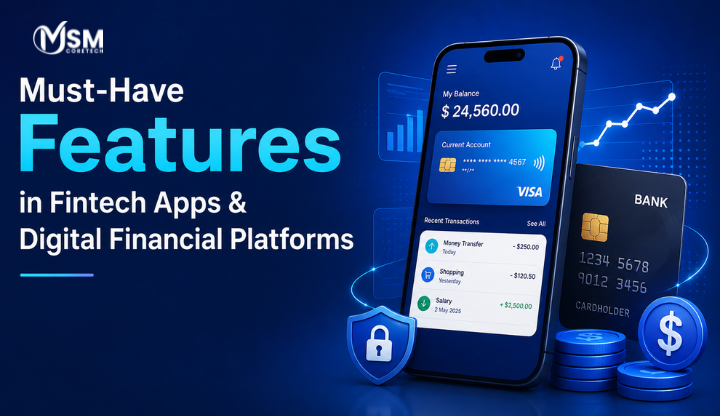
Think about how often you use your phone to pay bills, send money, shop online, or check your bank balance. A few years ago, people had to visit a bank to do many of these things. Today, fintech apps and digital financial platforms make managing money much easier, faster, and more convenient. You can send money in just a few seconds, apply for a loan online, and keep track of your daily spending from your phone. Fintech technology has completely changed the way people manage their money.
The fintech industry is also growing at a very fast pace. According to Fortune Business Insights, the global fintech market was valued at USD 394.88 billion in 2025 and is expected to reach USD 1.76 trillion by 2034, growing at a CAGR of 18.2%. This rapid growth is driven by increasing smartphone usage, digital payments, AI-powered financial services, and growing demand for secure online banking.
Today, building a fintech app is not only about allowing users to make payments. People now expect a range of useful features, such as secure login, fast money transfers, AI-based financial tips, budgeting tools, digital wallets, investment options, and robust data security. A fintech app with the right features gives users a better experience, builds their trust, keeps them coming back, and helps businesses stay ahead of their competitors.
In this guide, you will learn about the most important features that every modern fintech app and digital financial platform should have. We will also explain why these features matter, how they make apps safer and easier to use, and how they help businesses build secure, reliable, user-friendly, and future-ready financial solutions.
What is a Fintech App?
A fintech app is a mobile or web app that helps people manage their money using digital technology. The word “fintech” is made from two words: financial and technology. These apps allow users to send money, pay bills, save, invest, borrow, and track their spending anytime, using a smartphone or computer. Some common examples are digital banking apps, payment apps, and investment apps.
Fintech apps are making financial services faster, easier, and more convenient. In the past, people had to visit a bank to complete many financial tasks. Today, they can do most of these things in just a few minutes through a mobile app. Users can send money instantly, check their account balance at any time, make safe online payments, and get helpful financial suggestions based on their needs. This makes managing money much easier, saves time, allows people to access financial services from anywhere, and gives users a better overall experience.
There are many types of fintech apps available today. Some popular examples are digital banking apps, mobile payment apps, digital wallets, investment and trading apps, personal finance management apps, loan and lending apps, insurance (InsurTech) apps, and cryptocurrency apps. Each app is built to help people and businesses with different financial needs.
As more people use digital financial services, businesses need modern and secure fintech apps. Working with a trusted fintech app development company can help you build a safe, easy-to-use, and feature-rich fintech app that meets the needs of today’s users.
Also Read: A Complete Guide on Fintech Development Outsourcing
Why Features Matter in Fintech App Development
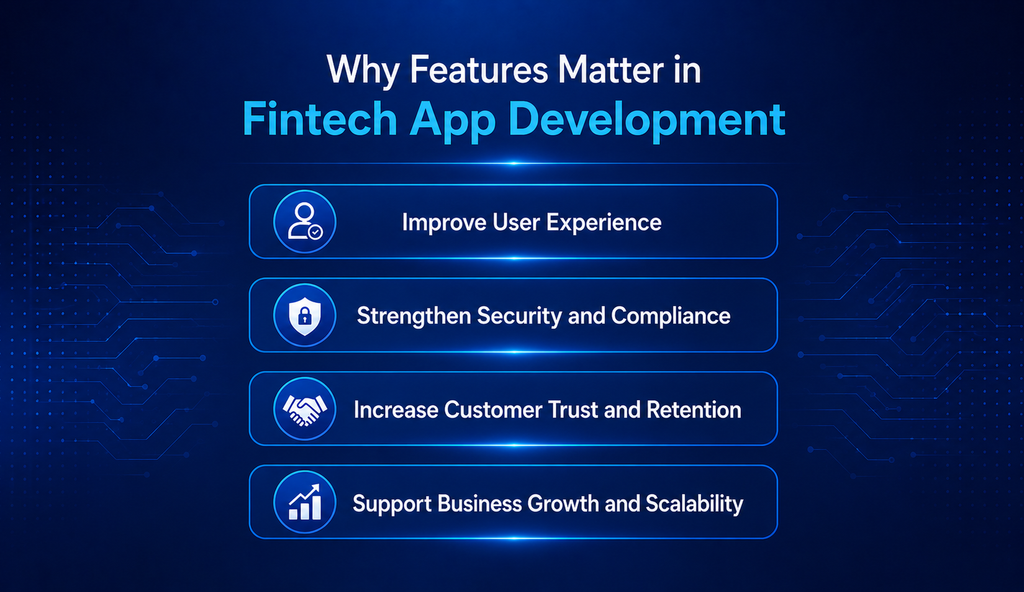
A fintech app becomes successful not only because of its design but also because of the features it offers. The right features make the app easy to use, safe, and reliable. Today, people want financial apps that are simple, fast, and secure. Whether they are sending money, paying bills, checking their account balance, or managing investments, they expect everything to work without any problems. By adding the right features, businesses can give users a better experience while also following important security and legal rules. A trusted banking app development company builds these important features to create secure, easy-to-use, and future-ready financial apps.
Improve User Experience
A good user experience makes people want to use your app again and again. The app should be simple to use, with easy navigation, quick sign-up, fast payments, and simple account management. Features like fingerprint or face login, instant notifications, and a smart search option help users save time and complete tasks more easily. When people can send money, make payments, or manage their accounts without any problems, they feel happy and trust the app more.
Strengthen Security and Compliance
Security is one of the most important parts of a fintech app. People share their personal and financial information, so keeping this data safe is very important. Features like two-factor authentication (2FA), data encryption, secure payment gateways, and fraud detection help protect user accounts from unauthorized access. Following rules like Know Your Customer (KYC) and Anti-Money Laundering (AML) also helps businesses meet legal requirements, reduce financial risks, and build customer trust.
Increase Customer Trust and Retention
People keep using a fintech app when they know their money and personal information are safe. Secure payments, clear transaction history, and instant alerts help users feel confident. Good customer support, fast solutions to problems, and honest services also make customers happy. When people have a good experience, they are more likely to keep using the app, tell others about it, and try more financial services in the future.
Support Business Growth and Scalability
The right features also help a fintech business grow easily. As more people start using the app, it should be able to handle more transactions without becoming slow. Businesses can also add new features like digital wallets, investment options, AI-based financial insights, or international payments as customer needs change. A flexible and feature-rich fintech app makes daily work easier, helps businesses stay ahead of competitors, and supports long-term growth in the fast-growing digital finance industry.
Also Read: Cost to Build A FinTech App Like Revolut
Must-Have Features in Fintech Apps & Digital Financial Platforms
Here are the must-have features every modern fintech app and digital financial platform should include to deliver a secure, user-friendly, and seamless financial experience.
1. Simple User Registration and Secure Login
User registration and login are the first things people use in a fintech app. That is why the process should be simple, fast, and secure. A quick signup process helps users create an account easily without any confusion, making the app easy to use.
Most fintech apps let users sign up with their email address, phone number, or social accounts like Google or Apple. Giving different signup and login options allows users to choose the method they like best.
To keep accounts safe, many fintech apps also offer biometric login, such as Face ID or fingerprint authentication. This helps users log in quickly while protecting their personal and financial information. Since every person’s fingerprint and face are unique, biometric login adds an extra level of security.
Another useful security feature is Multi-Factor Authentication (MFA). With MFA, users must complete one more verification step, such as entering a one-time password (OTP) sent to their phone or email. This extra step makes it much harder for anyone to access the account without permission, even if they know the user’s password.
2. User Profile Management
A user profile lets people keep all their personal information in one place. Users can easily update their name, phone number, email address, and other contact details whenever they need.
Fintech apps also use Know Your Customer (KYC) verification to confirm that a user is real. During this process, users upload important documents like a government ID, passport, or driver’s license. The app checks these documents to follow financial rules and help prevent fraud.
A safe and secure document upload and verification system protects users’ personal information, builds trust, and makes the app safer for everyone.
3. Secure Payment Gateway Integration
A secure payment gateway is one of the most important parts of a fintech app. It helps users send and receive money safely without worrying about fraud or their personal information being stolen. A good payment gateway should support credit card and debit card payments, so users can easily pay for products, services, or subscriptions in just a few taps. It should also support bank transfers, allowing users to send money between bank accounts quickly without visiting a bank.
Another helpful feature is digital wallet support. It lets users make payments directly from their wallet balance instead of entering their bank details every time. This makes payments faster and easier. QR code payments are also very useful. Users only need to scan a QR code to complete a payment, which saves time and helps avoid typing mistakes.
To keep every payment safe, a secure payment gateway should use strong encryption and secure authentication. These security features protect users’ money and personal financial information during every transaction.
Also Read: Top 10 FinTech APIs for Every Startup
4. Digital Wallet
A digital wallet lets users keep their money in one safe place. They can securely store money and make payments anytime without using cash. Users can also add money to their wallet or withdraw it whenever they need. This gives them full control over their money. The wallet also shows the current balance and recent transactions in real time. This helps users easily check their spending, manage their money better, and enjoy a fast, safe, and smooth payment experience every day.
5. Real-Time Money Transfers
Real-time money transfers are one of the best features of modern fintech apps. Today, people do not want to wait for hours or days for money to reach another account. They want to send and receive money quickly, safely, and without any trouble. Whether they are sending money to a friend, helping a family member, or paying for business, instant transfers make the whole process faster and easier.
Peer-to-peer (P2P) payments let users send and receive money directly from one person to another. With just a few taps, people can split a restaurant bill, pay rent, or send money as a gift without going to a bank. This saves time and makes everyday payments simple and convenient.
Fintech apps also allow users to make both local and international money transfers. They can send money within their own country or to another country through secure payment systems. This is very helpful for freelancers, businesses, students, and families who often need to make payments across the world.
Another useful feature is instant transaction processing. Payments are completed in real time, and users get a confirmation message right away. This reduces waiting time, increases trust, and makes digital payments smooth, quick, and reliable.
6. Bank Account Integration
Bank account integration lets users connect one or more bank accounts to the fintech app. This makes it easy to manage all their money in one place.
Users can connect bank accounts from different banks and switch between them whenever they want. They can also check their account balances without opening different banking apps. The app automatically updates all deposits, withdrawals, and payments in real time. This helps users always see the latest information about their money and manage their finances more easily.
7. Transaction History
The transaction history feature keeps a record of every payment users send or receive. It safely stores all transfers, bill payments, refunds, and purchases in one place.
Users can check their payment history anytime they need it. They can also download account statements for personal use, tax filing, or business records. To make searching easier, the app provides simple search and filter options. Users can quickly find transactions by date, amount, payment type, or the person’s name. This saves time and keeps financial records neat and easy to manage.
Also Read: Top 10 FinTech Startup Ideas
8. Budgeting and Expense Tracking
Budgeting and expense tracking help users manage their money more easily. A fintech app should automatically sort expenses into categories like groceries, shopping, rent, travel, entertainment, healthcare, and utility bills. This helps users quickly see where their money is being spent every month without checking each transaction one by one.
Another helpful feature is creating a monthly budget. Users can set a spending limit for different categories based on their income and financial goals. The app can also send alerts when they are close to their spending limit or when they spend more than their budget. This helps users control unnecessary spending and develop better money management habits.
Expense reports and analytics give users a simple view of their financial activity. Easy-to-understand charts, graphs, and monthly reports show how much money they earn and spend. These reports also help users understand their spending habits, making it easier to plan future budgets and make smarter financial decisions.
9. Investment Management
Many fintech apps also help users invest their money. People can invest in stocks, mutual funds, ETFs, and cryptocurrencies through a single app. This makes investing simple and saves time because everything is available in one place.
The app should also include portfolio tracking. This feature lets users see the current value of their investments at any time. They can easily check their profits, losses, market performance, and overall investment growth. Keeping all investment information in one place helps users understand how their money is growing and make better financial decisions.
10. AI-Powered Financial Insights
Artificial Intelligence (AI) makes fintech apps smarter and more useful. AI looks at a user’s spending habits and gives personalized spending analysis. It helps users understand where they spend the most money and where they can save more.
AI also gives savings recommendations, such as cutting unnecessary expenses or saving money for future goals. It can suggest investment options based on a user’s financial goals and how much risk they are comfortable taking. AI also uses past spending habits to predict future expenses. This helps users plan for upcoming bills, manage their money better, and build long-term financial stability.
11. Bill Payments and Recurring Payments
A good fintech app should make bill payments fast, easy, and hassle-free. Users should be able to pay electricity, water, gas, internet, mobile, insurance, and other utility bills directly from the app. This saves time because they do not have to visit different websites or payment centers.
Many people also pay every month for services like video streaming, music apps, cloud storage, and gym memberships. A fintech app should help users manage all these subscriptions in one place. They can easily check upcoming payments, cancel subscriptions they no longer use, or change their payment method whenever they want.
Auto-pay is also a very helpful feature. Users can set automatic payments for bills, loans, credit cards, or subscriptions. The app will make the payment automatically on the chosen date. This helps users avoid late payment charges and makes sure they never miss an important payment.
12. Push Notifications and Alerts
Push notifications keep users updated about everything happening in their account. When a payment is completed, the app sends an instant notification to let users know the payment was successful.
The app also sends a low balance alert when there is not enough money in the account. This gives users time to add money before any payment fails.
Security notifications are also very important. If the app finds any unusual or suspicious activity, it quickly alerts the user. This helps users take immediate action and protect their money.
The app also sends friendly reminders before bills or subscription payments are due. These reminders help users pay on time, stay organized, and avoid missing payment deadlines.
Also Read: What Is FinTech? A Complete Guide
13. In-App Customer Support
Good customer support helps users trust your app and enjoy a better experience. An AI chatbot can answer common questions anytime, such as checking payment status, explaining app features, or helping users fix simple problems in just a few minutes.
If users have a bigger or more difficult problem, they should be able to chat with a live support agent. This gives them personal help whenever they need it.
A help center with simple FAQs, easy guides, and step-by-step instructions also makes the app more useful. Users can quickly find answers by themselves without waiting for support. This saves time and makes the app easier, faster, and more convenient to use.
14. Advanced Security Features
Security is one of the most important parts of any fintech app because users trust these apps with their money and personal information. Strong security helps keep all data safe and protects users from online threats.
End-to-end encryption keeps personal and financial data secure while it is being sent or stored, so no unauthorized person can easily access it. AI-powered fraud detection checks every transaction in real time and quickly finds any unusual activity, helping stop fraud before it happens. Secure APIs allow the app to safely connect with banks, payment gateways, and other financial services without putting user data at risk. Device authentication adds extra protection by recognizing trusted devices and asking for additional verification when someone tries to log in from a new device.
All of these security features help users feel safe while using the app and protect both businesses and customers from online fraud and cyberattacks.
15. Compliance and Regulatory Features
Every fintech app must follow financial rules and legal requirements to keep users safe and provide trusted services. KYC (Know Your Customer) and AML (Anti-Money Laundering) help verify user identities and prevent fraud and illegal financial activities. PCI DSS compliance keeps card payment information safe and lowers the risk of data theft. GDPR and other data privacy rules help businesses collect, store, and manage customer information in a safe and responsible way while protecting user privacy. Audit logs keep a record of important actions and transactions, making it easier to track activities, fix problems, and meet legal requirements. Following these rules helps businesses build customer trust and avoid legal problems.
16. Analytics Dashboard
An analytics dashboard makes it easy for users to understand and manage their money. It shows a clear financial overview with account balances, recent transactions, and overall financial status in one place. Users can also check their spending trends to see where their money is being spent and find simple ways to save more. Income tracking helps users keep track of money coming from different sources. For people who invest, the dashboard shows investment performance, including profits, losses, and how their investments are growing. Simple charts, easy-to-read reports, and clear insights help users make better financial decisions and manage their money with more confidence.
Also Read: FinTech App Design Guide for Beginners
Advanced Features for Modern Fintech Platforms
Modern fintech platforms do much more than just help people send or receive money. They use smart technology to make financial services faster, safer, and easier for everyone. These advanced features give users a better experience, improve security, and help businesses stay ahead of their competitors. Below are some of the most important features that every modern fintech platform should have.
AI and Machine Learning
Artificial Intelligence (AI) and Machine Learning (ML) help fintech apps understand how users use their services and make better decisions. These technologies can quickly find unusual transactions to help stop fraud. They also study spending habits and give users simple, personalized financial tips. AI-powered chatbots can answer customer questions instantly, so users do not have to wait for support. By working with an ai development company, businesses can build smart fintech solutions that improve customer experience, increase security, and make financial services faster and more efficient.
Blockchain Integration
Blockchain technology helps make financial transactions safer, more secure, and easier to trust. It stores every transaction in a secure digital record that is very difficult to alter or hack; as a result, businesses and users can trust that the information is accurate. Blockchain is commonly used for digital payments, cryptocurrency, smart contracts, and secure identity verification. It also helps reduce fraud and improves trust between businesses and customers.
Open Banking APIs
Open Banking APIs help fintech apps connect safely with different banks and financial institutions. This allows users to link multiple bank accounts and manage all their money in one place. They can easily check account balances, send money, and view transaction history without opening different banking apps. This makes managing finances simpler, faster, and more convenient.
Voice Banking
Voice banking allows users to do banking tasks by simply speaking. They can check their account balance, see recent transactions, transfer money, or pay bills without typing. This makes banking faster, easier, and more convenient. It is also very helpful for people who prefer to use voice instead of their hands.
Robo-Advisors
Robo-advisors help users manage their investments automatically. They give investment suggestions based on a person’s financial goals, income, and risk level. They also track investment portfolios and recommend changes when needed. This helps people make smarter investment decisions, even if they have little or no investment experience.
Buy Now, Pay Later (BNPL)
Buy Now, Pay Later (BNPL) lets customers buy a product right away and pay for it in small parts over time. This makes shopping easier and more affordable. It also helps businesses get more sales and keeps customers happy by giving them flexible payment options.
Contactless Payments
Contactless payments let users pay quickly and safely by tapping their smartphone, smartwatch, or payment card on a payment machine. There is no need to insert a card or use cash. This makes the payment process faster, more convenient, and safer because it reduces physical contact.
Embedded Finance
Embedded finance allows people to use financial services directly inside other apps and websites. Users can make payments, apply for loans, buy insurance, or use other financial services without leaving the app they are already using. This makes everything faster, easier, and more convenient.
Personalized Financial Recommendations
Modern fintech platforms study how users spend, save, and earn money, along with their financial goals. Based on this information, they provide personalized suggestions, such as budgeting tips, savings plans, investment ideas, and spending alerts. These helpful recommendations make it easier for users to manage their money and make better financial decisions with confidence.
Also Read: Cost to Develop a Fintech App Like Wise
Benefits of Adding Advanced Features to Fintech Apps
Advanced features help fintech apps deliver a better user experience, improve security, increase customer satisfaction, and support long-term business growth in today’s competitive financial market.
Better User Engagement
Adding advanced features makes a fintech app more useful and easier to use. Features like AI-powered money tips, personalized spending reports, smart notifications, and simple dashboards help users manage their finances without any confusion. These useful features encourage people to open the app more often and spend more time using it. When users get helpful financial suggestions and can easily track their money, they enjoy using the app. A trusted mobile app development company can build these features to provide a smooth and user-friendly experience.
Increased Customer Retention
A simple and smooth user experience encourages customers to keep using the app. Fast services, personalized recommendations, easy navigation, and helpful customer support make users happy and satisfied. When people trust the app and find it easy to use, they are more likely to stay with the platform instead of moving to another financial app.
Enhanced Security
Security is one of the most important parts of a fintech app. Features like fingerprint or face login, two-step verification, data encryption, and AI-based fraud detection help keep user accounts and financial information safe. Strong security helps users trust the app and feel confident when they make payments or manage their money.
Faster Financial Transactions
Advanced features help users complete financial tasks faster and more easily. Instant money transfers, digital wallets, fast payment processing, and automatic payment systems save time and reduce delays. Faster transactions make using the app more convenient and provide a better experience for both individuals and businesses.
Competitive Business Advantage
Adding modern features helps your fintech business stand out from other apps in the market. Features like AI tools, budget planning, investment tracking, and personalized financial services give users a better experience. These useful features make more people choose your platform over others and help your business build a stronger position in the market.
Higher Revenue Opportunities
Advanced fintech features also help businesses earn more money. Happy customers use the platform more often, make more transactions, and recommend it to their friends and family. This brings in new users, increases customer loyalty, and creates more chances for long-term business growth and higher revenue.
Also Read: How Much Does It Cost To Build A Fintech App?
How to Choose the Right Features for Your Fintech App
Choosing the right features for your fintech app is one of the most important steps in creating a successful digital finance app. You do not need to add every feature you can think of. Instead, choose the features that solve your users’ real problems and help you reach your business goals. A simple and well-planned app is easier to use, costs less to build, and has a better chance of growing successfully in the future.
The first step is to understand your target users. Think about who will use your app and what they need the most. For example, students may need quick and easy money transfers, while business owners may want features like expense tracking and invoice management. When you understand your users’ needs, you can build the right features that make your app more useful and give them a better experience.
First, clearly define your business goals. Decide what you want your app to do and what results you want to achieve. Do you want to increase online payments, provide digital banking services, help users with investments, or offer personal finance management tools? Having clear goals helps you select the right features and keeps your app development process focused.
It is also important to choose the most important features first. Start with basic features like secure login, user registration, digital payments, transaction history, and account management. After launching your app, you can add advanced features such as AI-based financial advice, budgeting tools, investment options, and reward programs based on user feedback and needs.
You should also think about future growth. As more users start using your app, it should be able to manage more users, transactions, and new services without performance issues. Creating a flexible and scalable app from the beginning makes future updates easier and saves time and money.
Lastly, maintain a balance between cost and features. Spend your budget on features that give the most value to users. Avoid adding too many unnecessary features in the first version. A simple, secure, and easy-to-use fintech app can grow gradually as your business expands and customer needs change.
Why Choose MSM CoreTech for Fintech App Development
Choosing the right technology partner is very important for creating a successful fintech app. MSM CoreTech helps businesses build secure, reliable, and easy-to-use financial apps that match today’s customer needs. With an experienced fintech development team, MSM CoreTech understands the challenges of the finance industry and creates apps with the right features, strong security, and smooth performance.
The team offers custom fintech solutions based on your business goals and customer needs. Whether you want to build a digital wallet, payment app, banking app, or investment platform, MSM CoreTech develops solutions that match your specific requirements.
Security is very important for fintech apps. MSM CoreTech creates apps with strong and scalable security systems to protect important financial information and handle growth as more users join. These security measures help reduce risks and increase customer confidence.
The company also adds AI-powered features to make fintech apps smarter and more useful. AI can help detect fraud, provide personalized suggestions, analyze spending habits, and help users make better financial choices.
Along with app development, MSM CoreTech offers regular maintenance and support to keep your fintech app updated and working properly. Continuous improvements, performance checks, and technical assistance help businesses stay ahead in the fast-changing digital finance industry.
Conclusion
Fintech apps and digital financial platforms are changing the way people manage their money. Features like secure login, digital wallets, online payments, bank integration, transaction tracking, expense management, AI-based insights, and strong security systems help users enjoy faster, safer, and more convenient financial services. These features are important because they improve the overall user experience and build trust among customers.
However, creating a successful fintech app is not only about adding more features. Businesses need to maintain the right balance between security, simplicity, and innovation. Strong security measures protect sensitive financial data, while an easy-to-use design helps customers complete tasks without confusion. At the same time, modern technologies like AI, automation, and smart analytics help fintech platforms stay competitive.
Investing in a feature-rich fintech application can help businesses attract more users, improve customer satisfaction, and create new growth opportunities. With the right features, secure technology, and a customer-focused approach, fintech solutions can support long-term success in the growing digital finance industry.
FAQs
The most important features of a fintech app include secure user login, digital wallets, payment gateway integration, bank account connection, transaction tracking, expense management, AI-powered insights, and strong security features. These features help users manage their finances easily and safely.
Security is one of the most important parts of fintech app development because these apps handle sensitive financial information. Features like encryption, multi-factor authentication, fraud detection, and secure APIs help protect user data and build customer trust.
AI helps fintech apps provide smarter financial services. It can analyze user spending habits, detect fraud, offer personalized recommendations, automate tasks, and help users make better financial decisions.
A modern fintech app should include secure payment gateway integration, digital wallet support, bank transfers, QR payments, instant transactions, recurring payments, and real-time payment notifications to provide a smooth payment experience.
Fintech apps improve user experience by offering simple navigation, quick transactions, real-time updates, personalized financial insights, easy account management, and convenient features that allow users to handle financial tasks anytime and anywhere.
Advanced fintech platforms can include AI-based financial assistants, blockchain integration, open banking APIs, voice banking, robo-advisors, biometric authentication, predictive analytics, and personalized financial recommendations to deliver modern and innovative services.

Related Posts
15+ Top Video Live Streaming App Ideas for Business in 2026
Live streaming has become an easy way for businesses to connect with people in real time. Whether users are watching...
Read More
A Complete Guide on Fintech Development Outsourcing
Fintech development outsourcing means hiring an outside development team to build, improve, or manage financial technology solutions. Instead of creating...
Read More

How to Start an Online Handyman Business? A Complete Guide
Home services have slowly become one of the busiest parts of the on-demand economy. Today, people do not want to...
Read More


 Verified Review




 +44 7427829444
 71-75, Shelton Street, Covent Garden, London, United Kingdom, WC2H 9JQ