

Share this article


How Much Does It Cost To Develop A Travel App Like Booking.com?
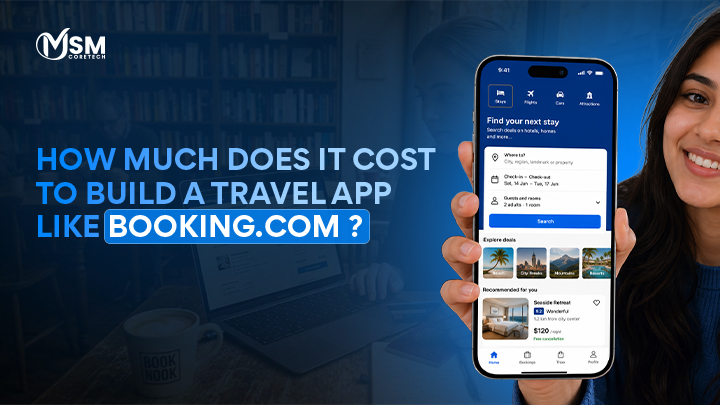
If you have ever used Booking.com to book a hotel or plan a trip, you already know how powerful a well-built travel app can be. It is fast, intuitive, packed with features, and trusted by millions of users worldwide. So it is no surprise that entrepreneurs and businesses are now asking the same question: how much does it cost to develop a travel app like Booking.com?
The global travel and tourism industry is bouncing back stronger than ever, and digital is leading the charge. According to Statista, the online travel market is projected to reach $1.06 trillion by 2030, growing at a CAGR of around 9.5%.

Well, the honest answer is, it depends. The cost to develop an app like Booking.com varies based on factors such as the features you want, the platform you choose, the location of your development team, and the technology stack you use. But do not worry, we are going to break it all down for you in this guide, in plain, simple language.
Whether you are a startup looking to build a travel app like Booking.com from scratch or an established business exploring travel app development, this guide will walk you through everything from features and steps to tech stack and, most importantly, the cost. Let us get into it.
Also Read: Cost to Develop a Hotel Booking App Like Agoda
What Is Booking.com?
Booking.com is one of the world’s largest online travel and accommodation platforms. Founded in Amsterdam in 1996, it has grown into a global powerhouse that connects travelers with hotels, apartments, resorts, vacation homes, and even flights and car rentals all in one place.
Today, Booking.com operates in over 220 countries and territories, listing more than 28 million accommodation options. It serves both leisure and business travelers, and its platform is available in over 40 languages. That tells you just how massive and complex the platform really is.
But here is what makes Booking.com truly impressive from a business standpoint: it is not just a listing site. It is a full-stack travel ecosystem. You can search, compare, book, pay, and review, all from within the app. Add in features like free cancellation, instant confirmation, loyalty rewards, and AI-powered recommendations, and you have a product that millions of people trust every day.
Now, when businesses talk about developing a travel app like Booking.com, they are not necessarily looking to clone it. They want to capture that same seamless experience, reliability, and conversion-focused design in their own platform. And that is exactly where a strong travel app development partner becomes essential.
How Does the Booking.com App Work?
Understanding how Booking.com works under the hood is important before you think about building something similar. It is not just a search engine for hotels. It is a multi-layered platform with several moving parts working together in real time.
Here is a simplified look at how the app works:
- A user opens the app and searches for accommodation by entering a destination, check-in and check-out dates, and the number of guests.
- The app pulls live data from thousands of properties using APIs and a massive backend database, then displays filtered, ranked results.
- The user browses listings complete with photos, reviews, pricing, availability, and amenities.
- Once a property is selected, the user can book instantly or request confirmation depending on the property type.
- Secure payment gateways process the transaction, and confirmation details are sent via email and in-app notification.
- After checkout, users can leave reviews, which then feed back into the platform’s recommendation engine.
Behind all of this is a powerful combination of cloud infrastructure, real-time API integrations, machine learning for recommendations, and a robust database management system. This is exactly what drives up the cost to develop an app like Booking.com, because every one of these layers needs to be built, tested, and maintained.
That said, you do not need to build all of this on day one. Most successful travel apps start with a core set of features and scale from there. Let us look at what those features typically look like and how they impact your travel app development budget.
Also Read: Pet Care App Development Companies in USA
Key Features of a Travel App Like Booking.com and Their Cost Impact
Features are the biggest driver of your development cost. The more features you add, the more time it takes to design, develop, and test them. Here is a breakdown of the most important features and how each one affects your budget when you build a travel app like Booking.com.
1. User Registration and Profiles
This is the foundation of any travel app. Users need to create accounts, manage their profiles, save preferences, and view booking history. Basic login with email and social sign-in (Google, Facebook, Apple) is standard. The cost for this module typically ranges from $800 to $1000, depending on complexity.
2. Search and Filter Functionality
A powerful search with filters for price, location, property type, amenities, ratings, and availability is essential. This requires backend logic connected to live property databases and APIs. This module can cost anywhere from $1,000 to $1500 due to its complexity.
3. Property Listings and Detail Pages
Each listing needs to display high-quality photos, descriptions, pricing, amenities, availability calendars, and guest reviews. Building dynamic, data-rich listing pages typically costs between $1000 to $2,000.
4. Real-Time Booking and Availability Management
This is where things get technically demanding. You need real-time syncing of availability across your platform, especially if you are pulling data from multiple sources. This can cost $2,000 to $2,500 or more, depending on the number of integrations required.
5. Secure Payment Gateway Integration
Integrating payment gateways like Stripe, PayPal, or regional payment providers is non-negotiable. You also need to handle multi-currency support, refunds, and invoicing. Expect to spend $2,000 to $3,000 on this module alone.
6. Reviews and Ratings System
User-generated reviews build trust and drive conversions. A full review system with moderation and response capability typically adds $2000 to $1500 to your overall cost.
7. Push Notifications and Alerts
Keeping users informed about booking confirmations, price drops, and promotions requires a notification system. This typically costs $2,000 to $3,000 to implement well.
8. Map Integration
Google Maps or Mapbox integration helps users visualize property locations. Map integration with property pins and nearby attraction data costs around $500 to $800.
9. Admin Dashboard
A backend admin panel for managing listings, bookings, users, and analytics is essential for operations. A well-built admin panel costs $2,000 – $3,000, depending on features.
10. AI Recommendations and Personalization (Advanced)
If you want to go the extra mile as Booking.com does with its smart recommendations, you will need machine learning capabilities. This is an advanced feature that can add $5,000 – $15,000+ or more to your project, depending on the level of sophistication.
Here is a quick summary of feature costs:
| Feature | Estimated Cost (USD) |
|---|---|
| User Registration & Profiles | $800 to $1000 |
| Search & Filter Functionality | $1,000 to $1500 |
| Property Listings & Detail Pages | $1000 to $2,000 |
| Real-Time Booking & Availability | $2,000 to $2,500 |
| Payment Gateway Integration | $2,000 to $3,000 |
| Reviews & Ratings System | $2000 to $1500 |
| Push Notifications | $2,000 to $3,000 |
| Map Integration | $500 to $800 |
| Admin Dashboard | $2,000 – $3,000 |
| AI Recommendations (Advanced) | $5,000 – $15,000+ |
Also Read: Develop Logistic App Like Amazon Flex
How Much Does It Cost to Develop a Travel App Like Booking.com?
Now, let us get to the number everyone really wants to know. The cost to develop an app like Booking.com depends on several variables, but we can give you a realistic range based on different approaches.
Basic MVP Travel App
Cost Range: $15,000 – $30,000
A Minimum Viable Product (MVP) includes core features like user registration, property search, listing pages, basic booking flow, and payment integration. This is a single-platform app (iOS or Android) and is enough to test your concept in the market. If you are a startup or first-time founder, this is the smartest place to start.
Mid-Level Travel App
Cost Range: $30,000 – $60,000
A mid-tier app includes everything in the MVP plus a more robust search and filter system, map integration, reviews, notifications, multi-currency payment support, and a basic admin panel. This version runs on both iOS and Android and is suitable for businesses ready to launch and grow.
Full-Featured Travel App Like Booking.com
Cost Range: $60,000 – $100,000+
A fully featured platform comparable to Booking.com includes all the above plus advanced features like AI-powered recommendations, multi-language support, loyalty programs, channel manager integrations, third-party API connections (flights, car rentals), and a powerful analytics dashboard. This is enterprise-grade travel app development built for scale.
Here is a clean overview:
| App Type | Platforms | Key Features | Estimated Cost |
|---|---|---|---|
| MVP / Basic | Single Platform | Search, Booking, Payments | $15,000 – $30,000 |
| Mid-Level | iOS + Android | Full Features + Admin | $30,000 – $60,000 |
| Full-Featured (Booking.com-like) | iOS + Android + Web | AI, Multi-language, APIs | $60,000 – $100,000+ |

Also Read: E-commerce App Development Companies in the USA
Cost by Development Region
Another major factor that affects cost is where your development team is located. Developer hourly rates vary dramatically by region, and this alone can make a huge difference in your final budget.
| Region | Hourly Rate (USD) | App Cost Estimate (Mid-Level) |
|---|---|---|
| North America (USA/Canada) | $100 – $200/hr | $150,000 – $250,000 |
| Western Europe | $80 – $150/hr | $100,000 – $200,000 |
| Eastern Europe | $40 – $80/hr | $60,000 – $120,000 |
| India / South Asia | $20 – $50/hr | $25,000 – $80,000 |
| Southeast Asia | $25 – $60/hr | $30,000 – $90,000 |
India-based teams, like MSM Coretech, offer world-class development quality at a fraction of the cost you would pay in the US or Europe. That is why so many global businesses choose to partner with a reliable hotel booking app development company based in India for their travel platform projects.
Hidden Costs to Keep in Mind
When you budget for travel app development, do not forget these often-overlooked costs:
- UI/UX Design: $5,000 to $20,000, depending on complexity and number of screens
- Quality Assurance & Testing: 15% to 20% of total development cost
- App Store Submission: One-time fees for Google Play ($25) and Apple App Store ($99/year)
- Backend Hosting & Cloud Infrastructure: $200 to $2,000+ per month depending on traffic
- Third-Party API Costs: Google Maps, payment gateways, and hotel data APIs all have usage-based pricing
- Post-Launch Maintenance: Typically 15% to 20% of the development cost annually
All of these add up, so make sure your budget accounts for the full lifecycle of the product, not just the initial build.
Tech Stack, We Use to Build a Travel App Like Booking.com
Choosing the right technology is critical when you build a travel app like Booking.com. The tech stack determines your app’s performance, scalability, security, and long-term maintainability. At MSM Coretech, we use a modern, proven stack that gives you the best of all worlds.
Using the right tech stack from day one saves you significant cost in the long run. Poor technology choices lead to performance issues, technical debt, and expensive rewrites down the line. That is why partnering with an experienced hotel booking app development company like MSM Coretech matters so much.
| Layer | Technology Used | Why We Use It |
|---|---|---|
| Frontend (Mobile) | React Native / Flutter | Cross-platform, cost-effective, native-like performance |
| Frontend (Web) | React.js / Next.js | Fast, SEO-friendly, component-based |
| Backend | Node.js / Python (Django) | Scalable, fast API development |
| Database | PostgreSQL / MongoDB | Relational + flexible document storage |
| Cloud Hosting | AWS / Google Cloud | Reliable, auto-scalable infrastructure |
| Payment Gateway | Stripe / Razorpay / PayPal | Secure, globally trusted payment processing |
| Maps | Google Maps API / Mapbox | Accurate location data and mapping |
| Push Notifications | Firebase Cloud Messaging | Real-time, reliable notification delivery |
| Authentication | Firebase Auth / OAuth 2.0 | Secure, fast social login support |
| Analytics | Google Analytics / Mixpanel | Actionable user behavior insights |
The tech stack itself also contributes to cost. React Native or Flutter for cross-platform mobile development typically costs less than building separate native iOS and Android apps, which alone can save you 30% to 40% on your total travel app development budget.
Also Read: Fitness App Development Companies in USA
Steps to Develop a Travel App Like Booking.com
Building a travel app is not something you do overnight. It is a structured process, and understanding each step helps you appreciate where your investment goes. Here is how the app development process typically looks:
Step 1: Discovery and Strategy ($2,000 – $8,000)
This is where everything starts. The team analyzes your business goals, target audience, competitor landscape, and technical requirements. You get a detailed project roadmap, feature list, and cost estimate. Skipping this step is one of the most expensive mistakes a client can make.
Step 2: UI/UX Design ($5,000 – $20,000)
Designers create wireframes, user flows, and high-fidelity mockups. Great design is not just about looks. It directly impacts conversion rates, user retention, and app store ratings. For a travel app like Booking.com, a clean, intuitive interface is non-negotiable.
Step 3: Frontend Development ($15,000 – $50,000)
Developers build out all the screens and user interactions. This includes everything users see and interact with, from the search bar to the booking confirmation page. The cost depends heavily on the number of screens and the level of animation or interaction.
Step 4: Backend Development ($20,000 – $80,000)
This is the engine of your travel app. The backend handles data management, API integrations, business logic, authentication, and everything the user never sees but absolutely depends on. This is typically the largest cost component in travel app development.
Step 5: API Integrations ($5,000 – $25,000)
Connecting third-party services like payment gateways, Google Maps, hotel data APIs, and notification services adds significant functionality. Each integration has its own complexity and cost depending on the API provider and the depth of integration required.
Step 6: Testing and Quality Assurance ($5,000 – $20,000)
Every screen, feature, and user flow needs to be thoroughly tested across different devices, operating systems, and network conditions. Poor testing is one of the most common reasons apps fail after launch. Do not cut corners here.
Step 7: Deployment and Launch ($2,000 – $5,000)
Getting your app live involves setting up cloud infrastructure, configuring servers, deploying to the App Store and Google Play, and running final checks. This step also includes configuring analytics and monitoring tools.
Step 8: Post-Launch Support and Maintenance (Ongoing)
After launch, your app needs regular updates, bug fixes, performance monitoring, and security patches. Budget at least 15% to 20% of your initial development cost annually for maintenance. This is what keeps your app competitive and secure over time.
Here is a cost summary across all development steps:
| Development Phase | Estimated Cost (USD) |
|---|---|
| Discovery & Strategy | $2,000 – $8,000 |
| UI/UX Design | $5,000 – $20,000 |
| Frontend Development | $15,000 – $50,000 |
| Backend Development | $20,000 – $80,000 |
| API Integrations | $5,000 – $25,000 |
| Testing & QA | $5,000 – $20,000 |
| Deployment & Launch | $2,000 – $5,000 |
| Post-Launch Maintenance (Annual) | 10-15% of dev cost |
Also Read: Logistics App Development Companies in USA
Factors That Affect the Cost to Develop an App Like Booking.com
By now, you have a good picture of the numbers, but let us quickly summarize the key factors that will ultimately determine where your project lands within these ranges:
- Number of Features: More features always mean more time and more cost. Every new feature adds design, development, and testing effort.
- Platform Choice: Building for iOS only, Android only, or both (plus a web version) directly multiplies your cost.
- UI/UX Complexity: A basic, clean design costs less than an animated, highly polished interface with custom micro-interactions.
- Third-Party Integrations: Every API you plug in adds cost. Some integrations are simple; others require significant custom work.
- Development Team Location: As shown in our regional cost table, where your team sits dramatically affects your hourly rate and total spend.
- Team Structure: A full in-house team costs more than working with a dedicated offshore agency. Freelancers are cheaper upfront but riskier for complex projects.
- Timeline: Rushed projects cost more. If you need something done in three months instead of six, expect to pay a premium for the extra resources required.
- Scalability Requirements: Building for ten users is very different from building for ten million. Infrastructure decisions made early have a major cost impact.
Understanding these factors lets you make smarter decisions and get more value from your budget. A good travel app development partner will help you prioritize features so you get the most impactful product within your budget constraints.

Also Read: On-Demand App Development Can Drive Business Growth
Why Choose MSM Coretech for a Travel App Like Booking.com?
There are hundreds of development agencies out there, so why should you choose MSM Coretech for your travel app project? Here is the honest answer.
MSM Coretech is a full-cycle software and app development company with deep expertise in building complex, scalable platforms across travel, fintech, healthcare, and e-commerce. We have helped startups and established businesses across the globe launch products they are proud of, and we know how to do it in a way that delivers real ROI.
We Have Deep Domain Knowledge
We understand the nuances of travel app development inside out. From real-time availability management to multi-currency payment flows, we have built these systems before and we know what works and what does not. That experience saves you time, money, and headaches.
We Offer Full-Cycle Development
From discovery and strategy to design, development, testing, launch, and ongoing support, MSM Coretech handles everything under one roof. You do not have to manage five different vendors. You have one accountable team working toward your success.
We Deliver Cost-Effective, World-Class Quality
Our team is based in India, which means you get exceptional development quality at a significantly lower cost than agencies in North America or Western Europe. Clients consistently tell us that working with MSM Coretech gives them access to enterprise-grade talent at startup-friendly prices.
We Build to Scale
We do not just build apps that work today. We architect systems designed to grow with your business. Whether you are going from zero to a thousand users or a thousand to a million, MSM Coretech builds with scalability baked in from day one.
Transparent Pricing, No Surprises
We believe in upfront, honest pricing. When we give you a cost estimate, we stand behind it. No hidden charges, no scope creep without your sign-off. You always know where your money is going.
Proven Track Record
We have successfully delivered projects across SaaS, fintech, e-commerce, healthcare, and travel verticals. Our portfolio speaks for itself, and our client testimonials reflect the quality and reliability that MSM Coretech brings to every project.
If you are serious about building a travel app that competes in today’s market and want a partner who truly understands travel app development from the inside out, MSM Coretech is ready to talk.
Also Read: Target Audience for Dating Apps
Conclusion
Building a travel app like Booking.com is absolutely achievable, whether you are a startup testing an MVP or an established brand going all-in on digital travel. The cost to develop an app like Booking.com can range anywhere from $25,000 for a basic MVP all the way to $300,000 or more for a fully featured, enterprise-grade platform. Where you land in that range depends on your features, platform choices, tech stack, and development team.
The key takeaway here is this: do not let cost uncertainty stop you from moving forward. Start with a clear strategy, prioritize your must-have features, choose a reliable development partner, and build iteratively. A well-executed MVP can validate your concept and start generating revenue while you plan your next phase of growth.
Travel app development is not just about writing code. It is about building a product that genuinely serves your users and supports your business goals.
Ready to develop a travel app like Booking.com? MSM Coretech is here to guide you every step of the way. Let us build something great together. Reach out to our team today for a free consultation and a transparent cost estimate tailored to your project.
FAQs
The cost to develop a travel app like Booking.com typically ranges from $25,000 for a basic MVP to $300,000+ for a fully featured platform. The final cost depends on factors like features, platform choice, tech stack, and your development team’s location.
A basic MVP can be built in 3 to 5 months, while a full-featured travel app like Booking.com can take 9 to 18 months. The timeline depends on the complexity of features and the size of your development team.
React Native or Flutter for mobile, Node.js for backend, and AWS for cloud hosting is a reliable and cost-effective tech stack for travel app development. This combination delivers strong performance, scalability, and faster development cycles.
A hotel booking app development company brings a full team of designers, developers, and testers working together under one roof with an accountable process. Freelancers may cost less upfront but often lead to delays, quality issues, and higher long-term costs.
Yes, MSM Coretech offers flexible engagement models and transparent pricing tailored to your specific project requirements and budget. Whether you are starting with an MVP or building a full-scale platform, our team will help you get maximum value for your investment.

Related Posts
Top 10 Digital Payment Apps for Secure Online Transactions in 2026
Cash is quietly fading into the background, and 2026 is the year digital payment apps have taken over almost every...
Read More
FinTech App Design Guide for Beginners: Best Practices & Tips
FinTech app design is the process of shaping how a financial app looks, feels, and behaves for the person using...
Read More
How to Build a Doctor Booking App: Complete Development Guide
Healthcare is becoming more digital every year, and doctor booking apps are making it easier for people to get medical...
Read More