

Share this article


Cost to Develop a Hotel Booking App Like Agoda: A Complete Guide
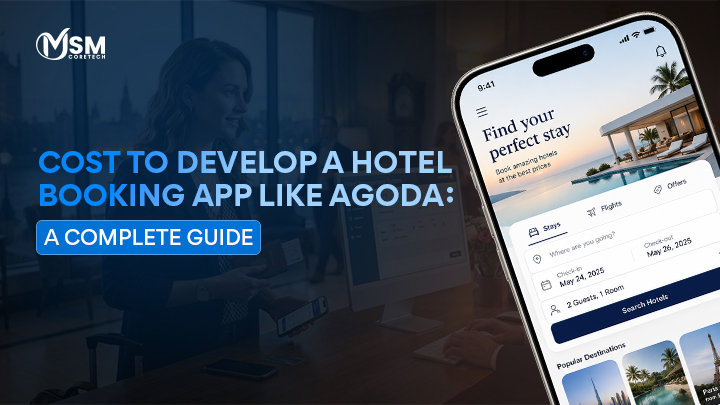
If you have ever planned a trip and used an app to find the perfect hotel at the best price, you already know how powerful hotel booking apps can be. They save time, offer great deals, and make traveling so much easier. And if you are a business owner thinking about entering this space, you are looking at a massive opportunity.
The global online travel market is booming. According to Statista, the online travel booking market is projected to generate revenue of approximately USD 521.03 billion in 2024 and is expected to grow at a CAGR of 4.25%, reaching around USD 643.51 billion by 2029. That is a huge market, and apps like Agoda are sitting right at the center of it.

So it makes perfect sense that entrepreneurs and businesses are asking: how much does it cost to develop an app like Agoda? The honest answer is, it depends. It depends on the features you want, the platform you choose, the team you hire, and the tech you use. But do not worry, because in this guide, we are going to break it all down for you in the simplest way possible.
Whether you want to build a hotel booking app like Agoda from scratch or create something similar with your own unique twist, this guide will walk you through everything. From what Agoda actually does, to the features you need, the steps to build it, and of course, the real cost to develop an app like Agoda, we have got it all covered. Let us dive in.
Also Read: Cost To Build a Logistics App Like Uber Freight
What is the Agoda App?
Before we talk about how to develop a hotel booking app like Agoda or how much it costs, let us first understand what Agoda actually is and why it is so popular.
Agoda is one of the world’s leading online travel platforms, headquartered in Singapore. It was founded in 2005 and later acquired by Booking Holdings (formerly Priceline Group) in 2007. Today, Agoda offers over 3.6 million properties in more than 200 countries and territories. That includes hotels, resorts, apartments, villas, and even hostels.
What makes Agoda stand out is its focus on Asia-Pacific markets, though it serves users globally. The app is known for offering competitive pricing, exclusive deals, and a very user-friendly experience. It supports multiple languages and currencies, making it incredibly accessible for international travelers.
The Agoda app is available on both iOS and Android and allows users to search for accommodations, compare prices, read reviews, and book instantly. The platform also offers flight bookings, airport transfers, and activities, but hotels remain its core offering.
From a business perspective, Agoda works on a commission-based model. Property owners list their properties on the platform, and Agoda charges a commission (typically 15%-20%) on each booking. This is a highly profitable model, which is exactly why many businesses want to build a hotel booking app like Agoda. Now, understanding this model is important because it directly affects the cost and complexity of the app you want to build. The more features and the wider the scope, the higher the development cost. But we will get into that in detail shortly.
Also Read: Cost to Develop a Home Service App like Thumbtack
How Does the Agoda App Work?
Understanding how the Agoda app works will help you figure out what you need to build and how much it might cost. Let us walk through the basic flow of the app in simple steps.
Step 1: User Registration and Login
The journey begins when a user downloads the app and creates an account. Users can sign up using their email, phone number, or social media accounts. This part of the development is relatively simple and typically costs depending on the authentication methods you want to include.
Step 2: Search and Discovery
This is one of the most important and costly parts of the app. Users enter their destination, check-in and check-out dates, and the number of guests. The app then fetches real-time data from its database and displays thousands of hotel options.
Step 3: Property Listings and Details
Each hotel listing shows photos, room types, amenities, pricing, and reviews. Displaying this information cleanly and loading it fast requires a well-built backend and optimized frontend. The cost for this section, including the property detail page, review system, and photo gallery.
Step 4: Booking and Payment
Once a user picks a hotel, they choose a room, enter their dates, and proceed to payment. Agoda supports multiple payment methods, including credit cards, debit cards, PayPal, and even local payment options in Asia. Integrating a secure payment gateway is one of the more technical and expensive parts, costing depending on the number of payment options.
Step 5: Confirmation and Notifications
After booking, the user receives a confirmation email and an in-app notification. The hotel also gets notified. Building a solid notification system with push notifications and emails adds.
Step 6: Review and Ratings
After their stay, users are prompted to leave a review. This review system helps future travelers make decisions.
So just walking through these basic steps, you can already see how the costs start to add up. And we have not even talked about the admin panel, property owner portal, or advanced AI features yet. But we will get there.
Also Read: Cost To Develop a Music Streaming Mobile App like Spotify
Key Features of a Hotel Booking App Like Agoda and Their Cost Impact
One of the biggest factors that determines the cost to develop an app like Agoda is the feature list. More features mean more development time, which means more money. Let us look at the core features you need and get a rough sense of what each one adds to your budget.
For Users (Customer Side)
- User Registration and Login: Sign up via email, phone, or social accounts. Cost: $800 to $1000
- Advanced Search and Filters: Search by location, date, price, star rating, and amenities. Cost: $1,000 to $1500
- Interactive Maps: Google Maps or Mapbox integration to show hotel locations. Cost: $500 to $800
- Hotel Listings with Photos and Details: High-quality images, amenities list, room types, descriptions. Cost: $1000 to $2,000
- Real-Time Pricing: Dynamic pricing that updates based on availability and demand. Cost: $2,000 to $2,500
- Secure Payment Gateway: Multiple payment options, secure transactions. Cost: $2,000 to $3,000
- Booking Management: View, modify, or cancel bookings easily. Cost: $3,000 to $4,000
- Reviews and Ratings: User reviews, star ratings, verified stay badges. Cost: $2000 to $1500
- Wishlist and Favorites: Save hotels for later. Cost: $500 to $1500
- Loyalty/Rewards Program: Points for bookings, redeemable for discounts. Cost: $1000 to $15,000
- Multi-Language and Multi-Currency Support: For global travelers. Cost: $3,000 to $5,000
- Push Notifications: Booking confirmations, deal alerts, reminders. Cost: $2,000 to $3,000
For Property Owners (Hotel Side)
- Property Listing Management: Add, edit, or remove property listings. Cost: $2,000 to $3,000
- Booking Calendar: Real-time availability calendar. Cost: $2,000 to $3,000
- Revenue Dashboard: Track bookings, revenue, and performance. Cost: $2,000 to $3,000
- Review Management: Respond to user reviews. Cost: $1,000 to $2,000
Admin Panel Features
- User Management: Manage users, properties, and bookings. Cost: $2,000 to $3,000
- Commission Management: Track and manage platform commissions. Cost: $2,000 to $2500
- Analytics Dashboard: Business insights, traffic data, revenue reports. Cost: $3,000 to $4,000
- Content Management System: Manage banners, promotions, and homepage content. Cost: $2000 to $4,000
When you add all of this up, just the features alone can push your total cost to somewhere between $15,000 and $50,000, depending on complexity and the team you choose. But other factors affect the final number too, which we will discuss in the cost breakdown section.
Also Read: Cost to Develop an App Like Grindr
Tech Stack, We Use to Build a Hotel Booking App Like Agoda
The technology you choose to build your app has a direct impact on development cost, performance, and scalability. At MSM Coretech, we carefully select the right tech stack to deliver a fast, secure, and scalable hotel booking app. Here is a look at what we typically use and why.
| Layer | Technology Used | Purpose | Approx. Cost Impact |
|---|---|---|---|
| Frontend (Mobile) | React Native or Flutter | Cross-platform iOS & Android app | Saves 20–30% vs native development |
| Frontend (Web) | React.js or Next.js | Web admin panel and hotel portal | Fast, SEO-friendly, scalable |
| Backend | Node.js or Django (Python) | API development, business logic | High performance, widely supported |
| Database | PostgreSQL + MongoDB | Structured and unstructured data storage | Flexible and scalable |
| Cloud Hosting | AWS or Google Cloud | App hosting, storage, scaling | $300–$2,000/month depending on traffic |
| Payment Gateway | Stripe, PayPal, Razorpay | Secure payment processing | $3,000–$8,000 integration cost |
| Maps Integration | Google Maps API or Mapbox | Hotel location display | $2,000–$5,000 + usage fees |
| Push Notifications | Firebase Cloud Messaging | In-app notifications | $1,000–$2,000 |
| Real-Time Features | Socket.IO or WebSockets | Live availability updates, chat | $2,000–$5,000 |
| CDN | Cloudflare or AWS CloudFront | Fast image and content loading | $200–$500/month |
Using React Native or Flutter for mobile development instead of building separate native apps for iOS and Android can save you between 20% and 30% on development costs.
Cloud infrastructure costs also depend heavily on traffic. At the beginning, you might spend $300 to $500 per month on hosting. As your app grows and you get more users, that figure can rise to $1,500 to $3,000 per month or more. Planning for scalability from day one is important, and our team at MSM Coretech always builds with growth in mind.
Also Read: Cost to Develop an App Like Hinge
Steps to Develop a Hotel Booking App Like Agoda
Now that you know what features you need and what tech is involved, let us talk about the actual process of building the app. This step-by-step breakdown also gives you a clearer picture of where the costs are generated.
Step 1: Discovery and Planning
This is the foundation of your project. During this phase, we work with you to understand your business goals, target audience, and competitive landscape. We define the scope of the project, create wireframes, and build a roadmap. Skipping this step is one of the biggest mistakes startups make, and it almost always leads to expensive changes later.
Step 2: UI/UX Design
Design is not just about making things look pretty. It is about creating an experience that makes users want to stay on your app and come back again. A well-designed hotel booking app has smooth navigation, clear CTAs, fast-loading pages, and a visually appealing layout. Poor design directly hurts conversion rates, so investing in good design is always worth it.
Step 3: Frontend Development
This is where your app starts to look and feel real. Our developers build the screens, animations, and interactions that users see. Using React Native or Flutter, we build for both iOS and Android at the same time, which saves you significant time and money compared to building two separate apps.
Step 4: Backend Development
The backend is the engine behind your app. It handles everything from user authentication, property listings, booking logic, payment processing, and notifications. This is typically the most expensive part of development because it involves the most complexity and needs to be built securely and at scale.
Step 5: API Integrations
Your app needs to talk to external services, including payment gateways, map services, notification services, and potentially third-party hotel databases. Each integration comes with its own development and licensing cost. For example, using the Google Maps API is free up to a point, but heavy usage starts incurring charges that need to be factored into your budget.
Step 6: Testing and QA
Testing is non-negotiable. Before your app goes live, it needs to be tested thoroughly for bugs, performance issues, security vulnerabilities, and user experience problems. A poorly tested app that crashes or has payment issues will destroy user trust instantly. QA is one of those areas where cutting corners always costs you more in the long run.
Step 7: Deployment and Launch
Getting your app onto the App Store and Google Play involves meeting their specific guidelines, setting up server infrastructure, and making sure everything runs smoothly in a live environment. This phase also includes the initial setup of your cloud infrastructure and CDN.
Step 8: Post-Launch Support and Maintenance
Launching the app is just the beginning. You will need ongoing maintenance to fix bugs, add new features, keep up with OS updates, and handle growing user traffic. Most businesses budget around 15% to 20% of the total development cost per year for maintenance.

Also Read: Cost to Develop an App Like Happn
Cost to Develop an App Like Agoda: Detailed Breakdown
This is the section you have been waiting for. Let us talk numbers. The cost to develop an app like Agoda is not a fixed figure. It varies based on a number of factors, including team location, app complexity, feature set, and technology choices. But here is a comprehensive breakdown to give you a realistic picture.
Cost by App Complexity
| App Type | Features Included | Estimated Cost | Timeline |
|---|---|---|---|
| Basic MVP | Search, listings, basic booking, one payment gateway | $8,000 to $12,000 | 3 to 5 months |
| Mid-Level App | All MVP features + map integration, reviews, multi-language, loyalty program | $15,000 to $25,000 | 5 to 8 months |
| Full-Scale App (Agoda-Level) | All above + AI recommendations, real-time pricing, multiple payment methods, advanced analytics | $25,000 to $51,000+ | 9 to 15 months |
Cost by Team Location
The location of your development team has a massive impact on the total cost. Here is a comparison of average hourly rates across different regions.
| Region | Avg. Hourly Rate | Cost for 1,000 Hours | Quality Level |
|---|---|---|---|
| USA / Canada | $100 to $200/hr | $100,000 to $200,000 | Very High |
| UK / Western Europe | $80 to $150/hr | $80,000 to $150,000 | Very High |
| Eastern Europe | $40 to $80/hr | $40,000 to $80,000 | High |
| India (like MSM Coretech) | $20 to $50/hr | $30,000 to $50,000 | High to Very High |
| Southeast Asia | $25 to $55/hr | $25,000 to $55,000 | Moderate to High |
This is why many global businesses choose to partner with development companies in India. You get top-quality work at a fraction of the cost compared to US or European agencies. At MSM Coretech, we combine competitive pricing with enterprise-level quality, giving you the best of both worlds.
Hidden Costs You Should Know About
Many businesses focus only on development costs and are surprised by additional expenses down the line. Here are some costs you should factor into your overall budget:
- App Store Fees: Apple Developer Account costs $99/year. Google Play Developer Account costs a one-time fee of $25.
- Third-Party API Costs: Google Maps, payment gateways, and SMS services all charge based on usage.
- Cloud Hosting: AWS or Google Cloud costs $300 to $2,000+ per month, depending on traffic.
- SSL Certificate: Around $50 to $300 per year for security.
- Marketing and ASO: Getting your app discovered costs money, too. Budget at least $5,000 to $15,000 for initial marketing.
- Legal and Compliance: Privacy policy, terms of service, and GDPR compliance setup can cost $1,000 to $3,000.
- Post-Launch Maintenance: Budget 15 to 20% of total development cost annually.
Total Cost Summary
| Cost Component | Low Estimate | Mid Estimate | High Estimate |
|---|---|---|---|
| Discovery and Planning | $2,000 | $3,500 | $5,000 |
| UI/UX Design | $5,000 | $8,000 | $12,000 |
| Frontend Development | $12,000 | $18,000 | $25,000 |
| Backend Development | $15,000 | $25,000 | $35,000 |
| API Integrations | $5,000 | $10,000 | $15,000 |
| Testing and QA | $5,000 | $7,500 | $10,000 |
| Deployment and Launch | $2,000 | $3,500 | $5,000 |
| First Year Maintenance | $12,000 | $18,000 | $24,000 |
| Total | $58,000 | $94,000 | $131,000 |
These estimates are for a well-rounded, production-ready hotel booking app. If you are looking to build something as feature-rich and scalable as Agoda, you should plan for $150,000 to $250,000 or more over time as you continue to add features and scale the platform.
Also Read: Cost to Develop an App Like Audiomack
Factors That Affect the Cost to Develop an App Like Agoda
Now that you have seen the numbers, let us talk about what actually moves those numbers up or down. Understanding these factors will help you make smarter budget decisions.
1. Number of Features
This is the single biggest cost driver. Every feature you add requires design time, development time, and testing time. A basic MVP with core booking features will cost significantly less than a full-scale app with AI recommendations, loyalty programs, and multi-currency support. The more features you want, the higher the bill.
2. Platform Choice: iOS, Android, or Both
Building for both platforms using React Native or Flutter is far more cost-effective than building two separate native apps. However, if you want a native experience with maximum performance, native development will cost you 30% to 50% more. For most hotel booking apps, cross-platform development is the smart choice.
3. Design Complexity
A simple, clean design costs less than a complex, animated, highly customized interface. That said, do not go too cheap on design. First impressions matter in the travel industry, and users will abandon a poorly designed app quickly.
4. Third-Party Integrations
Integrating with payment gateways, map APIs, CRM tools, or property management systems adds to development time and cost. Some integrations are straightforward, while others require extensive custom work.
5. Development Team Location
As we discussed in the table above, where your development team is based has a huge impact on cost. Indian development companies like MSM Coretech offer significant savings without compromising on quality or expertise.
6. Backend Complexity
If your app needs real-time inventory management, dynamic pricing, and data from hundreds of thousands of hotels, the backend becomes very complex and expensive. Scaling a backend to handle millions of concurrent users, as Agoda does, requires serious architecture investment.
7. Security Requirements
For a payment-processing app, security is not optional. Implementing SSL, two-factor authentication, data encryption, and PCI-DSS compliance adds to the cost but protects you and your users. Expect to spend an additional $5,000 to $15,000 on security-related features and audits.
8. Maintenance and Updates
An app is never truly finished. You will need to continuously fix bugs, add features, and adapt to new OS versions. Factoring in ongoing maintenance costs from the beginning will save you from budget shocks later.
Also Read: Music Streaming App Development Cost
How Will You Make Money? Monetization Models and Their Cost Implications
Understanding how your app will generate revenue also affects how you build it, and therefore how much it costs. Here are the main ways to monetize a hotel booking app like Agoda.
Commission-Based Model
This is Agoda’s primary model. You charge hotels a commission (typically 10% to 20%) on every booking made through your platform. Building this into your backend requires a robust billing and commission tracking system, which adds roughly $5,000 to $10,000 to your development cost.
Featured Listings
Hotels pay to appear at the top of search results or in featured spots on the homepage. This requires building an ad management system in your admin panel, costing an additional $4,000 to $8,000.
Subscription Model for Hotels
Charge property owners a monthly or yearly subscription fee for premium features like advanced analytics, professional listing management, or unlimited photos. Adding a subscription and billing module costs around $3,000 to $7,000.
Affiliate Revenue
Partner with airlines, car rental companies, or travel insurance providers and earn a commission when your users buy through your referral links. Integrating affiliate tracking adds $2,000 to $5,000.
Dynamic Pricing Tools
Offer hotels premium AI-powered dynamic pricing tools as a paid add-on. Building this AI feature is expensive, typically adding $15,000 to $30,000 to your development budget, but it can be a strong competitive differentiator.
Also Read: Taxi Booking App Development Cost
Why Choose MSM Coretech for a Hotel Booking App Like Agoda?
MSM Coretech is a leading hotel booking app development company. You now know what it takes to build a hotel booking app like Agoda. The features, the tech, the steps, the costs. The next question is: who do you trust to build it? There are hundreds of development companies out there, so why MSM Coretech?
Here is the honest answer. We have been in the software and app development business long enough to know what actually works in the real world, not just on paper. Our team has built complex, large-scale apps across fintech, e-commerce, travel, healthcare, and more. We know the pitfalls.
When it comes to hotel booking apps specifically, here is what sets us apart:
- End-to-End Development: We handle everything from discovery and design to development, testing, deployment, and ongoing support. You do not need to coordinate between multiple vendors.
- Transparent Pricing: We give you a detailed cost estimate upfront and stick to it. No hidden charges, no surprise invoices. What we quote is what you pay.
- Agile Development Process: We work in two-week sprints and keep you in the loop every step of the way. You always know what is being built and when it will be ready.
- Cross-Platform Expertise: Our developers are experts in React Native and Flutter, which means you get a high-quality app for both iOS and Android without paying for two separate builds.
- Post-Launch Support: We do not disappear after launch. Our dedicated support team handles bug fixes, updates, and new features as your business grows.
Whether you want to build an MVP to test the market quickly or you are ready to invest in a full-scale platform, MSM Coretech can help you get there. Our team is ready to turn your idea into a real, revenue-generating business.
Also Read: Cost to Build a Dating App Like Tinder
Conclusion
Building a hotel booking app like Agoda is a significant investment, but it is also a significant opportunity. The travel market is growing, digital-first travelers are increasing, and there is always room for a well-built, well-marketed platform that offers genuine value.
To summarize, the cost to develop an app like Agoda can range from $25,000 for a basic MVP to well over $150,000 for a full-featured, scalable platform. The exact number depends on your feature list, platform choice, design complexity, and the team you work with. Choosing the right development partner is often the most important decision you will make in this journey.
If you are serious about entering the travel tech space and want to build a hotel booking app like Agoda that is fast, secure, scalable, and user-friendly, then MSM Coretech is the partner you have been looking for. We bring the technical expertise, the industry knowledge, and the commitment to quality that your project deserves.
Do not let cost uncertainty hold you back. Reach out to MSM Coretech today for a free consultation and a detailed project estimate tailored to your specific needs. Let us build something great together. The journey of a thousand bookings begins with a single conversation.
FAQs
The cost to develop a hotel booking app like Agoda typically ranges from $25,000 for a basic MVP to $150,000 or more for a full-featured platform, depending on your features, tech stack, and development team location.
A basic MVP can be built in 3 to 5 months, while a full-scale app with advanced features like real-time pricing and AI recommendations can take 9 to 15 months to complete.
Core features include hotel search and filters, secure payment gateway, booking management, user reviews, push notifications, and multi-language support to serve a global audience.
React Native or Flutter for mobile, Node.js or Django for backend, and AWS or Google Cloud for hosting are the most reliable and cost-effective choices for building a scalable hotel booking app.
MSM Coretech offers end-to-end development with transparent pricing, scalable architecture, and post-launch support, delivering enterprise-quality hotel booking apps at highly competitive rates.

Related Posts
Top 10 Digital Payment Apps for Secure Online Transactions in 2026
Cash is quietly fading into the background, and 2026 is the year digital payment apps have taken over almost every...
Read More
FinTech App Design Guide for Beginners: Best Practices & Tips
FinTech app design is the process of shaping how a financial app looks, feels, and behaves for the person using...
Read More
How to Build a Doctor Booking App: Complete Development Guide
Healthcare is becoming more digital every year, and doctor booking apps are making it easier for people to get medical...
Read More