

Share this article


Music Streaming App Development Cost in 2026: A Complete Guide
The way people consume music has changed forever. Gone are the days of downloading MP3 files or carrying physical CDs. Today, over 85% of music lovers stream their favorite tracks on demand, and the numbers keep growing every year. If you are a startup founder, product manager, or entrepreneur thinking about entering the music streaming market, there has never been a better time to start.
This guide covers everything you need to know about music streaming app development cost in 2026. From core features and tech stack to licensing, strategy, and monetization, you will walk away with a clear picture of what it takes to build a competitive music app and how to promote it effectively.
Music Streaming App Market Size
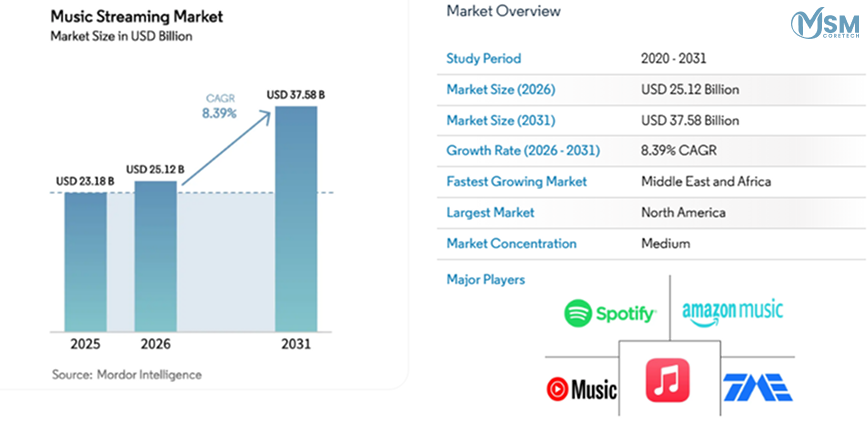
The global music streaming market continues steady growth, driven by rising subscriptions and evolving user experiences. Innovation in AI, content formats, and regional expansion is reshaping how platforms compete and monetize.
- Market to grow from US$23.18 billion (2026) to US$325.12 billion by 2031 at 8.39% CAGR
- On-demand streaming leads with 79.20% share, while live streaming grows fastest at 15.12% CAGR
- Subscription model dominates (64.20%), but ad-supported tier is rising at 8.72% CAGR
- Top 5 platforms hold 72% market revenue, with Spotify leading at 32.2% share
Also Read: Android App Development Trends
What Is a Music Streaming App?
A music streaming app is a cloud-based platform that allows users to listen to audio content in real time without permanently downloading files. These apps rely on Content Delivery Networks (CDNs) to deliver audio with minimal latency, paired with backend systems that manage user accounts, licensing, playlists, and recommendations.
Types of Music Streaming Apps
There are different types of streaming apps serving different purposes. Here are the major types of music streaming apps.
- On-demand apps (Spotify model): Users choose exactly what to play and when to play it, and build personal playlists
- Radio or curated apps (Pandora model): Algorithmically generated stations based on mood or genre, with limited skip controls
- Cloud storage apps: Users upload their own music library and stream it across devices
- Social music apps: Discovery is driven by what friends, influencers, or communities are listening to
- Podcast and music hybrid apps: Platforms like Spotify that combine music streaming with podcast and audio content in a single experience
Music Streaming App Market Overview & Business Opportunity
The dominant platforms have grown into mass-market generalists. They optimize for catalog size and algorithmic scale rather than niche communities, local artists, or deeply personalized experiences. This is exactly where new entrants can win. The market rewards well-built, focused apps that serve underserved audiences.
Where the Gaps Are
- Regional and language-specific music platforms remain largely unserved
- Indie and underground artist discovery tools are almost nonexistent at scale
- High-fidelity audio streaming is still a niche that most platforms treat as an afterthought
- Social listening rooms and community-driven music experiences are early-stage
Also Read: Develop a Food Delivery App Like Deliveroo
Key Features of a Music Streaming App
To make sure a music streaming app is a success, it needs to be packed completely with powerful features. Here are some of the core features that a Music Streaming App development company builds.
Core MVP Features
A Minimum Viable Product focuses on the essential experience that gets users to listen and return.
- User registration and login (email, Google, Apple Sign-In)
- Music player with play, pause, skip, shuffle, and repeat controls
- Search functionality across songs, albums, and artists
- Playlist creation and management
- Basic music library browsing by genre, mood, or album
| Feature Module | MVP Cost Range |
|---|---|
| User Auth and Profiles | $3,000 – $6,000 |
| Music Player Core | $5,000 – $10,000 |
| Search and Discovery | $4,000 – $7,000 |
| Playlist Management | $3,000 – $5,000 |
| Basic Music Library | $3,000 – $6,000 |
| Total MVP Estimate | $15,000 – $40,000 |
Advanced Features
- AI-based music recommendations using collaborative and content-based filtering
- Offline listening with encrypted local storage
- Social sharing to Instagram Stories, WhatsApp, and within the app
- Voice search through Siri, Google Assistant, and in-app voice commands
- Lyrics sync displayed in real time during playback
- Podcast and audio content support alongside music
- Smart device integration with CarPlay, Android Auto, and Alexa
Admin Panel Features
- Content management system for uploading, tagging, and moderating tracks
- User management with roles, permissions, and flagging tools
- Analytics dashboard showing streams, retention, revenue, and churn
App Overview: Feature & Cost
Here is a breakdown of different app types, features, and costs to develop a music streaming app.
| App Type | Features Included | Estimated Cost |
|---|---|---|
| Basic MVP | Auth, Player, Search, Playlists | $15,000 – $40,000 |
| Mid-Level | Above + AI Recs, Offline, Social | $50,000 – $100,000 |
| Advanced | Full feature set + Admin + AI/ML | $150,000 – $300,000 |
| Enterprise | Custom architecture, DRM, global scale | $300,000+ |
Music Streaming App Development Process
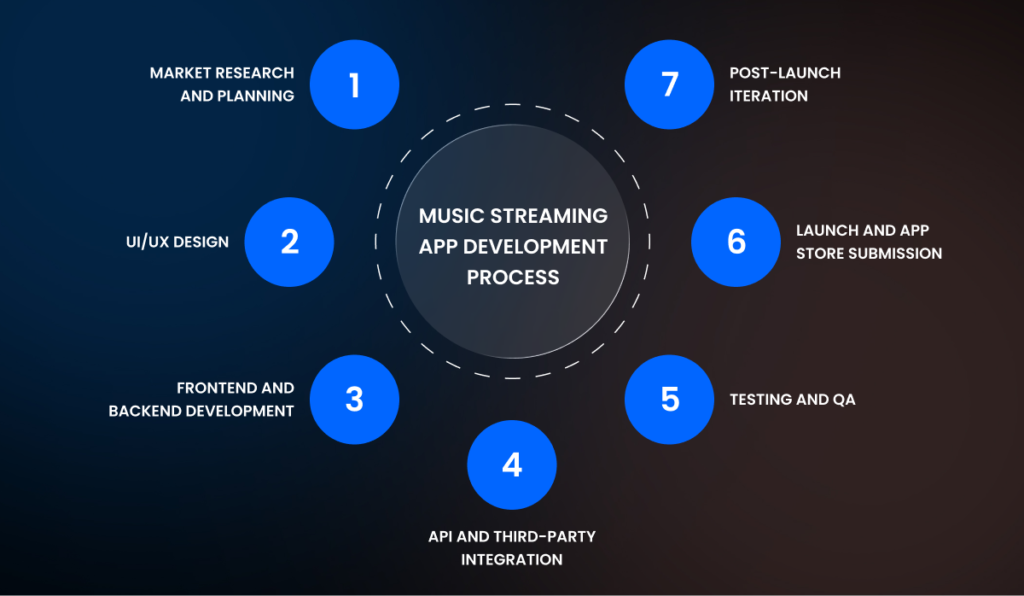
Building a music streaming app is not just about writing code. It follows a structured app development process that reduces rework and keeps the project on time and on budget.
Step 1: Market Research and Planning
Define your target audience, competitor analysis, and feature prioritization. This stage shapes every decision that follows.
Step 2: UI/UX Design
Wireframes, user flows, and high-fidelity mockups are created. Good UX design directly impacts retention. Users who find the app confusing within the first 30 seconds rarely return.
Step 3: Frontend and Backend Development
Frontend handles everything the user sees and interacts with. Backend manages streaming infrastructure, databases, APIs, and real-time data processing.
Step 4: API and Third-Party Integration
Payment gateways, social login, music licensing APIs, CDN services, and analytics tools are integrated at this stage.
Step 5: Testing and QA
Functional testing, performance testing under streaming load, security testing, and device compatibility checks are all conducted before release.
Step 6: Launch and App Store Submission
The app goes through Apple App Store and Google Play review processes. Both platforms have specific audio app requirements that must be met.
Step 7: Post-Launch Iteration
Real-world usage data reveals what users actually do versus what was assumed. Post-launch sprints improve retention, fix edge cases, and add features based on feedback.
Also Read: Fantasy Sports App Development Cost
Cost to Develop a Music Streaming App in 2026
It is very important to know the music streaming app development cost to make an informed decision.
Cost By Development Stage
Here are the music streaming app development costs based on the development stage.
| Development Component | Estimated Cost | Notes |
|---|---|---|
| UI/UX Design | $5,000 – $15,000 | Wireframes, prototypes, design system |
| Frontend Development | $15,000 – $25,000 | React Native or Flutter |
| Backend Development | $20,000 – $35,000 | APIs, streaming, auth, DB |
| Third-Party Integration | $5,000 – $12,000 | Payments, CDN, social login |
| AI/ML Recommendation Engine | $10,000 – $30,000 | Depends on model complexity |
| Testing and QA | $5,000 – $10,000 | Manual and automated |
| DevOps and Deployment | $3,000 – $8,000 | Cloud setup, CI/CD |
| Total (Mid-Level App) | $63,000 – $135,000 | Varies by team location |
Cost by Platform
Here are the music streaming app development costs based on platform type.
| Platform | Development Cost | Notes |
|---|---|---|
| iOS Only | $30,000 – $80,000 | Swift or React Native |
| Android Only | $25,000 – $75,000 | Kotlin or Flutter |
| iOS + Android (Cross-Platform) | $40,000 – $100,000 | React Native or Flutter saves 30-40% |
| Web App (Additional) | $10,000 – $50,000 | Progressive Web App or full web build |
What Can You Build With Your Budget?
Here are the different types of features and music streaming apps you can develop based on your budget range.
| Budget Range | What You Can Build |
|---|---|
| $10,000 – $30,000 | Basic MVP with player, auth, and search on one platform |
| $30,000 – $80,000 | Cross-platform app with playlists, offline mode, and basic recommendations |
| $80,000 – $200,000 | Full-featured app with AI recs, social features, admin panel, and analytics |
| $200,000+ | Enterprise-grade platform with custom streaming infra, DRM, and global CDN |
Music Licensing: The Cost Most Guides Ignore
Music licensing is the most frequently underestimated cost in music app development. You cannot legally stream copyrighted music without proper licensing agreements, and the penalties for non-compliance can end your business before it starts.
Types of Music Licenses You Need
- Performance Rights (PRO License): Covers public performance of copyrighted music. Issued by organizations like ASCAP, BMI, and SESAC in the US
- Master Recording License: Grants rights to stream the actual recorded version of a song. Negotiated directly with record labels
- Mechanical License: Required when music is reproduced. Relevant for offline listening features
- Sync License: Required if music is used alongside video content in your app
Also Read: Build a Food Delivery App Like Uber Eats
Licensing Cost Estimates
| License Type | Estimated Cost |
|---|---|
| PRO License Agreement | $1,500 – $5,000 per agreement |
| Master License (per catalog) | $10,000 – $100,000+ depending on label size |
| Blanket Streaming License (indie catalog) | $2,000 – $15,000 per year |
| DRM Implementation | $5,000 – $20,000 one-time development cost |
| Legal and Compliance Consultation | $3,000 – $10,000 |
The safest starting point for new apps is to license through aggregators like DistroKid, TuneCore, or Epidemic Sound. These services provide access to licensed catalogs at a fraction of the cost of direct label negotiations.
Hidden and Ongoing Costs to Plan For
| Cost Category | Estimated Annual Cost | Notes |
|---|---|---|
| Cloud Infrastructure (AWS/GCP) | $5,000 – $50,000/year | Scales with user base and stream volume |
| CDN Bandwidth | $500 – $10,000/month | Depends on total streaming hours |
| App Maintenance | 15% to 25% of build cost/year | Bug fixes, OS updates, security patches |
| Apple App Store Fee | 30% of in-app revenue | Reduced to 15% for small developers |
| Google Play Fee | 15% to 30% of in-app revenue | 15% on first $1M annually |
| Customer Support Tools | $200 – $2,000/month | Intercom, Zendesk, or custom |
| Security and GDPR Compliance | $3,000 – $15,000/year | Data privacy audits and updates |
Technology Stack for Music Streaming Apps
| Layer | Recommended Tools | Purpose |
|---|---|---|
| Frontend Mobile | React Native, Flutter | Cross-platform UI development |
| Frontend Web | React.js, Next.js | Web app and dashboard |
| Backend | Node.js, Python, Java | APIs, business logic, user management |
| Database | PostgreSQL, MongoDB, Redis | Structured data, caching, sessions |
| Audio Streaming | AWS S3, CloudFront CDN, HLS | Audio file storage and delivery |
| Real-time Processing | Apache Kafka | Event streaming and data pipelines |
| AI and ML | TensorFlow, PyTorch, Scikit-learn | Recommendation engine |
| Payments | Stripe, Razorpay, PayPal | Subscription billing |
| Analytics | Mixpanel, Firebase, Amplitude | User behavior and retention tracking |
Monetization Strategies for Music Apps
A single revenue stream is a fragile business. The most successful music apps combine multiple monetization models from day one.
- Freemium Model: Free tier with ads and limited features. Premium subscription removes ads and unlocks full functionality. Spotify converts roughly 27% of free users to paid.
- Subscription Tiers: Individual, family, and student plans at different price points improve conversion across audience segments.
- In-Stream Advertising: Audio ads between tracks and banner display ads generate revenue from non-paying users through networks like Google AdMob.
- In-App Purchases: One-time purchase of curated playlist packs, exclusive content, or enhanced audio quality tiers.
- White Labeling and Partnerships: License your technology to brands, gyms, or airlines that want custom-branded music experiences.
Also Read: Develop a Food Delivery App Like Hungerstation
Revenue Projection Reference
| Model | Revenue Potential | Best For |
|---|---|---|
| Freemium + Ads | $0.003 – $0.008 per stream | Apps with large free user bases |
| Subscription ($9.99/month) | $120/user/year | Apps targeting premium listeners |
| Family Plan ($14.99/month) | $180/family/year | Household-level retention |
| B2B White Label | $5,000 – $50,000/client/year | Niche and enterprise markets |
Also Read: Develop an App like Talabat
How to Reduce Music App Development Cost
- Start with an MVP: Build only the core listening experience first. Launch, collect user data, and invest in features that real users actually want.
- Use cross-platform frameworks: React Native or Flutter cuts iOS and Android development costs by 30% to 40% compared to two separate native builds.
- Leverage third-party APIs: Use existing solutions for payments (Stripe), auth (Firebase), and CDN (Cloudflare or AWS CloudFront) instead of building custom ones.
- Outsource to India or Eastern Europe: Experienced development teams in India charge $15 to $30 per hour compared to $100 to $200 per hour in the US. MSM CoreTech offers this combination of quality and cost-efficiency.
- Use open-source tools: FFmpeg for audio processing, Elasticsearch for music search, and Redis for caching are battle-tested and free to use.
Also Read: Develop a Food Delivery app like Postmates
Future Trends in Music Streaming Apps
- AI Personalization and Generative Playlists: Real-time mood detection and generative audio playlists created from user listening history will become table stakes.
- Spatial Audio and Dolby Atmos: High-fidelity listening experiences are moving from a premium niche to a mainstream expectation.
- Social and Live Listening Rooms: Shared listening sessions and community radio features create engagement that solo listening cannot replicate.
- Web3 and Tokenized Artist Royalties: Blockchain-based royalty distribution gives artists more transparency and gives superfans a way to invest in the artists they support.
- Voice-First Interfaces: Hands-free control through smart speakers and in-car systems will require apps to be fully functional without screen interaction.
How Long Does It Take to Build a Music Streaming App?
| App Type | Timeline | Key Milestones |
|---|---|---|
| MVP | 2 to 4 months | Design complete at Week 4, Beta at Week 10, Launch at Week 16 |
| Mid-Level App | 4 to 7 months | Feature complete at Month 5, QA at Month 6, Launch at Month 7 |
| Advanced App | 8 to 14 months | Core complete at Month 6, AI integration at Month 10, Launch at Month 14 |
| Enterprise Platform | 12 to 18 months | Infrastructure at Month 4, Licensing at Month 8, Global rollout at Month 18 |
Why Choose MSM CoreTech for Music Streaming App Development?
MSM CoreTech is a full-service mobile app development company with deep experience in building audio streaming platforms, media apps, and AI-driven mobile products. When you partner with MSM CoreTech, you are not hiring a vendor. You are working with a team that understands the full journey from idea to a live, monetizing product.
Our Expertise and Experience
- Years of hands-on experience building mobile and web applications across music, media, and entertainment verticals
- End-to-end delivery covering strategy, design, development, QA, launch, and post-launch growth
- Proven experience with streaming infrastructure, including CDN setup, audio encoding, and real-time playback optimization
What Makes Us Different
- Transparent pricing with detailed estimates and no hidden charges at invoice time
- Agile development process with weekly sprint reviews and regular client updates
- We build for scale from day one so your infrastructure does not need to be rebuilt when your user base grows
- Music licensing consultation support to help you understand your legal obligations before launch
Our Technical Capabilities
- Full-stack expertise: React Native, Flutter, Node.js, Python, AWS, and Google Cloud
- AI and ML integration for personalized recommendation engines
- CDN and streaming architecture design for low-latency global audio delivery
- DRM implementation and content protection systems
Ready to build your music streaming app? Contact MSM CoreTech today for a free consultation and project estimate. We will help you turn your idea into a live product that competes on day one.
Solving Challenges in Music App Development
- Licensing complexity: Securing rights from multiple rights holders across different territories requires legal expertise and budget set aside before development begins.
- Scalability at volume: Streaming infrastructure that works for 1,000 users needs entirely different architecture when handling 1 million concurrent streams.
- Standing out in a saturated market: Feature parity with Spotify is table stakes. Your differentiation needs to be built into the product positioning from day one.
- Managing churn: The average monthly churn rate for music apps is 5% to 8%. Reducing it by even 2% compounds into significant revenue over 12 months.
Conclusion
The music streaming market is large, growing, and still full of opportunities for apps that serve specific audiences better than the generalist platforms. The cost to develop a music streaming app in 2026 ranges from $15,000 for a basic MVP to over $300,000 for an enterprise-grade platform, with the most common mid-level builds sitting between $60,000 and $135,000.
Understanding the full picture, including licensing, infrastructure, and maintenance, is what separates apps that survive their first year from those that do not. The businesses that win in this space start with a clear niche, build an MVP fast, invest in user acquisition through iterate based on real retention data.
MSM CoreTech is ready to help you build that product. Reach out today for a free consultation and a detailed development estimate tailored to your specific idea and budget.
FAQs
A Spotify-like app with full features, including AI recommendations, offline listening, social sharing, and admin tools, costs between $150,000 and $300,000. A focused MVP version can be built for $30,000 to $80,000.
Music licensing is consistently the most underestimated cost. Depending on your catalog size and streaming volume, licensing can cost as much or more than the app development itself.
Yes, when the monetization model is well-designed. Apps using a freemium model with a 25%+ conversion rate and a mix of subscription, ad, and partnership revenue can reach profitability within 18 to 36 months.
Yes. A basic MVP with one platform, core streaming functionality, and simple playlist features can be built within that range, especially with cross-platform frameworks and a development team based in India.
Yes. Streaming copyrighted music without proper licensing agreements is a legal violation that can result in takedowns and significant financial penalties. Licensing should be addressed during the planning phase, not after launch.
India offers the best balance of technical quality, English proficiency, and cost. Hourly rates of $15 to $30 for experienced developers make it possible to build a mid-level music app for a fraction of US or European prices.

Related Posts
How Much Does It Cost to Build A FinTech App Like Revolut?
Today, many people want to manage their money using just one mobile app. With an app like Revolut, users can...
Read More

How to Build A Veterinary Medicine Online Shopping App?
Pet owners today don’t want to drive across town every time their dog needs a flea tablet, or their cat...
Read More
5 Ways Restaurant Technology Is Transforming the Industry
The restaurant industry is changing fast, and technology is now an important part of this change. Restaurants are using technology...
Read More


 Verified Review




 +44 7427829444
 71-75, Shelton Street, Covent Garden, London, United Kingdom, WC2H 9JQ