

Share this article


Top 10 Decentralized Crypto Wallets: Revenue Models & How to Build Your Own Crypto Wallet
Have you ever thought about why decentralized crypto wallets are becoming so popular everywhere?
What is really causing this big shift from traditional banking systems to decentralized digital money?
The answer is simple: the fast growth of blockchain technology and the rising need for safe ways to store digital assets.
The cryptocurrency world is growing very quickly. Because of this, more people now need non-custodial wallets which are digital wallets where users have full control over their private keys and their funds.
In 2026, this trend is expected to grow even more. The crypto wallet market is predicted to increase from $19.03 billion in 2025 to $57.61 billion by 2029, with a strong growth rate of 31.9% each year.
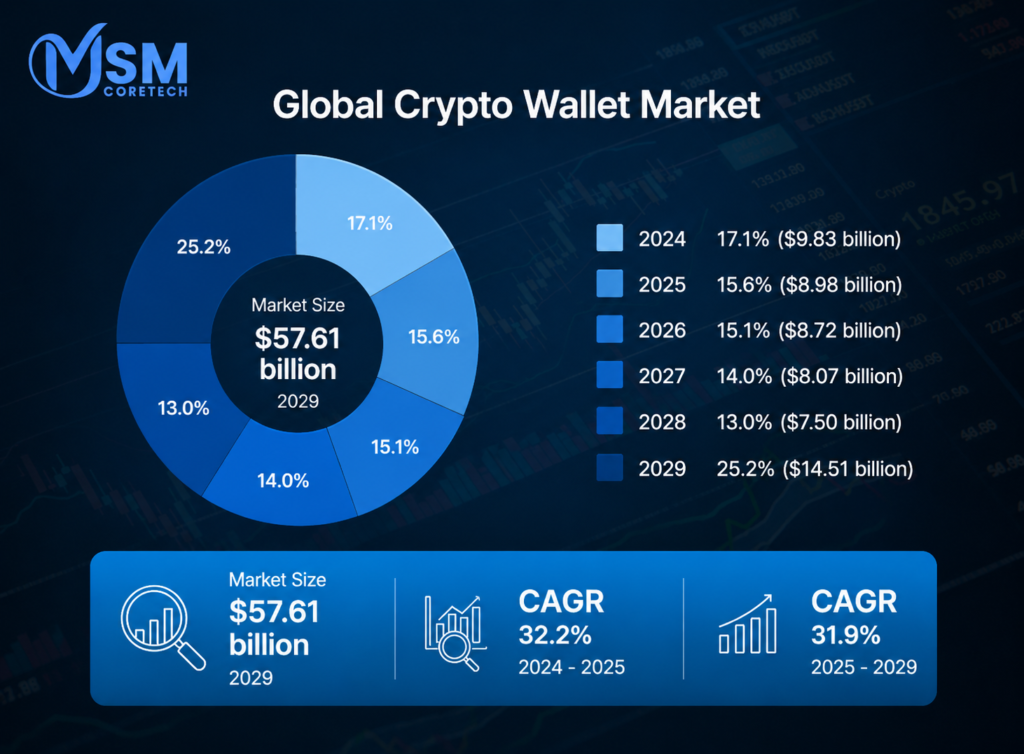
Decentralized crypto wallets market
This huge growth is happening because of several main reasons:
- More people are using cryptocurrencies: As digital currencies become more popular, people need safe and decentralized wallets to store and manage them.
- Growing use of digital assets: Not just individuals, but also big investors are using digital assets more and more. This creates a strong need for wallets that give full control and security over money.
- Increase in mobile and web wallet apps: With better mobile and web technology, decentralized wallets are now easy to use anytime and anywhere.
- Higher demand for hardware wallets: Security is very important, so many users prefer hardware wallets that keep crypto offline and protect it from hackers.
So, what does all this mean?
It means there is a big opportunity for anyone interested in the crypto wallet market, whether you are an investor looking for safe storage options or a business planning to build the next-generation decentralized wallet app.
But with so many choices available, how do you decide which one is best, or what direction to take for your crypto wallet project?
That is where we can help. As a leading decentralized crypto wallet development company, we guide you through the best crypto wallets that can help you protect your digital assets and stay ahead in the market.
In this blog, we will explore the top 10 decentralized crypto wallets in 2026, including their key features, advantages, and disadvantages. We will also help you understand how to build a top decentralized crypto wallet.
Read Also: 9+ Best Construction Software Development Companies in USA
What is a Decentralized Crypto Wallet?
Before we look at the top decentralized wallets of 2026, it’s important to first understand what a decentralized wallet is and why many crypto users prefer it for better control, privacy, and security.
A decentralized wallet, also called a non-custodial wallet, is a type of crypto wallet where you have full control over your digital money. You also control your private keys, which are like secret passwords that prove you own your crypto assets. No bank, exchange, or third party manages your funds. Only you have access and control.
On the other hand, a custodial wallet (also known as a centralized wallet) is managed by a third party, such as a crypto exchange or service provider. In this case, they hold your private keys for you. This makes it easier to use, especially for beginners, and they often provide customer support.
However, the main difference is control and safety. With custodial wallets, you depend on another company to protect your funds, which can sometimes increase the risk of hacks or loss of access.
Here’s the same content in much simpler, easy-to-understand language:
Non-Custodial vs Custodial Wallets
| Feature | Non-custodial Wallet (Decentralized) | Custodial Wallet (Centralized) |
|---|---|---|
| Private Key Ownership | You keep and control your own keys | The company controls your keys |
| Security | More secure because only you control your funds | Security depends on the platform |
| Responsibility | High – you must safely store your keys | Low – the platform takes care of everything |
| Censorship Resistance | Yes – no one can easily stop or control your wallet | Limited – can be restricted by rules or authorities |
| Ease of Use | Medium – a bit more complex to use | Very easy – beginner friendly |
| Best For | People who care about security and long-term holding | Beginners and people who trade casually |
So why does this matter?
As more people need safe ways to store digital money, many are choosing non-custodial wallets. The simple idea is that when you own your private keys, you fully control your money. No third party is involved, there are no location limits, and there is no risk of a central system failing. This is exactly what blockchain and decentralization are all about.
But there is one important point: with more control comes more responsibility. If you own your keys, you must also keep them safe yourself. If you lose them, there is no “forgot password” option to recover your funds. That’s why many modern decentralized wallets include extra safety features like fingerprint or face login, backup of seed phrases, and multi-signature security.
In simple words, a decentralized wallet is not just an app; it’s a way of thinking. It matches the main idea of Web3, which is to give people full freedom, privacy, and control over their digital assets.
Read Also: Top 9 B2B Web Design Companies in USA
Comparison Table: Simple Overview of Top Decentralized Wallets
| Wallet | Supported Cryptos | Key Features | Best For |
|---|---|---|---|
| MetaMask | Ethereum & ERC-20 tokens | dApp integration, token swapping | DeFi users, Ethereum holders |
| Trust Wallet | 160+ cryptocurrencies | Web3 browser, staking | Mobile users, DeFi and NFT users |
| Ledger Nano X | 1800+ cryptocurrencies | Bluetooth, secure hardware chip | Long-term investors |
| Trezor Model T | 1600+ cryptocurrencies | Open-source, passphrase support | Security-focused users |
| Exodus | 100+ cryptocurrencies | Built-in exchange, portfolio tracking | Traders, portfolio users |
| Atomic Wallet | 500+ cryptocurrencies | Staking, built-in exchange | Users with mixed portfolios |
| Coinomi | 1770+ cryptocurrencies | Exchange, dApp browser | Privacy-focused users |
| Mycelium | Bitcoin, Ethereum | CoinJoin privacy feature | Bitcoin and privacy users |
| ZenGo | Bitcoin, Ethereum | MPC security, biometric login | Beginners and casual users |
| BitPay | Bitcoin, Bitcoin Cash | Payment integration | Retail payments users |
Read Also: 9+ Best Travel App Development Companies in USA
Key Criteria for Selecting the Best Decentralized Wallets
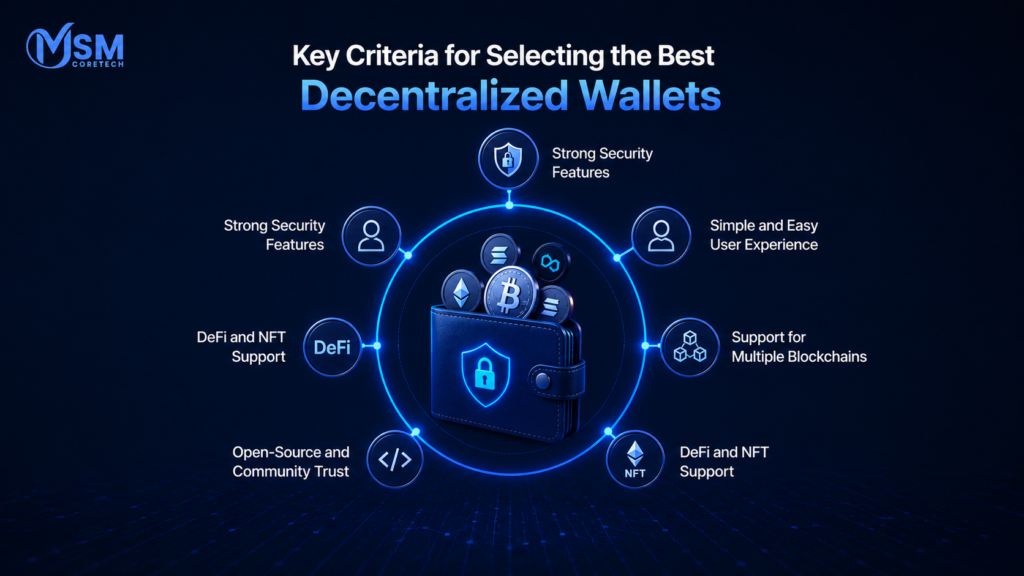
Whether you are new to crypto or already experienced in DeFi, picking the right wallet is not just about how it looks. It is mainly about security, ease of use, and whether it will continue to work well as your crypto needs grow over time.
To help you choose better, we have explained the most important features of a good crypto wallet today. These are not just trendy words but essential things you really need in a fast-changing crypto world.
Strong Security Features
Security is the most important thing. A good decentralized wallet must have strong protection like end-to-end encryption, two-factor authentication (2FA), and safe private key storage. Some wallets also connect with hardware devices or use fingerprint/face recognition for extra safety. Many wallets now also use multi-signature, which means more than one approval is needed before a transaction happens, making it even safer.
Simple and Easy User Experience
Even if a wallet is very secure, it is not useful if it is hard to use. The best wallets today focus on a clean and easy design so users can quickly understand everything. Whether you are sending tokens, staking coins, or swapping assets across networks, the process should feel smooth and easy for both beginners and advanced users.
Support for Multiple Blockchains
Single-chain wallets are no longer enough. In 2026, a good wallet must support many blockchains like Ethereum, Binance Smart Chain, Polygon, Avalanche, Solana, and more. This multi-chain support lets users access more opportunities without needing to switch between different wallets.
DeFi and NFT Support
Modern wallets are not just for storing crypto. They also act as a gateway to Web3. This means they should support DeFi features like staking, farming, and lending, as well as NFT features. Good wallets also include dApp browsers, NFT galleries, and easy access to decentralized exchanges and lending platforms, all in one place.
Open-Source and Community Trust
A wallet is more trusted when its code is open for everyone to see. Open-source development allows developers around the world to check the code for safety and issues. When combined with an active community, regular updates, and strong developer support, it builds real trust among users, which is very important.
These five points are the main standards to judge any decentralized wallet in 2026. Whether you use it for daily transactions, DeFi earning, NFT trading, or long-term storage, these features help ensure your wallet is safe, flexible, and ready for the future.
Also, as a decentralized crypto wallet development company, these same principles are used in every product we build, so we can deliver secure, modern, and future-ready solutions for users.
Read Also: Cost To Develop A Travel App Like Booking.com
Top 10 Decentralized Crypto Wallets in 2026
With so many wallets available today, it can be hard to know which ones are actually safe and reliable and which are just hype.
That’s why we’ve carefully selected and reviewed the top 10 decentralized crypto wallets in 2026. We looked at important factors like security, support for different blockchains, dApp connectivity, NFT support, ease of use, and overall performance. These wallets are not just apps; they are key tools powering the future of decentralized finance.
Let’s start with one of the most well-known names in Web3.
1. MetaMask
MetaMask is still one of the most popular Ethereum wallets in 2026. It has millions of users around the world and is widely used in DeFi and NFT platforms. Many people see it as a gateway to the decentralized internet.
It was first made for Ethereum, but now it also works with many other Ethereum-compatible blockchains. This means you can manage different tokens and use dApps across multiple networks in one place. It is available as a browser extension and a mobile app, making it easy for both beginners and advanced users.
Key Features:
- Available as a browser extension (Chrome, Brave, Firefox, Edge) and also as a mobile app (iOS and Android)
- Supports Ethereum and ERC-20 tokens, and also allows adding other networks like Polygon, Arbitrum, BNB Smart Chain, and Avalanche
- Built-in swap feature that helps you exchange tokens by comparing prices from different decentralized exchanges
- Easy connection with popular dApps and NFT platforms like Uniswap, OpenSea, and Aave
- Syncs between mobile and desktop for a smooth experience
Pros:
- Very easy to use, especially for people new to crypto
- Strong dApp support, allowing access to DeFi trading, NFTs, and DAO activities
- Open-source and regularly checked for security, supported by a large development community
Cons:
- Mainly focused on Ethereum and EVM networks, so it doesn’t natively support blockchains like Solana
- Security depends on user safety; it can be risky if users fall for phishing or unsafe websites
Read Also: 9+ Best Subscription App Development Companies in USA
2. Trust Wallet
Trust Wallet is a popular decentralized crypto wallet that is supported by Binance but is still non-custodial, meaning users fully control their own funds and private keys. In 2026, it became one of the most widely used wallets because it is simple, flexible, and supports many different blockchains. It works with networks like Ethereum, BNB Smart Chain, Solana, Avalanche, and many others, which makes it a great choice for people who want to manage different types of crypto in one place.
This wallet is mainly designed for mobile users and is open-source. It allows users to store and manage crypto, use DeFi apps, browse dApps, and collect NFTs directly inside the app. Everything can be done without needing separate tools or platforms.
Key Features:
- Supports 70+ blockchains and more than 4.5 million crypto assets, including tokens and NFTs.
- Built-in Web3 browser to easily access DeFi platforms and dApps.
- Lets users buy crypto and stake coins like BNB, TRX, and ATOM inside the app.
- Strong security with biometric login and full control of private keys.
- Works with both EVM and non-EVM blockchains like Solana and Tezos.
Pros:
- Very strong multi-chain support compared to many other wallets.
- Easy-to-use design, good for beginners as well as experienced users.
- All-in-one access to DeFi, staking, and NFTs in one app.
- Open-source and trusted by the community with regular updates.
Cons:
- Only available on mobile; no desktop or browser extension version.
- Web3 browser is not as advanced as MetaMask on desktop.
- Some dApps do not fully support mobile linking, which can limit usage in certain cases.
Read Also: Cost to Develop a Hotel Booking App Like Agoda
3. Ledger Nano X
In 2026, the Ledger Nano X is still one of the most trusted choices for people who want strong security for their crypto. It is a hardware wallet, which means it stores your private keys offline. This keeps your crypto safe from hackers, viruses, and online attacks, making it a popular option for cold storage.
It also offers a good balance of security and convenience. With Bluetooth support, you can connect it to your mobile phone using the Ledger Live app. This makes it easy to manage your crypto anytime, whether you are a long-term investor or someone who trades more often.
Key Features:
- Bluetooth hardware wallet that works with iOS and Android through the Ledger Live app
- Supports more than 1,800 cryptocurrencies like Bitcoin, Ethereum, Solana, XRP, and ERC-20 tokens
- Uses a Secure Element (SE) chip, similar to the technology used in passports and bank cards
- Offers extra protection like passphrase security and two-factor authentication
Pros:
- Very strong cold storage security, great for large crypto holdings
- Small and portable, easy to carry safely
- Ledger Live app allows tracking your portfolio, staking coins, and exchanging crypto
Cons:
- You need to buy the physical device first
- Costs more at the start compared to software wallets
4. Trezor Model T
The Trezor Model T by SatoshiLabs is still one of the most trusted crypto hardware wallets in 2026. It is known for its open-source software and easy-to-use touchscreen, making it popular among experienced crypto users and people who care about privacy.
It also offers strong security features like passphrase protection and a secure boot system. Because of this, users feel confident that they have full control of their crypto and that everything is transparent and safe. It also supports many different cryptocurrencies.
Key Features:
- Easy-to-use touchscreen for checking and approving transactions
- Supports more than 1,600 cryptocurrencies, including Bitcoin (BTC), Ethereum (ETH), Cardano (ADA), and Polkadot (DOT)
- Open-source software that anyone can review for transparency
- Shamir Backup, which gives extra recovery options and better security
Pros:
- Very strong security with full control of your private keys
- Touchscreen makes it simple to use, even for complex tasks
- Works well with popular software wallets and DeFi platforms
Cons:
- You need to buy a physical device to use it
- More expensive than basic or entry-level hardware wallets
Read Also: 9+ Best Legal Software Development Companies in USA
5. Exodus
If you want a crypto wallet that looks nice, is easy to use, and works mainly on desktop, Exodus is a strong option in 2026. It also has built-in exchange features. It is designed to be simple for beginners while still offering useful tools like portfolio tracking and support for many different cryptocurrencies. It can also connect with Trezor hardware wallets if you want extra security.
This wallet is a good choice for people who want a self-custody wallet but are not ready to use a hardware wallet from the start.
Key Features:
- Works on desktop, mobile, and as a browser extension
- Supports 100+ cryptocurrencies like BTC, ETH, LTC, SOL, and more
- Built-in crypto exchange for easy swapping with good rates
- Shows real-time portfolio tracking and price updates
- Can connect with Trezor hardware wallets for cold storage
Pros:
- Simple and attractive design, great for beginners
- Regular updates and helpful customer support
- All-in-one tool: wallet, exchange, and portfolio tracking in one place
Cons:
- Not open-source, which may not be preferred by some users
- Does not include advanced DeFi features or staking tools for expert users
Read Also: How to Create a Real Estate Website
6. Atomic Wallet
Atomic Wallet is a popular crypto wallet in 2026 that lets you manage many cryptocurrencies in one place. It is easy to use and suitable for beginners as well as people with some experience in crypto.
With this wallet, you can store, send, receive, and also exchange and stake your crypto directly inside the app. It uses atomic swap technology, which helps users trade crypto safely without needing a middleman.
It supports more than 500 cryptocurrencies, including Bitcoin (BTC), Ethereum (ETH), and many other altcoins.
This wallet works on multiple devices like Windows, macOS, Android, and iOS, so you can use it on both desktop and mobile.
It is a non-custodial wallet, which means you fully control your private keys and your funds.
Key Features:
- Supports 500+ cryptocurrencies such as BTC, ETH, XRP, LTC, and more
- Built-in options for exchanging and staking crypto
- Works on desktop and mobile (Windows, macOS, Android, iOS)
- Non-custodial, so you have full control of your private keys
Pros:
- Supports a large number of coins, good for diverse portfolios
- Easy-to-use and clean interface
- Built-in staking for coins like ATOM, ZIL, and ADA
Cons:
- Some exchange and staking features may require KYC verification
- Customer support is limited to email and support tickets
Read Also: 9+ Best Pet Care App Development Companies in USA
7. Coinomi
Coinomi is an old and trusted crypto wallet that is still popular in 2026. It is mainly known for focusing on user privacy. It supports more than 1,770 cryptocurrencies, so users can store a wide variety of coins in one place. It is a good choice for people who care about privacy and want to hold their crypto for a long time.
It also supports multiple blockchains and has a built-in dApp browser, which makes it useful for users who use DeFi and Web3 apps.
Key Features:
- Supports 1,770+ cryptocurrencies like BTC, ETH, LTC, and DASH
- Built-in exchange tool to easily swap crypto assets
- Strong privacy features – does not link identity or track IP
- Works on both desktop and mobile devices
Pros:
- Very strong focus on user privacy
- Supports many different coins and tokens
- Built-in browser for decentralized apps (dApps)
Cons:
- User interface looks a bit old and less modern
- Does not offer advanced trading or deep DeFi features
Read Also: 9+ Best SaaS Development Companies in the USA
8. Mycelium
Mycelium is one of the oldest and most trusted mobile crypto wallets. It is mainly made for users who care a lot about privacy and want more control over their crypto.
In 2026, it is still known for strong security. It also offers special privacy tools like CoinJoin for Bitcoin and supports hardware wallets.
It is mostly designed for Bitcoin users, but it also supports Ethereum and ERC-20 tokens. It gives advanced control, but it does not have many extra features.
Key Features:
- Mobile-only wallet for Android and iOS
- Supports Bitcoin, Ethereum, and some ERC-20 tokens
- Privacy tools like CoinJoin and address rotation
- Works with hardware wallets like Trezor and Ledger
Pros:
- Strong privacy and anonymity features
- Open-source and regularly updated
- Easy connection with hardware wallets
Cons:
- Not easy for beginners to use
- Supports fewer cryptocurrencies compared to other wallets
Read Also: 9+ Best HR Software Development Companies in the USA
9. ZenGo
ZenGo is a crypto wallet that focuses on making security simple. Instead of using traditional private keys, it uses a system called Multi-Party Computation (MPC). This removes one of the biggest problems in crypto wallets: losing your private key. In 2026, ZenGo is popular among beginners because it is easy to use and offers biometric login.
Key Features:
- Uses MPC security, so there is no need to store private keys or backup seed phrases.
- Supports major cryptocurrencies like Bitcoin, Ethereum, Dogecoin, and more.
- Offers biometric login and account recovery using an encrypted face scan.
- Available on both iOS and Android devices.
Pros:
- Very beginner-friendly since you don’t need to manage seed phrases.
- Secure and convenient with biometric and cloud-based recovery options.
- Simple and clean design that is easy to understand and use.
Cons:
- Supports fewer cryptocurrencies compared to some other multi-asset wallets.
- Some users may worry about cloud storage and centralization risks.
Read Also: 9+ Best Cybersecurity Software Development Companies in the USA
10. BitPay Wallet
BitPay Wallet is mainly made for using Bitcoin to make payments, especially in stores and for everyday purchases. In 2026, it is still popular because it also supports a few other cryptocurrencies and works well with the BitPay payment system. It is a good option for people who want to spend crypto instead of just keeping it.
Key Features:
- Supports Bitcoin, Bitcoin Cash, Ethereum, and stablecoins like USDC.
- Works with the BitPay Card so you can spend crypto in real life.
- Allows buying gift cards and making crypto payments easily.
- Designed to be simple and works well with merchants.
Pros:
- Great for spending Bitcoin and stablecoins.
- Easy to use and very fast.
- BitPay Card helps you use crypto in everyday life.
Cons:
- Mostly focused on Bitcoin, so not the best for holding many different coins.
- Does not offer much support for DeFi, staking, or dApps.
Read Also: Develop Logistic App Like Amazon Flex
How to Build a Top Decentralized Crypto Wallet in 2026
In 2026, more and more people are using decentralized crypto wallets because they want full control over their money. Unlike traditional wallets, these wallets let users keep their own private keys, which means only they control their funds. They also support DeFi, NFTs, and multiple blockchains.
So, how can you build a successful decentralized crypto wallet that people actually use in a competitive market?
Let’s understand it step by step in a very simple way.
Step 1: Decide the Purpose and Users of Your Wallet
Before building anything, you need to be clear about what your wallet will do and who will use it.
Your wallet can focus on things like:
- Supporting many blockchains like Ethereum, Bitcoin, Solana, Polygon, BNB Chain, etc.
- DeFi features like staking, lending, and earning rewards
- NFT storage, buying, and selling
- Business or enterprise use, including future CBDC support
When you are clear about the goal, it becomes easier to build the right product without confusion or extra work.
Step 2: Make Security Your First Priority
Security is the most important part of a crypto wallet. People will only trust your wallet if their money is safe.
You should include:
- MPC (Multi-Party Computation) for safer key management
- Biometric login like fingerprint or face unlock
- Cold storage and hardware wallet support for extra protection
- Strong encryption for data, transactions, and backups
Good security builds trust, and trust helps your wallet grow.
Step 3: Keep the Design Simple and Easy to Use
A wallet should not be complicated. Even if it is powerful, users should be able to use it easily.
Focus on:
- Mobile-friendly app with a web version
- Simple and clean design for beginners and experts
- Options to customize the look and features
A smooth user experience helps more people use your wallet without confusion.
Step 4: Support Multiple Blockchains and Tokens
Today, users don’t use just one blockchain. So your wallet must support many networks.
You should include:
- Popular blockchains like Ethereum, Bitcoin, Solana, Polygon, BNB, Avalanche
- Cross-chain transfers and swapping
- Support for tokens, stablecoins, NFTs, and governance tokens
This makes your wallet a complete place for managing all crypto assets.
Read Also: How Fintech Apps Make Money
Step 5: Add DeFi, NFTs, and Web3 Features
Modern users expect more than just storage. Your wallet should also connect them to Web3.
Include features like:
- Staking and earning rewards inside the wallet
- NFT storage, creation, and marketplaces
- Built-in browser for using DeFi apps
- Easy access to liquidity across chains
This turns your wallet into a full Web3 platform, not just a storage app.
Step 6: Follow Rules and Make It Scalable
Crypto rules are becoming stricter in many countries like the US, UAE, Europe, and Asia. So your wallet must be ready for regulations.
Make sure your wallet:
- Follows KYC and AML rules when needed
- Can support CBDC (digital currency from governments) in the future
- Is built in a way that it can grow easily for big companies and users
This helps you avoid legal issues and makes your wallet more trusted.
Step 7: Work With Experts in Wallet Development
Building a secure and advanced crypto wallet is not easy. You need experts who understand blockchain technology.
A good development partner should know:
- Blockchain systems and smart contracts
- Easy and clean UI/UX design for users
- Security testing and audits
- Ongoing support and updates
Working with a professional crypto wallet development company like MSM CoreTech can help you build a wallet that is secure, scalable, and ready for the future.

Why MSM CoreTech is the #1 Choice for Decentralized Crypto Wallet Development in 2026
In 2026, MSM CoreTech became one of the top companies for decentralized crypto wallet development. This is because the company combines strong blockchain knowledge, AI technology, and secure coding practices. With more than 6 years of experience and clients from around the world, MSM CoreTech builds modern decentralized apps that give users full control over their digital money.
One major reason companies trust MSM CoreTech is its strong focus on blockchain technology. The team creates secure non-custodial wallets, which means users always keep full control of their private keys. They also build wallets that support multiple blockchains and include features like DeFi and NFT integration, making them ready for the future of Web3.
Security is another key strength of the company. MSM CoreTech uses advanced encryption methods, smart contract audits, and strong authentication systems to keep digital assets safe from hackers and cyber threats. Their focus on transparency and decentralized systems makes their wallets very reliable for startups as well as large businesses.
MSM CoreTech also uses AI in its development process. With the help of artificial intelligence, they improve transaction tracking, detect fraud more effectively, and create a better, more personalized user experience. This makes their wallets smarter and easier to use.
In addition, the company provides complete development services. This includes UI/UX design, backend development, app deployment, and support after launch. Their agile working style helps deliver projects faster, in a scalable and cost-friendly way for clients around the world.
With a strong history of successful projects and clients from many countries, MSM CoreTech continues to be a top choice for businesses that want secure, scalable, and high-performance decentralized crypto wallets in 2026.
Conclusion
Decentralized crypto wallets are now a very important part of modern digital finance in 2026. As blockchain technology is growing fast, more people are using non-custodial wallets. These wallets let users fully control their private keys, keep their assets more secure, and truly own their digital money.
In this blog, we discussed the top 10 decentralized crypto wallets. Each wallet has its own benefits, such as support for multiple blockchains, DeFi and NFT features, strong mobile and hardware security, and simple, easy-to-use designs. Some popular software wallets like MetaMask and Trust Wallet are widely used, while hardware wallets like Ledger Nano X and Trezor Model T offer extra security. Together, these wallets are helping shape the future of Web3.
We also learned that building a good decentralized crypto wallet is not only about writing code. It needs proper planning, strong security, a smooth user experience, support for multiple blockchains, and connection with DeFi and NFT platforms. Most importantly, it needs expert developers to make sure the wallet is safe, scalable, and ready for long-term use.
In today’s fast-growing and competitive market, choosing the right development partner is very important. Companies like MSM CoreTech are helping businesses build secure, AI-based, and future-ready crypto wallet solutions that match global standards and user needs.
In short, decentralized wallets are more than just tools to store crypto; they are becoming the base of the Web3 world. Businesses and users who start using the right wallet solutions now will be better prepared for the future of digital finance.
FAQs
A decentralized crypto wallet (non-custodial wallet) is a digital wallet where users fully control their private keys and funds. No third party like a bank or exchange manages your assets, giving you complete ownership and control.
In a custodial wallet, a third party stores your private keys and manages your funds. In a non-custodial wallet, you control your own private keys. Non-custodial wallets offer more security and control, but also require users to manage their own backup and safety.
Some of the most popular wallets in 2026 include MetaMask, Trust Wallet, Ledger Nano X, Trezor Model T, Exodus, Atomic Wallet, Coinomi, Mycelium, ZenGo, and BitPay Wallet. Each wallet offers different features for DeFi, NFTs, security, and payments.
A good wallet should offer strong security, multi-blockchain support, a simple user interface, DeFi and NFT integration, and open-source transparency. These features ensure safety, flexibility, and better user experience in Web3.
To build a crypto wallet, you need to define your purpose, focus on strong security, support multiple blockchains, and add DeFi and NFT features. It is also important to work with experienced blockchain developers to ensure the wallet is secure, scalable, and future-ready.

Related Posts

Top 10 Dating App Development Companies in Australia
The way Australians meet and build relationships has changed dramatically over the past decade. Mobile dating apps have become a...
Read More
Top 7 React Native App Development Companies in Australia
Mobile apps are now a vital part of business growth across Australia. From fintech startups in Sydney and healthcare providers...
Read More
Top 5 Android App Development Companies in Australia
Android is the world’s most widely used mobile operating system, making it an ideal platform for businesses looking to reach...
Read More


 Verified Review




 +44 7427829444
 71-75, Shelton Street, Covent Garden, London, United Kingdom, WC2H 9JQ