

Share this article


AI in Restaurant Industry: Use Cases, Cost, and Development Guide
Artificial Intelligence (AI) is changing the restaurant industry by making everyday work easier, faster, and smarter. It helps restaurants take online orders, manage inventory, and predict customer demand. AI also reduces manual work, improves customer service, and helps restaurants grow their business. Today, many small and large restaurants use AI to make their daily operations more efficient.
Restaurants are using AI because customers now expect faster and better service. People want quick food ordering, easy table booking, and food suggestions based on their preferences. AI helps restaurants meet these needs by handling routine tasks automatically, understanding customer choices, and providing useful real-time information. It also helps restaurant owners make better business decisions using accurate data instead of guessing.
AI offers many benefits for both restaurant owners and customers. For restaurant owners, it helps reduce operating costs, improve staff productivity, manage inventory better, reduce food waste, and increase profits. AI can also predict busy hours, improve the menu, and make sure orders are more accurate.
For customers, AI makes dining easier and more enjoyable. It provides personalized food recommendations, faster ordering, shorter waiting times, secure online payments, and quick support through AI chatbots.
As AI technology continues to grow, more restaurants are using AI-powered solutions to stay ahead of the competition. Whether it is a small café or a large restaurant chain, AI helps improve service, increase efficiency, and support long-term business growth.

Restaurant Industry Market Overview
The restaurant industry is changing quickly, and more restaurants are using digital technology to improve their services. Artificial Intelligence (AI) is playing a big role in this growth. According to Grand View Research, the global restaurant management software market was worth USD 6.6 billion in 2025. It is expected to grow to USD 24.1 billion by 2033, with a CAGR of 18.0%. This growth is happening because more restaurants are using online ordering, cloud-based POS systems, AI-powered data analysis, and automated tools to manage their daily operations.
The use of AI in the food and restaurant industry is also increasing. A 2025 Deloitte survey found that 82% of restaurant executives plan to spend more on AI in the next fiscal year. Today, many restaurants use AI to answer customer questions, suggest menu items, manage inventory, predict customer demand, and automate order processing. These AI solutions help restaurants work more efficiently and provide a better experience for their customers.
In the future, AI will keep changing the restaurant industry with features like voice ordering, robotic kitchens, smart inventory management, personalized dining experiences, and predictive analytics. These technologies will help restaurants, startups, and business owners lower costs, increase profits, serve customers faster, and provide a more personalized dining experience.
Read Also: Cost To Develop A Restaurant App Like OpenTable
What Is AI in the Restaurant Industry?
Artificial Intelligence (AI) in the restaurant industry means using smart technology to help restaurants work better, faster, and more easily. AI can learn from data, understand what customers like, and handle many tasks that people usually do. This helps restaurants run smoothly, serve customers better, and make better business decisions. Many businesses also partner with a restaurant app development company to build AI-powered restaurant apps that improve customer experience and simplify daily operations.
AI is changing how restaurants work every day. It can take online orders, answer customer questions through chatbots, suggest food based on customer choices, and manage table bookings. AI can also predict busy hours, reduce food waste, keep track of food stock, and help manage staff schedules. In the kitchen, AI-powered tools can help prepare food and check cooking quality. These smart solutions save time, reduce costs, and give customers a better dining experience.
Restaurants use different AI technologies to help with different daily tasks.
Machine Learning (ML) studies customer data and helps restaurants understand what customers like. It can also predict which menu items will be popular and when the restaurant will be busiest. Natural Language Processing (NLP) helps chatbots and voice assistants understand what customers are saying and reply with the right answers.
Computer Vision uses cameras and AI to check food quality, identify ingredients, and help improve kitchen work. Predictive Analytics looks at past data to predict future customer demand. This helps restaurants prepare the right amount of food, avoid food waste, and manage supplies better.
Many restaurants also use Cloud Computing and Internet of Things (IoT) devices to connect kitchen equipment, inventory, and management systems. This allows everything to work together and share information in real time.
By using these AI technologies, restaurants can work more efficiently, provide a better experience for customers, reduce waste, and grow their business more successfully.
Read Also: How to Build a Restaurant App: A Complete Guide
How Does AI Work in the Restaurant Industry?
AI works by collecting information, studying it, making smart decisions, and learning from the results over time. It helps restaurants give better customer service, lower costs, and manage daily work more smoothly.
Data Collection
AI collects information from many places, such as online food orders, table bookings, customer reviews, payment details, loyalty programs, and kitchen activities. It also collects details about what customers like to eat, which menu items are ordered the most, and the busiest times of the day. This information helps AI understand how the restaurant is performing and where improvements can be made.
AI-Powered Analysis
After collecting the data, AI looks at it carefully to understand what is happening. It finds useful patterns and trends. For example, it can show which dishes sell the most, predict busy restaurant hours, understand what customers like, and notice changes in customer demand. This information helps restaurant owners make better business decisions.
Decision-Making and Automation
After studying the data, AI can handle many daily tasks automatically. It can suggest menu items to customers, manage food inventory, create staff schedules, process online orders, answer customer questions through chatbots, and send personalized offers. This saves time, reduces manual work, and helps restaurants provide better customer service.
Continuous Learning and Improvement
AI keeps learning from new data every day. As more customers place orders and give feedback, the system becomes smarter and works better. Over time, it understands customer needs more accurately. This helps restaurants improve their service, work more efficiently, reduce food waste, and give customers a better dining experience.
Top AI Use Cases in the Restaurant Industry
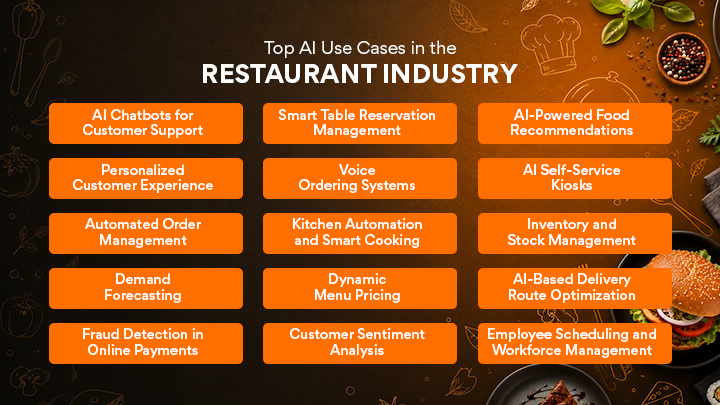
Artificial Intelligence (AI) is helping restaurants improve the way they work and serve customers. From taking orders to managing inventory, AI can automate many daily tasks, reduce mistakes, and save time. It also helps restaurants understand customer preferences and make better business decisions. Here are some of the most common AI use cases in the restaurant industry.
AI Chatbots for Customer Support
AI chatbots can help customers at any time, day or night. They answer common questions, show the menu, help place food orders, book tables, and let customers track their deliveries. Customers get quick answers without waiting for restaurant staff. This improves customer service and reduces the workload of restaurant employees.
Smart Table Reservation Management
AI makes table booking simple and easy. It automatically manages reservations, suggests available time slots, and helps prevent double bookings. It can also predict when customers may not show up by using past booking data. This helps restaurants use their tables better and serve more customers smoothly.
Read Also: Cost To Develop a Restaurant App Like TheFork
AI-Powered Food Recommendations
AI looks at what customers ordered before, their favorite foods, and what they like to eat. Based on this, it suggests meals they may enjoy. These personal suggestions make the dining experience better and often encourage customers to order more food.
Personalized Customer Experience
Every customer likes different types of food. AI uses details like past orders, food choices, and special occasions to give each customer a more personal experience. Restaurants can send special offers, discounts, and food suggestions that match each customer’s interests.
Voice Ordering Systems
Voice AI lets customers order food by simply speaking. They can use their voice through a mobile app, smart device, or drive-thru system. This makes ordering quicker, reduces the need to type, and helps avoid order mistakes.
AI Self-Service Kiosks
Many restaurants use AI-powered self-service kiosks to make ordering easier. Customers can look at the menu, choose and customize their food, and pay on their own without standing in a long line. AI can also suggest extra items during checkout, which helps restaurants increase their sales.
Automated Order Management
AI automatically takes customer orders, arranges them, and sends them to the kitchen. It also tracks each order and helps the kitchen staff prepare food in the right order. This helps reduce delays and makes the service faster.
Kitchen Automation and Smart Cooking
AI-powered kitchen machines help chefs cook food more accurately. These smart systems check the cooking temperature, cooking time, and food quality to keep the taste consistent and reduce food waste.
Inventory and Stock Management
AI makes it easier to manage restaurant inventory. It keeps track of ingredients in real time, checks stock levels, and lets managers know when items are running low. AI also helps reduce food waste by predicting how much food will be needed each day.
Demand Forecasting
AI studies past sales, holidays, weather, and local events to predict how many customers are likely to visit. This helps restaurants prepare the right amount of food, schedule enough staff, and avoid running out of ingredients or wasting food.
Dynamic Menu Pricing
AI can change menu prices based on customer demand, ingredient costs, special events, or busy times of the day. This helps restaurants increase their revenue while still keeping their prices competitive for customers.
Read Also: Top 5 Hotel and Restaurant Website Design Companies
AI-Based Delivery Route Optimization
AI helps restaurants deliver food faster by choosing the best delivery route. It checks traffic, distance, and multiple orders to find the quickest path. This helps reduce delivery time and keeps customers happy.
Fraud Detection in Online Payments
AI helps keep online payments safe by finding unusual or suspicious payment activity. If it detects anything suspicious, it can alert the restaurant or stop the payment. This helps prevent fraud and makes online payments more secure for both customers and restaurants.
Customer Sentiment Analysis
AI looks at customer reviews, ratings, and social media comments to understand what people think about a restaurant. It finds common complaints and positive feedback. This helps restaurant owners improve their food, service, and overall customer experience.
Employee Scheduling and Workforce Management
AI helps restaurant managers make employee work schedules based on how many customers are expected, when employees are available, and the restaurant’s working hours. This helps make sure there are enough staff during busy hours and fewer staff during slow hours. As a result, work becomes more organized, employees stay productive, and the restaurant can reduce labor costs.
AI is improving every part of the restaurant business, from customer service and kitchen operations to inventory management and business planning. It can handle many routine tasks automatically, help managers make better decisions, and give customers a more personalized experience. This allows restaurants to work more efficiently, save time, lower costs, and provide faster and better service. As AI technology continues to improve, more restaurants are using these smart tools to stay competitive and give every customer a better dining experience.
Read Also: Top 10 Online Restaurant Ordering Apps in USA
Key Features of an AI Restaurant Solution
An AI restaurant solution comes with many helpful features for customers, restaurants, and admins. These features make it easier to serve customers, reduce manual work, and help restaurants run their daily operations more smoothly. A trusted aI app development company can build these smart solutions to meet the unique needs of restaurants.
Customer Features
Customers can easily search for their favorite food using AI-powered search. The app also suggests dishes based on what they like and what they have ordered before. Customers can order food online, book a table, and track their orders in real time. It offers secure payment options, so payments are safe and easy. Customers can also leave reviews and ratings to share their experience. Loyalty programs reward regular customers with points, discounts, and special offers for ordering again.
Restaurant Features
Restaurant owners can easily update their food menu using the menu management feature. They can also manage and track customer orders with the order management system. Inventory tracking helps keep an eye on food stock and reduces waste. Customer analytics show what customers like and how they order. AI sales forecasting helps predict future food demand, so restaurants can prepare for busy times. The system also includes staff management to organize employee schedules and promotion management to create special offers and marketing campaigns.
Admin Features
The admin panel gives a complete dashboard to track the overall business performance. It includes user management to manage customer and staff accounts, and restaurant management to handle restaurant details. AI reporting creates helpful business reports and insights. Revenue tracking helps monitor income and sales. Notification management sends important updates to users, and security controls keep customer information safe and protect the system from unauthorized access.
Benefits of AI in the Restaurant Industry
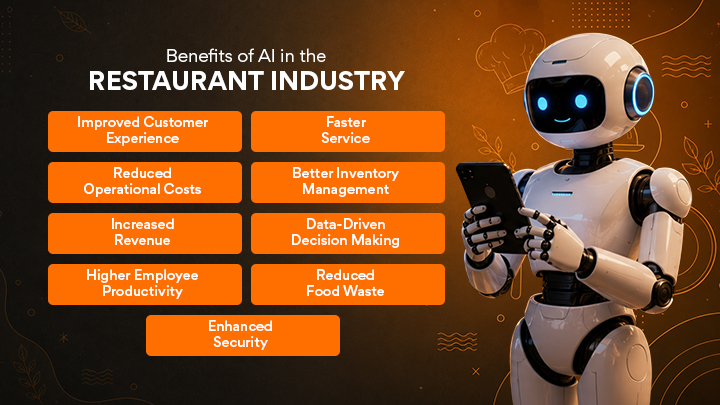
Artificial Intelligence (AI) is helping restaurants improve their daily operations and provide better services to customers. From taking orders to managing inventory, AI makes restaurant management faster, smarter, and more efficient.
Improved Customer Experience
AI helps restaurants give customers a better experience. It suggests food based on what customers like, makes table booking quick and easy, and answers questions through chatbots. This makes dining more enjoyable and hassle-free.
Read Also: Food Delivery App Like Deliveroo: A Complete Guide
Faster Service
AI helps restaurants take orders faster, manage kitchen work more smoothly, and process payments quickly. As a result, customers get their food sooner and spend less time waiting.
Reduced Operational Costs
AI handles many daily tasks automatically, so staff have less manual work to do. This helps restaurants reduce labor costs and lower their overall operating expenses.
Better Inventory Management
AI keeps track of ingredients and checks stock levels in real time. This helps restaurants know when to order more items, avoid running out of stock, and prevent buying too much.
Increased Revenue
AI suggests popular dishes, gives customers personalized offers, and improves their overall experience. This helps restaurants increase sales and encourages customers to come back again.
Data-Driven Decision Making
AI studies customer behavior, sales, and business performance. It gives useful insights that help restaurant owners make better decisions and grow their business.
Higher Employee Productivity
AI takes care of routine tasks like managing orders and creating staff schedules. This gives employees more time to serve customers well and focus on preparing good-quality food.
Reduced Food Waste
AI studies customer demand and helps restaurants prepare the right amount of food. This reduces extra food waste and helps save money.
Read Also: Cost to Build a Food Delivery App Like Uber Eats
Enhanced Security
AI makes online payments more secure, detects unusual activities, and keeps customer information safe. Working with an experienced app development company can help restaurants build secure and reliable AI-powered solutions.
Technologies Required for AI Restaurant App Development
Building an AI-powered restaurant app requires the right technologies to make the platform smart, fast, and reliable. Each technology plays an important role in improving restaurant operations and customer experience during the app development process.
- Artificial Intelligence (AI) & Machine Learning (ML): AI and ML help the app understand customer behavior, predict future demand, suggest menu items, and handle daily tasks automatically.
- Natural Language Processing (NLP): NLP helps chatbots and voice assistants understand what customers say or type. It can take food orders, answer questions, and give quick replies in simple language.
- Computer Vision: Computer vision helps the app identify food items, keep track of kitchen activities, and support contactless ordering and payments by using cameras.
- Predictive Analytics: It studies old data to predict customer demand, busy times, and the amount of food and supplies needed. This helps restaurants reduce food waste and plan better.
- Cloud Computing: Cloud technology keeps data safe online. It allows restaurant owners to check orders, reports, and customer details from anywhere at any time.
- IoT Integration: IoT (Internet of Things) connects smart kitchen machines, sensors, and inventory systems. This helps restaurants manage their daily work more easily and efficiently.
- Big Data Analytics: Big data helps restaurants understand what customers like, what they buy, and how the business is performing. This information helps them make better business decisions.
- Mobile App Development: Mobile app development creates simple and easy-to-use apps for customers, restaurant staff, and administrators. These apps work on both Android and iOS devices.
- API Integrations: APIs connect the app with payment systems, food delivery services, POS systems, CRM software, and other third-party tools. This helps all systems work together smoothly and efficiently.
Read Also: How to develop a food delivery app like Postmates
Cost to Develop an AI Restaurant Solution
The cost of developing an AI restaurant solution depends on the features you want to include, the AI functions, the app design, third-party integrations, and how complex the app is. A simple AI restaurant app with basic features costs less. On the other hand, an advanced AI restaurant platform with smart automation and detailed analytics costs more. Knowing the app development cost helps businesses plan their budget and choose the right solution based on their needs.
AI Restaurant Solution Development Cost
| Solution Type | Features Included | Estimated Cost | Development Timeline |
|---|---|---|---|
| Basic AI Restaurant App | Online ordering, table reservations, menu management, AI chatbot, secure payments, push notifications | $10,000–$15,000 | 3–5 months |
| Mid-Level AI Restaurant App | All basic features, AI recommendations, inventory management, customer analytics, demand forecasting, loyalty program, delivery tracking | $15,000–$25,000 | 5–8 months |
| Advanced AI Restaurant Platform | AI demand forecasting, dynamic pricing, kitchen automation, voice ordering, computer vision, predictive analytics, multi-location management, workforce management | $25,000–$75,000+ | 8–12+ months |
Basic AI Restaurant App
A Basic AI Restaurant App includes the main features a restaurant needs to serve customers online. It lets customers order food, book tables, create an account, and make secure payments. It also includes menu management, AI chat support to answer common questions, and push notifications for order updates and offers. This type of app is a good choice for small restaurants that want to improve customer service and make their daily work easier without using advanced AI features.
Mid-Level AI Restaurant App
A mid-level AI restaurant app comes with more advanced features than a basic app. It includes everything in the basic version, plus smart food recommendations based on customer preferences, inventory management, customer insights, demand forecasting, loyalty programs, delivery tracking, and a restaurant management dashboard. This type of app is a good choice for growing restaurants and restaurant chains that want to improve daily operations and provide a better customer experience.
Advanced AI Restaurant Platform
An advanced AI restaurant platform is made for large restaurant chains, cloud kitchens, and food delivery businesses. It comes with smart AI features like demand forecasting, dynamic pricing, kitchen automation, voice ordering, computer vision, predictive analytics, workforce management, multi-location management, and detailed business reports. These features help restaurants automate daily tasks, reduce operating costs, improve efficiency, and make better business decisions using real-time data.
The final cost of developing an AI restaurant solution depends on many factors. These include AI features, custom functions, UI/UX design, third-party integrations, cloud services, testing, and regular maintenance. Building the solution with a scalable structure also makes it easier to add new features and support business growth in the future. Choosing an experienced AI app development company helps you get a secure, high-quality solution that fits your business needs and provides a better experience for both restaurant staff and customers.
Factors Affecting AI Restaurant App Development Cost
The cost of developing an AI restaurant app depends on many factors. Every restaurant has different business goals, so the final price changes based on the features, technology, and level of customization you need. Below are the main factors that affect the overall development cost.
App Complexity
The complexity of the app is one of the main factors that affects the development cost. A simple AI restaurant app with basic features like online food ordering, table booking, and basic AI recommendations costs less. A larger app with many AI features, real-time reports, and restaurant management tools costs more. This is because advanced apps take more time and effort to develop.
Read Also: How to Launch a Food Delivery App: Top 10 Tips
AI Features
The AI features you add also affect the total development cost. Simple AI features like chatbots and food recommendations are less expensive to build. Advanced AI features such as demand forecasting, voice ordering, image recognition, smart inventory management, and personalized customer recommendations need more development time, AI training, and testing. Because of this, they increase the overall cost.
Platform (Android, iOS, Web)
The platform you choose for your app also affects the development cost. Creating an app only for Android or only for iOS usually costs less. However, if you want the app to work on both Android and iOS, along with a web dashboard for restaurant owners and an admin panel, the cost will increase because more time and effort are needed for development.
UI/UX Design
A simple and easy-to-use design helps customers order food, book tables, and use the app without any difficulty. Creating custom designs, smooth screen movement, attractive layouts, and interactive features requires more time and effort. A better design improves the user experience, but it can also increase the overall app development cost.
Third-Party Integrations
Many AI restaurant apps need to connect with other services to work better. These services can include payment gateways, maps and navigation tools, POS systems, delivery services, CRM software, SMS services, and cloud kitchens. Adding each integration requires development, testing, and regular maintenance, which can increase the overall app development cost.
Cloud Infrastructure
AI apps need cloud servers to store customer information, run AI features, and keep the app working smoothly. The cost depends on factors like the amount of data, number of users, storage needs, and server usage. A strong cloud setup helps the app perform well and handle business growth in the future.
Development Team Location
The cost of development also depends on where the development team is located. Different countries have different hourly rates. Hiring a skilled team from a region with lower development costs can help reduce the overall budget while still creating a good-quality AI restaurant app. However, businesses should focus on the team’s experience, skills, and work quality instead of choosing only the lowest price.
Security and Compliance
Restaurant apps handle important customer information, such as personal details, payment information, and order records. To keep this data safe, the app needs features like secure login, data encryption, payment protection, and privacy measures. Adding strong security features may increase development costs, but it helps protect customer data and builds trust among users.
Maintenance and Updates
The work does not finish after launching the AI restaurant app. Regular maintenance is required to fix errors, improve AI features, add new updates, strengthen security, and make sure the app works well with new devices and operating systems. Proper maintenance helps keep the app safe, reliable, and ready for future business growth.
Read Also: Top 10 Food Delivery Apps in 2026
Future Trends of AI in the Restaurant Industry
AI is changing the restaurant industry by helping restaurants work smarter, faster, and provide better service to customers. In the future, restaurants will use more advanced AI tools to improve their daily operations, lower costs, and create a better experience for customers.
Generative AI for Customer Interactions
Generative AI will help restaurants connect with customers in an easier and faster way. Smart chatbots and virtual assistants powered by AI can answer customer questions, suggest food items, help with orders, and provide support anytime. This will help restaurants offer quick and smooth customer service.
AI-Powered Robotic Kitchens
In the future, AI-powered robotic kitchens will become more popular as restaurants need faster and more accurate food preparation. AI robots can help with cooking, preparing food items, and checking food quality. This reduces manual work and helps restaurants operate more smoothly.
Hyper-Personalized Dining Experiences
AI will help restaurants understand customer likes, order history, and food preferences. Using this information, restaurants can suggest personalized menus, provide special offers, and create a better dining experience for each customer.
Predictive Demand Planning
AI can study past sales data, customer behavior, and market trends to predict future food demand. This helps restaurants manage inventory better, reduce food waste, and prepare the right amount of food during busy times.
Voice and Conversational AI
Voice assistants will make food ordering easier for customers. People will be able to order food, book tables, and ask questions using simple voice commands. This will help create a faster and more convenient experience for customers.
Smart Restaurants with IoT
AI and IoT technology will help create smart restaurants where machines, kitchen equipment, and systems can work automatically. Smart sensors can check temperature, manage inventory, and help restaurants improve their daily operations.
AI-Powered Sustainability Solutions
AI will help restaurants save energy, reduce food waste, and use more eco-friendly methods. By studying data, AI can suggest better ways to manage resources and help restaurants operate in a more sustainable way.
Read Also: Food Delivery App Development Cost: A Complete Guide
Why Choose MSM CoreTech for AI Restaurant App Development?
Choosing the right development partner is important for building a successful AI-powered restaurant app. MSM CoreTech helps businesses create smart and modern restaurant solutions with the latest AI technologies. Our experienced AI development team understands restaurant needs and builds solutions that improve customer experience and business operations.
We provide custom AI-powered restaurant solutions based on your business goals, whether you need AI chatbots, smart recommendations, automated ordering, inventory management, or customer analytics. Our team creates solutions that are easy to use and deliver real business value.
MSM CoreTech focuses on building scalable and secure architecture so your restaurant app can handle more users, growing data, and future technology updates. We follow strong security practices to keep customer and business information safe.
We offer end-to-end development services, including planning, UI/UX design, AI integration, app development, testing, deployment, and maintenance. Our complete approach helps you launch a reliable AI restaurant solution smoothly.
After launch, our team provides post-launch support and maintenance to fix issues, improve performance, and add new features when needed. With MSM CoreTech, businesses can build a powerful AI restaurant app that improves efficiency, increases customer satisfaction, and supports long-term growth.

Conclusion
AI is changing the restaurant industry by making daily operations faster, smarter, and more customer-friendly. From AI chatbots and voice ordering to smart recommendations, inventory management, and demand forecasting, AI helps restaurants improve services and reduce costs. It allows restaurant owners to understand customer needs better and make data-driven decisions.
Investing in AI-driven restaurant solutions is becoming important for businesses that want to stay competitive in the digital market. AI can improve customer experiences, increase efficiency, reduce food waste, and create new growth opportunities. As technology continues to grow, restaurants that adopt AI solutions can build stronger connections with customers and manage their operations more effectively.
Businesses looking to develop custom AI-powered restaurant solutions can partner with MSM CoreTech. With expertise in AI development and modern technologies, MSM CoreTech helps create scalable, secure, and user-friendly restaurant applications that support business growth and deliver better customer experiences.
FAQs
AI in the restaurant industry means using artificial intelligence technologies to improve restaurant operations. It helps with tasks like online ordering, customer support, food recommendations, inventory management, and demand prediction.
AI helps restaurants improve customer experiences, reduce operational costs, manage inventory better, reduce food waste, increase efficiency, and make smarter business decisions using data.
Common AI use cases include AI chatbots, voice ordering, smart table reservations, personalized recommendations, automated order management, kitchen automation, customer analysis, and inventory tracking.
The cost of developing an AI restaurant solution depends on features, app complexity, platform, AI technologies, design, and development requirements. A basic AI solution may cost less, while advanced solutions with automation and predictive features require a higher investment.
Businesses should invest in AI restaurant app development to improve service quality, increase customer satisfaction, automate operations, and stay competitive in the growing digital restaurant market. A custom AI solution can help restaurants achieve long-term growth.

Related Posts
10 Key Applications of AI in the Food Industry (2026)
Walk into any restaurant kitchen, grocery warehouse, or food delivery control room today, and you will find something quietly running...
Read More

How To Develop An App Like YouTube Music: A Complete Guide
Music is now a part of our everyday life. People listen to songs while getting ready in the morning, working,...
Read More
Must-Have Features in Fintech Apps & Digital Financial Platforms
Think about how often you use your phone to pay bills, send money, shop online, or check your bank balance....
Read More


 Verified Review




 +44 7427829444
 71-75, Shelton Street, Covent Garden, London, United Kingdom, WC2H 9JQ