

Share this article


Top 10 FinTech APIs for Every Startup
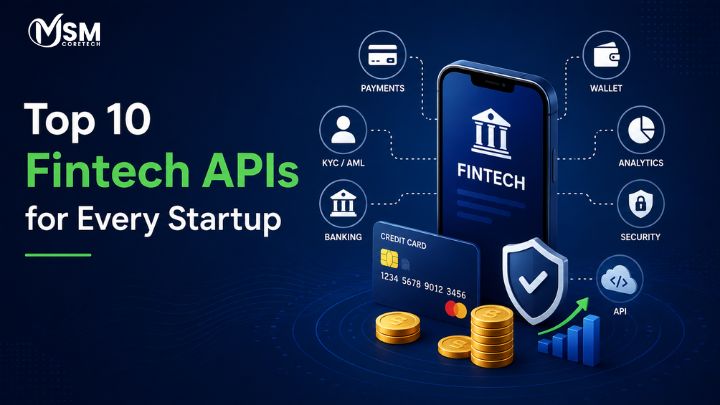
If you’re building a startup today, chances are money needs to move somewhere inside your product payments, payouts, identity checks, or bank data. A few years ago, that meant hiring a large engineering team, negotiating with banks, and spending months on compliance paperwork before writing a single line of customer-facing code. That’s not how it works anymore. Fintech APIs for startups have changed the game by letting you plug into ready-made financial infrastructure instead of building it yourself.
A fintech API is simply a tool that lets your app talk to a bank, a card network, or a payment processor, so your team can focus on the product instead of the plumbing behind it. In this guide, we’ll walk through the best fintech APIs startups are using in 2026, why they matter, how to pick the right one, and how to actually integrate one into your app without wasting months of engineering time. By the end, you’ll have a clear, practical shortlist to work from.

Also Read: Top 10 FinTech Startup Ideas
What Is a Fintech API?
Let’s keep this simple. An API, short for Application Programming Interface, is basically a messenger. It takes a request from your app, sends it to another system, and brings back a response. A fintech API does the same job, except the “other system” is a bank, a payment network, a credit bureau, or a financial data provider. Instead of your team building a connection to Visa or a bank’s core system from scratch, you send a request through the API, and it handles the heavy lifting behind the scenes.
In plain terms, financial APIs are the bridge between your app and the financial world. They let a mobile app, a web platform, or a piece of software talk to banks and payment networks in a language both sides understand, using pre-built, tested, and secure connections instead of custom-built ones.
These connections power almost everything you see in a modern app that touches money. A few common examples:
- Payments: Accepting cards, wallets, or bank transfers at checkout.
- Banking: Opening accounts, moving money, or issuing virtual accounts.
- KYC and identity verification: Confirming a user is who they say they are before letting them transact.
- Financial data: Pulling balances, transactions, or income data from a user’s bank account (with their permission).
- Lending: Running credit checks, verifying income, and disbursing loans.
- Investments: Buying, selling, or tracking stocks, funds, and other assets.
- Fraud prevention: Screening transactions in real time to catch suspicious activity.
Here’s a simple way to picture how it all fits together in a real transaction:
Startup App → Fintech API → Bank / Payment Network → Financial Transaction
Your app never talks to the bank directly. It talks to the API, the API talks to the bank or card network, and the transaction gets completed usually in a second or two. That’s the entire idea behind fintech APIs, and it’s why they’ve become the backbone of so many modern startups.
Also Read: What Is FinTech?
Why Should Startups Use Fintech APIs?
Startups don’t have the luxury of unlimited time or money, and financial infrastructure is expensive and slow to build from the ground up. Using fintech APIs is less about following a trend and more about making a practical trade-off: you give up a bit of control over the low-level plumbing, and in return you get speed, reliability, and a lot less risk. Here’s what that actually looks like in practice.
Faster Product Development
Building payment processing, KYC checks, or bank connectivity from scratch can take a development team six months to a year, and that’s before dealing with banks and regulators. With a fintech API, you can usually get a working payment flow or account verification running in days, because someone else has already solved the hard engineering problems.
Reduced Development Costs
Hiring specialized engineers who understand banking protocols, security standards, and financial regulations is expensive. APIs let you rent that expertise instead of hiring it, which is a much lighter cost for an early-stage company still finding product-market fit.
Access to Financial Infrastructure
Startups don’t have banking licenses, direct connections to card networks, or relationships with credit bureaus. Fintech APIs give you access to all of that instantly, through a provider that already has those relationships in place.
Better Scalability
A good API is built to handle a jump from a hundred transactions a day to a hundred thousand without you needing to redesign your backend. That kind of scalability would take serious in-house engineering effort to replicate.
Improved Security
Reputable fintech API providers invest heavily in encryption, fraud detection, and compliance because it’s their core business. You benefit from that investment without having to build or maintain it yourself.
Easy Third-Party Integrations
Most fintech APIs are designed to work well with other tools in your stack analytics platforms, customer support tools, and accounting software so your financial features don’t end up isolated from the rest of your product.
Faster Market Launch
Because so much of the groundwork is already done, you can go from idea to a working MVP much faster, which matters a lot when you’re trying to validate a business model before running out of runway.
Automated Financial Operations
Things like reconciliation, payout scheduling, and transaction categorization can be automated through the API instead of handled manually, which saves your team hours every week as your user base grows.
Also Read: FinTech App Design Guide
Top 10 Fintech APIs for Startups in 2026
This is the core of the guide. We’ve picked ten APIs that consistently come up when startups are choosing financial infrastructure, covering payments, banking data, card issuing, cross-border transfers, and open banking. Each one is broken down the same way so you can compare them side by side.
1. Stripe API
Stripe is probably the most recognizable name on this list, and for good reason: it’s built one of the most complete and developer-friendly payment platforms available today.
- What it does: Lets businesses accept, process, and manage online payments, subscriptions, and payouts through a single platform.
- Key features: Card payments, recurring billing, invoicing, marketplace payment splitting, fraud protection through Stripe Radar, and tools for tax and identity verification.
- Best use cases: SaaS subscriptions, online stores, marketplaces, and any app that needs to collect payments from customers around the world.
- Supported payment methods: Credit and debit cards, digital wallets like Apple Pay and Google Pay, bank debits, and several local payment methods depending on the country.
- Developer experience: Widely regarded as one of the easiest APIs to integrate, with clear documentation, ready-made SDKs, and a strong sandbox for testing.
- Advantages: Broad feature set, reliable uptime, strong documentation, and a large developer community that makes troubleshooting easier.
- Limitations: Pricing can add up at high transaction volumes, and some advanced features are only available on higher-tier plans.
- Pricing approach: Usage-based, with a percentage plus a fixed fee per successful transaction; custom pricing is available for larger volumes.
- Best for which startups: SaaS products, subscription businesses, e-commerce platforms, and marketplaces that need flexible payment handling.
2. Plaid API
Plaid is the go-to choice when a startup needs to connect to a user’s bank account rather than just take a payment. It’s especially common in personal finance and lending apps.
- Financial account connectivity: Connects your app to thousands of banks and credit unions so users can securely link their accounts.
- Bank account linking: Provides a simple, guided flow for users to log in to their bank and grant access without sharing raw credentials with your app.
- Transaction data: Pulls categorized transaction history that you can use for budgeting tools, spending insights, or underwriting.
- Identity verification: Confirms account ownership details to help with KYC and reduce fraud.
- Income and financial data: Verifies income and account balances, which is especially useful for lending products.
- Use cases: Budgeting apps, lending platforms, personal finance dashboards, and any product that needs a read-only view into a user’s financial life.
- Pricing approach: Usage-based, generally billed per successfully linked account or per data product used.
- Best suited startups: Fintech apps, digital lenders, personal finance tools, and neobanks that need bank data as a core part of the product.
3. PayPal APIs
PayPal has been around long enough that most consumers already trust it, which makes its APIs useful for startups that want to reduce friction at checkout.
- Online payments: Lets customers pay using their existing PayPal balance, linked cards, or bank account.
- Checkout: Provides a pre-built checkout button and flow that’s recognizable to millions of shoppers worldwide.
- Payment processing: Handles authorization, capture, and settlement for both one-time and recurring charges.
- Payouts: Supports sending money to multiple recipients at once, useful for marketplaces paying out sellers or gig workers.
- Subscriptions: Offers built-in recurring billing tools for membership or subscription-based products.
- Global payment capabilities: Supports transactions across a large number of countries and currencies.
- Developer tools: Offers SDKs, sandbox testing, and prebuilt UI components to speed up integration.
- Best use cases: Online stores, marketplaces, and any consumer-facing app where checkout trust and brand recognition matter.
4. Adyen API
Adyen is built for businesses that need to accept payments across many countries and channels through one unified platform, which makes it popular with startups planning to scale internationally early.
- Global payments: Processes transactions across a wide range of countries, currencies, and local payment methods from a single integration.
- Payment methods: Supports cards, digital wallets, bank transfers, and dozens of region-specific options.
- Fraud prevention: Uses machine-learning-based risk scoring to flag suspicious transactions in real time.
- Recurring payments: Handles subscription billing and stored payment methods for repeat customers.
- Marketplace payments: Supports split payments so marketplaces can pay multiple sellers from a single transaction.
- Global business use cases: Well-suited to startups selling in multiple regions that want one platform instead of stitching together local providers.
- Advantages and limitations: Strong global reach and unified reporting, but the onboarding process is more thorough and better suited to startups with some transaction volume already, rather than very early-stage teams.
5. Marqeta API
Marqeta focuses on one thing and does it well: giving companies the tools to issue their own branded cards without becoming a bank.
- Card issuing: Lets companies create and manage their own debit, credit, or prepaid card programs.
- Virtual cards: Issues instantly usable virtual card numbers for online spending or employee expenses.
- Physical cards: Supports ordering and shipping physical cards linked to the same program.
- Card controls: Allows spending limits, merchant category restrictions, and real-time freeze or unfreeze controls.
- Transaction management: Provides real-time authorization data so businesses can approve or decline transactions programmatically.
- Embedded finance use cases: Popular for gig-economy payout cards, expense management tools, and buy-now-pay-later products.
- Best for fintech startups and platforms: Companies building card programs, expense management tools, or embedded finance products that need direct control over card issuing logic.
6. Dwolla API
Dwolla is built specifically around moving money directly between bank accounts in the US, which makes it a strong fit for businesses that don’t want to rely on card networks.
- Account-to-account payments: Moves funds directly between bank accounts without going through a card network.
- ACH payments: Specializes in Automated Clearing House transfers, a common and lower-cost way to move money in the US.
- Bank transfers: Supports both one-time and recurring transfers between linked accounts.
- Payment automation: Lets businesses trigger transfers automatically based on events in their own systems.
- Business use cases: Common in B2B platforms, payroll tools, rent collection apps, and marketplaces paying out vendors.
- Developer-friendly infrastructure: Offers clear documentation and a sandbox environment built around real ACH workflows.
7. Wise Platform API
Wise built its reputation on transparent, low-cost international transfers, and its platform API extends that same infrastructure to other businesses.
- International payments: Sends money across borders using local banking rails instead of expensive traditional wire transfers.
- Cross-border transfers: Supports transfers between dozens of currencies with real, mid-market exchange rates.
- Multi-currency accounts: Lets businesses hold and manage balances in multiple currencies.
- Exchange rates: Provides real-time rate data so businesses can quote accurate costs to their own users.
- Global payouts: Useful for paying international contractors, freelancers, or suppliers without heavy transfer fees.
- Best use cases for international startups: Payroll platforms, marketplaces with global sellers, and any startup whose users regularly send or receive money across borders.
8. TrueLayer API
TrueLayer is one of the more established names in open banking, particularly across the UK and Europe, where regulation has pushed banks to open up their data through standardized APIs.
- Open banking: Connects directly to banks using regulated open banking standards rather than screen-scraping.
- Account information: Retrieves balances and transaction history with the user’s explicit consent.
- Payment initiation: Lets users pay directly from their bank account instead of using a card, often at a lower cost per transaction.
- Bank connectivity: Covers a large number of banks across the UK and Europe.
- Authentication: Uses secure, bank-level login flows so users never share passwords with your app.
- European market focus: Particularly strong for startups launching first in the UK or EU, where open banking adoption is more mature.
- Best use cases: Account aggregation apps, direct bank-transfer checkouts, and lending products that need verified account data.
9. MX API
MX is focused on turning raw bank data into something a product team can actually use, with a strong emphasis on clean categorization and financial insights.
- Financial data aggregation: Pulls data from a wide network of financial institutions into one consistent format.
- Account connectivity: Lets users securely link checking, savings, credit, and investment accounts.
- Transaction categorization: Automatically tags transactions by type, which saves significant engineering effort for budgeting features.
- Personal finance applications: A common backbone for budgeting apps, net-worth trackers, and money-management tools.
- Financial insights: Generates spending trends and patterns that can power in-app recommendations or alerts.
- Best use cases: Personal finance apps, digital banking platforms, and any product built around helping users understand their spending.
10. Finicity API
Finicity, a Mastercard company, is widely used in lending because of how thoroughly it verifies income and account data, two things underwriters care about most.
- Open banking: Provides consented access to a user’s bank account data through standardized connections.
- Financial data: Retrieves account balances, transaction history, and account details for verification purposes.
- Account verification: Confirms account ownership and status, reducing fraud risk during onboarding.
- Income verification: Verifies income directly from bank data instead of relying on pay stubs or manual documents.
- Lending applications: A strong fit for mortgage, personal loan, and credit-underwriting products that need verified financial data.
- Financial data connectivity: Connects to a broad network of US financial institutions.
- Best suited startups: Digital lenders, mortgage-tech platforms, and any startup where verified income and account data directly affects underwriting decisions.

Also Read: Cost to Develop a Fintech App Like Wise
Fintech API Comparison Table
Here’s a side-by-side view to make comparison easier. Note that pricing details change often, so treat the pricing column as a general approach rather than an exact quote. Always confirm current pricing directly with the provider before making a decision.
| API | Primary Use | Key Feature | Best For | Pricing | Developer Experience |
|---|---|---|---|---|---|
| Stripe | Payments | Payment processing | SaaS & eCommerce | Usage-based | Excellent |
| Plaid | Banking data | Account connectivity | Fintech apps | Varies | Excellent |
| PayPal | Payments | Global payments | Online businesses | Transaction-based | Good |
| Adyen | Payments | Global payment infrastructure | Enterprises & platforms | Custom/varies | Good |
| Marqeta | Card issuing | Card infrastructure | Fintech platforms | Custom/varies | Good |
| Dwolla | Bank transfers | ACH payments | B2B platforms | Varies | Good |
| Wise Platform | Cross-border | Multi-currency payments | Global startups | Varies | Good |
| TrueLayer | Open banking | Account-to-account payments | Open banking apps | Varies | Excellent |
| MX | Financial data | Data aggregation | Personal finance | Custom | Good |
| Finicity | Financial data | Verification | Lending & fintech | Custom | Good |
Important: Fintech API pricing changes frequently as providers adjust tiers, add volume discounts, or restructure fees. Always verify current pricing directly on the provider’s website before making a final decision or presenting numbers to stakeholders.
Also Read: Cost To Build A Fintech App
How to Choose the Right Fintech API for Your Startup?
Picking an API isn’t just about which name is most popular; it’s about which one fits your specific product, users, and stage of growth. Here’s a practical way to work through the decision.
1. Define Your Financial Use Case
Start by being specific about what you actually need: payments, banking data, lending, investments, or card issuing. Startups often waste time evaluating APIs that solve a problem they don’t have. A clear use case narrows your shortlist immediately.
2. Check API Coverage
Make sure the API actually supports the countries, currencies, payment methods, and financial institutions your users will need. An API that’s excellent in the US might have limited or no coverage in Europe or Asia, so check this early rather than after you’ve built around it.
3. Evaluate Pricing
Look beyond the headline API fee. The real cost usually includes several layers:
- Transaction fees: Charged per successful payment or data pull.
- Setup fees: One-time costs to get your account configured.
- Monthly minimums: Fees charged even if your usage is low.
- Premium features: Extra charges for things like advanced fraud tools or priority support.
- Volume-based pricing: Rates that change as your transaction volume grows, which can work for or against you.
4. Review Security and Compliance
Financial data is sensitive, so security can’t be an afterthought. Check whether the provider maintains standards like PCI DSS, SOC 2, and proper KYC/AML processes, along with data encryption and tokenization for stored payment information. Also check what regulatory coverage they offer in the regions you plan to operate in.
5. Evaluate Developer Experience
Your engineering team will be living inside this API’s documentation for weeks or months, so it’s worth testing before committing. Look for clear documentation, ready-made SDKs, a working sandbox environment, solid testing tools, reliable webhooks, and some form of API monitoring or status page.
6. Consider Scalability
Think ahead to what your product looks like at ten times its current size. The API you choose should be able to support that growth in transaction volume and user count without requiring you to switch providers later, which is a costly and time-consuming migration.
7. Check Support
When something breaks in production and eventually something will you want a provider that responds quickly. Look at the technical support channels available, any service-level agreements (SLAs), the quality of documentation, and how smooth the onboarding process is.
Key Features to Look for in a Fintech API
Regardless of which specific API you end up choosing, certain features separate a solid, production-ready fintech API from one that will cause headaches down the line. Use this as a checklist while you evaluate providers:
- RESTful APIs: Clean, standard API architecture that’s easy for most development teams to work with.
- Webhooks: Real-time event notifications so your app knows instantly when a payment succeeds or fails.
- SDKs: Pre-built libraries in your programming language that speed up integration significantly.
- Sandbox environment: A safe testing space that mimics production without moving real money.
- Real-time transactions: The ability to process and confirm transactions instantly rather than in batches.
- Authentication: Secure methods like OAuth 2.0 to control who can access your API keys and data.
- Encryption: Data protected both in transit and at rest.
- Fraud detection: Built-in tools to flag suspicious activity before it becomes a problem.
- KYC/AML capabilities: Identity verification and anti-money-laundering checks baked into the flow.
- Payment processing: Reliable handling of charges, refunds, and payouts.
- Bank connectivity: Broad coverage of banks and financial institutions relevant to your users.
- Reporting and analytics: Dashboards and exportable data to track transactions and performance.
- Multi-currency support: Useful if you plan to serve users outside a single country.
- Documentation: Clear, well-maintained docs that make integration and troubleshooting faster.
- Scalability: Infrastructure that can grow with your transaction volume without breaking.
How to Integrate a Fintech API Into Your Startup
Integrating a fintech API isn’t something you do in an afternoon, but it also doesn’t need to be a massive undertaking if you follow a structured process. Here’s a simple, ten-step roadmap most teams follow:
- Define business requirements: Get clear on exactly what financial functionality your product needs before evaluating any provider.
- Select the API provider: Use the comparison criteria above to shortlist and choose a provider that fits your use case, coverage, and budget.
- Create a developer account: Sign up for API access and get your test credentials from the provider’s developer portal.
- Test APIs in the sandbox: Run through common flows payments, account linking, or verification in a safe, non-production environment.
- Set up authentication: Implement secure API key management and authentication flows like OAuth 2.0.
- Build the integration: Connect the API to your app’s backend and frontend, following the provider’s documentation and SDKs.
- Configure webhooks: Set up real-time event listeners so your app reacts instantly to things like successful payments or failed transfers.
- Test transactions and error handling: Run through edge cases failed payments, expired sessions, declined cards so your app handles them gracefully.
- Complete security/compliance checks: Confirm your integration meets the relevant security and regulatory requirements before going live.
- Move to production and monitor performance: Launch with real transactions and keep an eye on success rates, latency, and error logs going forward.
Also Read: Top FinTech Trends
Security and Compliance Considerations for Fintech APIs
Security isn’t optional when you’re handling money or personal financial data; it’s the foundation everything else sits on. Getting this right also builds trust with your users and investors. Keep in mind that exact requirements vary by product type and by country, so treat the list below as a starting point rather than a complete compliance checklist for your specific business.
Data Encryption
Sensitive data, both while it’s moving between systems and while it’s sitting in storage, should be encrypted using industry-standard protocols.
API Authentication
API keys and access tokens need to be tightly controlled, rotated periodically, and never exposed in client-side code.
OAuth 2.0
This is the standard protocol many fintech APIs use to let users grant access to their financial accounts without ever sharing their actual bank login credentials with your app.
Tokenization
Instead of storing raw card or account numbers, tokenization replaces them with a secure reference, reducing the risk if your systems are ever compromised.
PCI DSS
The Payment Card Industry Data Security Standard applies to any business handling card data, and most fintech APIs help reduce your compliance burden by keeping raw card data off your servers entirely.
KYC and AML
Know Your Customer and Anti-Money Laundering checks confirm user identity and screen for suspicious activity, which is required for most regulated financial products.
Data Privacy
Handling personal financial data means being clear with users about what’s collected, how it’s used, and complying with relevant privacy laws in your operating regions.
Access Controls
Limit who inside your own team can access production financial data or API credentials, and log every access event.
Fraud Monitoring
Ongoing, real-time monitoring for unusual transaction patterns helps catch problems before they escalate.
Audit Logs
Keeping detailed logs of transactions and system activity is important both for troubleshooting and for demonstrating compliance if you’re ever audited.
Regulatory Requirements by Country
Financial regulation differs significantly from one country to another, so a compliance setup that works in the US may not automatically satisfy requirements in the EU, UK, or elsewhere. It’s worth involving legal or compliance expertise early rather than treating it as an afterthought.
Benefits of Using Fintech APIs Instead of Building From Scratch
It helps to see the trade-off laid out directly. Here’s how building your own financial infrastructure compares to using an established fintech API:
| Building From Scratch | Using Fintech APIs |
|---|---|
| Longer development time | Faster integration |
| Higher infrastructure cost | Lower initial investment |
| Complex compliance | Provider-supported infrastructure |
| More maintenance | Managed infrastructure |
| Difficult scaling | Designed for scalability |
| More engineering resources | Smaller development effort |
How Much Does It Cost to Integrate a Fintech API?
There’s no single number that accurately represents the cost of fintech API integration, and any article that gives you one fixed figure is oversimplifying things. The real cost depends on several factors specific to your product:
- API provider: Different providers have very different pricing structures and fee schedules.
- Type of financial service: Payments, banking data, and card issuing all come with different cost models.
- Number of transactions: Higher volume usually means better per-transaction rates, but also higher total spend.
- Countries supported: Adding international coverage often increases both API and compliance costs.
- API calls: Some providers charge based on the number of calls made, not just successful transactions.
- Monthly users: More active users linking accounts or making payments increases usage-based fees.
- Compliance requirements: Additional KYC/AML checks or regulatory coverage can add extra cost.
- Custom development: Any custom logic your engineering team builds around the API adds to the overall project cost.
- Third-party services: Tools like fraud scoring or identity verification add-ons can carry separate fees.
- Maintenance and monitoring: Ongoing engineering time to keep the integration healthy as your product evolves.
A useful way to think about the total cost is to break it into five buckets:
API/Platform Fees + Transaction Fees + Development Cost + Compliance Cost + Maintenance Cost
Adding these up for your specific use case, rather than relying on a generic industry average, will give you a far more accurate budget.
Also Read: How Fintech Apps Make Money
Fintech APIs vs Fintech SDKs
These two terms get used interchangeably sometimes, but they’re not quite the same thing, and it’s worth understanding the difference.
- API: Enables communication between systems; it’s the set of rules and endpoints that let your app send requests to a bank or payment network and get a response back.
- SDK: Provides development tools, libraries, and pre-built components that make working with an API easier; think of it as a toolkit that wraps around the API so your developers don’t have to write raw HTTP requests by hand.
In practice, most fintech providers offer both: the API itself, plus SDKs in popular languages like JavaScript, Python, or Swift to speed up integration. If you’re comparing providers, check whether they offer SDKs in the language your team already works in; it can save meaningful development time.
Common Mistakes Startups Should Avoid When Choosing a Fintech API
A lot of startups run into avoidable trouble simply because they rushed the API selection process. Here are the mistakes that come up most often:
- Choosing only based on price: The cheapest option isn’t always the best fit if it lacks the coverage or reliability your product needs.
- Ignoring geographic availability: Picking an API before confirming it actually supports the countries your users are in.
- Not checking transaction limits: Some APIs cap transaction size or volume in ways that only become a problem after you’ve scaled.
- Skipping sandbox testing: Going straight to production without properly testing edge cases in the sandbox environment.
- Ignoring documentation quality: Poor documentation slows down your entire engineering team and makes troubleshooting painful.
- Underestimating compliance requirements: Assuming the API handles all compliance for you, when in reality you often still have obligations of your own.
- Not planning for scalability: Choosing an API that works fine at low volume but becomes expensive or unreliable as you grow.
- Failing to implement webhook handling: Not building proper logic to react to real-time events, which can lead to inconsistent data or missed transactions.
- Not having a fallback/error-handling strategy: Assuming the API will never go down or return an error, instead of building graceful handling for when it does.
- Choosing an API without checking support: Discovering too late that support response times are slow when something breaks in production.
How MSM CoreTech Can Help You Build Fintech Solutions
Choosing the right fintech API is only half the job; integrating it correctly, securely, and in a way that scales with your business is where a lot of startups get stuck. MSM CoreTech works with startups and growing businesses to design and build fintech products from the ground up, whether that means integrating a payment gateway, connecting bank data through an aggregator, building a card issuing program, or setting up a full lending or banking app.
Our team handles the technical side API integration, secure architecture, compliance-aware development, and ongoing support so your team can stay focused on your product and your customers instead of getting buried in banking infrastructure. Whether you’re at the idea stage or already have a live product that needs a fintech feature added, MSM CoreTech can help you pick the right APIs for your use case and build the integration properly the first time.

Also Read: Best Cash Advance Apps
Conclusion
Fintech APIs have made it possible for startups to offer serious financial functionality without building a bank’s worth of infrastructure themselves. Whether you need to accept payments, verify a user’s identity, connect to their bank account, issue cards, or move money across borders, there’s very likely an established API built for exactly that job. The right choice depends entirely on your specific business model; a payments-heavy marketplace has very different needs than a lending platform or a personal finance app. Before committing to any provider, take the time to evaluate security, compliance, pricing structure, scalability, and developer experience, since these factors matter far more in the long run than which name is most popular.
And because pricing and coverage change often in this space, always confirm current details directly with the provider before finalizing your decision. If you’re ready to move from research to an actual working product, working with an experienced fintech app development company like MSM CoreTech can help you turn the right API choice into a secure, scalable product built correctly from day one, without the trial and error of figuring it out alone.
FAQs
A fintech API is a tool that lets your app connect to financial services like payments, banking data, or identity verification, without building that infrastructure yourself.
It depends on your use case. Stripe is strong for payments, Plaid for bank data, and Marqeta for card issuing. There’s no single “best” one for every startup.
Costs vary based on the provider, transaction volume, and features used, and usually combine platform fees, transaction fees, and development costs.
Reputable providers invest heavily in encryption, tokenization, and compliance, but your own app still needs proper security practices around how you use the API.
A basic integration can take a few days to a few weeks, while more complex use cases involving compliance and custom logic can take a few months.
In most cases, no, the API provider typically holds the necessary licenses or partnerships, which is one of the main reasons startups use them.
Yes, but it usually requires re-integration work and testing, so it’s worth choosing carefully upfront to avoid an unnecessary migration down the line.

Related Posts

How to Build a Dating App Like Badoo: Complete Guide
Finding a match is no longer limited to meeting people through friends or social events. Dating apps have made it...
Read More

The Ultimate Guide to Medicine Delivery App Development
Ordering medicines online has become as normal as ordering food or booking a cab, and that shift is exactly why...
Read More
How Much Does It Cost to Develop a Medicine Delivery App Like 1mg?
Online pharmacies have quietly become one of the busiest corners of the internet. People no longer want to stand in...
Read More


 Verified Review




 +44 7427829444
 71-75, Shelton Street, Covent Garden, London, United Kingdom, WC2H 9JQ