

Share this article


Top AI Trends in 2026: Transforming Businesses Across Industries
Key Takeaways
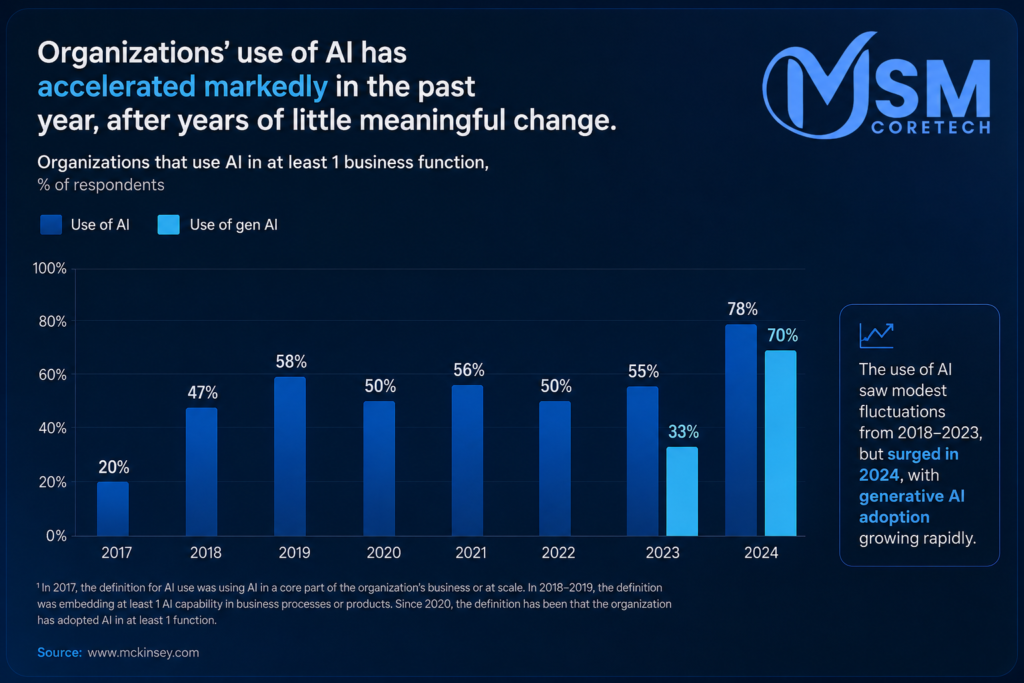
- A large number of organizations, around 78% of companies, are now actively using AI in at least one part of their operations. This clearly shows that AI is no longer experimental; it has become a core part of modern business strategy across industries.
- The rise of advanced AI technologies such as Conversational AI, Agentic AI, and Multi-Modal AI is reshaping how businesses operate. These systems are making machines more capable of understanding and responding to text, voice, images, and even actions, leading to more natural and intelligent interactions.
- Predictive analytics powered by AI is helping businesses move from reactive decisions to proactive planning. Companies can now analyze patterns, forecast future outcomes, improve supply chains, reduce risks, and make faster and more accurate data-driven decisions.
- Edge AI and on-device machine learning are becoming increasingly important in today’s tech ecosystem. By processing data directly on devices instead of relying heavily on cloud servers, these technologies help improve speed, reduce latency, enhance security, and strengthen user privacy.
- Generative AI is experiencing rapid growth and adoption across industries. It is being widely used for content creation, automation of repetitive tasks, code generation, marketing support, and improving customer experiences at scale, making business processes more efficient and creative.
- With over 50 AI solutions successfully delivered and achieving up to 98% model accuracy, the company has built strong technical expertise and reliability in AI development. This track record, along with industry recognition, positions MSM Coretech as a trusted and experienced AI partner for businesses looking to adopt or scale AI solutions.
“Artificial Intelligence (AI) is not just helping businesses automate tasks; it is completely changing the way they work.” Need proof? These statistics show how quickly AI is growing:
• In 2024, 78% of organizations said they were using AI in at least one area of their business. This is a big increase from 55% the year before.
• Private investment in Generative AI in eCommerce reached $33.9 billion in 2024, showing that more companies are investing heavily in this technology.
• According to McKinsey & Company’s 2025 AI survey, the use of AI and Generative AI has grown rapidly over the past year.
New AI technologies such as Agentic AI, multimodal AI models, and predictive analytics are helping businesses work more efficiently, improve customer experiences, and make faster, data-driven decisions.
The impact of AI on businesses is already clearly visible. For example, the World Trade Organization estimates that AI could increase global trade value by 34–37% by 2040. It is expected to improve areas such as manufacturing, logistics, compliance, and various business services.
In simple terms, the AI era is no longer something for the future; it is already here. This means that businesses today should not be asking whether they need AI, but how quickly they can adopt the latest AI trends.
Companies that start using AI early are gaining a strong competitive advantage. They are improving their efficiency, providing better customer experiences, and bringing new ideas and innovations to the market faster.
In this blog, we will discuss the top AI trends, explore the latest market statistics, and understand how AI is transforming industries around the world.
Read Also: How We Built a Modern AI-Powered Dating Application
AI Market Statistics and Adoption Trend in Businesses
AI is growing very quickly and changing the way businesses work in many industries around the world. According to a Forbes Advisor survey, companies are using AI in different areas of their business. The most common uses include customer service (56%), cybersecurity and fraud detection (51%), digital assistants (47%), customer relationship management (46%), inventory management (40%), and content creation (35%).
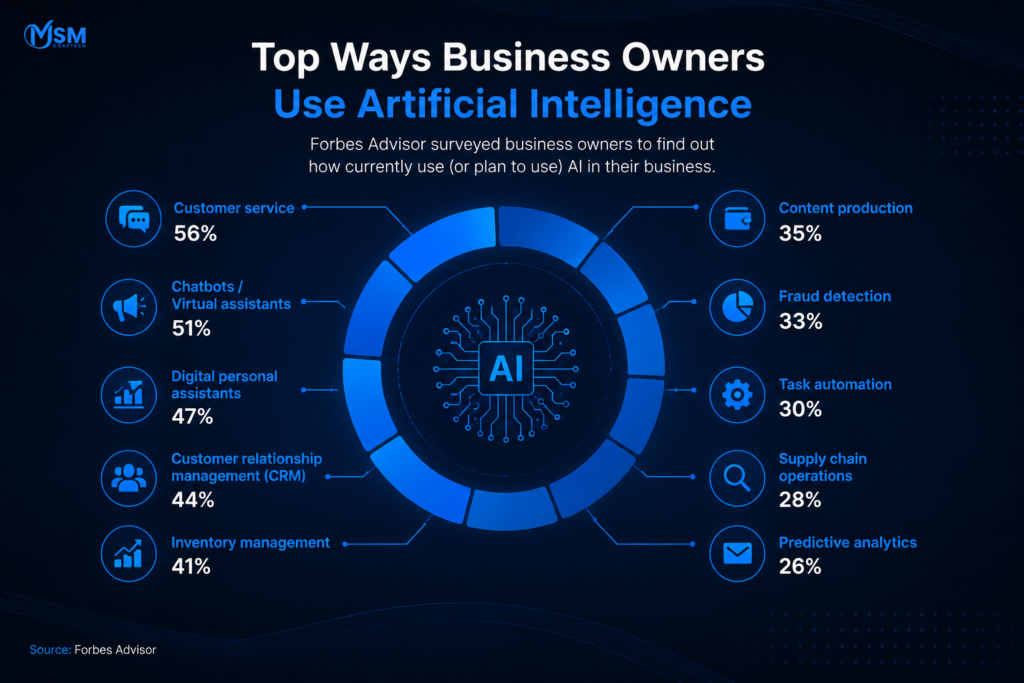
Many businesses are also investing in AI-powered analytics and automation tools. These tools help companies work faster, reduce costs, and stay ahead of their competitors. As AI technology continues to improve, it is becoming an important part of daily business operations.
AI is helping industries become more innovative, efficient, and automated. Its many applications allow businesses to work smarter and achieve better results.
Here are some interesting statistics that show the impact of AI Integration on businesses, the economy, and everyday life:
• 97% of business owners believe that ChatGPT for enterprises will positively impact their business operations, especially for creating content in different languages and developing website content.
• More than 60% of business owners think AI can help them build stronger relationships with their customers.
• More than 60% of Chief Technology Officers (CTOs) believe AI is a useful tool for improving productivity and increasing workplace efficiency.
Read Also: Guide to Build an AI-Powered Dating App
Emerging AI Trends Transforming Today’s and Tomorrow’s Business World
AI is growing fast and is expected to become even more important in the future. Because of this, many new trends are emerging that are making AI more powerful and changing how businesses set their goals. As a result, partnering with an experienced AI development company can help businesses successfully adopt these technologies and stay competitive.
For businesses in 2026 and the years ahead, keeping up with the latest AI and machine learning trends is very important to stay ahead of competitors. Now, let’s explore these important AI trends in detail below.
Conversational AI
Conversational AI has grown a lot from simple AI chatbots into advanced smart assistants. Earlier, chatbots could only follow basic rules, but now they can understand context, user intent, tone, and even emotions. This makes them much better at handling complex and repetitive tasks, improving customer experience, and increasing productivity.
For example, the retail company Amazon is improving its AI systems with tools like Nova Sonic, which helps in real-time speech processing and makes conversations feel more natural and human-like.
According to a report by Grand View Research, the global conversational AI market was valued at $11.58 billion in 2024 and is expected to grow to $41.39 billion by 2030.
Today, conversational AI systems are also powered by large language models (LLMs) and Retrieval-Augmented Generation (RAG). These technologies help AI give more accurate, up-to-date, and knowledge-based answers in different languages and across various platforms.
Read Also: AI in Dating Apps
Predictive Analytics
Businesses use predictive analytics to stay in line with the latest AI trends. It helps companies make better and more informed decisions. With this technology, they can manage inventory more effectively, improve delivery speed, reduce operating costs, and increase sales and profits.
For example, in the manufacturing industry, predictive analytics can help detect possible machine failures before they happen. This allows companies to avoid sudden breakdowns and expensive repairs.
Also, predictive analytics uses real-time data and machine learning to help businesses better predict customer behavior and future market demand. This makes forecasting more accurate than before.
Read Also: cost to create a mobile app in Texas
AI Democratization (Low-Code/No-Code)
Low-code and no-code AI development make it easier for businesses to build and customize smart applications without needing advanced coding skills. Using simple drag-and-drop tools and ready-made templates, companies can create AI-powered solutions and automate repetitive, rule-based tasks more quickly.
According to Google Cloud’s Data and AI Trends Report 2024, around two-thirds of decision-makers expect AI insights and tools to become more accessible to everyone in the coming years. This growing AI trend also allows businesses to use AI platforms, such as Sway AI, to analyze data, improve current processes, and make better decisions for the future.
Read Also: 9+ Best Insurance App Development Companies in USA
Ethical and Explainable AI
As AI systems are being used more and more to make important decisions, people want them to be more transparent and responsible. However, many current AI models work like a “black box,” meaning even AI researchers and developers do not fully understand how they make certain decisions. Because of this lack of clarity, these systems can sometimes lead to unfair discrimination, bias, or misuse. This is why there is a growing need for ethical and explainable AI that helps people understand how decisions are made and ensures AI is used fairly and responsibly.
Today, many people are working to solve the AI “Black Box” problem, where it is difficult to understand how AI systems make decisions.
Because of this, Explainable AI (XAI) is becoming more important. Organizations are adopting XAI to make AI systems more transparent, trustworthy, and easier to understand. It helps ensure that AI decisions are clear, fair, and accountable. XAI also helps reduce bias while making sure AI models remain accurate and reliable.
Read Also: Cost To Develop A Travel App Like Booking.com
Multi-Modal AI
Multi-modal AI is one of the most popular AI trends in business today. It uses machine learning to work with different types of data, such as text, speech, images, videos, audio, and numerical data. By combining these different data sources, it can understand information in a way that is closer to how humans think and learn.
Businesses can use multi-modal AI to create smarter systems that analyze different kinds of data at the same time. This helps improve language understanding, image recognition, and voice recognition, leading to better user experiences.
For example, Google DeepMind’s Gato is a multi-modal AI system that can perform different tasks, including understanding language, processing visual information, and controlling robotic movements.
Meta has recently launched five important AI models and research projects. These include AI systems that can understand both text and images, advanced language models, technology that can create music, tools that can detect AI-generated speech, and projects focused on making AI more diverse and inclusive.
Digital Twins
Digital Twins have become very popular in recent years, especially with Industry 4.0 and the Internet of Things (IoT). A digital twin is a virtual copy of a real object, process, or system. By using digital twins, businesses can monitor performance, analyze data, and make improvements in real time, helping them work more efficiently and make better decisions.
Digital twins are becoming an important AI trend for businesses. They are helping companies work on areas like ESG modeling, drug design, smart cities, and many other applications.
For example, NVIDIA, a leading GPU company, uses digital twin technology and has partnered with Siemens to build an industrial metaverse.
Read Also: Cost to Develop a Hotel Booking App Like Agoda
Collaboration of Humans and Robots (CoBots)
Collaborative Robots (Cobots) are changing the way people work. As technology continues to grow, cobots are becoming more common and are expected to remain important in the future. Millions of robots are already being used in factories around the world. These robots work together with human employees to improve productivity, safety, and efficiency.
AI-powered cobots combine human intelligence with robotic accuracy. They handle complex and repetitive tasks in manufacturing, while human workers can focus on higher-level roles such as design, programming, and maintenance.
Generative AI
Generative AI is a part of machine learning that helps businesses create new content, data, and 2D/3D images by using existing data. It uses deep learning technology to understand patterns in text, images, videos, audio, programming languages, and other types of data.
For example, in healthcare, Generative AI can help create prosthetic limbs, organic molecules, and other medical solutions from scratch using technologies like 3D printing and CRISPR. It can also support the early detection of diseases, helping doctors create better treatment plans. In the case of diabetic retinopathy, Generative AI analyzes patterns and generates useful information that helps doctors make informed decisions.
One of the most popular examples of Generative AI developed by OpenAI
- DALL-E: DALL-E is a well-known AI tool that can create realistic images from simple text descriptions. Users can generate completely new images, edit existing ones, design products, remove unwanted parts of an image, add new elements to photos, and perform many other creative tasks.
- ChatGPT: ChatGPT was launched in November 2022. It is one of the most popular AI language models that helps people create human-like content from the prompts they provide. It can be used for many different tasks and has a wide range of useful applications.
Read Also: 9+ Best AI App Development Companies in the USA
Shadow AI
One of the latest and most advanced AI trends is Shadow AI. But what is Shadow AI? It means using AI tools and applications without the knowledge or approval of the IT department. Many companies are starting to use Shadow AI because it helps them work faster, try new ideas, and become more flexible and innovative.
This creates both opportunities and challenges for businesses. On the one hand, it helps teams develop and work faster. On the other hand, it can create security and compliance risks. Companies need to carefully compare the benefits of these unofficial AI tools with the risks, such as data leaks and poor integration with existing systems.
To use shadow AI safely, businesses need strong AI governance and regular monitoring. Good management helps reduce risks while still taking advantage of AI. Companies that manage shadow AI effectively can become more flexible and respond faster than their competitors, especially when they focus on making AI-generated content sound more natural and human.
Retrieval-Augmented Generation (RAG)
One important AI trend is Retrieval-Augmented Generation (RAG). This latest AI technology improves AI performance by allowing models to access external information while processing requests. It combines the strengths of traditional search engines and generative AI models, helping provide more accurate, relevant, and reliable answers.
RAG is especially useful in industries like healthcare, legal services, and customer support, where people need quick and accurate information. By using RAG, businesses can access large amounts of data and provide more detailed, reliable, and meaningful answers.
Read Also: 9+ Best Real Estate App Development Companies in USA
Sentiment AI
Sentiment AI is one of the most advanced trends in artificial intelligence and machine learning. It helps computers understand and analyze human emotions through text, speech, and images.
This AI trend is very important for small and medium-sized businesses because it helps create more personalized and human-like interactions. For example:
• In customer service, businesses can better understand customer feelings and provide responses that match their needs, improving customer satisfaction and loyalty.
• In marketing, Sentiment AI helps create campaigns that connect with people’s emotions, leading to higher engagement and better conversion rates.
• In mental health, Sentiment AI can help identify emotional and psychological conditions, making it easier to provide timely and effective support and treatment.
Quantum AI
Quantum AI is one of the latest AI trends that combines artificial intelligence with quantum computing. It helps AI systems solve complex problems much faster than traditional computers. This technology can support advancements in areas such as system optimization, material science, and data encryption.
Quantum AI can also improve machine learning by processing large amounts of data more efficiently and performing calculations that are currently difficult or impossible for traditional computers. Because of its powerful processing capabilities and high accuracy, Quantum AI has the potential to transform many industries. As the technology continues to grow, it is expected to drive innovation and make new breakthroughs in fields that have been limited by conventional computing power.
For example, according to AOL News, Zapata and D-Wave have partnered to improve the integration of Quantum AI. Their collaboration aims to speed up the development and deployment of combined quantum and generative AI solutions on D-Wave’s Leap cloud platform.
Read Also: 9+ Best Education App Development Companies in USA
Agentic AI
Agentic AI is an advanced AI technology that takes artificial intelligence to the next level. Instead of only following fixed rules, Agentic AI can learn from data, adapt to new situations, and make decisions with very little human help.
For businesses, this can bring many benefits. Customer support systems can handle tasks on their own, supply chains can identify and solve problems before they become serious, and analytics tools can not only analyze data but also take actions based on it.
While this technology offers exciting opportunities, it also creates important challenges. Businesses need to make sure AI systems behave in an ethical and responsible way. There are also questions about who is responsible if an AI system makes a wrong decision. As AI becomes more independent, proper rules and oversight will be just as important as new innovations.
As Agentic AI, multimodal AI systems, and edge computing continue to change business strategies, learning how to build an AI application that can keep up with these changes has become an important priority for business and technology leaders.
Physical and Embodied AI
Physical or embodied AI means AI that can do more than just work for AI software. It can move, see, sense, and interact with the real world through robots, drones, and self-driving machines.
We are already using physical AI in many areas today. For example, robots help surgeons during operations in hospitals. Drones inspect power lines and other difficult-to-reach places. Automated machines work on factory floors with great accuracy and can operate for long hours without getting tired.
Physical AI helps improve productivity and makes many jobs safer. However, it also brings some challenges. As more physical jobs become automated, people may need new skills to stay employed. We also need to think about privacy, safety, and building trust in machines that work alongside humans.
Read Also: Cost To Build a Logistics App Like Uber Freight
Sovereign AI and Geopolitical Dynamics
Sovereign AI is the idea of countries creating and controlling their own AI systems. The main goal is to keep AI data, technology, and infrastructure within the country for better security and independence.
For example, the European Union has proposed the AI Act, and countries like the United States and China are investing billions of dollars in their own AI programs. Many nations want to become leaders in AI technology.
However, there are some risks. If countries develop AI separately and do not work together, global cooperation and innovation may slow down. The future of AI will depend on finding the right balance between protecting national interests and encouraging collaboration, so that new ideas and knowledge can continue to be shared around the world.
Responsible AI
Responsible AI means creating and using AI systems in a way that is ethical, transparent, and beneficial for society. It focuses on important principles such as fairness, accountability, and reducing bias in AI models.
As AI becomes a bigger part of our daily lives, businesses need to make responsible AI a priority. Doing so helps build trust with users and reduces the risk of unfair treatment or discrimination. It also helps organizations follow rules and regulations, making sure AI benefits everyone while reducing possible harm.
Read Also: 9+ Best Fitness App Development Companies in USA
AI Governance
AI governance has become very important for businesses that use AI. It helps ensure that AI systems are managed properly and continue to deliver reliable results in the future.
AI governance involves creating clear rules and policies for data usage, AI transparency, accountability, and regular reviews of AI decisions. These measures help reduce risks such as bias, discrimination, and unexpected outcomes.
Good AI governance also requires ongoing monitoring of AI systems. Businesses need to track AI performance, fix issues when they arise, and make sure AI systems follow the company’s values and ethical standards. This helps maintain trust among customers, partners, and regulators.
Power of AI Industry Trends Combined with Other Emerging Technologies
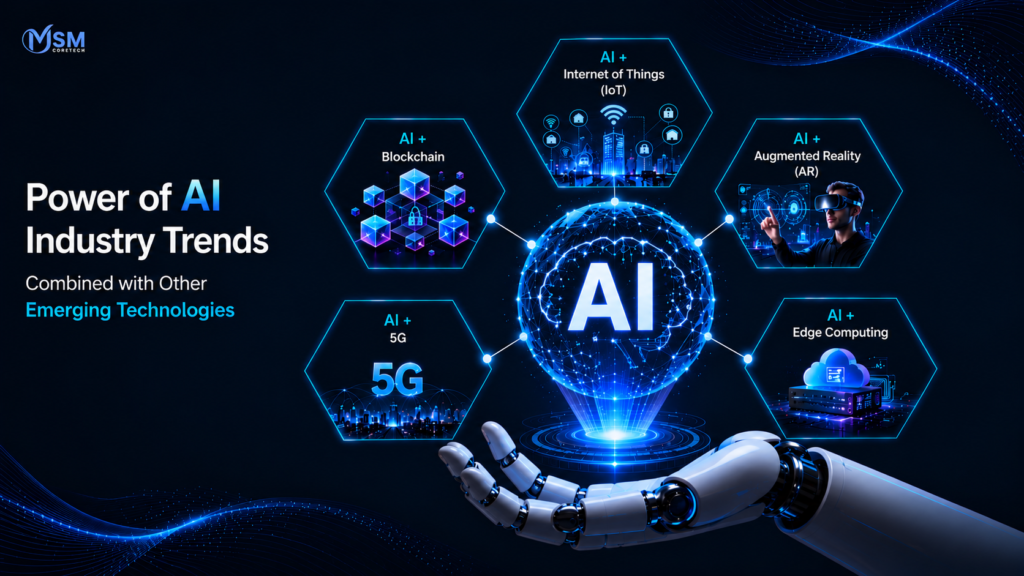
The best way to get the most value from the latest AI trends is to combine them with other new technologies and use the ones that fit your business needs. This modern AI trend helps businesses improve automation, work smarter, and discover many new opportunities. By using AI together with emerging technologies, companies can increase efficiency, improve decision-making, and achieve better results. Let’s take a look at some of the key technologies that are commonly used alongside artificial intelligence.
AI + Internet of Things (IoT)
AI and IoT work together to connect different devices and help them perform many tasks automatically. As more businesses use this technology, it is important to understand the latest IoT trends to stay competitive in 2026.
AI helps analyze large amounts of data, find patterns, and make predictions. IoT devices collect real-time information and respond quickly to different situations. When AI and IoT are combined, they create smarter systems that help businesses work more efficiently, make better decisions, and achieve greater success.
AI + Blockchain
Blockchain is another technology that is becoming popular across many industries. When AI and Blockchain are used together, businesses can enjoy the benefits of both technologies.
This powerful combination helps improve transactions, provide more accurate and reliable data, support decentralized systems, reduce barriers for entering new markets, increase transparency, and build greater trust. Together, AI and Blockchain help organizations operate more effectively and securely.
Read Also: Geolocation in Dating Apps Development: Privacy & UX
AI + Augmented Reality (AR)
Artificial Intelligence (AI) and Augmented Reality (AR) are changing the way businesses interact with customers and the world around them. When these two technologies work together, they create more engaging and realistic experiences that combine the real and digital worlds.
With AI-powered AR, businesses can identify surfaces, understand distances, recognize objects, and place virtual elements in the right position in real time. This helps create more interactive and immersive experiences for users.
AI + Edge Computing
Edge computing is another growing AI trend that brings data processing closer to where the data is created instead of sending everything to distant cloud servers.
When AI is combined with edge computing, data can be analyzed locally and much faster. This reduces delays, improves response times, and helps devices make quick decisions.
This combination is especially useful for Internet of Things (IoT) devices and real-time applications where instant responses are important. It is also valuable in situations where a constant connection to central servers is difficult or not possible.
AI + 5G
5G is the latest generation of mobile network technology. It provides much faster internet speeds and lower delays than older network technologies. When AI is combined with 5G, it can process data more quickly and enable faster communication between devices.
This combination is very important for advanced technologies such as self-driving cars and smart cities, where quick data processing and fast decision-making are required.
For example, in smart cities, AI systems can instantly analyze large amounts of data collected from cameras and sensors installed across the city. In the same way, self-driving cars use 5G connections to quickly receive and analyze information from nearby vehicles and road infrastructure, helping them make safe and timely decisions.
Read Also: Customer-Facing Apps: Examples, Benefits, and Challenges
Enterprise AI Trends and Their Applications in Different Sectors
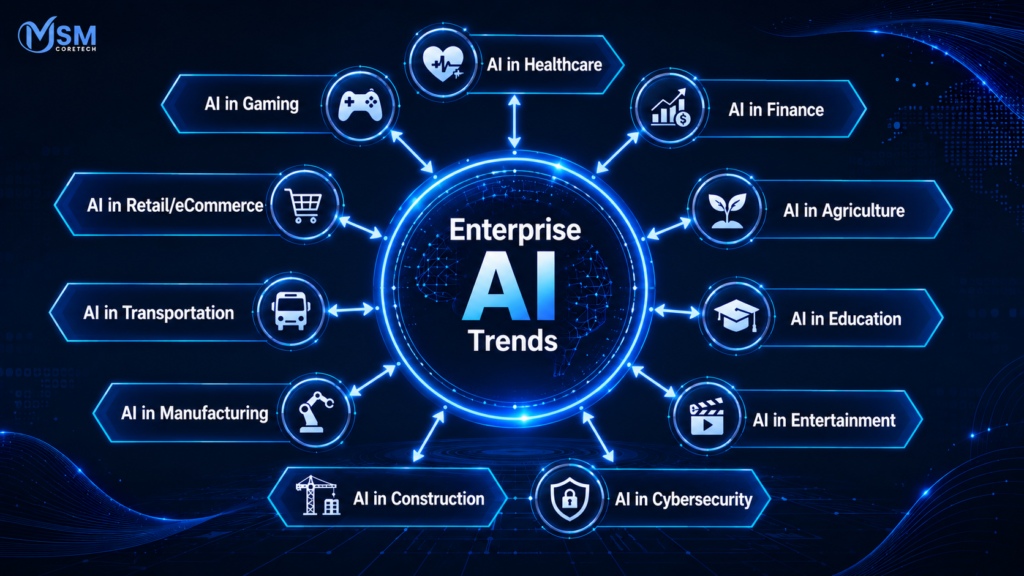
Enterprise AI trends are changing the way businesses work. They help companies use smart automation, improve efficiency, boost innovation, and achieve better results. Let’s look at some of the most important ways AI is being used across different industries and sectors around the world.
AI in Healthcare
AI is changing the healthcare industry very quickly. It helps doctors provide better treatment and improve patient care. Here are some ways AI is being used in healthcare:
- Diagnosis and Treatment:
AI helps doctors find diseases by analyzing medical images such as X-rays and MRI scans. It can also suggest personalized treatment plans based on a patient’s condition. - Drug Discovery:
AI helps speed up the process of developing new medicines. It can predict how different molecules will interact and identify possible drug candidates. - Remote Monitoring:
AI-powered wearable devices allow doctors to monitor patients’ health in real time. If any unusual health changes are detected, medical professionals can take immediate action. - Healthcare Biometrics:
AI uses advanced neural networks to perform retinal scans, track changes in skin color, support new diagnostic methods, and identify potential health risks that may otherwise go unnoticed.
This system has improved communication between patients and healthcare staff and made record management much easier. Because of its benefits, more than five hospital chains in the United States have adopted it. It has also helped increase nurses’ real-time response rates by 60%.
Read Also: Cost to Develop a Home Service App like Thumbtack
AI in Gaming
Artificial Intelligence is changing the gaming industry by making games more interactive and enjoyable for players. Here are some simple ways AI is being used in gaming:
- Improved Visual Quality: AI helps improve the graphics and visual quality of video games. This makes games look more realistic and gives players a better gaming experience.
- Voice Assistant Support: AI-powered voice assistants allow players to access game features using voice commands, making gameplay easier and more convenient.
- Personalized Gaming Experience: AI helps developers create game worlds that can adjust to each player’s behavior and preferences. This makes every gaming experience more unique and engaging.
AI in Retail/eCommerce
AI is helping retail and eCommerce businesses work more efficiently and provide a better shopping experience for customers. Here are some common ways AI is being used in this industry:
- Inventory Management: AI helps businesses predict customer demand, manage stock levels, and reduce product waste. This ensures that the right products are available when customers need them.
- Visual Search: AI allows customers to search for products by uploading or using images instead of typing keywords. This makes online shopping faster and easier. Many SaaS companies provide visual search solutions to retailers to improve customer engagement.
- Checkout-Free Shopping: AI-powered checkout-free systems let customers shop without standing in line or scanning products. These systems use technologies like smart carts, QR codes, RFID tags, and computer vision to track selected items and automatically generate the bill. Companies like Amazon Go and Standard Cognition were among the first to introduce this technology.
- Personalized Marketing: AI studies customer behavior and shopping preferences to recommend relevant products. This helps businesses increase customer engagement, improve marketing results, and encourage repeat purchases.
Read Also: How to Build a Taxi Booking App Like Uber
AI in Transportation
AI is helping make transportation safer, smarter, and more efficient. From self-driving vehicles to better traffic control systems, AI is changing the way people travel.
- Autonomous Vehicles: AI makes self-driving cars possible by helping them understand their surroundings and drive safely. These vehicles can improve road safety and help reduce traffic congestion.
- Traffic Management: AI analyzes traffic data from cameras and sensors to manage traffic more effectively. This helps reduce traffic jams and makes travel smoother in cities.
- Smart Tracks: Smart Tracks is a transportation project introduced in China. Instead of using traditional railway tracks, the train follows virtual tracks created with painted dashed lines. This innovative AI-based technology is expected to become more popular around the world in the future.
- Digital Number Plates: AI-powered digital number plates can provide real-time information to transport authorities. They can send instant alerts during accidents and use GPS technology to help track vehicle locations quickly.
AI in Manufacturing
The manufacturing industry is using AI to work faster, improve product quality, and increase overall efficiency. Here are some common ways AI is being used in manufacturing:
- Predictive Maintenance: AI studies data from machines and sensors to predict equipment problems before they happen. This helps reduce downtime and lowers maintenance costs.
- Supply Chain Optimization: AI helps manufacturers improve delivery routes, reduce delays, and make the supply chain more efficient.
- Industry 5.0: Industry 5.0 uses AI and data-driven technologies to improve product quality, increase process efficiency, and enhance customer satisfaction.
- Computer Vision: Computer Vision is an AI technology that helps manufacturers with tasks such as object detection, real-time monitoring, and facial recognition. It continues to play an important role in improving manufacturing operations.
Read Also: 7 Proven UX Design Guidelines for Modern On-Demand Apps
AI in Finance
AI is changing the finance industry by helping businesses make better decisions and improve security. Here are some common ways AI is used in financial services:
- Credit Risk Assessment: AI helps financial companies keep track of customer information and analyze their loan and credit card payment history. This helps them decide whether a customer can repay a loan.
- Fraud Detection: AI uses smart algorithms to identify unusual activities and suspicious behavior in real time. This helps prevent fraudulent transactions and protects customers from financial fraud.
- Safe Trading: AI studies market data and trends to help businesses and investors make faster trading decisions, improve investment strategies, and reduce risks when buying or selling stocks and shares.
- Auto Claims Processing: Insurance companies use AI to detect fraud and verify insurance claims. AI can analyze accident photos, calculate a driver’s risk level, and monitor driving behavior to ensure claims are genuine before making payments.
This helps financial and insurance companies work more efficiently, reduce risks, and provide better services to customers.
AI in Agriculture
AI is helping improve the agriculture industry in many ways. It makes farming easier, smarter, and more efficient. Here are some important ways AI is used in agriculture:
- Precision Farming: AI helps farmers check crop health, soil quality, and weather conditions. This helps them make better decisions, grow more crops, and use resources wisely.
- Automated Machinery: AI-powered tractors and harvesting machines can perform farming tasks more accurately and efficiently, reducing the need for manual labor.
- Soil Management: AI analyzes soil data and provides recommendations for proper irrigation and fertilization, helping improve soil quality and crop growth.
- Pest and Disease Management: AI systems can detect pests and plant diseases at an early stage. This helps farmers take quick action, reduce crop damage, and lower the use of pesticides.
Read Also: Cost to Develop an App Like Grindr
AI in Education
AI is changing the education industry and making learning easier and more effective for both students and teachers.
- Personalized Learning: AI helps create learning materials based on each student’s learning style and speed, helping them learn better.
- Simplified Administrative Tasks: AI can handle tasks such as grading assignments and managing schedules, giving teachers more time to focus on teaching.
- Better Tutoring and Student Support: AI-powered tutoring tools provide extra help to students outside classroom hours and help them overcome learning difficulties.
- Improved Assessment Tools: AI-based assessment systems analyze student performance in detail, helping teachers identify areas where students need support and create more personalized learning plans.
AI in Entertainment
AI is changing the entertainment industry by making content creation and delivery faster, smarter, and more personalized. It is also improving how people interact with movies, music, games, and other forms of entertainment.
- Content Creation: AI helps create artwork, music, videos, and even scripts, giving creators new and innovative tools to produce content.
- Audience Analysis: AI studies viewers’ interests, preferences, and behavior to help content creators understand what their audience likes the most.
- Personalized Content Delivery: AI recommends movies, shows, music, and other content based on each user’s interests and viewing habits, making the experience more enjoyable.
- Real-Time Adaptation: AI can track audience reactions in real time and help adjust content or storytelling to keep viewers engaged and satisfied.
Read Also: How to Develop a Mobile CRM App
AI in Construction
AI in construction is helping the industry work faster, safer, and better. It improves project work by using smart tools for planning, monitoring construction sites in real time, and managing materials and transport more accurately.
- Project Planning: AI helps plan construction work, set schedules, assign workers and resources, improve timelines, and reduce costs.
- Predictive Maintenance: AI can predict when machines may break down or need repair, which helps avoid delays and keeps equipment working longer.
- Safety Surveillance: AI cameras and sensors watch construction sites to find safety risks, make sure rules are followed, and help prevent accidents.
- Quality Assurance: AI checks the quality of construction work, finds mistakes or defects early, and helps maintain good standards while reducing rework.
AI in cybersecurity
AI in cybersecurity uses smart technology to find weak points in systems and stop hackers from carrying out harmful attacks. Companies that do not use AI in their security systems are more exposed to cyber threats and have a higher risk of data breaches.
Here are some strong uses of AI in cybersecurity:
- Facial Recognition: Facial recognition is a common type of biometric security that identifies a person using their face. It helps block unknown or suspicious users from accessing systems. That is why many businesses are adding this feature to their apps and systems to stop unauthorized access and keep their environment more secure.
- Cyber Threat Hunting: Cyber threat hunting is a proactive way to find hidden cyber threats inside a network before they cause harm. It uses both manual methods and AI-based automatic tools to detect and stop threats early. This helps reduce the risk of cyber-attacks and keeps systems safe and secure.
- Surveillance: AI helps organizations monitor their systems all the time, 24/7. A good example is Japan’s AI Guardman, a machine learning system that watches for unusual or suspicious behavior in shops and immediately alerts the store owner, even in crowded areas.
Visit: Hire AI App Developer
What Are the Future Trends in Artificial Intelligence?
In the coming years, AI trends are not expected to slow down. Instead, AI will keep growing and become more important in many areas of business.
This is supported by a Statista report, which says that the global AI market was worth $254.50 billion in 2025. It is expected to grow and reach $1.68 trillion by 2031.
But what will drive this fast growth and wide use of AI in the future? Let’s take a look at what the future may bring.
- AI is becoming part of everyday life: AI is no longer just a special or advanced tool. It is becoming a normal part of daily life. AI helps with tasks at home and work through smart assistants and systems. It is also being used to solve big problems like climate change and improve healthcare access. Slowly, AI is becoming a regular part of how we live and work.
- Fast growth in AI investment: Big companies around the world are spending more and more money on AI. According to IDC, global spending on AI is expected to grow from $307 billion in 2025 to $632 billion by 2028. This shows that businesses are strongly focusing on AI development.
- Improvement in AI thinking ability: AI is getting better at “reasoning,” which means it can make smarter decisions and solve more complex problems. To support this, companies are investing in special computer chips and advanced AI models.
- Focus on AI safety and ethics: As AI becomes more powerful, it is very important to use it safely and fairly. The International AI Safety Report warns about risks like privacy problems and misuse of AI. Because of this, strict rules and systems are needed to control how AI is used.
Overall, these AI changes are very important for the coming years. Business leaders should also study specific machine learning trends to make better decisions about money and hiring.
Keep Up with the Latest AI Trends with MSM Coretech
As AI technology keeps changing and improving, businesses need to stay ahead instead of reacting late. At MSM Coretech, we help companies stay updated with the latest AI trends by providing custom AI development services. With over 6 years of industry experience and strong expertise in AI technologies, we help businesses use the full power of AI and grow faster.
By working with MSM Coretech, our clients have achieved:
• 75% faster decision-making
• 98% AI prediction accuracy
• 40% average cost reduction
• 10x faster time-to-market
Conclusion
Artificial Intelligence (AI) is no longer a future idea. It is already changing the way businesses work in almost every industry. From healthcare, finance, and manufacturing to retail, education, and transport, AI is helping companies work faster, more accurately, and more efficiently. It also helps in making better decisions. New AI trends like Generative AI, Agentic AI, Multi-Modal AI, Predictive Analytics, and Edge AI are making businesses smarter, more automated, and more focused on customer needs.
At the same time, important ideas like Responsible AI, AI Governance, Ethical AI, and Explainable AI are making sure AI is used in a safe, clear, and trusted way. AI is also becoming more powerful when combined with technologies like IoT, Blockchain, 5G, AR, and Edge Computing. This is creating even more opportunities for innovation.
As more companies invest in AI, those who start using it early are getting a strong advantage, such as saving costs, making faster decisions, and improving overall performance.
In today’s fast-changing world, keeping up with AI trends is very important for long-term success. MSM Coretech supports businesses in this journey by providing advanced AI solutions that bring real results and help them grow for the future.
The current trends in Artificial Intelligence (AI) include:
- Conversational AI
- Predictive Analytics
- AI Democratization (Low-Code/No-Code)
- Ethical and Explainable AI
- Multi-Modal AI
- Digital Twins
- Generative AI
- Retrieval-Augmented Generation (RAG)
- Shadow AI
- Sentiment AI
- Quantum AI
- Agentic AI
- Physical and Embodied AI
- Sovereign AI and Geopolitical Dynamics
These trends are driving innovation, improving automation, and transforming industries worldwide.
The AI industry is evolving rapidly, with several important developments shaping the future of technology. Some of the key advancements include:
- Generative AI: Companies are introducing more advanced generative AI tools that can create text, images, videos, code, and other content, helping businesses improve productivity and creativity.
- AI Chatbots and Virtual Assistants: Organizations are adopting intelligent chatbots and virtual assistants to provide faster customer support, automate routine tasks, and enhance user experiences.
- AI-Enabled Cloud Platforms: Cloud service providers are expanding their AI capabilities, allowing businesses to access powerful tools for data analysis, machine learning, automation, and application development.
These innovations are enabling organizations to work more efficiently, make smarter decisions, and discover new opportunities for growth.
As AI-powered search continues to advance, businesses should pay attention to these key trends:
- Conversational Search: Users are increasingly interacting with search engines through AI chatbots and conversational interfaces that provide direct and personalized answers.
- Intent-Based Search: Search systems are becoming smarter at understanding user intent and context, delivering more accurate and relevant results.
- Voice and Visual Search: The use of voice commands and image-based searches is growing, making search experiences faster, easier, and more interactive for users.
AI is transforming data analytics and helping organizations make smarter decisions through:
- Real-Time Data Analysis – Processing and analyzing data instantly for faster insights.
- Predictive Analytics – Identifying patterns and forecasting future outcomes based on historical data.
- AI-Powered Visual and Text Analysis – Extracting valuable insights from images, documents, and unstructured text data.
These innovations help businesses make faster, more accurate, and data-driven decisions.
ChatGPT and Generative AI are rapidly advancing and opening new possibilities across various industries, including:
- Customer Support – Delivering faster, more personalized assistance through AI-powered interactions.
- Content Development – Generating high-quality text, images, and other digital content efficiently.
- Learning and Development – Enhancing education, employee training, and knowledge-sharing experiences.
These technologies are helping organizations increase productivity, improve customer engagement, and accelerate innovation.

Related Posts
Top AI Chatbot Development Platforms for eCommerce Businesses
If you run an online store today, chances are your customers already expect instant answers, day or night. That is...
Read More
Agentic AI in Financial Services: A Complete Guide
The financial industry is changing very quickly, and businesses need smarter ways to help customers, reduce risks, and manage their...
Read More
How AI is Transforming Demand Forecasting: A Complete Guide
Businesses need to know what their customers may buy in the future so they can plan their work better. This...
Read More


 Verified Review




 +44 7427829444
 71-75, Shelton Street, Covent Garden, London, United Kingdom, WC2H 9JQ